Reviewed learning material · Video analysis · EnglishRead the full overview
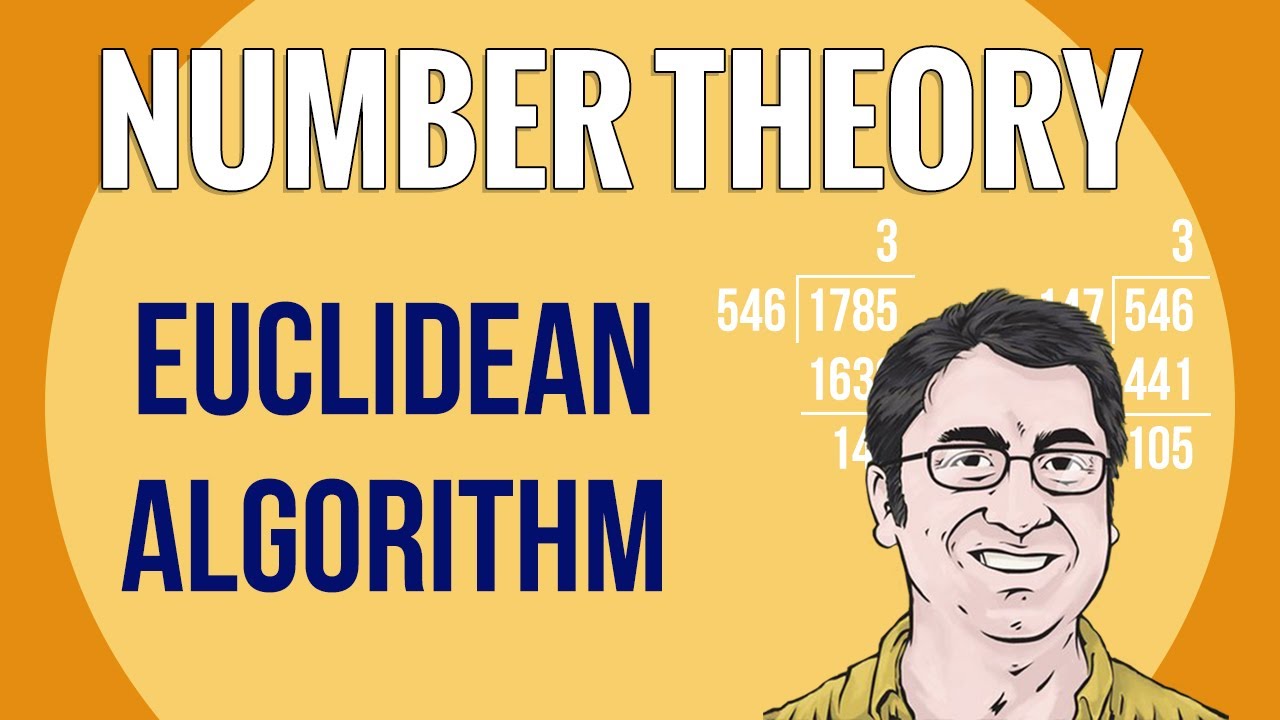
Michael Penn applies the Euclidean algorithm to the positive integers 5295 and 4321. Eight divisions lead to a final nonzero remainder of 1, so their greatest common divisor is 1 and the pair is relatively prime. The lesson recalls the stopping rule and demonstrates its use; it does not give a general correctness proof.
Use the learning inspector for key ideas and moments, or open the reading tabs for the complete notes.
Generated from the video's visuals and explanation; not verbatim speech.
The board separates the general procedure from the worked example. Repeated division follows a=bq1+r1, b=r1q2+r2, r1=r2q3+r3, and continues to rn−2=rn−1qn+0. The illustrated inputs are positive integers; each division uses a positive divisor.
The recalled stopping rule identifies the last nonzero remainder rn−1 with the original pair's gcd. This lesson applies the rule rather than proving it in general.
Turning to the right side, he introduces the concrete example gcd(5295,4321). The numbers 5295 and 4321 instantiate the abstract inputs a and b from the left-side template.
The first Euclidean step is computed directly: 5295=1⋅4321+974. The remainder 974 is identified as the first nonzero remainder in the chain.
To form the next line, the instructor uses the recurrence pattern from the general method: the previous divisor 4321 becomes the new dividend, and the previous remainder 974 becomes the new divisor. Arrows on the board visually mark this downward shift.
The second step is then written and read aloud: 4321=4⋅974+425. Thus the next remainder is 425, and the pair has been reduced from (5295,4321) to (974,425).
Next, 974 becomes the dividend and 425 becomes the divisor. At this point the instructor starts writing the quotient 2; the rest of this division follows in the continuation.
Continuing the same worked example, the first two completed lines remain on the board. The next line is 974=2⋅425+124: 974 is divided by 425, giving quotient 2 and remainder 124. The general repeated-division scheme remains visible on the left.
Next, divide the previous divisor by the previous remainder: 425=3⋅124+53. The new remainder is smaller than the positive divisor, and the same pattern continues.
Continue with 124=2⋅53+18, 53=2⋅18+17, and 18=1⋅17+1. For x=yq+r, the next pair is (y,r): the old divisor becomes the new dividend and the old remainder becomes the new divisor.
Reaching remainder 1 already establishes gcd 1. The final line 17=17⋅1+0 also makes the standard zero-remainder stopping condition explicit; the preceding nonzero remainder is 1.
The final board annotation is gcd(5295,4321)=1. This means the two numbers are relatively prime: their only common positive divisor is 1.
Knowledge cards
01
Euclidean algorithm
For positive integer inputs, repeatedly divide and reuse the divisor and remainder as the next pair, with 0≤r<y, where y is the positive divisor. Stop when the remainder is zero. The displayed chain has nonzero intermediate remainders; editorial clarification: if the first division is exact, the initial divisor is already the gcd.
In the displayed chain, the last nonzero remainder rn−1 is the greatest common divisor. The video recalls this rule; a general correctness proof is outside this worked example.
rn−1=gcd(a,b)
03
Worked example introduced: gcd(5295,4321)
The instructor instantiates the general method with the concrete pair 5295 and 4321. These numbers play the roles of a and b in the left-side template.
04
First Euclidean division in the example
Applying the division algorithm to the initial pair gives quotient 1 and remainder 974. This is the first nonzero remainder in the worked chain.
5295=1⋅4321+974
05
How the next Euclidean line is formed
The board uses arrows to show the recurrence: the previous divisor becomes the next dividend, and the previous remainder becomes the next divisor. This visual step explains how to move from one line of the Euclidean algorithm to the next.
06
Second Euclidean division in the example
Using the shifted pair (4321,974), the next division yields quotient 4 and remainder 425. After this step, the active pair has been reduced to (974,425).
4321=4⋅974+425
07
Continue before selecting the gcd
At this point the third division has only been started. An intermediate remainder need not be the gcd: continue until a zero remainder identifies the final nonzero value.
08
Euclidean algorithm by repeated division
For the positive input pair shown here, repeated division reuses the previous divisor and remainder until reaching remainder 0. The last nonzero remainder in the displayed chain then gives the gcd. The video applies the rule, rather than proving the general correctness theorem.
Every worked line has the form dividend = divisor × quotient + remainder. In the example this produces 5295=1⋅4321+974, 4321=4⋅974+425, 974=2⋅425+124, and so forth. The remainder is always smaller than the divisor in that step.
x=yq+r,0≤r<y
10
Why add the final zero-remainder step
Once the remainder 1 appears, the gcd is already visible. Nevertheless, the instructor writes one more line, 17=17⋅1+0, because the stated version of the algorithm terminates only when the remainder is exactly 0. This makes the identification of the last nonzero remainder match the formal stopping rule.
11
Worked example: gcd(5295,4321)
The right panel computes the full chain: 5295=1⋅4321+974, 4321=4⋅974+425, 974=2⋅425+124, 425=3⋅124+53, 124=2⋅53+18, 53=2⋅18+17, 18=1⋅17+1, and finally 17=17⋅1+0. Since the last nonzero remainder is 1, the example concludes gcd(5295,4321)=1.
gcd(5295,4321)=1
12
Relatively prime means gcd equals 1
After obtaining gcd(5295,4321)=1, the speaker says the numbers are relatively prime. In this clip, "relatively prime" is used as the verbal description of a pair of integers whose greatest common divisor is 1.
Detailed learning notes
Explore conditions, steps and evidence. Supplementary explanations are labeled separately from content shown in the video.
Symbols · 10
a,b
Clear evidence
Shown in the video
Evidence
Formula
Observation
Left board states Suppose a,b∈N.
Audio
Observation
The speaker says the example is to find the gcd of two natural numbers and recalls the Euclidean algorithm for two natural numbers.
Symbol
a,b
Meaning
Two natural-number inputs to the Euclidean algorithm; in the worked example they are instantiated as 5295 and 4321.
Domain
Natural numbers N
gcd(a,b)
Clear evidence
Shown in the video
Evidence
Formula
Observation
Right board header reads Ex: Find gcd(5295,4321) and left board conclusion reads gcd(a,b).
Audio
Observation
The narration identifies the task as finding a greatest common divisor and recalls the last-nonzero-remainder rule.
Symbol
gcd(a,b)
Meaning
Greatest common divisor of the two input natural numbers a and b.
Domain
Defined here for natural-number inputs
qi,ri
Clear evidence
Shown in the video
Evidence
Formula
Observation
Left board displays the division-algorithm chain a=bq1+r1, b=r1q2+r2, r1=r2q3+r3, ..., rn−2=rn−1qn+0.
Uncertainties
The board does not explicitly write the size condition on each remainder, although the method name “division algorithm” normally includes it.
Symbol
qi,ri
Meaning
Quotients and remainders produced by successive applications of the division algorithm in the Euclidean algorithm.
Domain
Integers/natural numbers as generated by repeated division steps
rn−1
Clear evidence
Shown in the video
Evidence
Formula
Observation
Left board conclusion line reads rn−1=gcd(a,b).
Audio
Observation
The narration identifies the final nonzero remainder as the output of the Euclidean algorithm.
Symbol
rn−1
Meaning
The last nonzero remainder in the displayed Euclidean-algorithm chain.
Domain
Remainder appearing immediately before the final zero-remainder step
5295,4321
Clear evidence
Shown in the video
Evidence
Formula
Observation
Right board header reads Ex: Find gcd(5295,4321).
Audio
Observation
The narrated example uses the positive integer pair 5295 and 4321.
Symbol
5295,4321
Meaning
Concrete pair of natural numbers used to illustrate the Euclidean algorithm.
Domain
Natural numbers
gcd(a,b)
Clear evidence
Shown in the video
Evidence
Formula
Observation
The board heading reads "Ex: Find gcd(5295,4321)".
Audio
Observation
The narration identifies the computed greatest common divisor as 1.
Symbol
gcd(a,b)
Meaning
Greatest common divisor of the integers a and b.
Domain
Defined for positive integers in this example; here a=5295 and b=4321.
a,b
Clear evidence
Shown in the video
Evidence
Formula
Observation
Left board text includes "Suppose a,b∈N" and the division-algorithm chain starts with a and b.
Formula
Observation
Right board example uses the concrete pair 5295 and 4321.
Symbol
a,b
Meaning
Two natural-number inputs to the Euclidean algorithm; in the worked example they are instantiated as 5295 and 4321.
Domain
Natural numbers N.
ri
Clear evidence
Shown in the video
Evidence
Formula
Observation
The left board displays r1,r2,r3,…,rn−1 and a terminal remainder 0.
The remainder produced at step i of the repeated division algorithm.
Domain
Integers satisfying 0≤ri < previous divisor in each division step.
qi
Clear evidence
Shown in the video
Evidence
Formula
Observation
Left board shows quotients q1,q2,q3,…,qn−1,qn in the equations a=bq_1+r1, b=r1q_2+r2, etc.
Formula
Observation
Right board displays explicit quotients 1,4,2,3,2,2,1,17.
Symbol
qi
Meaning
The quotient used at step i when dividing the current dividend by the current divisor.
Domain
Nonnegative integers in the displayed divisions.
n
Clear evidence
Derived from the video
Evidence
Formula
Observation
The left board states rn−1=gcd(a,b) after the displayed chain whose final remainder is 0.
Uncertainties
The exact index n is not instantiated numerically on the right board; it is implicit from the last nonzero remainder.
Symbol
n
Meaning
Index of the final division step whose remainder is 0.
Domain
Positive integer indexing the terminating step of the algorithm.
Knowledge points · 6
Euclidean algorithm as repeated division
Clear evidence
Supplementary explanation
Evidence
Formula
Observation
Left board title is Euclidean Algorithm with the setup Suppose a,b∈N, if we repeatedly perform the division algorithm: followed by the chain of equations ending in rn−2=rn−1qn+0 and rn−1=gcd(a,b).
Audio
Observation
The narration recalls successive divisions and the stopping rule for the Euclidean algorithm.
Uncertainties
The video states the method and conclusion but does not prove why the last nonzero remainder equals the gcd within this clip.
Method
Explanation
For the positive integer inputs illustrated here, repeated division replaces the active pair by its divisor and remainder. A zero remainder stops the process; the last nonzero value gives the gcd. Editorial boundary case: if the first division is already exact, the initial divisor is the gcd. The displayed chain illustrates the case with intermediate nonzero remainders.
For the positive integer inputs illustrated here, every active divisor is positive; editorial clarification: use the usual remainder bound 0 ≤ remainder < divisor.
The division algorithm is applied repeatedly.
The displayed chain ends when the remainder becomes 0.
The conclusion identifies the last nonzero remainder rn−1 as gcd(a,b).
Prerequisites
Successive division-algorithm equations used in the example
Successive division-algorithm equations used in the example
Clear evidence
Shown in the video
Evidence
Formula
Observation
The left board explicitly writes the sequence a=bq1+r1, b=r1q2+r2, r1=r2q3+r3, continuing down to rn−2=rn−1qn+0.
Uncertainties
The board does not separately state the usual constraint 0≤ri < divisor, though the phrase “division algorithm” conventionally includes it.
Formula
Explanation
Each new line divides the previous divisor by the previous remainder. The previous divisor becomes the new dividend, and the previous remainder becomes the new divisor.
Applies to the pair of natural numbers being reduced step by step.
Each equation is an instance of the division algorithm.
The chain terminates at a zero remainder.
Euclidean algorithm via repeated division
Clear evidence
Supplementary explanation
Evidence
Formula
Observation
Left board title reads "Euclidean Algorithm".
Formula
Observation
The left board ends its division chain with rn−2=rn−1qn+0 and then identifies rn−1=gcd(a,b).
Audio
Observation
Throughout the clip the instructor repeatedly applies the same pattern: bring down the previous divisor, divide by the previous remainder, write quotient plus new remainder.
Method
Explanation
The video presents the Euclidean algorithm as a sequence of division-algorithm steps. Starting with two natural numbers a and b, one repeatedly divides the previous divisor by the previous remainder until a remainder of 0 is reached. The last nonzero remainder is then identified as gcd(a,b). In the worked example, the chain is 5295, 4321, 974, 425, 124, 53, 18, 17, 1, 0, so the last nonzero remainder is 1.
The illustrated inputs a and b are positive integers and all intermediate divisors are nonzero (editorial scope clarification).
Each step uses the division algorithm with remainder less than the divisor
The process stops when a remainder equals 0
Prerequisites
Division algorithm form used in each step
Greatest common divisor
Division algorithm form used in each step
Clear evidence
Shown in the video
Evidence
Formula
Observation
Left board explicitly says "if we repeatedly perform the division algorithm" and writes equations of the form dividend = divisor × quotient + remainder.
Audio
Observation
The narration completes the third division with remainder 124, matching 974=2⋅425+124.
Definition
Explanation
Each line on the board has the structure current dividend = current divisor × quotient + remainder. The example uses this repeatedly: 5295=1⋅4321+974, 4321=4⋅974+425, 974=2⋅425+124, and so on. This is the operational rule behind the Euclidean algorithm shown here.
Formula
x=yq+r,0≤r<y
Conditions
x,y are positive integers in the displayed example
q is the integer quotient
r is the remainder
Greatest common divisor
Clear evidence
Shown in the video
Evidence
Audio
Observation
The narration identifies the final nonzero remainder as the gcd, giving 1.
Formula
Observation
At 158s he writes "=1" next to the original prompt "Ex: Find gcd(5295,4321)".
Definition
Explanation
The greatest common divisor is the largest integer dividing both input numbers. In this clip the algorithm terminates with last nonzero remainder 1, and the instructor records gcd(5295,4321)=1 on the board.
Formula
gcd(5295,4321)=1
Conditions
Inputs are the specific integers 5295 and 4321
Relatively prime interpretation of gcd equal to 1
Clear evidence
Shown in the video
Evidence
Audio
Observation
The final narration interprets gcd 1 as the two input integers being relatively prime.
Definition
Explanation
After concluding that the gcd is 1, the instructor rephrases the result by saying the two numbers are relatively prime. Thus in this video, "relatively prime" is used as the verbal equivalent of having greatest common divisor 1.
Formula
Conditions
Applies to the pair 5295 and 4321 in this example
Prerequisites
Greatest common divisor
Claims and conditions · 4
Last nonzero remainder equals the gcd
Clear evidence
Supplementary explanation
Evidence
Formula
Observation
Left board concludes rn−1=gcd(a,b) after writing the chain ending in rn−2=rn−1qn+0.
Audio
Observation
The narration states that the final nonzero remainder gives the original pair's greatest common divisor.
Uncertainties
This clip presents the statement as a recalled fact/method rather than proving it.
Proposition
Statement
If the Euclidean algorithm is performed on natural numbers a and b by repeatedly applying the division algorithm until a zero remainder occurs, then the last nonzero remainder rn−1 equals gcd(a,b).
Hypotheses
a and b are positive integers in the displayed division chain, with nonzero intermediate divisors and the usual division-algorithm remainder bounds (editorial scope clarification).
The division algorithm is applied repeatedly as shown.
The process reaches a step with remainder 0.
Quantifiers
For the displayed finite chain of successive divisions ending in remainder 0.
Termination rule of the Euclidean algorithm
Clear evidence
Supplementary explanation
Evidence
Formula
Observation
The left board states rn−1=gcd(a,b) after the displayed chain whose final remainder is 0.
Audio
Observation
At 143s-157s the instructor notes that the gcd should already be obvious from reaching remainder 1, then adds one more step to obtain remainder 0 before concluding gcd=1.
Theorem
Statement
If the repeated division algorithm for a,b∈N ends with rn=0, then the preceding nonzero remainder rn−1 equals gcd(a,b).
Hypotheses
a and b are positive integers with the displayed nonzero intermediate divisors (editorial scope clarification).
The sequence is generated by repeated application of the division algorithm
The final displayed remainder is 0
Quantifiers
For the natural numbers a and b under the displayed iterative procedure.
Computed gcd for the worked example
Clear evidence
Shown in the video
Evidence
Audio
Observation
The narration concludes that the greatest common divisor of the input pair is 1.
Formula
Observation
At 158s the board is completed as "Ex: Find gcd(5295,4321)=1".
Proposition
Statement
gcd(5295,4321)=1.
Hypotheses
The displayed Euclidean-algorithm chain has been carried out correctly on the board
Quantifiers
Specific claim about the two integers 5295 and 4321.
Relatively prime conclusion for the example
Clear evidence
Shown in the video
Evidence
Audio
Observation
The closing narration describes the input pair as relatively prime.
Proposition
Statement
The integers 5295 and 4321 are relatively prime.
Hypotheses
gcd(5295,4321)=1 as concluded from the worked algorithm
Quantifiers
Specific claim about the pair (5295,4321).
Derivations and proofs · 3
Worked reduction of gcd(5295,4321) through the first two Euclidean steps
Clear evidence
Shown in the video
Evidence
Audio
Observation
The narration accompanies the two completed divisions, with quotients 1 and 4 and remainders 974 and 425, and explains carrying the prior divisor and remainder into the next line.
Formula
Observation
Right board shows 5295=1⋅4321+974 and then 4321=4⋅974+425.
Animation
Observation
After the first line is written, arrows are drawn from 4321 and 974 downward to indicate the next dividend/divisor pair.
Numerical verification
Steps
Expression
5295=1⋅4321+974
Explanation
Apply the division algorithm to the initial pair (5295,4321), obtaining quotient 1 and remainder 974.
Justification
Direct computation shown on the board and stated aloud.
Shown in the video
Expression
4321=4⋅974+425
Explanation
Shift downward in the Euclidean chain: the previous divisor 4321 becomes the new dividend and the previous remainder 974 becomes the new divisor, giving quotient 4 and remainder 425.
Justification
Matches the general pattern b=r1q2+r2 from the left-board method and the spoken instruction to move the previous remainder into the next line.
Shown in the video
Conclusion
After two Euclidean steps, the pair has been reduced from (5295,4321) to (974,425), with remainders 974 and then 425.
Beginning of the third Euclidean step
Approximate timing
Shown in the video
Evidence
Audio
Observation
The narration starts the next division with dividend 974 and quotient 2; the 82-second segment ends while this line is being written.
Formula
Observation
By 01:21 the right board shows 974=2 with the rest of the line not yet completed.
Uncertainties
The third division is only begun in this clip; the full expression and remainder are not visible or audible before cutoff.
The exact continuation beyond 2 times 4... cannot be confirmed from the provided segment.
Numerical verification
Steps
Expression
974=2⋯
Explanation
Start the next division by moving 974 to the left-hand side and beginning the quotient as 2.
Justification
Visible board writing and spoken setup indicate the next line of the Euclidean algorithm, but the line is incomplete in this clip.
Shown in the video
Conclusion
The example proceeds to a third division step, but this clip ends before that step is completed.
Worked Euclidean algorithm for gcd(5295,4321)
Clear evidence
Shown in the video
Evidence
Formula
Observation
The right board accumulates the full chain of divisions from 5295 down to 17=17⋅1+0.
Audio
Observation
The narration follows the written divisions, including completion of the third division and the final division with remainder 0.
Uncertainties
The first two lines were already present at the start of the clip; only their continuation is directly observed here.
Numerical verification
Steps
Expression
5295=1⋅4321+974
Explanation
Initial division of the larger number by the smaller one.
Justification
Already written on the board at the start of the clip.
Shown in the video
Expression
4321=4⋅974+425
Explanation
Next division uses the previous divisor 4321 and previous remainder 974.
Justification
Already written on the board at the start of the clip.
Shown in the video
Expression
974=2⋅425+124
Explanation
The instructor completes the third division during this portion, obtaining remainder 124.
Justification
Visible completion on the board and spoken narration at 82s-90s.
Shown in the video
Expression
425=3⋅124+53
Explanation
Bring down 425 and divide by 124 to get quotient 3 and remainder 53.
Justification
Written on the board around 95s-106s and spoken aloud.
Shown in the video
Expression
124=2⋅53+18
Explanation
Bring down 124 and divide by 53 to get quotient 2 and remainder 18.
Justification
Written on the board around 109s-121s and spoken aloud.
Shown in the video
Expression
53=2⋅18+17
Explanation
Bring down 53 and divide by 18 to get quotient 2 and remainder 17.
Justification
Written on the board around 125s-133s and spoken aloud.
Shown in the video
Expression
18=1⋅17+1
Explanation
Bring down 18 and divide by 17 to get quotient 1 and remainder 1.
Justification
Written on the board around 135s-142s and spoken aloud.
Shown in the video
Expression
17=17⋅1+0
Explanation
One final division is added to force the remainder to be 0, matching the stated stopping condition.
Justification
Spoken at 143s-157s and written on the board.
Shown in the video
Expression
gcd(5295,4321)=1
Explanation
Since the last nonzero remainder is 1, the gcd is 1.
Justification
Follows from the left-board rule rn−1=gcd(a,b); the instructor states this verbally and writes "=1" at 158s.
Shown in the video
Conclusion
The repeated division chain terminates with last nonzero remainder 1, so gcd(5295,4321)=1 and the numbers are relatively prime.
Worked examples · 2
Partial worked example: gcd(5295,4321)
Clear evidence
Shown in the video
Evidence
Formula
Observation
Right board header reads Ex: Find gcd(5295,4321).
Audio
Observation
Speaker introduces the example verbally as finding the GCD of 5,295 and 4,321.
Formula
Observation
Board work shows 5295=1⋅4321+974, then 4321=4⋅974+425, then the start of 974=2....
Uncertainties
The example is unfinished in this clip; no final gcd value is reached before the cutoff.
Problem
Find gcd(5295,4321) using the Euclidean algorithm.
Given
a=5295
b=4321
Use repeated division as in the displayed Euclidean algorithm.
Goal
Reduce the pair step by step until the last nonzero remainder is found.
Steps
Expression
5295=1⋅4321+974
Explanation
First division of the larger number by the smaller gives remainder 974.
Justification
Shown on the board and stated aloud.
Shown in the video
Expression
4321=4⋅974+425
Explanation
Second division uses the previous divisor and remainder, producing remainder 425.
Justification
Shown on the board and stated aloud.
Shown in the video
Expression
974=2⋯
Explanation
Third division is started by moving 974 down as the new dividend.
Justification
Visible partial board writing and spoken setup, but the line is incomplete in this clip.
Shown in the video
Answer
No final answer is given within this clip; the worked example stops after beginning the third division.
Verification
The clip itself does not reach a zero remainder, so the final gcd cannot be verified from this segment alone.
Find gcd(5295,4321) using the Euclidean algorithm
Clear evidence
Shown in the video
Evidence
Formula
Observation
Right board heading reads "Ex: Find gcd(5295,4321)".
Formula
Observation
Full worked chain is visible by the end of the clip, ending with 17=17⋅1+0 and the appended result =1.
Audio
Observation
The instructor narrates the computations and concludes at 160s that the numbers are relatively prime.
Uncertainties
The first two division lines predate the clip start, but their content is fully visible.
Problem
Compute gcd(5295,4321) by repeated division.
Given
a=5295
b=4321
Use the Euclidean algorithm / division algorithm repeatedly until remainder 0
Goal
Determine the greatest common divisor of 5295 and 4321.
Steps
Expression
5295=1⋅4321+974
Explanation
Start with the given pair.
Justification
Visible on the board at the beginning of the clip.
Shown in the video
Expression
4321=4⋅974+425
Explanation
Divide the previous divisor by the previous remainder.
Justification
Visible on the board at the beginning of the clip.
Shown in the video
Expression
974=2⋅425+124
Explanation
Continue the same pattern.
Justification
Completed on screen and spoken during 82s-90s.
Shown in the video
Expression
425=3⋅124+53
Explanation
Next remainder is 53.
Justification
Written and narrated around 95s-106s.
Shown in the video
Expression
124=2⋅53+18
Explanation
Next remainder is 18.
Justification
Written and narrated around 109s-121s.
Shown in the video
Expression
53=2⋅18+17
Explanation
Next remainder is 17.
Justification
Written and narrated around 125s-133s.
Shown in the video
Expression
18=1⋅17+1
Explanation
Next remainder is 1.
Justification
Written and narrated around 135s-142s.
Shown in the video
Expression
17=17⋅1+0
Explanation
Add one final step to reach remainder 0.
Justification
Explicitly stated by the instructor at 143s-157s.
Shown in the video
Expression
gcd(5295,4321)=1
Explanation
The last nonzero remainder is 1.
Justification
Uses the left-board rule rn−1=gcd(a,b); also written beside the example heading at 158s.
Shown in the video
Answer
gcd(5295,4321)=1
Verification
The final line 17=17⋅1+0 has remainder 0. The preceding nonzero remainder 1 gives the gcd, so the two input integers are relatively prime.
Visual events · 5
Two-column blackboard structure
Clear evidence
Shown in the video
Evidence
Diagram
Observation
A single blackboard is split conceptually into two regions: left side contains the general Euclidean algorithm statement, right side contains the worked example header and computations.
Animation
Observation
The instructor points to the left-side general formula while recalling the method, then turns to the right side to write the concrete example.
Objects
Left column: Euclidean Algorithm general statement
Right column: Ex: Find gcd(5295,4321) worked example
Instructor standing beside the board
Changes
Attention shifts from the general left-side formula to the right-side numerical example.
New equations are added sequentially beneath the example header.
Invariants
The left-side general method remains visible throughout the clip.
The example header Ex: Find gcd(5295,4321) stays fixed at the top right.
Interpretation
The visual layout separates theory from practice: the left side supplies the algorithm template, and the right side instantiates it on specific numbers.
Arrows showing how the next Euclidean line is formed
Clear evidence
Shown in the video
Evidence
Animation
Observation
After writing 5295=1⋅4321+974, arrows are drawn from 4321 and 974 downward toward the next line.
Audio
Observation
The narration explains reusing the previous divisor and remainder for the next division; the arrows show their new roles.
Objects
Downward arrows from 4321 and 974
Next line 4321=4⋅974+425
Changes
The previous divisor 4321 is moved to become the new dividend.
The previous remainder 974 is moved to become the new divisor.
Invariants
The overall Euclidean pattern remains the same from one line to the next.
Interpretation
The arrows visually encode the recurrence in the Euclidean algorithm: each step reuses the prior divisor and remainder as the next pair.
Two-panel blackboard organization
Clear evidence
Shown in the video
Evidence
Diagram
Observation
The blackboard is split into a left theoretical panel titled "Euclidean Algorithm" and a right worked-example panel titled "Ex: Find gcd(5295,4321)".
Diagram
Observation
Curved arrows on the right connect each remainder to the next line's divisor position.
Objects
Left panel: general Euclidean algorithm statement
Right panel: numerical example gcd(5295,4321)
Curved arrows linking successive lines
Changes
The right panel grows downward as new division equations are written.
By the end, the example heading is extended with "=1".
Invariants
The left panel remains unchanged throughout the clip.
The right panel always preserves the same dividend = divisor × quotient + remainder format.
Interpretation
The visual layout separates theory from computation: the left side states the algorithm and termination rule, while the right side instantiates it on concrete integers and uses arrows to show how each remainder becomes the next divisor.
Arrow notation showing carry-down of divisors and remainders
Clear evidence
Shown in the video
Evidence
Diagram
Observation
During the opening of this continuation, a curved arrow carries 425 from the preceding line into the next divisor position.
Diagram
Observation
Similar arrows appear between 124 and the next line, 53 and the next line, 18 and the next line, and 17 and the next line.
Objects
Curved arrows between successive equations
Numerals 425, 124, 53, 18, 17
Changes
Each arrow visually transfers the previous divisor or remainder into the next division step.
The chain proceeds downward line by line until the final zero remainder.
Invariants
Every new line begins with the quantity carried down from the previous line.
The remainder from one line becomes the divisor in the next line.
Interpretation
The arrows encode the recurrence of the Euclidean algorithm: after writing x=yq+r, the next line starts with y and divides by r. This makes the iterative substitution explicit without restating the general formula each time.
Completion of the example heading with the answer
Clear evidence
Shown in the video
Evidence
Diagram
Observation
At 158s the instructor writes "=1" immediately after the heading "Ex: Find gcd(5295,4321)".
Objects
Heading "Ex: Find gcd(5295,4321)"
Added "=1"
Changes
The problem statement is transformed into a solved statement by appending the result.
Invariants
The underlying division chain remains unchanged once completed.
Interpretation
The final annotation records the outcome of the algorithm at the top of the example, linking the computed last nonzero remainder back to the original question.
Misconceptions · 2
An intermediate remainder need not be the gcd
Clear evidence
Supplementary explanation
Evidence
Audio
Observation
The 0–82-second portion ends while the third division is being started.
Formula
Observation
Only 974=2 is visible by the end; no zero-remainder terminating line has been written.
Misconception
One might think the example has already determined gcd(5295,4321) because several remainders have been computed.
Clarification
At this point the division process is still in progress. Continue until a remainder of 0 appears; the last nonzero value then gives the gcd.
Stopping before the zero-remainder line
Clear evidence
Supplementary explanation
Evidence
Audio
Observation
The instructor identifies gcd 1 and still writes the final zero-remainder division to make the displayed stopping rule explicit.
Misconception
Any intermediate nonzero remainder can be accepted as the gcd.
Clarification
An arbitrary intermediate remainder is not enough. Reaching 1 does establish gcd 1, so early exit is valid in that special case. The video also writes 17=17⋅1+0 to display the standard zero-remainder stopping rule.
Concept relations · 7
Euclidean algorithm as repeated division → Partial worked example: gcd(5295,4321)
Clear evidence
Shown in the video
Evidence
Diagram
Observation
Left board gives the general Euclidean algorithm; right board applies it to gcd(5295,4321).
Audio
Observation
The narration moves from the general algorithm statement to a concrete pair of positive integers.
Application
Explanation
The worked example is a direct instantiation of the general Euclidean-algorithm procedure stated on the left side of the board.
Successive division-algorithm equations used in the example → Last nonzero remainder equals the gcd
Clear evidence
Shown in the video
Evidence
Formula
Observation
The left board writes the division chain and then concludes rn−1=gcd(a,b).
Prerequisite
Explanation
The claim about the last nonzero remainder depends on the displayed repeated division-algorithm chain as its setup.
Euclidean algorithm as repeated division → Last nonzero remainder equals the gcd
Clear evidence
Shown in the video
Evidence
Formula
Observation
The method summary and the concluding line appear together on the left board.
Audio
Observation
Speaker states the method and conclusion in one sentence.
Contains
Explanation
The Euclidean-algorithm method includes the proposition that the last nonzero remainder is the gcd.
Division algorithm form used in each step → Euclidean algorithm via repeated division
Clear evidence
Shown in the video
Evidence
Formula
Observation
Left board says "if we repeatedly perform the division algorithm" and then lists the Euclidean chain.
Prerequisite
Explanation
The Euclidean algorithm shown here is built by iterating the division-algorithm identity x=yq+r at each step.
Euclidean algorithm via repeated division → Greatest common divisor
Clear evidence
Shown in the video
Evidence
Formula
Observation
The left board states rn−1=gcd(a,b) after the displayed chain whose final remainder is 0.
Audio
Observation
At 143s-160s the instructor applies this rule to conclude gcd(5295,4321)=1.
Application
Explanation
The algorithm is used as a method for computing the greatest common divisor of two natural numbers.
Greatest common divisor → Relatively prime interpretation of gcd equal to 1
Clear evidence
Shown in the video
Evidence
Audio
Observation
The closing narration connects gcd 1 with relative primality of the input pair.
Equivalent
Explanation
In this clip, having gcd equal to 1 is presented as equivalent to the two numbers being relatively prime.
Euclidean algorithm via repeated division → Find gcd(5295,4321) using the Euclidean algorithm
Clear evidence
Shown in the video
Evidence
Diagram
Observation
The right panel instantiates the left-panel algorithm on the concrete pair 5295 and 4321.
Application
Explanation
The worked example is a direct application of the Euclidean algorithm described on the left side of the board.
Find an answer · 10
What is the Euclidean algorithm and how is it set up for two natural numbers?
Clear evidence
Shown in the video
Evidence
Audio
Observation
Speaker recalls the Euclidean algorithm for two natural numbers.
Formula
Observation
Left board displays the full method statement.
Knowledge points
Euclidean algorithm as repeated division
Successive division-algorithm equations used in the example
Last nonzero remainder equals the gcd
Why does the Euclidean algorithm stop at the last nonzero remainder and call it the gcd?
Clear evidence
Shown in the video
Evidence
Audio
Observation
The narration recalls the terminal-remainder rule without presenting its general proof.
Formula
Observation
Left board concludes rn−1=gcd(a,b).
Uncertainties
This clip states the result but does not prove it.
Knowledge points
Last nonzero remainder equals the gcd
Euclidean algorithm as repeated division
In the Euclidean algorithm, how do you form the next division line from the previous one?
Clear evidence
Shown in the video
Evidence
Animation
Observation
Arrows show 4321 and 974 being carried down to form the next equation.
Audio
Observation
The narration and arrows show the previous divisor becoming the next dividend and the previous remainder becoming the next divisor.
Knowledge points
Successive division-algorithm equations used in the example
Worked reduction of gcd(5295,4321) through the first two Euclidean steps
Arrows showing how the next Euclidean line is formed
What is the status of the worked example gcd(5295,4321) in this segment?
Clear evidence
Shown in the video
Evidence
Formula
Observation
Right board shows the example header and the first two completed divisions, then a partial third line.
Uncertainties
The final gcd is not reached in this clip.
Knowledge points
Partial worked example: gcd(5295,4321)
Worked reduction of gcd(5295,4321) through the first two Euclidean steps
Beginning of the third Euclidean step
What do a, b, qi, ri, and rn−1 mean in the displayed Euclidean algorithm?
Clear evidence
Shown in the video
Evidence
Formula
Observation
Left board uses a,b,qi,ri,rn−1 in the displayed chain.
Knowledge points
a,b
qi,ri
rn−1
Successive division-algorithm equations used in the example
What is the Euclidean algorithm and how does repeated division compute a gcd?
Clear evidence
Shown in the video
Evidence
Formula
Observation
Left board title and general chain define the method.
Knowledge points
Euclidean algorithm via repeated division
Division algorithm form used in each step
Termination rule of the Euclidean algorithm
Why is the last nonzero remainder equal to gcd(a,b) in this presentation?
Clear evidence
Shown in the video
Evidence
Formula
Observation
The left board states rn−1=gcd(a,b) after the displayed chain whose final remainder is 0.
Knowledge points
Termination rule of the Euclidean algorithm
Euclidean algorithm via repeated division
How do you compute gcd(5295,4321) step by step?
Clear evidence
Shown in the video
Evidence
Formula
Observation
Right board heading asks for gcd(5295,4321) and later appends =1.
Knowledge points
Find gcd(5295,4321) using the Euclidean algorithm
Worked Euclidean algorithm for gcd(5295,4321)
Greatest common divisor
What does it mean when the Euclidean algorithm gives gcd 1?
Clear evidence
Shown in the video
Evidence
Audio
Observation
At 160s the instructor says the numbers are relatively prime after finding gcd 1.
Knowledge points
Relatively prime interpretation of gcd equal to 1
Greatest common divisor
Relatively prime conclusion for the example
Do you have to continue until the remainder is exactly 0?
Clear evidence
Shown in the video
Evidence
Audio
Observation
At 143s-157s the speaker adds one last step to get remainder 0 even though gcd 1 is already obvious.
Knowledge points
Stopping before the zero-remainder line
Termination rule of the Euclidean algorithm
Find gcd(5295,4321) using the Euclidean algorithm
Coverage and review notes
Covered · General Euclidean algorithm statement and conclusion are fully visible and audible.
Covered · The instructor introduces the concrete example gcd(5295,4321).
Covered · First two Euclidean divisions are completed and the transition rule is demonstrated.
Covered · The third division is observed beginning with 974 and quotient 2. This segment ends while writing is in progress; this is fully observed content, not missing audio or video. Its completion belongs to the next supplied interval.
Covered · The entire clip is a continuous whiteboard demonstration of the Euclidean algorithm on gcd(5295,4321), including the general rule on the left board, the worked division chain on the right board, the final annotation gcd=1, and the verbal conclusion that the numbers are relatively prime.
From 0 to 163 seconds, the board recalls repeated division, works all eight divisions for 5295 and 4321, reaches a zero remainder, and identifies the preceding nonzero remainder as 1. The video applies the algorithm; it does not prove the general theorem.
From 143 to 163 seconds, the final line is 17=17⋅1+0, the last nonzero remainder is 1, and the board records gcd(5295,4321)=1; the speaker concludes that the pair is relatively prime.
To form the next division line, you take the divisor from the previous line and make it the dividend of the new line. Then, you take the remainder from the previous line and make it the divisor of the new line.
Conditions: You have just completed a division step in the Euclidean algorithm.; The previous remainder is not 0.
Strictly speaking, the standard stopping condition for the Euclidean algorithm is to continue until the remainder is 0. The last nonzero remainder is then the gcd.
Conditions: The inputs are natural numbers.; The Euclidean algorithm is being applied.
To compute gcd(5295,4321), apply the Euclidean algorithm by repeatedly dividing the previous divisor by the previous remainder. Start with 5295=1⋅4321+974.
Conditions: The inputs are 5295 and 4321.; The Euclidean algorithm is used.; The division algorithm is applied at each step.
The Euclidean algorithm computes the greatest common divisor by repeatedly applying the division algorithm. Starting with two natural numbers a and b, you divide the larger by the smaller to get a quotient and a remainder.
Conditions: The inputs a and b are natural numbers.; The division algorithm is applied repeatedly.; The process stops when a remainder equals 0.
In the displayed Euclidean algorithm, a and b are the two initial natural numbers whose gcd is being found. qi represents the quotient at the i-th division step.
Conditions: The symbols are from the general statement of the Euclidean algorithm on the left board.
When the Euclidean algorithm yields a greatest common divisor of 1, it means the two input numbers are relatively prime (or coprime). This indicates that they share no common positive integer divisors other than 1.
Conditions: The inputs are natural numbers.; The Euclidean algorithm terminates with a last nonzero remainder of 1.
The Euclidean algorithm is a method for finding the greatest common divisor (gcd) of two natural numbers. It is set up by repeatedly applying the division algorithm.
Conditions: The inputs a and b are natural numbers.; The division algorithm is used at each step.