Math concepts explained with videos
Understand math, one concept at a time.
Watch the explanation. Read the notes. Jump to the moment.
A growing library of mathematical understanding.
Explore videos, concepts and reviewed notes across every source language.
Explore mathematics, one concept at a time.
Understand math concepts with videos that show how an idea works, and readable notes that help you revisit it. These math videos with notes connect definitions, worked examples, learning maps and knowledge graphs. Move from a question to a concept, then jump to the moment that explains it. Start with something familiar and follow a nearby idea when you need another perspective.
In calculus, limits describe what happens near a point. Derivatives make that local behavior useful for understanding rates of change, while integrals describe accumulation across an interval. Explore these concepts together to see how a graph, a formula and a worked problem express the same mathematical idea. The calculus learning map provides an order for connecting definitions with applications.
Linear algebra starts with vectors and develops a language for transformations. Matrices organize those transformations and the calculations behind linear systems. Eigenvalues reveal directions whose behavior is especially simple. Comparing geometric explanations with algebraic examples can help you understand what a calculation means, rather than treating its steps as a recipe.
Probability adds a different question: what changes when new information arrives? Conditional probability describes a probability under a stated condition, and Bayes’ theorem connects that condition with updated beliefs. Each concept page brings together its definition, reviewed questions and answers, related concepts and available video explanations. Use the concept index to find another starting point, or browse the video directory when you already know the topic, teaching style or length you want.
01INSIDE
This segment introduces pointwise convergence for sequences of functions in real analysis.
Pointwise Convergence Definition
A sequence of functions () with domain I converges pointwise to a function f if for every fixed point x̃ in I, the numerical sequence ((x̃)) converges to f(x̃). This means the convergence property must hold individually at each point in the domain, reducing function convergence to ordinary sequence convergence.
02MOMENTS
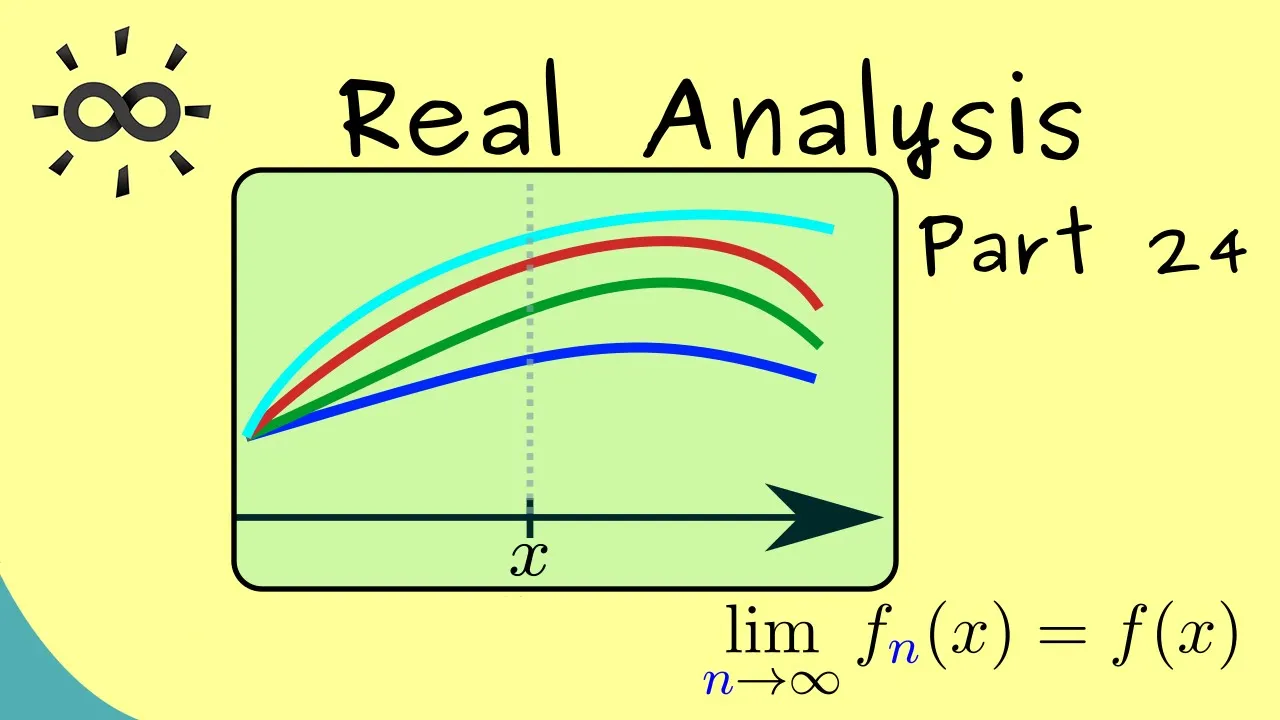 Open moment0:00
Introduction and Recap
The Bright Side of Mathematics · YouTube · 8:13
03CONNECTIONS
- Pointwise convergenceExplanation
Why this connection? · 0:28
Reviewed English material v1: card "Pointwise Convergence Definition" at 0:28 — A sequence of functions () with domain I converges pointwise to a function f if for every fixed point x̃ in I, the numerical sequence ((x̃)) converges to f(x̃). This means the convergence property must hold individually at each point in the domain, reducing function convergence to ordinary sequence convergence.
Course placement does not imply a prerequisite relationship.
Connections across the video; no reviewed connection for this chapter yet.
Calculus
Explore change, accumulation and approximation through single-variable calculus.
27 concepts · 23 with reviewed resourcesDiscrete Mathematics: Counting and Number Theory
Connect functions and counting with elementary number theory, graph structures and algorithmic reasoning. Shared concepts and reviewed map connections organize the path; video explanations are added as resources pass review.
18 concepts · 12 with reviewed resourcesMathematical Foundations and Proofs
Explore sets and relations; logic and statements; proof and infinity. Concepts and connections are available independently of video coverage.
20 concepts · 12 with reviewed resourcesLinear algebra
Connect vectors, linear transformations and matrix computations, with geometric and algebraic viewpoints.
28 concepts · 24 with reviewed resourcesMathematical modeling
Turns engineering, economic, biological and social questions into variables, assumptions, solvable models, validated answers and an honest limits section.
58 concepts · 43 with reviewed resourcesProbability and statistics
Move from uncertain events to random variables, probability models and evidence-based statistical inference.
36 concepts · 28 with reviewed resourcesBesides physical education course teaching quality, what other applications are claimed for the fuzzy formula method?
How does the video estimate the probability that total time exceeds 9 hours?
What is conditional entropy H(X|Y) and how is it defined for discrete random variables?
What is the mathematical definition of a percent?
Other explanations to explore
Explore videos →Ordinary differential equations 2 Singular solutions & envelopes, Picard sequences, Existence and uniqueness for ODEs
某某些些的书匠 · Bilibili · English
Boundary value problems, PDE classification, Partial differential equations|小鹿老师ya
小鹿老师ya · Bilibili · English
Euler's totient, Quadratic residues|封无义
封无义 · Bilibili · English
Pseudoinverse, Quadratic forms, Singular value decomposition|晓之车高山老师
晓之车高山老师 · Bilibili · English
Markov chains you must know, whether tested or not! | Zhao Lixian - Gaokao Mathematics
赵礼显老师 · Bilibili · English
Bernoulli distribution, Chi-squared distribution, Exponential distribution|吾知凡而学
吾知凡而学 · Bilibili · English