Translate a claim
The chocolate-bar example tests a mean of 5 grams. A claim that the mean changed in either direction gives a two-sided alternative: and $:\mu e5$.
Math and Science · YouTube · 23:40
Introduce null and alternative hypotheses and explain why failure to reject is not proof of the null.
Use the learning inspector for key ideas and moments, or open the reading tabs for the complete notes.
Generated from the video's visuals and explanation; not verbatim speech.
The chocolate-bar example tests a mean of 5 grams. A claim that the mean changed in either direction gives a two-sided alternative: and $:\mu e5$.
The decision is to reject the null or fail to reject it. Insufficient evidence against the null does not establish that the null is true.
A test statistic summarizes sample evidence. Its decision rule must account for sampling variability and a chosen significance level; neither a confidence level nor a p-value is the probability that the null hypothesis is true.
The chocolate-bar example tests a mean of 5 grams. A claim that the mean changed in either direction gives a two-sided alternative: and $:\mu e5$.
The decision is to reject the null or fail to reject it. Insufficient evidence against the null does not establish that the null is true.
A test statistic summarizes sample evidence. Its decision rule must account for sampling variability and a chosen significance level; neither a confidence level nor a p-value is the probability that the null hypothesis is true.
The chocolate-bar example tests a mean of 5 grams. A claim that the mean changed in either direction gives a two-sided alternative: and $:\mu e5$. The decision is to reject the null or fail to reject it. Insufficient evidence against the null does not establish that the null is true. A test statistic summarizes sample evidence. Its decision rule must account for sampling variability and a chosen significance level; neither a confidence level nor a p-value is the probability that the null hypothesis is true.
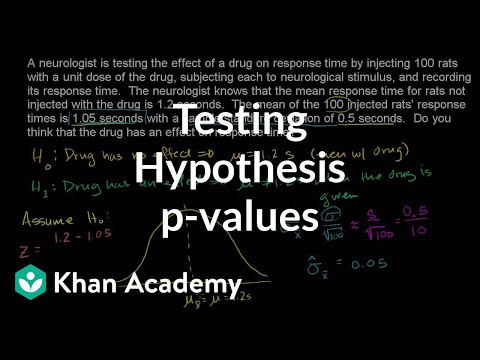 YouTube11:26
Another explanation of Hypothesis testing.
Hypothesis testing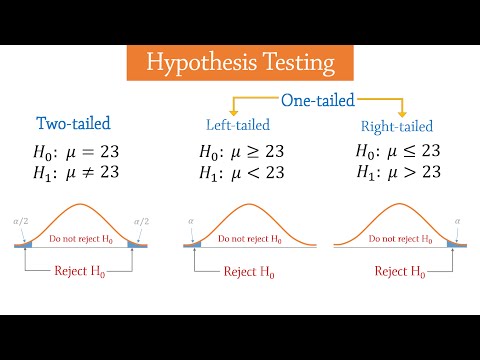 YouTube4:00
Another explanation of Hypothesis testing.
Hypothesis testing YouTube10:54
Prerequisite in Probability and statistics: Distributions → Hypothesis testing.
Distributions · View learning sequence YouTube11:26
Prerequisite in Probability and statistics: Sampling → Hypothesis testing.
Sampling · View learning sequence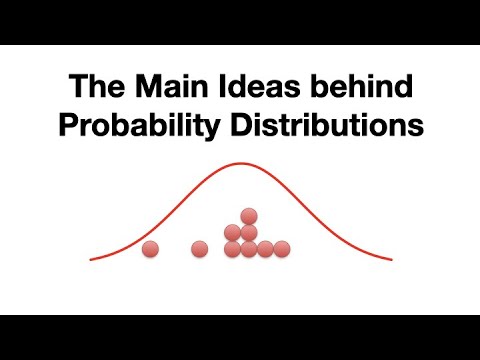 YouTube5:14
Prerequisite in Probability and statistics: Distributions → Hypothesis testing.
Distributions · View learning sequenceYouTube11:26Whiteboard for Hypothesis testing, compared with the current lecture.
Hypothesis testingYouTube4:00Visual explanation for Hypothesis testing, compared with the current lecture.
Hypothesis testing