Product rule review
The lesson starts from the standard derivative of a product of two functions. This identity is the foundation for everything that follows in the clip.
Khan Academy · YouTube · 3:52
This 180-second whiteboard clip introduces integration by parts as a consequence of the product rule. After writing the heading "Product Rule -> Integration by Parts," the instructor starts from , expands '(x)'(x), then takes antiderivatives of both sides to obtain '(x)\,'(x)\,dx. A yellow box marks '(x)\,dx as the target term, and subtracting the other integral yields the rearranged identity '(x)\,'(x)\,dx. The derivation intentionally omits constants of integration. This 52-second whiteboard clip derives the integration-by-parts formula from the product rule. The board shows '(x)'(x), then integrates both sides, rearranges terms, and switches sides to box '(x) '(x). The speaker explains that this is the standard formula, notes that it applies to integrals of the form '(x), and addresses the apparent drawback that another integral remains by saying later examples will show how it can simplify antiderivative problems.
Use the learning inspector for key ideas and moments, or open the reading tabs for the complete notes.
Generated from the video's visuals and explanation; not verbatim speech.
The clip opens on a black digital board. Yellow handwriting forms the heading "Product Rule -> Integration by Parts," signaling that the lesson will connect a differentiation rule to an integration technique.
The instructor begins with a product of two functions, , and applies the derivative operator. The product rule is written out as '(x)'(x). The spoken explanation matches the visual structure: first the derivative of the first factor times the second factor, then the first factor times the derivative of the second factor.
Next, the instructor reverses the differentiation step by taking an antiderivative of both sides. The board gains a second line: '(x)\,'(x)\,dx. At this stage the narration explicitly sets aside the constant of integration, so the displayed formula is a simplified working identity rather than the most general indefinite-integral statement.
A yellow box is drawn around '(x)\,dx to identify the term to solve for. The instructor then subtracts the other integral from both sides, producing the third line '(x)\,'(x)\,dx. Equivalently, this is the integration-by-parts relation '(x)\,'(x)\,dx, showing how the method emerges directly from the product rule.
The board opens with the title “Product Rule → Integration by Parts,” and the first line states the product rule exactly: '(x)'(x). Below it, the second line shows the result of taking antiderivatives: '(x)'(x) dx, with the second integral visually boxed to mark the term that will be isolated.
As the speaker says he is copying and pasting the other side and switching sides into a more familiar calculus-book form, the third line is already arranged as '(x)'(x) dx. The lower-left integral term is selected, and the complementary expression is pasted on the right so the final line can be rewritten in standard order.
The bottom line becomes '(x) '(x). The speaker explicitly identifies this as “essentially the formula for integration by parts,” and a solid yellow rectangle is drawn around the whole equation to emphasize it as the main result of the derivation.
Pointing across the boxed formula, the speaker explains its use: if you have an integral, or antiderivative, of the form times the derivative of another function, namely '(x) dx, then you can apply this identity to rewrite it as minus a different integral, '(x).
He then anticipates a natural objection: the new formula still contains an integral, so at first glance it may not seem helpful. His response is that this rearrangement can actually simplify many antiderivative problems, and the next videos will demonstrate concrete cases where the remaining integral is easier to evaluate than the original one.
The lesson starts from the standard derivative of a product of two functions. This identity is the foundation for everything that follows in the clip.
By applying an antiderivative to the product-rule identity, the derivative on the left disappears and the right side becomes a sum of two indefinite integrals. The video temporarily ignores the additive constant.
The instructor isolates the boxed integral by subtracting the other integral from both sides. The resulting formula expresses one integral in terms of a product minus another integral, which is the integration-by-parts pattern introduced here.
The derivation suppresses the constant of integration for clarity. In a fully general indefinite-integral treatment, an arbitrary constant should be acknowledged even if it is omitted in the presentation.
The derivation begins from the ordinary product rule for differentiation, written on the board as '(x)'(x). This identity is the foundation for everything that follows in the clip.
Taking antiderivatives of both sides gives '(x)'(x) dx. The video highlights the second integral because the goal is to solve for that term.
By subtracting '(x) from both sides, the equation becomes '(x)'(x) dx. This is pure algebra on the integrated identity.
Switching the sides produces the familiar boxed formula '(x) '(x). The speaker explicitly names this as the formula for integration by parts.
The speaker says the formula is used when the integrand has the form times the derivative of another function, i.e. '(x). In that case, the original integral can be rewritten using the boxed identity.
Although the right-hand side still contains an integral, the speaker explains that this new integral may be simpler than the original one. He previews that later videos will show examples where integration by parts substantially simplifies antiderivative calculations.
Explore conditions, steps and evidence. Supplementary explanations are labeled separately from content shown in the video.
The speaker says to start with a function expressed as a product involving .
is written on the black background and reused in the product-rule line, the integrated line, and the final rearranged line.
One factor in the product whose derivative is expanded by the product rule and whose antiderivative relation is later rearranged.
A differentiable function of x; the video does not specify a narrower domain.
The speaker says the function can be expressed as a product of two other functions, times .
appears in the product, in both terms of the derivative expansion, and in the final integration-by-parts expression.
The second factor in the product; its derivative appears in the product-rule expansion and it remains undifferentiated inside the subtracted integral after rearrangement.
A differentiable function of x; the video does not specify a narrower domain.
The speaker says, "let's take the derivative" and "apply the derivative operator."
The written left side is .
Derivative operator with respect to x applied to the product .
Applied to differentiable functions of x.
The speaker describes the first term as the derivative of the first function times the second function.
f'(x) is written in the product-rule expansion and then inside the first indefinite integral after antidifferentiation.
f'(x)
Derivative of f with respect to x.
Defined where f is differentiable.
The speaker says the second term is the first function times the derivative of the second.
g'(x) is written in the product-rule expansion and then inside the integral that is isolated at the end.
g'(x)
Derivative of g with respect to x.
Defined where g is differentiable.
The speaker says to take the antiderivative of both sides.
Integral signs are written before f'(x) and before '(x) dx.
The video uses indefinite integrals but does not display constants of integration.
\, dx
Indefinite integral or antiderivative operator with respect to x.
Applied to integrands built from f, g, f', and g'.
Every displayed function is written with argument x, and each integral ends with dx.
x
Independent variable of differentiation and integration.
Real variable implied by the calculus notation; no explicit interval is given.
appears throughout the displayed derivation and final boxed formula.
The speaker refers to it as “f of x.”
A differentiable function used as one factor in the product-rule derivation.
Functions for which f'(x) exists on the interval under consideration.
appears throughout the displayed derivation and final boxed formula.
The speaker describes it as “some other function.”
A differentiable function used as the other factor in the product-rule derivation.
Functions for which g'(x) exists on the interval under consideration.
is shown at the top of the board.
dx appears in each integral term.
, dx
Differentiation with respect to x, and the differential variable of integration.
Single-variable calculus notation.
Integral signs appear in the antiderivative expressions.
The speaker calls these “integral” or “antiderivative” expressions.
No constant of integration +C is written in the displayed formulas.
Indefinite integral / antiderivative operator.
Applied to integrands built from , , f'(x), and g'(x).
f'(x) appears in the product-rule expansion and in '(x).
f'(x)
Derivative of f with respect to x.
Defined where f is differentiable.
The speaker states that the video will review the product rule and then derive integration by parts from it.
The board shows '(x)'(x).
The clip begins by reviewing the standard product rule. The derivative of the product is written as the sum of two terms: the derivative of the first factor times the second factor, plus the first factor times the derivative of the second factor. This identity is the starting point for the later derivation.
f and g are treated as differentiable functions of x.
The video presents this as review rather than proving it from first principles.
The speaker says, "Now, let's take the antiderivative of both sides of this equation."
The next written line is '(x)\,'(x)\,dx.
The spoken explanation omits the constant of integration; the board also omits it.
The method step is to apply an antiderivative to both sides of the product-rule equation. The left side becomes the original product , while the right side becomes the sum of two indefinite integrals, one containing f'(x) and the other containing '(x).
The functions involved must be integrable on the interval under consideration.
For a fully general indefinite-integral statement, an additive constant should be included; the video explicitly postpones that issue.
The speaker says he wants to solve for the boxed integral and subtracts the other integral from both sides.
The final displayed equation is '(x)\,'(x)\,dx.
A yellow box highlights '(x)\,dx as the target term.
The speaker mentions copying and pasting to swap sides near the end, but the visible final board state remains the displayed equation above within this clip.
After antidifferentiation, the clip isolates the integral containing '(x) by subtracting the other integral from both sides. The resulting identity expresses '(x)\,dx in terms of the product minus '(x)\,dx. This is the algebraic core of integration by parts as introduced here.
Derived from the product rule after antidifferentiation.
The displayed derivation suppresses the constant of integration.
The video frames the result as the inverse of the product rule.
Top line shows '(x)'(x).
The speaker says he is copying and pasting the other side and switching sides to match a form seen in a calculus book.
The clip begins from the product rule for differentiation, written as '(x)'(x). This identity is the source of the later integral rearrangement.
f and g are differentiable functions of x.
Second line shows '(x) + ['(x) dx], with the second integral boxed.
The speaker frames the next steps as algebraic rearrangement rather than introducing a new theorem.
The displayed equation omits +C even though indefinite integrals are being used.
Taking antiderivatives of both sides of the product rule gives '(x)'(x) dx. The video visually emphasizes the second integral term by boxing it.
The product-rule identity applies.
Indefinite integrals are understood up to an additive constant.
Third line shows '(x)'(x) dx.
The speaker says he is switching the sides to give a more familiar textbook form.
By subtracting '(x) from both sides, the equation is rearranged so that '(x) dx stands alone on the right-hand side.
Valid as algebraic manipulation of the previous antiderivative equation.
Bottom line is rewritten as '(x) '(x) and then boxed.
The speaker explicitly says, “This is essentially the formula for integration by parts.”
The formula is presented without +C.
The speaker does not introduce the common shorthand u and dv notation in this clip.
Switching sides yields the standard-looking integration-by-parts identity '(x) '(x). The video boxes this result as the main takeaway.
f and g must be differentiable.
The formula is an identity between antiderivatives, so any omitted constant is implicit.
The speaker says the formula applies when you have an integral of the form f of x times the derivative of some other function.
He adds that although it still contains an integral, it can simplify many antiderivative problems in later videos.
The formula is useful for integrals whose integrand can be recognized as one function multiplied by the derivative of another function. The speaker acknowledges that the right-hand side still contains an integral, but says the method can simplify many antiderivative computations in subsequent examples.
The integrand should be recognizable in the form '(x).
The remaining integral '(x) should ideally be easier than the original.
The speaker says they will derive the formula for integration by parts, which could really be viewed as the inverse product rule.
The title text on screen reads "Product Rule -> Integration by Parts".
The clip claims that the formula for integration by parts can be obtained by reversing the product rule through antidifferentiation and algebraic rearrangement.
Start from a differentiable product .
Apply the product rule.
Take antiderivatives of both sides.
Solve for one of the resulting integrals.
For functions f and g for which the displayed derivatives and antiderivatives exist.
The board title reads “Product Rule → Integration by Parts.”
The derivation proceeds from through integrated and rearranged forms to the boxed final formula.
Starting from the product rule and integrating/rearranging yields the integration-by-parts identity '(x) '(x).
f and g are differentiable functions of x.
For differentiable functions f and g, the displayed identity holds as an equality of antiderivatives up to an additive constant.
The narration follows the sequence: start with , take its derivative, apply the product rule, take the antiderivative of both sides, then solve for the boxed integral.
The board successively displays the product-rule line, the antidifferentiated line, and the rearranged final line.
The target integral '(x)\,dx is boxed in yellow before the subtraction step.
No constant of integration is shown anywhere in the derivation.
The last spoken remark about swapping sides is not matched by a new visible final form within the sampled frames.
Begin with a function written as the product of two functions of x.
Stated setup in the audio and shown on the board.
Apply the derivative operator to the product.
Explicitly announced as the next step.
Expand the derivative using the product rule.
The speaker identifies this as review of the product rule and writes both terms in order.
Take the antiderivative of both sides of the product-rule identity.
Directly stated in the audio and written on the board; the left side returns to the original product up to an omitted constant.
Subtract '(x)\,dx from both sides to isolate the boxed integral.
The speaker says he wants to solve for the highlighted term and performs that subtraction.
Rewrite the isolated relation in the conventional integration-by-parts orientation.
Equivalent rearrangement of the previous displayed equation; the clip verbally mentions swapping sides near the end.
The clip derives the integration-by-parts relation '(x)\,'(x)\,dx from the product rule by antidifferentiation and subtraction, while omitting constants of integration.
Four displayed lines show the full sequence from product rule to boxed integration-by-parts formula.
The speaker narrates copying/pasting, switching sides, and identifying the final boxed expression as integration by parts.
The video does not write +C on the antiderivative lines.
The step from the product rule to the integrated line is shown directly without separately discussing constants of integration.
Begin with the product rule for differentiation.
Standard product rule.
Take antiderivatives of both sides of the product-rule identity.
Integration reverses differentiation up to an additive constant; the video displays the resulting sum of two indefinite integrals.
Subtract '(x) from both sides to isolate the desired integral term.
Algebraic rearrangement of an equality.
Switch the sides to obtain the familiar textbook form and box it as the final result.
Symmetry of equality; the speaker explicitly identifies this as the formula for integration by parts.
The boxed identity '(x) '(x) is the integration-by-parts formula derived from the product rule.
Handwritten yellow title text is progressively written across the top: first "Product Rule", then an arrow, then "Integration by Parts".
By 15 seconds the full heading reads "Product Rule -> Integration by Parts".
Yellow handwritten heading
Arrow between concepts
Black background
The heading is built left to right over the opening seconds.
The arrow visually links the product rule to integration by parts.
The background remains black.
No formulas appear below the title until after the heading is complete.
The visual sequence announces that the lesson will move from a known differentiation rule to the corresponding integration technique.
The formula '(x)'(x) is written term by term beneath the title.
Different colors distinguish parts of the expression, including the derivative operator, f-related terms, and g-related terms.
Exact color assignment varies across frames and is not fully stable in the sampled images.
Derivative operator
Bracketed product
Right-hand side terms f'(x) and '(x)
The left-hand derivative expression is written first.
The equality sign and the two summands are added sequentially.
Color coding separates the factors and their derivatives.
The mathematical content remains the standard product rule throughout this interval.
The staged writing mirrors the verbal explanation that the derivative of a product splits into two additive terms.
A second line appears below the product-rule line: '(x)\,'(x)\,dx.
The speaker says he is taking the antiderivative of both sides.
Original product
Two indefinite integrals on the right-hand side
The new line is added under the earlier derivative identity.
Integral signs and dx terms are inserted around the two summands from the product-rule expansion.
The same f, g, f', and g' symbols persist from the previous line.
The visual transition shows how differentiation is reversed into an integral identity.
A yellow rectangular box is drawn around '(x)\,dx on the second line.
A third line is then written: '(x)\,'(x)\,dx.
The speaker says he wants to solve for the boxed part and subtracts the other integral from both sides.
The mention of copying and pasting to swap sides occurs near the end, but no additional final rewritten board state is clearly visible in the provided frames.
Boxed integral '(x)\,dx
Unboxed integral '(x)\,dx
Product term
The rightmost integral on the second line is enclosed in a yellow box.
A new third line is written showing subtraction of the other integral from both sides.
The boxed term reappears alone on the right-hand side of the new equation.
The algebraic content is a rearrangement of the previous line, not a new theorem.
The highlighting identifies which integral is being solved for, and the third line records the resulting integration-by-parts relation.
At the start, the lower-left integral term is selected with a dashed box while the cursor moves.
Around 00:07–00:15, the left-hand expression is copied and pasted to the right side of the bottom line.
Around 00:18–00:24, a solid yellow rectangular box is drawn around the completed bottom-line formula.
From about 00:24 onward, the cursor points to the left integral, the middle product term, and the right integral in turn.
Dashed selection box around '(x) dx
Copied expression '(x)
Solid yellow box around the final formula
Cursor pointer
The isolated integral term is moved to the left side of the final equation.
The previously separated expression is pasted on the right side.
The final formula is enclosed in a solid box for emphasis.
The cursor highlights each component of the boxed formula sequentially.
The algebraic content of the equation remains the same after switching sides.
The upper three lines stay visible while the bottom line is rearranged.
The animation makes the rearrangement explicit: the same equality is rewritten into the more familiar order '(x) '(x), then visually marked as the key result.
The speaker says, "We won't think about the constant for now. We can ignore that for now."
The antidifferentiated line is written without any +C term.
A learner may infer that indefinite integration here produces a unique antiderivative with no additive constant.
The video explicitly postpones discussion of the constant. In a fully general indefinite-integral derivation, an arbitrary constant should be accounted for even if it is suppressed for presentation.
The speaker frames integration by parts as derivable from the product rule rather than as an unrelated rule.
The on-screen heading reads "Product Rule -> Integration by Parts".
A learner may treat integration by parts as a standalone memorization target with no link to earlier calculus.
This clip shows integration by parts emerging directly from the product rule by antidifferentiating both sides and rearranging the result.
The speaker anticipates the objection that the formula “doesn’t seem that useful” because there is still an integral on the right-hand side.
He answers that in the next videos this can simplify many antiderivative problems.
Because the formula still contains an integral, one might think it has not accomplished anything.
The method replaces the original integral with a different one that may be simpler; the speaker explicitly says later examples will show how this can simplify many antiderivative computations.
The speaker says they will review the product rule and from that derive integration by parts.
The final identity is obtained only after starting from '(x)'(x).
The product rule is the direct starting point; without it, the antidifferentiated equation and the rearranged integration-by-parts formula would not follow in this clip.
The second displayed line converts the derivative identity into an equation involving two indefinite integrals.
The speaker explicitly says to take the antiderivative of both sides.
The rearranged integration-by-parts formula depends on first rewriting the product rule as an antiderivative identity.
The final displayed relation isolates one integral in terms of a product minus another integral.
The speaker calls the result the formula for integration by parts.
The clip does not yet introduce the common u- and v-substitution notation, so the broader template is inferred from the displayed special form.
The displayed identity is the concrete form of the general integration-by-parts principle introduced in this clip as the inverse of the product rule.
Title states “Product Rule → Integration by Parts.”
The integration-by-parts formula shown in this clip is obtained directly from the product rule by integrating and rearranging terms.
The third line is algebraically switched to produce the fourth boxed line.
Switching sides does not change the mathematical content; it only rewrites the same equality in the more familiar integration-by-parts form.
After boxing the formula, the speaker explains what kind of integral it applies to and why it can be useful.
The general identity is applied to integrals of the form '(x), with the promise that future examples will show simplifications.
The whole clip is organized as a derivation from the product rule to integration by parts.
The speaker says they will ignore the constant for now while antidifferentiating both sides.
The yellow box marks '(x)\,dx as the target term.
The speaker says he wants to solve for that boxed part.
The board displays the full product-rule expansion.
Boxed bottom-line formula is shown.
Speaker names it as the formula for integration by parts.
All intermediate lines from product rule to final formula are visible.
Speaker addresses the concern that the formula still contains an integral and says it can simplify many problems.
Covered · Opening black frame with no visible mathematical content yet; inspected as part of the full clip.
Covered · Title is written and the lesson goal is stated verbally.
Covered · The product rule is set up and expanded on screen.
Covered · Both sides are antidifferentiated; the constant is explicitly deferred.
Covered · The target integral is boxed and the equation is rearranged into the integration-by-parts relation.
Covered · Final spoken remark about swapping sides continues over the already displayed rearranged equation; no new distinct mathematical event is clearly visible in the sampled end frame.
Covered · Audio and formulas cover the setup, integration of the product rule, and rearrangement while the lower expression is copied and pasted.
Covered · The speaker identifies the rearranged bottom line as the integration-by-parts formula and boxes it.
Covered · The speaker explains the applicable integral form and anticipates the objection that an integral remains on the right-hand side.
Reviewed current material begins with the product rule, integrates both sides, and rearranges the identity to isolate the target integral, producing the standard integration-by-parts formula; the omitted constant of integration is explicitly flagged.
 Bilibili5:38
Prerequisite in Calculus: Derivatives → Integration by parts.
Derivatives · View learning sequence YouTube2:28
Prerequisite in Calculus: Definite integrals → Integration by parts.
Definite integrals · View learning sequence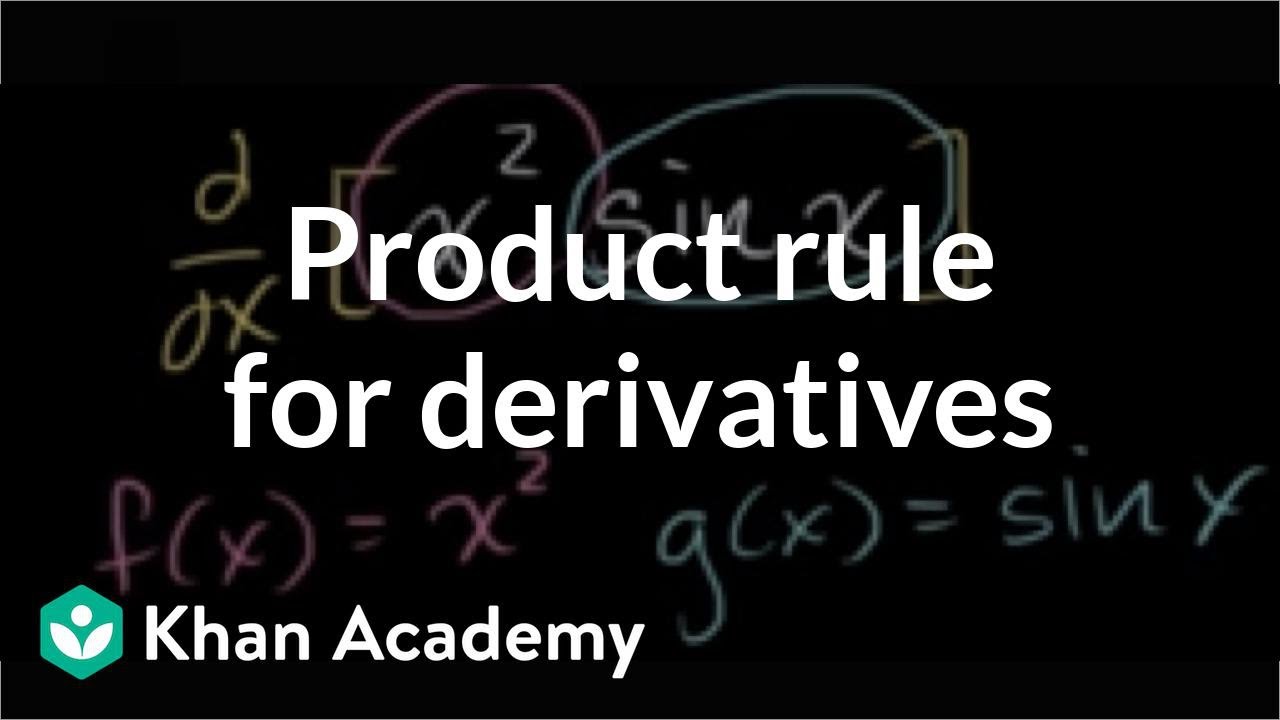 YouTube2:39
Prerequisite in Calculus: Derivatives → Integration by parts.
Derivatives · View learning sequence