Non-uniqueness of N in Limit Definition
When proving sequence limits, the integer N satisfying the condition for a given is not unique. Any N large enough works. The video derives three distinct values (7, 10, 9) for the same example.
Charles队长 · Bilibili · 1:13
This video visually demonstrates the epsilon-N definition of sequence limits using Geometer's Sketchpad. It shows that for the same limit problem, different inequality scaling techniques yield different valid values for N.
Use the learning inspector for key ideas and moments, or open the reading tabs for the complete notes.
Generated from the video's visuals and explanation; not verbatim speech.
A limit proof needs an effective cutoff, not a unique answer. Once all later terms are within ε of the limit, the requirement is met. The animation compares three ways of obtaining such a cutoff for the same sequence.
For n>√3 the error is 9/(n²−3). Solving the error inequality directly gives n>√(). Choose an integer cutoff guaranteeing this condition.
For , n²−²/2, so the error is bounded by ². Requiring n>√(), together with the stated range restriction, gives another valid cutoff.
For , the sharper bound n²−²/3 gives error at most ². Different bounds can therefore yield different integer cutoffs.
Different valid values of N do not conflict. Each must guarantee the error condition for every , and any larger cutoff works too. Existence and control of all later terms matter, rather than uniqueness or minimality.
When proving sequence limits, the integer N satisfying the condition for a given is not unique. Any N large enough works. The video derives three distinct values (7, 10, 9) for the same example.
Directly solving the absolute value inequality algebraically to find the range of n. This is rigorous but can be computationally intensive compared to estimation methods. Use this equivalence only for n>√3.
Simplifies calculation by reducing the denominator to increase the fraction's value (e.g., replacing with ). This typically yields a larger, simpler N. This bound holds for ; the cutoff must also satisfy that restriction.
A compromise scaling approach where is bounded below by . This results in a coefficient of 13.5, further illustrating the flexibility in finding N. This bound holds for ; the cutoff must also satisfy that restriction.
The same sequence-limit example admits cutoffs ,10,9. The epsilon-N definition requires a sufficiently large cutoff rather than a unique smallest one. The supporting estimates retain their domains: direct equivalence for n>√3 and the displayed denominator bounds for .
This phrase summarizes the core logical requirement of the epsilon-N definition. 'Existence' refers to the existential quantifier : we only need to find one valid cutoff. 'Control' refers to the universal quantifier : we must ensure that *every* term after the cutoff stays within the -neighborhood of the limit. It emphasizes that the behavior of finitely many initial terms (before ) is irrelevant, and uniqueness of is not required.
Conditions: Proving sequence limits.; Interpreting the logical structure of the epsilon-N definition.
For , the inequality holds. This allows replacing the complex denominator in the error term with the simpler .
Conditions: .; Error term is .; Goal is to find such that error .
The inequalities and are not true for all . They rely on being sufficiently large.
Conditions: Using scaling techniques for the error term .; is a positive integer.
The definition requires the existence of at least one integer cutoff such that for all , the error is less than . It does not demand a unique or minimal .
Conditions: Proving using the epsilon-N definition.; is given.; must be a positive integer.
To solve directly, isolate . First, note that for the error to be defined and positive, we typically consider .
Conditions: .; to ensure the denominator is positive.; Solving .
Using the inequality for , the error term is bounded above by . This provides a tighter upper bound than the estimate, potentially leading to a smaller valid integer cutoff .
Conditions: .; Error term is .; Scaling inequality is .
 Bilibili5:38
Next in Calculus: Limits → Derivatives.
Derivatives · View learning sequence YouTube2:28
Next in Calculus: Limits → Definite integrals.
Definite integrals · View learning sequence YouTube2:39
Next in Calculus: Limits → Derivatives.
Derivatives · View learning sequence YouTube2:26
English video covering Limits; the current video is in Chinese.
Limits YouTube2:38
English video covering Limits; the current video is in Chinese.
Limits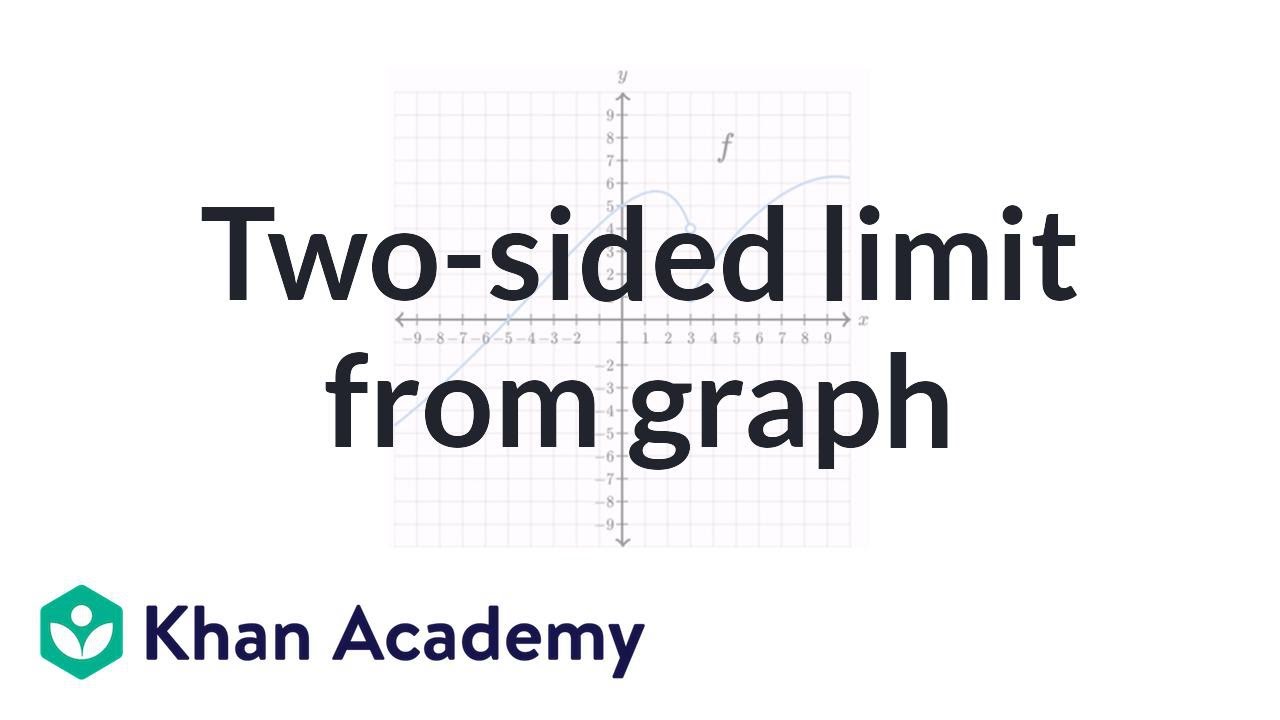 YouTube2:46
English video covering Limits; the current video is in Chinese.
LimitsYouTube2:26Whiteboard for Limits, compared with the current visual explanation.
LimitsYouTube2:38Whiteboard for Limits, compared with the current visual explanation.
LimitsYouTube2:46Whiteboard for Limits, compared with the current visual explanation.
Limits