Finding definite integrals using area formulas | AP Calculus AB | Khan Academy
Evaluate four definite integrals from a graph using semicircles, triangles and a trapezoid. Learn how geometric area and position above or below the axis determine each signed result.
Reviewed learning material · Video analysis · English
Four definite integrals are evaluated from the same graph using elementary geometry. The upper semicircle on [-6,-2] gives 2π, the lower trapezoid on [-2,1] gives −4, the upper triangle on [1,4] gives 6, and the lower semicircle on [4,6] gives −π/2. The lesson keeps ordinary geometric area separate from the sign of the integral. For a Riemann-integrable function on an ordered finite interval a<b, the definite integral is net signed area: regions above the axis add, while regions below subtract. The displayed piecewise curve is continuous, which is sufficient for integrability. The curved pieces are the semicircles specified in this geometric exercise, rather than arbitrary curves inferred to be circular.
Before you watch
Basic Cartesian graph reading
Area of a circle
Area of a triangle
Area of a rectangle or trapezoid
Concept of signed area under a curve
Basic coordinate-graph reading
Elementary area formulas for rectangles, triangles, and circles
Initial notion of the definite integral as accumulated signed area
Generated from the video's visuals and explanation; not verbatim speech.
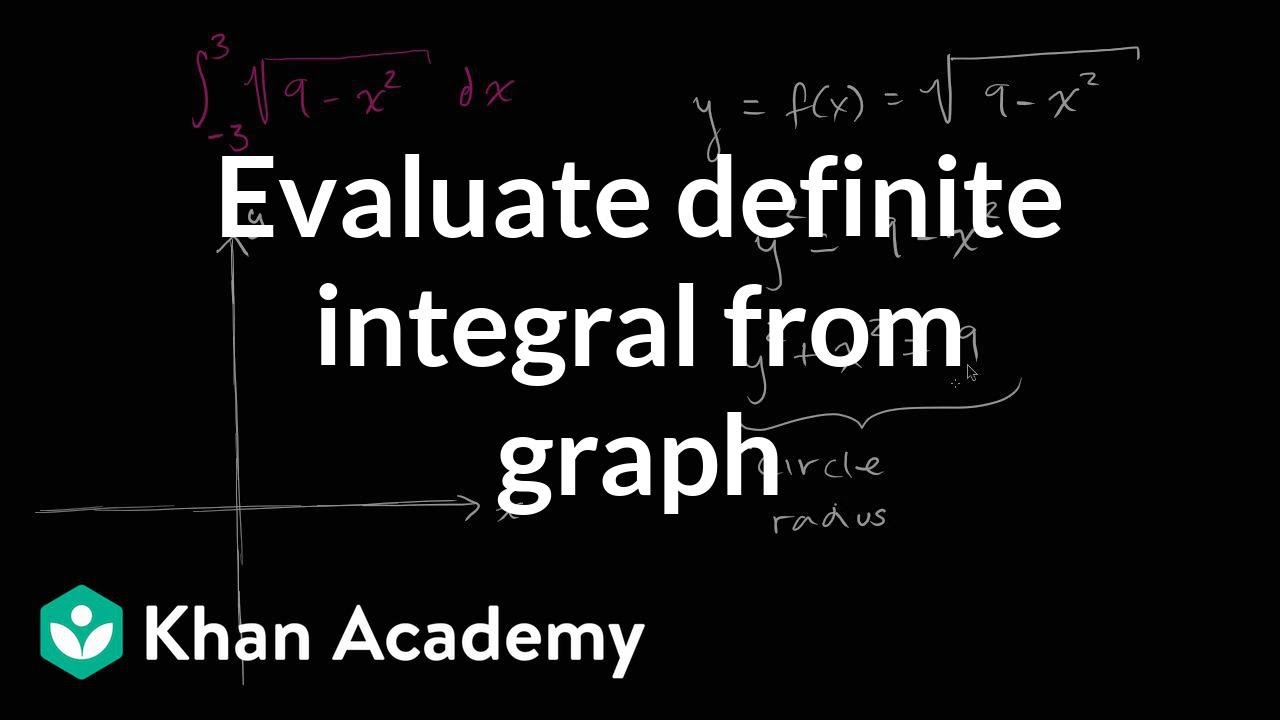
The graph supplies four geometric regions. We will evaluate ∫−6−2f(x)dx, ∫−21f(x)dx, ∫14f(x)dx and ∫46f(x)dx using their areas and signs.
For the interval from x=-6 to x=-2, the relevant part of the graph lies above the x-axis. The video therefore treats the definite integral as the geometric area enclosed between the curve and the axis.
That shaded region is identified as a semicircle. Reading the radius from the graph gives r=2, so the area is half of the full circle area πr², namely (π·2²)/2 = 2π. This completes the first integral.
The second prompt is ∫−21f(x)dx. Here the graph is below the x-axis, so the video emphasizes a sign change: compute the ordinary geometric area first, then attach a negative sign because the integral represents signed area.
The lower polygon is a trapezoid. Split it into a rectangle and two triangles, or use the trapezoid formula directly. The first triangle has base1 and height2, so its area is1; the calculation continues in the following part of this same video.
At this point, the graph of the function f and four definite-integral prompts remain visible. The current focus is ∫−21f(x)dx. The region between the graph and the x-axis on [−2,1] lies below the axis and is split into three simple pieces: a small triangle, a rectangle, and another small triangle.
Using the triangle formula A△=21bh, one triangular piece has base 1 and height 2, so its area is 21⋅1⋅2=1. The rectangle has side lengths 2 and 1, so its area is 2⋅1=2. The other triangle is congruent in area to the first, again giving 1.
Adding the unsigned areas gives 1+2+1=4. At this point the speaker highlights the common mistake of stopping at 4. Because the entire region is below the x-axis, the definite integral is the negative of the geometric area, so ∫−21f(x)dx=−4.
The next prompt is ∫14f(x)dx. Here the bounded region is a single triangle above the x-axis. Its base runs from x=1 to x=4, so b=3, and its height is 4.
Applying the same triangle-area formula yields 21⋅3⋅4=6. Since this region is above the axis, no sign change is needed, and therefore ∫14f(x)dx=6.
The final prompt is ∫46f(x)dx. The relevant region is a semicircle below the x-axis with radius 1. Start from the full-circle area formula A=πr2, substitute r=1, and then divide by 2 because only half of the circle is present.
This gives the unsigned semicircle area 2π⋅12=2π. Because the region lies below the x-axis, the integral takes the opposite sign, so ∫46f(x)dx=−2π. The clip closes by reinforcing the general rule: compute geometric area first, then assign the sign according to whether the region is above or below the axis.
Knowledge cards
01
Definite integrals
For a Riemann-integrable function on an ordered finite interval a<b, the definite integral is net signed area: regions above the axis add, while regions below subtract. The displayed piecewise curve is continuous, which is sufficient for integrability. The curved pieces are the semicircles specified in this geometric exercise, rather than arbitrary curves inferred to be circular.
02
Area of a semicircle
A semicircle has half the area of a full circle. If the radius is r, then the area is (πr²)/2. In the first example, r=2, so the area is (π·2²)/2 = 2π.
Asemicircle=2πr2
03
Negative signed area below the x-axis
If the function is below the x-axis on the interval, the definite integral is the negative of the geometric area of that region. The video applies this rule to ∫−21f(x)dx.
04
Trapezoid or decomposition method
For a polygonal region below the axis, the area can be computed either as a single trapezoid or by splitting the shape into a rectangle and two triangles, then summing the pieces.
05
Triangle area in the second example
The first triangle has base1 and height2, giving area1. At this early time the decomposition is being introduced; the next part completes the second integral.
A△=21⋅2
06
Definite integral as signed area from a graph
For a Riemann-integrable function on an ordered finite interval a<b, the definite integral is net signed area: regions above the axis add, while regions below subtract. The displayed piecewise curve is continuous, which is sufficient for integrability. The curved pieces are the semicircles specified in this geometric exercise, rather than arbitrary curves inferred to be circular.
∫abf(x)dx=signed area between f and the x-axis on [a,b]
07
Why $\int_{-2}^{1} f(x)\,dx=-4$
On [−2,1], the region below the x-axis is decomposed into two triangles of area 1 each and one rectangle of area 2. Their total unsigned area is 1+2+1=4. Since the whole region is below the axis, the definite integral is negative: −4.
1+2+1=4⇒∫−21f(x)dx=−4
08
Triangle area formula used in the examples
The area of a triangle is one-half base times height. The clip uses this twice: for a small triangle with base 1 and height 2, and for a larger triangle with base 3 and height 4.
A△=21bh
09
Why $\int_{1}^{4} f(x)\,dx=6$
The region on [1,4] is a single triangle above the x-axis. Its base is 4−1=3 and its height is 4, so its area is 21⋅3⋅4=6. Because the region is above the axis, the integral equals the positive area.
21⋅3⋅4=6
10
Semicircle area from the circle formula
A full circle has area πr2. If the region is exactly half a circle, divide that by 2. With radius r=1, the semicircle area is 2π⋅12=2π.
Asemicircle=2πr2
11
Why $\int_{4}^{6} f(x)\,dx=-\frac{\pi}{2}$
On [4,6], the bounded region is a semicircle of radius 1 lying below the x-axis. Its geometric area is 2π, but because it is below the axis, the definite integral is the negative of that area.
∫46f(x)dx=−2π⋅12=−2π
12
Common mistake: forgetting the sign below the x-axis
A frequent error is to add the areas of the pieces and stop there. In the lower-trapezoid example, that would give 4. The correct definite integral is −4 because signed area, not just geometric area, determines the value of the integral.
Detailed learning notes
Explore conditions, steps and evidence. Supplementary explanations are labeled separately from content shown in the video.
Symbols · 11
f
Clear evidence
Shown in the video
Evidence
Formula
Observation
The left side lists four integrals of the form ∫ f(x) dx.
Diagram
Observation
The graph on the right is labeled with the function name f.
Symbol
f
Meaning
The given function whose graph is used to evaluate definite integrals.
Domain
The displayed graph extends from−6 to6; this initial section works with the first two intervals.
x
Clear evidence
Shown in the video
Evidence
Formula
Observation
Each integral is written with dx.
Diagram
Observation
The horizontal axis is labeled x.
Symbol
x
Meaning
Independent variable / horizontal coordinate on the graph.
Domain
Real variable along the x-axis.
y
Clear evidence
Shown in the video
Evidence
Diagram
Observation
The vertical axis is labeled y.
Symbol
y
Meaning
Dependent value of the function f at x.
Domain
Real values shown on the vertical axis.
π
Clear evidence
Shown in the video
Evidence
Audio
Observation
The circle-area computation uses the constant π.
Formula
Observation
The handwritten expression uses π in (π·2²)/2 = 2π.
Symbol
π
Meaning
Circle constant used in the area formula for a circle.
Domain
Positive real constant.
r
Clear evidence
Shown in the video
Evidence
Audio
Observation
The upper curved region is identified as a semicircle with its shown radius.
Formula
Observation
The written calculation substitutes r = 2 into πr².
Symbol
r
Meaning
Radius of the circle associated with the semicircular region.
Domain
Positive real number; here r = 2.
f(x)
Clear evidence
Shown in the video
Evidence
Formula
Observation
The integrals are written as ∫f(x)dx, and the graph is labeled f.
Symbol
f(x)
Meaning
The function whose definite integrals are being evaluated from its graph.
Domain
Piecewise graph on the displayed coordinate plane; values are positive above the x-axis and negative below it.
x
Clear evidence
Shown in the video
Evidence
Diagram
Observation
Horizontal axis labeled x with tick marks from about −6 to 6.
Formula
Observation
Each integral contains dx.
Symbol
x
Meaning
Independent variable / horizontal coordinate used as the integration variable.
Domain
Real interval shown on the graph, approximately [−6,6].
y
Clear evidence
Shown in the video
Evidence
Diagram
Observation
Vertical axis labeled y with tick marks from about −5 to 5.
Symbol
y
Meaning
Dependent variable / vertical coordinate representing the value of f(x).
Domain
Displayed range approximately [−5,5].
\int_a^b f(x)\,dx
Clear evidence
Shown in the video
Evidence
Formula
Observation
Four definite integrals are listed: ∫−6−2f(x)dx, ∫−21f(x)dx, ∫14f(x)dx, ∫46f(x)dx.
Symbol
\int_a^b f(x)\,dx
Meaning
Definite integral of f from a to b, interpreted here as signed area between the graph and the x-axis.
Domain
a,b are the displayed limits of integration.
\pi
Clear evidence
Shown in the video
Evidence
Formula
Observation
Circle-area expression written as π⋅12 and then divided by 2.
Audio
Observation
The circle-area formula is applied with the final semicircle radius, and the full-circle area is halved.
Symbol
\pi
Meaning
Constant in the area formula for a circle.
Domain
Positive real constant.
r
Clear evidence
Shown in the video
Evidence
Audio
Observation
The circle-area formula is applied with the final semicircle radius, and the full-circle area is halved.
Formula
Observation
Written expression uses 12 after substituting radius 1.
Symbol
r
Meaning
Radius of the circle used in the area formula πr2.
Domain
Here r=1.
Knowledge points · 9
Definite integral as geometric area above the x-axis
Clear evidence
Supplementary explanation
Evidence
Audio
Observation
The first positive region is linked to the definite integral by its geometric area.
Diagram
Observation
The region under the semicircle from x=-6 to x=-2 is shaded to match the first integral.
Definition
Explanation
For the first example, the video interprets ∫−6−2f(x)dx as the geometric area between the curve and the x-axis when the graph lies above the axis.
Formula
Conditions
The function is above the x-axis on the interval being considered.
For a Riemann-integrable function on an ordered finite interval a<b, the definite integral is net signed area: regions above the axis add, while regions below subtract. The displayed piecewise curve is continuous, which is sufficient for integrability. The curved pieces are the semicircles specified in this geometric exercise, rather than arbitrary curves inferred to be circular.
Area of a semicircle from the circle area formula
Clear evidence
Shown in the video
Evidence
Audio
Observation
The upper curved region is identified as a semicircle with its shown radius.
Formula
Observation
The handwritten work shows (π·2²)/2 = 2π.
Formula
Explanation
The video computes the area of a semicircle by taking half of the full circle area πr². With r=2, it obtains (π·2²)/2 = 2π.
Formula
Asemicircle=2πr2
Conditions
The region is exactly a semicircle.
The radius is known.
Prerequisites
Definite integral as geometric area above the x-axis
Definite integral is negative when the graph is below the x-axis
Clear evidence
Supplementary explanation
Evidence
Audio
Observation
The explanation identifies the lower region and assigns a negative sign to its integral contribution.
Diagram
Observation
The second shaded region lies below the x-axis between x=-2 and x=1.
Method
Explanation
For ∫−21f(x)dx, the video explains that one can compute the ordinary geometric area of the region below the axis and then attach a negative sign because the function lies below the x-axis.
Formula
Conditions
The interval is traversed from lower limit to higher limit.
The function is below the x-axis throughout the region being measured.
For a Riemann-integrable function on an ordered finite interval a<b, the definite integral is net signed area: regions above the axis add, while regions below subtract. The displayed piecewise curve is continuous, which is sufficient for integrability. The curved pieces are the semicircles specified in this geometric exercise, rather than arbitrary curves inferred to be circular.
Prerequisites
Definite integral as geometric area above the x-axis
Computing polygonal area by trapezoid formula or decomposition
Clear evidence
Supplementary explanation
Evidence
Audio
Observation
The lower trapezoid can be measured directly or decomposed into simpler polygonal pieces.
Diagram
Observation
The lower region is visually decomposed into simpler polygonal pieces.
Method
Explanation
The pictured lower quadrilateral is a trapezoid. Its geometric area can be found as one trapezoid or as a rectangle plus two triangles; this is not a rule that every polygon is a trapezoid.
Formula
Conditions
The region has straight-line boundaries so it can be treated as a polygon.
Prerequisites
Definite integral is negative when the graph is below the x-axis
Triangle area computation inside the second example
Clear evidence
Shown in the video
Evidence
Audio
Observation
The explanation starts measuring the triangular component from its base and height.
Diagram
Observation
One triangular piece of the lower region is singled out during the decomposition.
Formula
Explanation
The triangular piece has base1 and height2, so its geometric area is1. A unit-area label is already visible near the end of this initial section.
Formula
A△=21⋅2
Conditions
The chosen piece is a triangle with base 1 and height 2.
Prerequisites
Computing polygonal area by trapezoid formula or decomposition
Evaluate definite integrals from a graph using signed area
Clear evidence
Supplementary explanation
Evidence
Audio
Observation
The worked regions illustrate positive contributions above the axis and negative contributions below it.
Diagram
Observation
Shaded regions are drawn between the graph and the x-axis for each requested interval.
Method
Explanation
For a Riemann-integrable function on an ordered finite interval a<b, the definite integral is net signed area: regions above the axis add, while regions below subtract. The displayed piecewise curve is continuous, which is sufficient for integrability. The curved pieces are the semicircles specified in this geometric exercise, rather than arbitrary curves inferred to be circular.
Formula
∫abf(x)dx=(signed area between f and the x-axis on [a,b])
Conditions
The graph of f is available on [a,b].
The region can be decomposed into standard shapes whose areas are known.
A single sign applies only when that region is on one side of the axis; otherwise add its positive and negative pieces separately.
Area formula for a triangle
Clear evidence
Supplementary explanation
Evidence
Audio
Observation
The triangular component is measured by one-half times its base times perpendicular height.
Formula
Observation
The local small-triangle computation uses one-half times base1 times height2, giving area1; the larger triangle is treated later.
Formula
Explanation
The area of a triangle equals one-half times its base times its height. The video applies this twice: once to a small triangle of base 1 and height 2, and once to a larger triangle of base 3 and height 4.
Formula
A△=21bh
Conditions
b is a chosen base length.
h is the perpendicular height corresponding to that base.
Area formula for a rectangle
Clear evidence
Shown in the video
Evidence
Audio
Observation
The rectangle component is measured by multiplying its two side lengths.
Diagram
Observation
A rectangular portion of the shaded region below the x-axis is identified on the graph.
Formula
Explanation
The area of a rectangle is length times width. In the worked example, the rectangle has side lengths 2 and 1, giving area 2.
Formula
Arect=lw
Conditions
l and w are the side lengths of the rectangle.
Area formula for a circle and semicircle
Clear evidence
Shown in the video
Evidence
Audio
Observation
The circle-area formula is applied with the final semicircle radius, and the full-circle area is halved.
Formula
Observation
Written as π⋅12, then divided by 2 for a semicircle.
Formula
Explanation
The area of a full circle is πr2. If only half of the circle is present, as in the final interval, the area is halved: 2πr2. With r=1, the semicircle area is 2π.
Formula
Acircle=πr2,Asemicircle=2πr2
Conditions
The region is a full circle or exactly half of a circle.
r is the radius.
Claims and conditions · 2
Integral over a region below the x-axis is negative
Clear evidence
Supplementary explanation
Evidence
Audio
Observation
The polygon pieces add to the ordinary area, then the lower region gives the negative integral result.
Formula
Observation
The answer for ∫−21f(x)dx is written as −4.
Proposition
Statement
If the relevant region between the graph and the x-axis lies below the x-axis, then the definite integral over that interval equals the negative of the ordinary geometric area.
Hypotheses
The graph of f is below the x-axis on the interval under consideration.
The total unsigned area of the region has been computed.
For a Riemann-integrable function on an ordered finite interval a<b, the definite integral is net signed area: regions above the axis add, while regions below subtract. The displayed piecewise curve is continuous, which is sufficient for integrability. The curved pieces are the semicircles specified in this geometric exercise, rather than arbitrary curves inferred to be circular.
Quantifiers
For the shown ordered intervals with nonpositive f and positive ordinary area; endpoints on the axis contribute zero.
Integral over a region above the x-axis is positive
Clear evidence
Supplementary explanation
Evidence
Audio
Observation
The upper triangle uses the shown base and height, so its positive geometric area gives the integral.
Formula
Observation
Written result: 21⋅3⋅4=6.
Proposition
Statement
When the bounded region lies above the x-axis, the definite integral equals the positive geometric area of that region.
Hypotheses
The graph of f is above the x-axis on the interval under consideration.
The region’s geometric area has been computed.
For a Riemann-integrable function on an ordered finite interval a<b, the definite integral is net signed area: regions above the axis add, while regions below subtract. The displayed piecewise curve is continuous, which is sufficient for integrability. The curved pieces are the semicircles specified in this geometric exercise, rather than arbitrary curves inferred to be circular.
Quantifiers
For the shown ordered interval with nonnegative f and positive ordinary area.
Derivations and proofs · 5
Evaluation of ∫−6−2f(x)dx by semicircle area
Clear evidence
Shown in the video
Evidence
Audio
Observation
The first calculation halves the circle area and reaches the displayed semicircle result.
Formula
Observation
The handwritten chain shows (π·2²)/2 = 2π.
Diagram
Observation
The shaded semicircular region from x=-6 to x=-2 is identified as the relevant area.
Visual argument
Steps
Expression
∫−6−2f(x)dx
Explanation
Start with the first requested definite integral.
Justification
This is the problem statement shown on screen.
Shown in the video
Expression
area under f and above the x-axis on [−6,−2]
Explanation
Interpret the integral as the geometric area of the shaded region.
Justification
Uses the displayed region, its recognized shape and the area formula explained at this stage.
Shown in the video
Expression
region is a semicircle with radius 2
Explanation
Identify the shape and read off its radius from the graph.
Justification
Uses the displayed region, its recognized shape and the area formula explained at this stage.
Shown in the video
Expression
2πr2=2π⋅22
Explanation
Use the circle area formula and take half because the region is a semicircle.
Justification
Uses the displayed region, its recognized shape and the area formula explained at this stage.
Shown in the video
Expression
2π
Explanation
Simplify the expression to obtain the value of the integral.
Justification
Arithmetic simplification of (π·2²)/2.
Shown in the video
Conclusion
∫−6−2f(x)dx = 2π.
Partial evaluation of ∫−21f(x)dx using signed area and decomposition
Clear evidence
Supplementary explanation
Evidence
Audio
Observation
The second calculation establishes the negative sign and begins the decomposition of the lower region.
Diagram
Observation
The region from x=-2 to x=1 is shaded below the axis and then split into simpler shapes.
Formula
Observation
One triangle is written as 1 times 2 times one-half.
Uncertainties
At this early timestamp the second calculation is still in progress; later in the same complete video it reaches −4 and the final two problems are also solved.
Visual argument
Steps
Expression
∫−21f(x)dx
Explanation
Begin the second requested definite integral.
Justification
This is the next problem shown and spoken aloud.
Shown in the video
Expression
f(x)≤0(−2≤x≤1)
Explanation
The graph is nonpositive on the closed interval and negative in its interior; both endpoints are on the axis.
Justification
Uses the displayed region, its recognized shape and the area formula explained at this stage.
Supplementary explanation
Expression
∫−21f(x)dx=−(geometric area of the region)
Explanation
Convert the geometric area into a signed integral value by adding a minus sign.
Justification
Uses the displayed region, its recognized shape and the area formula explained at this stage.
Shown in the video
Expression
area can be found as a trapezoid or as rectangle + two triangles
Explanation
Choose a method for computing the geometric area of the polygonal region.
Justification
Uses the displayed region, its recognized shape and the area formula explained at this stage.
Shown in the video
Expression
A△=21⋅2
Explanation
Compute one triangular piece in the decomposition.
Justification
Uses the displayed region, its recognized shape and the area formula explained at this stage.
Shown in the video
Conclusion
At this early timestamp the second calculation is still in progress; later in the same complete video it reaches −4 and the final two problems are also solved.
Derivation of ∫−21f(x)dx=−4
Clear evidence
Shown in the video
Evidence
Audio
Observation
The polygon pieces add to the ordinary area, then the lower region gives the negative integral result.
Formula
Observation
Final written answer is −4.
Visual argument
Steps
Expression
A1=1
Explanation
A small triangular piece of the shaded region has area 1.
Justification
Triangle area formula 21bh with base 1 and height 2.
Shown in the video
Expression
A2=2
Explanation
A rectangular piece has area 2.
Justification
Rectangle area formula lw with side lengths 2 and 1.
Shown in the video
Expression
A3=1
Explanation
Another triangular piece also has area 1.
Justification
Triangle area formula 21bh with base 1 and height 2.
Shown in the video
Expression
Atotal=1+2+1=4
Explanation
Add the three unsigned areas to get the total geometric area.
Justification
Additivity of area for non-overlapping pieces.
Shown in the video
Expression
∫−21f(x)dx=−4
Explanation
Because the whole region lies below the x-axis, the signed integral is the negative of the total area.
Justification
Signed-area interpretation of the definite integral.
Shown in the video
Conclusion
∫−21f(x)dx=−4.
Derivation of ∫14f(x)dx=6
Clear evidence
Shown in the video
Evidence
Audio
Observation
The upper triangle uses the shown base and height, so its positive geometric area gives the integral.
Formula
Observation
Written computation: 21⋅3⋅4=6.
Visual argument
Steps
Expression
b=4−1=3
Explanation
The base of the triangle spans from x=1 to x=4.
Justification
Reading the horizontal extent from the graph.
Shown in the video
Expression
h=4
Explanation
The height of the triangle is 4 units.
Justification
Reading the vertical extent from the graph.
Shown in the video
Expression
A=21⋅3⋅4=6
Explanation
Apply the triangle area formula.
Justification
A△=21bh.
Shown in the video
Expression
∫14f(x)dx=6
Explanation
The region is above the x-axis, so the signed area is positive.
Justification
Signed-area interpretation of the definite integral.
Shown in the video
Conclusion
∫14f(x)dx=6.
Derivation of ∫46f(x)dx=−2π
Clear evidence
Shown in the video
Evidence
Audio
Observation
The lower curved region is identified as a semicircle, its area is halved from the circle formula, and its integral receives a negative sign.
Formula
Observation
Written result: −2π⋅12=−2π.
Visual argument
Steps
Expression
r=1
Explanation
The curved region is identified as a semicircle of radius 1.
Justification
Uses the displayed region, its recognized shape and the area formula explained at this stage.
Shown in the video
Expression
Acircle=πr2=π⋅12
Explanation
Start from the full-circle area formula.
Justification
Circle area formula.
Shown in the video
Expression
Asemicircle=2π⋅12
Explanation
Only half of the circle is present, so divide by 2.
Justification
Semicircle is half of a circle.
Shown in the video
Expression
∫46f(x)dx=−2π⋅12=−2π
Explanation
The semicircular region lies below the x-axis, so the integral is negative.
Justification
Signed-area interpretation of the definite integral.
Shown in the video
Conclusion
∫46f(x)dx=−2π.
Worked examples · 5
Example 1: ∫−6−2f(x)dx
Clear evidence
Shown in the video
Evidence
Formula
Observation
The first listed integral is ∫−6−2f(x)dx = ?.
Audio
Observation
The first calculation halves the circle area and reaches the displayed semicircle result.
Diagram
Observation
The semicircular region above the x-axis is shaded.
Problem
Find the definite integral ∫−6−2f(x)dx from the given graph of f.
Given
The graph of f is provided.
On [-6,-2], the graph forms a semicircle above the x-axis.
The semicircle has radius 2.
Goal
Compute the exact value of the definite integral.
Steps
Expression
∫−6−2f(x)dx
Explanation
Identify the target integral.
Justification
Given in the problem list on screen.
Shown in the video
Expression
area of shaded region above the x-axis
Explanation
Translate the integral into an area problem.
Justification
Uses the displayed region, its recognized shape and the area formula explained at this stage.
Shown in the video
Expression
2π⋅22
Explanation
Use the semicircle area formula with radius 2.
Justification
The region is identified as a semicircle and the circle area formula is πr².
Shown in the video
Expression
2π
Explanation
Simplify to the final value.
Justification
Direct arithmetic simplification.
Shown in the video
Answer
2π
Verification
The result matches the handwritten final expression shown beside the first integral.
Example 2: ∫−21f(x)dx (partial solution)
Approximate timing
Supplementary explanation
Evidence
Formula
Observation
The second listed integral is ∫−21f(x)dx = ?.
Audio
Observation
The second calculation establishes the negative sign and begins the decomposition of the lower region.
Diagram
Observation
The region below the x-axis is shaded and split into simpler polygonal parts.
Uncertainties
At this early timestamp the second calculation is still in progress; later in the same complete video it reaches −4 and the final two problems are also solved.
Problem
Find the definite integral ∫−21f(x)dx from the same graph of f.
Given
The graph of f is provided.
On [-2,1], the relevant region lies below the x-axis.
The lower region can be viewed as a trapezoid or decomposed into a rectangle and two triangles.
One triangle has base 1 and height 2.
Goal
Compute the definite integral using geometric area and sign.
Steps
Expression
∫−21f(x)dx
Explanation
Identify the second target integral.
Justification
Given in the problem list on screen.
Shown in the video
Expression
function is below the x-axis
Explanation
Recognize that the region contributes negative signed area.
Justification
Uses the displayed region, its recognized shape and the area formula explained at this stage.
Shown in the video
Expression
−(geometric area)
Explanation
Plan to compute the ordinary area first and then negate it.
Justification
Uses the displayed region, its recognized shape and the area formula explained at this stage.
Shown in the video
Expression
trapezoid or rectangle + two triangles
Explanation
Choose a geometric decomposition for the area.
Justification
Uses the displayed region, its recognized shape and the area formula explained at this stage.
Shown in the video
Expression
21⋅2
Explanation
Begin computing one triangular component.
Justification
Uses the displayed region, its recognized shape and the area formula explained at this stage.
Shown in the video
Answer
At this early timestamp the second calculation is still in progress; later in the same complete video it reaches −4 and the final two problems are also solved.
Verification
The later same-video result −4 confirms the negative sign and ordinary area4.
Example: ∫−21f(x)dx
Clear evidence
Shown in the video
Evidence
Formula
Observation
Prompt on screen: ∫−21f(x)dx=?; final written answer −4.
Audio
Observation
The polygon pieces add to the ordinary area, then the lower region gives the negative integral result.
Problem
Find ∫−21f(x)dx from the given graph.
Given
Graph of f on the coordinate plane.
Interval [−2,1].
Region below the x-axis composed of two triangles and one rectangle.
Goal
Compute the definite integral as signed area.
Steps
Expression
A△=21⋅1⋅2=1
Explanation
Compute the first small triangle’s area.
Justification
Triangle area formula.
Shown in the video
Expression
Arect=2⋅1=2
Explanation
Compute the rectangle’s area.
Justification
Rectangle area formula.
Shown in the video
Expression
A△=21⋅1⋅2=1
Explanation
Compute the second small triangle’s area.
Justification
Triangle area formula.
Shown in the video
Expression
1+2+1=4
Explanation
Add the unsigned areas.
Justification
Total area is the sum of the pieces.
Shown in the video
Expression
∫−21f(x)dx=−4
Explanation
Attach a negative sign because the region is below the x-axis.
Justification
Signed-area rule for definite integrals.
Shown in the video
Answer
−4
Verification
Matches the written final answer on screen.
Example: ∫14f(x)dx
Clear evidence
Shown in the video
Evidence
Formula
Observation
Prompt on screen: ∫14f(x)dx=?; written computation 21⋅3⋅4=6.
Audio
Observation
The upper triangle uses the shown base and height, so its positive geometric area gives the integral.
Problem
Find ∫14f(x)dx from the given graph.
Given
Graph of f.
Interval [1,4].
Region above the x-axis shaped like a triangle.
Goal
Compute the definite integral as signed area.
Steps
Expression
b=3
Explanation
The base runs from x=1 to x=4.
Justification
Horizontal distance on the graph.
Shown in the video
Expression
h=4
Explanation
The height is 4 units.
Justification
Vertical extent read from the graph.
Shown in the video
Expression
21⋅3⋅4=6
Explanation
Apply the triangle area formula.
Justification
A△=21bh.
Shown in the video
Expression
∫14f(x)dx=6
Explanation
The region is above the x-axis, so the signed area is positive.
Justification
Signed-area interpretation.
Shown in the video
Answer
6
Verification
Matches the written final answer on screen.
Example: ∫46f(x)dx
Clear evidence
Shown in the video
Evidence
Formula
Observation
Prompt on screen: ∫46f(x)dx=?; written result −2π⋅12=−2π.
Audio
Observation
The lower curved region is identified as a semicircle, its area is halved from the circle formula, and its integral receives a negative sign.
Problem
Find ∫46f(x)dx from the given graph.
Given
Graph of f.
Interval [4,6].
Region below the x-axis shaped like a semicircle of radius 1.
Goal
Compute the definite integral as signed area.
Steps
Expression
r=1
Explanation
Identify the radius of the semicircle.
Justification
Uses the displayed region, its recognized shape and the area formula explained at this stage.
Shown in the video
Expression
Afull circle=πr2=π⋅12
Explanation
Write the full-circle area.
Justification
Circle area formula.
Shown in the video
Expression
Asemicircle=2π⋅12
Explanation
Take half because only a semicircle appears.
Justification
Semicircle is half a circle.
Shown in the video
Expression
∫46f(x)dx=−2π⋅12=−2π
Explanation
Negate because the region is below the x-axis.
Justification
Signed-area interpretation.
Shown in the video
Answer
−2π
Verification
Matches the written final answer on screen.
Visual events · 7
Overall layout of the worked problem
Clear evidence
Shown in the video
Evidence
Diagram
Observation
A coordinate grid with labeled axes and a teal graph of f is visible throughout.
Formula
Observation
Four integrals are listed on the left side of the screen.
Objects
Cartesian coordinate plane
Graph of f
List of four definite integrals
Purple pointer dot
Changes
The pointer moves among the listed integrals and corresponding parts of the graph.
Handwritten annotations appear next to the first two integrals as they are discussed.
Invariants
The graph of f remains fixed on the right.
The four integral prompts remain listed on the left.
Interpretation
The visual setup ties each algebraic integral to a specific region under the graph of f.
Shading and annotation for the first integral
Clear evidence
Shown in the video
Evidence
Diagram
Observation
The region from x=-6 to x=-2 above the x-axis is shaded.
Formula
Observation
The handwritten expression (π·2²)/2 = 2π appears beside the first integral.
Objects
Semicircular region above the x-axis
Radius marks labeled 2
Handwritten area formula
Changes
The semicircular region becomes shaded.
Radius annotations and the area computation are written in.
Invariants
The rest of the graph stays unchanged.
Interpretation
The animation visually converts the first definite integral into a semicircle area problem.
Shading and decomposition for the second integral
Clear evidence
Shown in the video
Evidence
Diagram
Observation
The region from x=-2 to x=1 below the x-axis is shaded.
Animation
Observation
The lower region is then subdivided into simpler polygonal pieces.
Uncertainties
At this early timestamp the second calculation is still in progress; later in the same complete video it reaches −4 and the final two problems are also solved.
Objects
Polygonal region below the x-axis
Rectangle piece
Two triangular pieces
Trapezoid interpretation
Changes
The lower region is shaded.
Internal lines divide the region into simpler shapes for area calculation.
Invariants
The outer boundary of the region from x=-2 to x=1 remains the same.
Interpretation
The visual process supports the spoken method of computing geometric area first and then assigning a negative sign to the integral.
Graph with shaded areas for four integrals
Clear evidence
Shown in the video
Evidence
Diagram
Observation
The graph shows several colored regions between the curve and the x-axis, corresponding to the four requested integrals.
Animation
Observation
As each integral is discussed, the relevant region is visually emphasized.
Uncertainties
Exact color coding of every subregion is not fully described in the audio.
Objects
Coordinate axes labeled x and y.
Graph of f.
Shaded regions over [−6,−2], [−2,1], [1,4], and [4,6].
List of four definite integrals on the left.
Changes
Attention shifts from one integral to the next.
Each target region is highlighted when its integral is discussed.
Invariants
The underlying graph of f remains the same throughout.
The four requested integrals remain listed on screen.
Interpretation
The visual setup supports interpreting each definite integral as the signed area between the graph and the x-axis over the specified interval.
Decomposition of the region below the x-axis on [−2,1]
Clear evidence
Shown in the video
Evidence
Diagram
Observation
The region for [−2,1] is broken into simpler geometric pieces.
Audio
Observation
The polygon pieces add to the ordinary area, then the lower region gives the negative integral result.
Objects
One small triangle.
One rectangle.
Another small triangle.
Changes
The speaker moves piece by piece through the composite region.
The separate areas are summed into one total.
Invariants
All pieces lie below the x-axis.
The overall interval remains [−2,1].
Interpretation
A composite region can be evaluated by splitting it into standard shapes, summing their areas, and then applying the correct sign.
Single triangular region above the x-axis on [1,4]
Clear evidence
Shown in the video
Evidence
Diagram
Observation
The region for [1,4] is a single triangle above the x-axis.
Audio
Observation
The upper triangle uses the shown base and height, so its positive geometric area gives the integral.
Objects
One triangle bounded by the graph and the x-axis.
Changes
Base and height are identified directly from the graph.
Invariants
The region stays entirely above the x-axis.
Interpretation
When the region is a single simple shape, its area can be read off directly and used as the positive value of the integral.
Semicircular region below the x-axis on [4,6]
Clear evidence
Shown in the video
Evidence
Diagram
Observation
The region for [4,6] is a semicircular cap below the x-axis.
Audio
Observation
The lower curved region is identified as a semicircle, its area is halved from the circle formula, and its integral receives a negative sign.
Objects
One semicircle of radius 1.
Changes
Full-circle area formula is adapted to a semicircle by dividing by 2.
Sign is then reversed because the region is below the axis.
Invariants
The shape remains circular/semicircular throughout the explanation.
Interpretation
Curved regions can still be handled by recognizing them as fractions of circles and applying the same signed-area principle.
Misconceptions · 2
Do not treat area below the x-axis as positive in the definite integral
Clear evidence
Shown in the video
Evidence
Audio
Observation
The explanation identifies the lower region and assigns a negative sign to its integral contribution.
Misconception
One might compute only the geometric area of a region below the x-axis and forget that the definite integral carries a negative sign.
Clarification
The video explicitly warns that when the function is below the x-axis, the integral equals the negative of the geometric area.
Mistaking total geometric area for the definite integral
Clear evidence
Shown in the video
Evidence
Audio
Observation
The polygon pieces add to the ordinary area, then the lower region gives the negative integral result.
Misconception
After adding the areas of the pieces, one may incorrectly conclude that ∫−21f(x)dx=4.
Clarification
The definite integral is signed area. Since the region lies below the x-axis, the correct value is −4, not 4.
Concept relations · 7
Definite integral as geometric area above the x-axis → Area of a semicircle from the circle area formula
Clear evidence
Shown in the video
Evidence
Audio
Observation
The first positive region is linked to the definite integral by its geometric area.
Application
Explanation
The definition of the definite integral as area is applied to a semicircular region in the first example.
Definite integral is negative when the graph is below the x-axis → Computing polygonal area by trapezoid formula or decomposition
Clear evidence
Shown in the video
Evidence
Audio
Observation
The lower trapezoid can be measured directly or decomposed into simpler polygonal pieces.
Application
Explanation
The signed-area rule determines the final sign, while the trapezoid/decomposition method supplies the geometric area magnitude.
Computing polygonal area by trapezoid formula or decomposition → Triangle area computation inside the second example
Clear evidence
Shown in the video
Evidence
Audio
Observation
The explanation starts measuring the triangular component from its base and height.
Contains
Explanation
The decomposition method contains the triangle-area computation as one of its substeps.
Evaluate definite integrals from a graph using signed area → Area formula for a triangle
Clear evidence
Shown in the video
Evidence
Audio
Observation
The triangular component is measured by one-half times its base times perpendicular height.
Application
Explanation
The signed-area method reduces the integral to geometric area computations, including the triangle formula.
Evaluate definite integrals from a graph using signed area → Area formula for a rectangle
Clear evidence
Shown in the video
Evidence
Audio
Observation
The rectangle component is measured by multiplying its two side lengths.
Application
Explanation
The same integral-evaluation method uses the rectangle area formula for one subregion.
Evaluate definite integrals from a graph using signed area → Area formula for a circle and semicircle
Clear evidence
Shown in the video
Evidence
Audio
Observation
The circle-area formula is applied with the final semicircle radius, and the full-circle area is halved.
Application
Explanation
For the last interval, the signed-area method relies on the circle/semicircle area formula.
Integral over a region below the x-axis is negative → Integral over a region above the x-axis is positive
Clear evidence
Shown in the video
Evidence
Audio
Observation
The worked regions illustrate positive contributions above the axis and negative contributions below it.
Contrast
Explanation
Regions below the x-axis contribute negative signed area, while regions above contribute positive signed area.
Find an answer · 8
How do you evaluate a definite integral when the graph over the interval is a semicircle?
Clear evidence
Shown in the video
Evidence
Audio
Observation
The upper curved region is identified as a semicircle with its shown radius.
Knowledge points
Definite integral as geometric area above the x-axis
Area of a semicircle from the circle area formula
Evaluation of ∫−6−2f(x)dx by semicircle area
Example 1: ∫−6−2f(x)dx
Why does a definite integral become negative when the function lies below the x-axis?
Clear evidence
Shown in the video
Evidence
Audio
Observation
The explanation identifies the lower region and assigns a negative sign to its integral contribution.
Knowledge points
Definite integral is negative when the graph is below the x-axis
Do not treat area below the x-axis as positive in the definite integral
Partial evaluation of ∫−21f(x)dx using signed area and decomposition
What are alternative geometry methods for finding the area under a piecewise linear graph?
Clear evidence
Shown in the video
Evidence
Audio
Observation
The lower trapezoid can be measured directly or decomposed into simpler polygonal pieces.
Knowledge points
Computing polygonal area by trapezoid formula or decomposition
Triangle area computation inside the second example
Partial evaluation of ∫−21f(x)dx using signed area and decomposition
How can you match each definite integral to the correct shaded region on a graph?
Clear evidence
Shown in the video
Evidence
Diagram
Observation
The screen pairs listed integrals with shaded regions on the graph of f.
Knowledge points
Definite integral as geometric area above the x-axis
Overall layout of the worked problem
Shading and annotation for the first integral
Shading and decomposition for the second integral
Why is ∫−21f(x)dx equal to −4 instead of 4?
Clear evidence
Shown in the video
Evidence
Audio
Observation
The polygon pieces add to the ordinary area, then the lower region gives the negative integral result.
Knowledge points
Evaluate definite integrals from a graph using signed area
Integral over a region below the x-axis is negative
Mistaking total geometric area for the definite integral
How do you find the base and height of the triangle used for ∫14f(x)dx?
Clear evidence
Shown in the video
Evidence
Audio
Observation
The upper triangle uses the shown base and height, so its positive geometric area gives the integral.
Knowledge points
Area formula for a triangle
Example: ∫14f(x)dx
How is the area of the semicircle on [4,6] computed from the circle formula?
Clear evidence
Shown in the video
Evidence
Audio
Observation
The lower curved region is identified as a semicircle, its area is halved from the circle formula, and its integral receives a negative sign.
Knowledge points
Area formula for a circle and semicircle
Example: ∫46f(x)dx
What is the general method for evaluating a definite integral from a graph using areas?
Clear evidence
Shown in the video
Evidence
Audio
Observation
The worked regions illustrate positive contributions above the axis and negative contributions below it.
Knowledge points
Evaluate definite integrals from a graph using signed area
Coverage and review notes
Covered · Problem setup: four integrals are shown and the first integral is introduced.
Covered · First example is fully solved as the area of a semicircle with radius 2.
Covered · The lower region is identified and subdivided; the following section continues the same area calculation.
Covered · Evaluation of ∫−21f(x)dx by decomposing the region into triangle + rectangle + triangle and assigning a negative sign.
Covered · Transition to the next integral ∫14f(x)dx; no new mathematical content beyond introducing the next example.
Covered · Evaluation of ∫14f(x)dx as the positive area of a triangle with base 3 and height 4.
Covered · Brief transition to the final integral.
Covered · Evaluation of ∫46f(x)dx as the negative area of a semicircle of radius 1.
Covered · Closing remark “And we are done,” with no additional mathematical content.
For a Riemann-integrable function on an ordered finite interval a<b, the definite integral is net signed area: regions above the axis add, while regions below subtract. The displayed piecewise curve is continuous, which is sufficient for integrability. The curved pieces are the semicircles specified in this geometric exercise, rather than arbitrary curves inferred to be circular.
 math
math