Equivalence relation definition
An equivalence relation is a relation on a set that has all three properties listed on screen: it is reflexive, symmetric, and transitive. The video presents this as the central definition of the segment.
Dr. Trefor Bazett · YouTube · 4:35
This 120-second introductory lecture segment defines an equivalence relation as a relation on a set that is reflexive, symmetric, and transitive, using a persistent on-screen definition box. The lecturer then shows that ordinary equality on numbers is an equivalence relation by testing the three properties with the concrete example . After emphasizing that equivalence relation generalizes the idea of equality, he introduces modular arithmetic as a second example and writes 10 mod 3, explaining that its value is 1 because it is the remainder when 10 is divided by 3. The clip ends before the broader verification that modular equality is an equivalence relation is fully carried out. This video segment introduces the concept of an equivalence relation, defining it as a relation that is reflexive, symmetric, and transitive. The instructor uses modular arithmetic, specifically modulo 3, to demonstrate these three properties. He shows that a number is always congruent to itself (reflexive), that if two numbers have the same remainder they are congruent regardless of order (symmetric), and begins to set up an example for transitivity by introducing a third number with the same remainder. This video segment defines an equivalence relation as one that is reflexive, symmetric, and transitive. It illustrates the transitive property using modular arithmetic with base 3, showing that if 10 ≡ 7 (mod 3) and 7 ≡ 13 (mod 3), then 10 ≡ 13 (mod 3). The speaker clarifies this is an illustrative example rather than a formal proof.
Use the learning inspector for key ideas and moments, or open the reading tabs for the complete notes.
Generated from the video's visuals and explanation; not verbatim speech.
The segment opens with a fixed definition box stating that an equivalence relation on a set is a relation that is reflexive, symmetric, and transitive. The lecturer introduces this as the special class of relations that will matter most in the discussion.
He then gives the first example: ordinary equality of numbers. Equality is reframed as a relation because it connects a number on the left with a number on the right.
Using the concrete statement , he checks the three defining properties in order. Reflexivity appears because 3 is always equal to itself.
Symmetry appears because swapping the two sides of still leaves a true statement.
Transitivity appears because chaining with still yields that the original 3 equals the third 3. From these checks, he concludes that equality is an equivalence relation.
The lecturer then explains that this is not accidental: the notion of equivalence relation is meant to capture the essence of equality in a more generalized form.
To make that generalization concrete, he introduces a second example from modular arithmetic, saying viewers have already seen this kind of equivalence before without naming it.
He writes the expression 10 mod 3 on the board and evaluates it as 1, explaining that mod gives the remainder after division.
He begins to justify the computation by rewriting 10 in terms of division by 3, but the clip ends mid-sentence before the broader modular-equality argument is developed.
The video begins by establishing that 10 divided by 3 leaves a remainder of 1, setting the stage for exploring equivalence relations.
Next, the instructor addresses the first property of an equivalence relation: reflexivity. He explains that this is straightforward, demonstrating that 10 mod 3 is equal to itself, thus satisfying the condition that any element is related to itself.
Moving on to the second property, symmetry, the instructor introduces another number, 7, which also has a remainder of 1 when divided by 3. He shows that since 10 mod 3 equals 7 mod 3, reversing the order to 7 mod 3 equals 10 mod 3 still holds true, illustrating the symmetric property.
Finally, the instructor begins to discuss transitivity. He introduces a third number, 13, noting that it also leaves a remainder of 1 when divided by 3. This sets up the premise that if 10 is related to 7, and 7 is related to 13, then 10 should be related to 13, although the full proof is not completed in this segment.
The speaker continues explaining the properties of equivalence relations, focusing on transitivity. Using the example of modulo 3 arithmetic, he states that since 10 mod 3 equals 7 mod 3, and 7 mod 3 equals 13 mod 3, it logically follows that 10 mod 3 must equal 13 mod 3. This demonstrates the transitive property for this specific relation.
He then adds a crucial caveat: this numerical demonstration is merely an illustrative example, not a rigorous formal proof applicable to all integers. Despite this limitation, he concludes that both standard equality and modular arithmetic serve as valid examples of equivalence relations because they satisfy the required properties.
An equivalence relation is a relation on a set that has all three properties listed on screen: it is reflexive, symmetric, and transitive. The video presents this as the central definition of the segment.
Ordinary equality on numbers is used as the first example. The lecturer treats equality as a relation between left-hand and right-hand numbers and verifies the three properties using .
Reflexivity is illustrated by the fact that a number is always equal to itself. In the example, 3 is always equal to 3.
Symmetry is illustrated by swapping the two sides of an equality statement. If , then the reordered statement is still .
Transitivity is illustrated by chaining two true equalities to obtain the same relation again. From and , the lecturer concludes the original 3 equals the third 3.
The lecturer explains that equivalence relation is not just a label for ordinary equality; it captures the essence of equality in a broader, more generalized concept.
The second example introduced is equality of modular arithmetic. The clip begins this example by writing a concrete modulo expression rather than completing the full equivalence proof.
The expression 10 mod 3 is evaluated as 1. The lecturer explains mod as the remainder obtained when 10 is divided by 3.
An equivalence relation on a set is a specific type of binary relation that must satisfy three fundamental properties: reflexivity, symmetry, and transitivity. These properties ensure that the relation partitions the set into distinct, non-overlapping subsets called equivalence classes.
A relation R on a set S is reflexive if every element in S is related to itself. Mathematically, for all a in S, aRa. In the context of modular arithmetic, this means any number is congruent to itself modulo n.
A relation R on a set S is symmetric if for any two elements a and b in S, if a is related to b, then b is also related to a. Mathematically, for all a, b in S, if aRb, then bRa. In modular arithmetic, if a has the same remainder as b when divided by n, then b has the same remainder as a.
A relation R on a set S is transitive if for any three elements a, b, and c in S, if a is related to b and b is related to c, then a is also related to c. Mathematically, for all a, b, c in S, if aRb and bRc, then aRc. In modular arithmetic, if a and b have the same remainder modulo n, and b and c have the same remainder modulo n, then a and c must also have the same remainder modulo n.
An equivalence relation on a set is a binary relation that satisfies three core properties: reflexivity, symmetry, and transitivity.
Transitivity is illustrated using modulo 3 arithmetic. If the remainder of 10 divided by 3 equals the remainder of 7 divided by 3, and the remainder of 7 divided by 3 equals the remainder of 13 divided by 3, then the remainder of 10 divided by 3 must equal the remainder of 13 divided by 3.
The speaker distinguishes between using specific numbers to illustrate a concept (like transitivity) and providing a formal mathematical proof that holds for all cases. The example shown helps build intuition but does not constitute a general proof.
Explore conditions, steps and evidence. Supplementary explanations are labeled separately from content shown in the video.
On-screen text box reads: "An equivalence relation on a set is a relation that is" followed by bullets "Reflexive", "Symmetric", "Transitive".
The lecturer says that when a relation has all three properties, "we're going to call it an equivalence relation."
equivalence relation
A relation on a set that is reflexive, symmetric, and transitive.
Relations on sets
Bullet 1 in the definition box: "Reflexive".
Lecturer lists "they are reflexive" as one of the three required properties.
Reflexive
Property of a relation requiring every element to be related to itself; illustrated verbally with .
Binary relations
Bullet 2 in the definition box: "Symmetric".
Lecturer lists "they are symmetric" and later demonstrates reordering .
Symmetric
Property of a relation allowing the two sides of a related pair to be swapped while preserving the relation.
Binary relations
Bullet 3 in the definition box: "Transitive".
Lecturer lists "they are transitive" and later chains equalities involving 3.
Transitive
Property of a relation where if one element relates to a second and the second relates to a third, then the first relates to the third.
Binary relations
Handwritten expression appears as "10 mod 3".
Lecturer says "how about 10 mod 3" and explains it as the remainder when 10 is divided by 3.
mod
Modulo operator giving the remainder after division.
Integers (as used in the example)
Written as the left operand in "10 mod 3".
Spoken as part of the example "10 mod 3".
10
Dividend in the modular arithmetic example.
Integer constant
Written as the right operand in "10 mod 3".
Spoken as the divisor in "10 mod 3".
3
Divisor/modulus in the modular arithmetic example.
Positive integer constant
Lecturer states "10 mod 3 is going to be the value of 1" and calls it the remainder.
1
Remainder of 10 upon division by 3.
Integer result
The notation 'a mod b' is written on the board multiple times, such as '10 mod 3'.
Modulo operation, representing the remainder when a is divided by b.
Integers
The expression 'mod 3' appears repeatedly in the handwritten examples on the board.
Modulo 3 operation, which finds the remainder when a number is divided by 3.
Integers
Definition box explicitly names the concept and lists three bullet properties.
Lecturer introduces the term and ties it to having all three properties.
An equivalence relation is a relation on a set that simultaneously satisfies three properties: reflexivity, symmetry, and transitivity. The video presents this as the central named concept of the segment.
Defined for a relation on a set
Requires all three listed properties at once
Lecturer says equality is "a way ... of relating numbers on the left with numbers on the right" and calls it a relation on numbers.
The lecturer treats ordinary equality between numbers as a relation: it connects a number on the left with a number on the right. This reframing is used to show that equality fits the abstract notion of a relation before checking the three equivalence properties.
Applies to numbers (example uses integers)
Lecturer announces a second example, "equality of modular arithmetic," then writes and discusses "10 mod 3".
Handwritten "10 mod 3" appears on screen.
The full verification that modular equality is an equivalence relation is not completed within this 120-second clip.
After using ordinary equality as the first example, the lecturer introduces modular arithmetic as a second example of an equivalence relation. The method shown is to start from a concrete modulo expression, compute its remainder, and use that as the basis for discussing equality modulo a number.
Uses a concrete integer example
Clip ends before the broader equivalence-relation verification is fully developed
A text box on the screen defines an equivalence relation.
An equivalence relation on a set is a relation that satisfies three properties: it is reflexive, symmetric, and transitive.
Must be defined on a set
Must satisfy reflexivity
Must satisfy symmetry
Must satisfy transitivity
The speaker explains the reflexive point using the example 10 mod mod 3.
Written on the board: 'R: 10 mod mod 3'.
A relation is reflexive if every element is related to itself. In modular arithmetic, this means a mod mod n for any integer a.
n is a positive integer
a is an integer
The speaker demonstrates symmetry by showing that if 10 mod mod 3, then 7 mod mod 3.
Written on the board: 'S: 10 mod mod 3 => 7 mod mod 3'.
A relation is symmetric if whenever x is related to y, y is also related to x. In modular arithmetic, if a mod mod n, then b mod mod n.
n is a positive integer
a and b are integers
The speaker begins to explain transitivity by introducing a third number, 13, which also has a remainder of 1 when divided by 3.
Written on the board: 'T: 13 mod 3'.
The full derivation for transitivity is not completed within the provided video segment.
A relation is transitive if whenever x is related to y and y is related to z, then x is related to z. The speaker sets up an example with 10, 7, and 13 to demonstrate this.
n is a positive integer
a, b, and c are integers
An equivalence relation on a set is a relation that is Reflexive, Symmetric, Transitive.
An equivalence relation on a set is defined as a relation that satisfies three properties: it must be reflexive, symmetric, and transitive.
The relation must be reflexive.
The relation must be symmetric.
The relation must be transitive.
Well, if you have that 10 mod 3 equals 7 mod 3, and you have that 7 mod 3 equals 13 mod 3... then the 10 mod 3 equals the 13 mod 3 as well. And so you can get transitivity for your modular arithmetic.
Handwritten text shows 'T: 13 mod 3' with arrows pointing to previous equations.
Transitivity is demonstrated using specific numbers: if 10 mod 3 equals 7 mod 3, and 7 mod 3 equals 13 mod 3, then it follows that 10 mod 3 equals 13 mod 3.
The relation is equality of remainders modulo 3.
Text box states: "An equivalence relation on a set is a relation that is" with bullets "Reflexive", "Symmetric", "Transitive".
Lecturer says that when we have all three properties, we call it an equivalence relation.
A relation on a set is an equivalence relation exactly when it is reflexive, symmetric, and transitive.
The object under discussion is a relation on a set.
For a given relation on a set, the three properties must all hold.
Lecturer checks reflexivity, symmetry, and transitivity for equality using examples with 3, then concludes: "So equality is our notion of an equivalence relation."
Ordinary equality on numbers is an equivalence relation because it is reflexive, symmetric, and transitive.
Equality is viewed as a relation on numbers.
Illustrated with the specific example 3, but stated generally for equality.
Lecturer says "10 mod 3 is going to be the value of 1" and identifies it as the remainder when 10 is divided by 3.
The written setup is "10 mod 3".
10 mod 3 equals 1.
mod is interpreted as the remainder operation from division.
Specific numerical claim.
The lecturer verbally walks through each property in order using the number 3 as the example.
The argument is presented informally with a single numeric example rather than a fully symbolic general proof.
The lecturer begins with the concrete statement that three is always equal to three.
Used to illustrate reflexivity of equality.
He then says that if the two sides are reordered, the same equality still holds.
Used to illustrate symmetry of equality.
Finally he chains two equalities and concludes that the original 3 equals the third 3.
Used to illustrate transitivity of equality.
Equality is an equivalence relation because it satisfies reflexivity, symmetry, and transitivity.
Handwritten expression "10 mod 3" is shown.
Lecturer explains the value as the remainder when 10 is divided by 3.
The final spoken sentence is cut off mid-explanation after "you can say 10 is equal to 3...".
The lecturer introduces a concrete modular arithmetic expression.
Setup for the second example.
He states that the value is 1.
Interpreted as the remainder after dividing 10 by 3.
He begins to justify the remainder by rewriting 10 in terms of division by 3, but the sentence is incomplete in the clip.
Standard division-with-remainder explanation; only partially audible here.
In the example, 10 mod 3 equals 1 because 1 is the remainder when 10 is divided by 3.
Speaker states 'Doing the reflexive point is pretty trivial here... we're just going to be saying that this is exactly the same thing as 10 modulo 3, which is also equal to 1.'
Board shows '10 mod mod 3' with '1' written below both sides.
Express 10 in terms of division by 3.
Definition of modulo operation.
Calculate the remainder of 10 divided by 3.
From the previous step.
State the reflexive property for the specific example.
Any value is equal to itself.
The relation is reflexive because 10 mod 3 is equal to itself.
Speaker says 'If I look at 10 modulo 3... how about 7 modulo 3? Indeed, 7 is twice 3 plus 1... So all of these turn out to be equal to these values just of 1.' Then, 'if I flip this around and try to write 7 mod 3, well, that is also equal to 10 mod 3.'
Board shows 'S: 10 mod mod 3 => 7 mod mod 3' with '1' written below each term.
Establish the value of the first term.
Previously calculated.
Express 7 in terms of division by 3.
Definition of modulo operation.
Calculate the remainder of 7 divided by 3.
From the previous step.
State the initial symmetric relationship.
Both sides equal 1.
Flip the relationship to show symmetry.
Equality is symmetric.
The relation is symmetric because if 10 mod 3 equals 7 mod 3, then 7 mod 3 also equals 10 mod 3.
Speaker explains the transitive property using the numbers 10, 7, and 13 modulo 3.
Board shows S: 10 mod mod 3 => 7 mod mod 3, and T: 13 mod 3.
First premise given in the example.
Stated by the speaker and written on the board under 'S'.
Second premise given in the example.
Stated by the speaker.
Conclusion derived from the two premises.
Application of the transitive property.
The relation of having equal remainders modulo 3 is transitive.
The lecturer repeatedly uses the number 3 to test the three properties of equality.
Show, using equality of numbers, how the three properties of an equivalence relation appear.
Ordinary equality on numbers
Concrete example value 3
Demonstrate reflexivity, symmetry, and transitivity for equality.
This shows that a number is equal to itself.
Reflexivity.
Reordering the two sides does not change the truth of the statement.
Symmetry.
Chaining the equalities leads back to the same conclusion.
Transitivity.
Equality satisfies all three properties and therefore serves as an example of an equivalence relation.
The lecturer explicitly concludes: "So equality is our notion of an equivalence relation."
Handwritten "10 mod 3" appears on screen.
Lecturer says the value is 1 and describes it as the remainder from division.
The broader claim that modular equality is an equivalence relation is introduced but not fully worked out before the clip ends.
Evaluate the modular expression 10 mod 3 as the start of a second example of equivalence.
Expression 10 mod 3
mod means remainder after division
Find the value of 10 mod 3.
Write the modular expression.
Given example.
State the remainder.
Division of 10 by 3 leaves remainder 1.
1
The lecturer identifies 1 as the remainder when 10 is divided by 3.
The entire segment uses numbers like 10, 7, and 13 with modulo 3 to illustrate the properties.
Demonstrate that the relation 'a mod mod 3' is an equivalence relation by checking its reflexive, symmetric, and transitive properties.
The relation is defined as a ~ b if and only if a mod mod 3.
Test numbers include 10, 7, and 13.
Verify the three properties of an equivalence relation for the given relation.
Check reflexivity using the number 10.
A number is always equal to itself.
Check symmetry using the numbers 10 and 7.
Both 10 mod 3 and 7 mod 3 equal 1, so they are equivalent. Flipping the order maintains equality.
Introduce a third number, 13, for the transitivity check.
, so its remainder is 1.
The segment successfully demonstrates reflexivity and symmetry. It sets up the transitivity check but does not complete the full proof within the provided time.
The numerical values (10 mod , 7 mod , 13 mod ) confirm that all tested numbers belong to the same equivalence class under modulo 3.
Speaker uses 10, 7, and 13 to show transitivity.
Handwritten equations on the board.
Show that the relation 'has the same remainder modulo 3' is transitive using specific numbers.
Prove that .
Calculate the remainder of 10 divided by 3.
Arithmetic calculation.
Calculate the remainder of 7 divided by 3.
Arithmetic calculation.
Calculate the remainder of 13 divided by 3.
Arithmetic calculation.
Since both sides equal 1, they are equal to each other.
Substitution based on previous steps.
All three numbers (10, 7, 13) leave a remainder of 1 when divided by 3, confirming the equality.
A cyan-bordered black text box remains in the upper-right throughout the clip.
It reads: "An equivalence relation on a set is a relation that is" with bullets "Reflexive", "Symmetric", "Transitive".
Cyan-bordered text box
Title phrase "equivalence relation" highlighted in cyan
Three bullet points
No visible change in the box content during the clip.
The definition and three-property list remain continuously visible.
The visual anchor defines the topic and keeps the three required properties in view while the lecturer gives examples.
The lecturer turns toward the board and writes with a pink marker.
The handwritten expression becomes legible as "10 mod 3".
Pink handwritten text "10 mod 3"
Lecturer's writing hand and marker
Before 100s, no handwritten example is present in the main board area.
Around 100s the lecturer begins writing.
By roughly 110s the full expression "10 mod 3" is visible.
The upper-right definition box stays unchanged while the new example is added.
The animation shifts from abstract definition to a concrete second example in modular arithmetic.
The lecturer repeatedly raises fingers, opens palms, and points upward while speaking.
Exact one-to-one mapping of each gesture to a specific word is approximate.
Lecturer's hands
Markers held in hand
Early gestures coincide with listing the three properties.
Later open-palm and pointing gestures accompany the equality example and transition to modular arithmetic.
The speaker remains against a black background with the definition box fixed on screen.
The gestures visually reinforce enumeration of properties and emphasis during the examples.
The speaker writes mathematical expressions on a transparent board while standing in front of a black background.
Speaker
Transparent board
Marker
Text box defining equivalence relation
The speaker sequentially writes examples for Reflexive (R), Symmetric (S), and Transitive (T) properties.
Numbers like 10, 7, and 13 are introduced and their modulo 3 values are calculated as 1.
The definition of an equivalence relation remains visible in the top right corner throughout the segment.
The visual progression mirrors the logical structure of proving a relation is an equivalence relation by addressing each required property one by one.
The speaker points to different parts of the handwritten equations on the blackboard while explaining.
Handwritten equations for R, S, and T properties
Typed definition box
Speaker's hand moves to point at specific equations corresponding to the spoken explanation.
The text on the board remains static throughout the clip.
The visual layout separates the general definition (typed box) from specific examples (handwritten), aiding comprehension.
Lecturer says an equivalence relation captures the essence of what equality should be "but in a slightly more generalized concept," then introduces modular arithmetic as another example.
One might assume that only standard numerical equality counts as an equivalence relation.
The video explicitly broadens the idea: equivalence relation generalizes the behavior of equality, and modular arithmetic provides another instance.
Now, I haven't really formally proven it, I just did a quick example with some numbers...
Believing that showing a single numerical example constitutes a formal mathematical proof for all cases.
The speaker explicitly states that the demonstration was just a quick example to illustrate the idea, not a formal proof.
After defining equivalence relation, the lecturer immediately uses equality as the first example and checks the three properties.
The abstract definition is applied to ordinary equality to show a familiar case satisfying all three properties.
The lecturer says the generalized nature of equivalence relations will become apparent in the second example, modular arithmetic.
Modular arithmetic is presented as a broader, less obvious example showing that equivalence is not limited to ordinary equality.
The definition box lists Reflexive, Symmetric, Transitive as the contents of the definition.
The concept of equivalence relation contains the three named properties as its defining components.
The text box lists Reflexive, Symmetric, and Transitive as components of an equivalence relation.
The definition of an equivalence relation contains the requirement of being reflexive.
The text box lists Reflexive, Symmetric, and Transitive as components of an equivalence relation.
The definition of an equivalence relation contains the requirement of being symmetric.
The text box lists Reflexive, Symmetric, and Transitive as components of an equivalence relation.
The definition of an equivalence relation contains the requirement of being transitive.
Definition lists Reflexive, Symmetric, Transitive.
The concept of an equivalence relation contains the requirement of transitivity, which is then illustrated by the example.
Definition box directly answers this question.
The lecturer checks reflexivity, symmetry, and transitivity for equality using examples.
Handwritten "10 mod 3".
Lecturer explains it as the remainder when 10 is divided by 3.
The three bullets name the properties.
The equality example demonstrates each one in order.
Speaker explains the reflexive point using an example.
Speaker demonstrates the symmetric property by flipping an equation.
Text box provides the definition.
Explanation of transitivity using modulo 3.
Covered · Opening definition of equivalence relation with persistent on-screen text listing Reflexive, Symmetric, Transitive.
Covered · First example: ordinary equality on numbers is checked against the three properties using .
Covered · Transition explaining that equivalence relation generalizes equality and introducing modular arithmetic as a second example.
Covered · Concrete modular arithmetic example 10 mod 3 is written and evaluated as remainder 1; the clip ends before the full equivalence-relation verification for modular equality is developed.
Covered · The entire segment covers the definition of an equivalence relation and provides examples for its reflexive, symmetric, and transitive properties using modulo 3 arithmetic.
Covered · Full clip covers the definition of equivalence relations and a specific example of transitivity in modular arithmetic.
Reviewed English material v1: card "Equivalence relation definition" at 0:00 — An equivalence relation is a relation on a set that has all three properties listed on screen: it is reflexive, symmetric, and transitive. The video presents this as the central definition of the segment.
Reviewed English material v1: card "Symmetric Property" at 2:30 — In modular arithmetic, if a has the same remainder as b when divided by n, then b has the same remainder as a.
 YouTube10:56
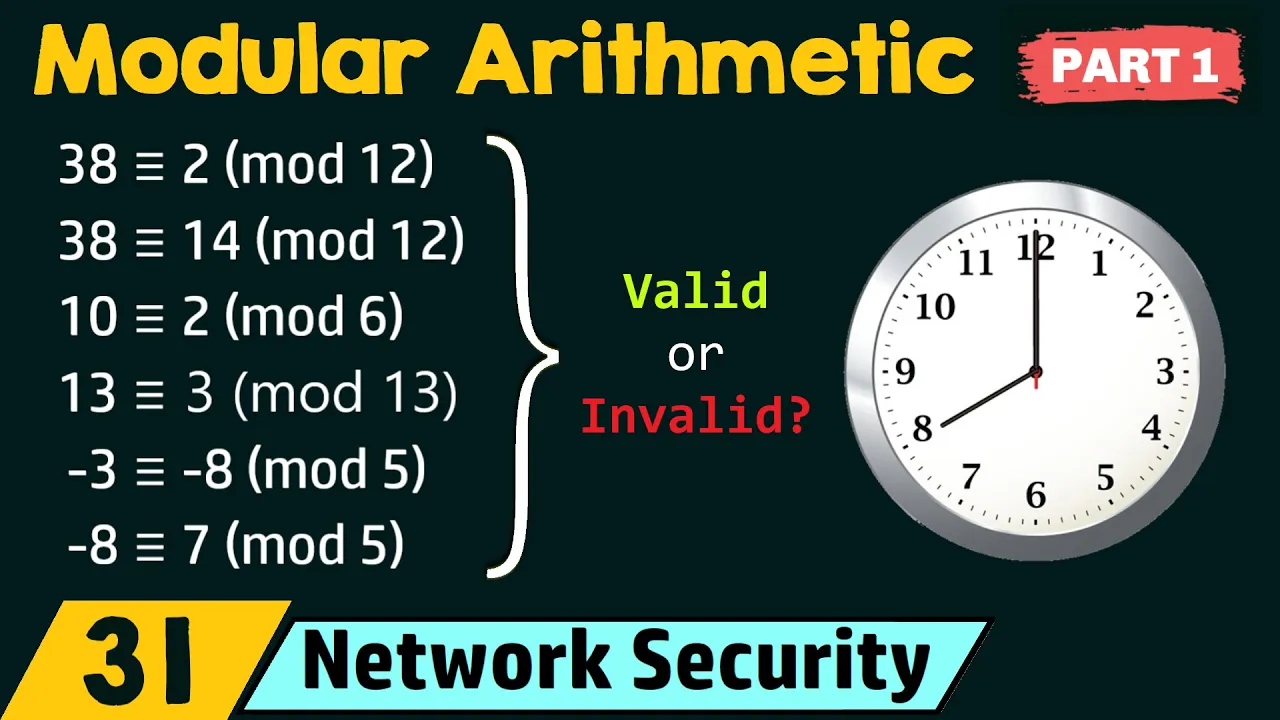
Another explanation of Modular arithmetic.
Modular arithmetic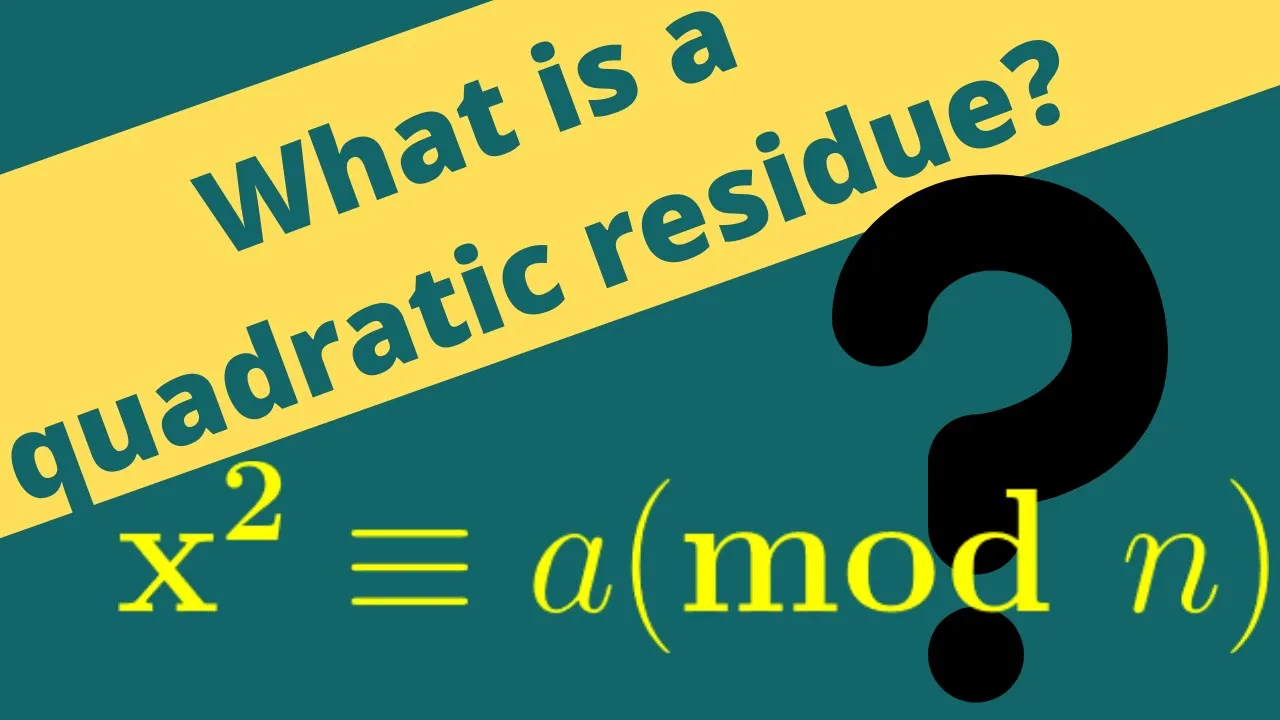 YouTube4:44
Next in Number Theory: Modular arithmetic → Quadratic residues.
Quadratic residues · View learning sequence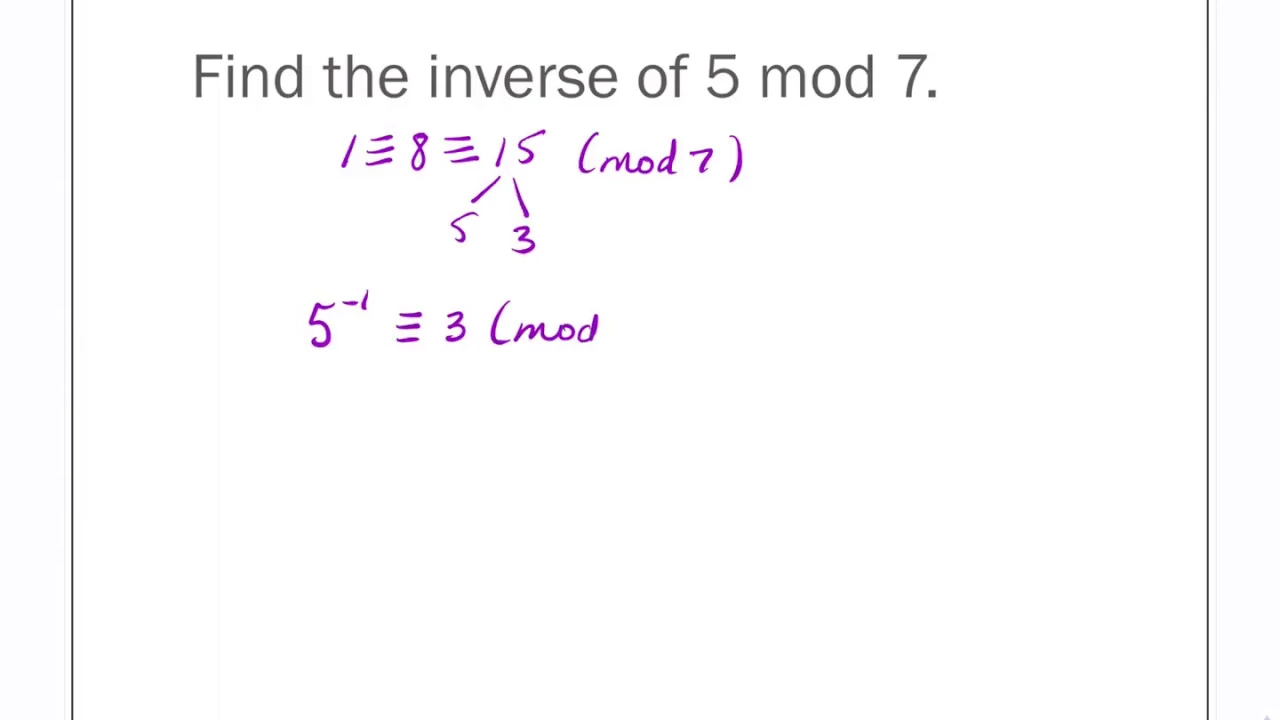 YouTube5:00
Next in Cryptography: Modular arithmetic → Modular inverses.
Modular inverses · View learning sequence YouTube8:24
Application of Equivalence relations, complementing the current explanation.
Equivalence relations YouTube8:49
Application of Modular arithmetic, complementing the current explanation.
Modular arithmetic