The net-change formula
For a continuously differentiable function on the interval, integrating its derivative gives the endpoint difference: the integral of f′ from a to b equals .
Foolish Chemist · YouTube · 4:59
Read the fundamental theorem of calculus as accumulated local change equaling total endpoint change.
Use the learning inspector for key ideas and moments, or open the reading tabs for the complete notes.
Generated from the video's visuals and explanation; not verbatim speech.
For a continuously differentiable function on the interval, integrating its derivative gives the endpoint difference: the integral of f′ from a to b equals .
The notation df/dx motivates tiny vertical changes paired with tiny horizontal changes. Informally canceling dx helps intuition here, but the derivative is defined by a limit, not by dividing two ordinary numbers.
Each small horizontal step uses its own local slope. The resulting vertical increments accumulate to the total rise from to , which is the geometric meaning of the theorem.
For a continuously differentiable function on the interval, integrating its derivative gives the endpoint difference: the integral of f′ from a to b equals .
The notation df/dx motivates tiny vertical changes paired with tiny horizontal changes. Informally canceling dx helps intuition here, but the derivative is defined by a limit, not by dividing two ordinary numbers.
Each small horizontal step uses its own local slope. The resulting vertical increments accumulate to the total rise from to , which is the geometric meaning of the theorem.
For a continuously differentiable function on the interval, integrating its derivative gives the endpoint difference: the integral of f′ from a to b equals . The notation df/dx motivates tiny vertical changes paired with tiny horizontal changes. Informally canceling dx helps intuition here, but the derivative is defined by a limit, not by dividing two ordinary numbers. Each small horizontal step uses its own local slope. The resulting vertical increments accumulate to the total rise from to , which is the geometric meaning of the theorem.
The net-change formula states that for a continuously differentiable function on an interval, integrating its derivative gives the endpoint difference. Specifically, the integral of the derivative from to equals .
Conditions: The function is continuously differentiable on the interval.; The integration is over the interval from to .
The notation motivates thinking of tiny vertical changes paired with tiny horizontal changes, and informally canceling helps intuition. However, it is misleading because the derivative is defined by a limit, not by dividing two ordinary numbers.
Conditions: Interpreting the differential notation in the context of the theorem.; Understanding the formal definition of the derivative.
The geometric meaning is that each small horizontal step uses its own local slope. The resulting vertical increments accumulate to the total rise from to .
Conditions: Viewing the theorem through the lens of Riemann sums or local linear approximation.; The function is differentiable on the interval.
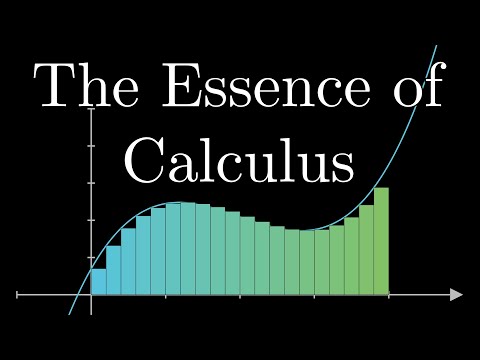 YouTube17:04
Another explanation of Fundamental theorem of calculus.
Fundamental theorem of calculus YouTube2:28
Prerequisite in Calculus: Definite integrals → Fundamental theorem of calculus.
Definite integrals · View learning sequence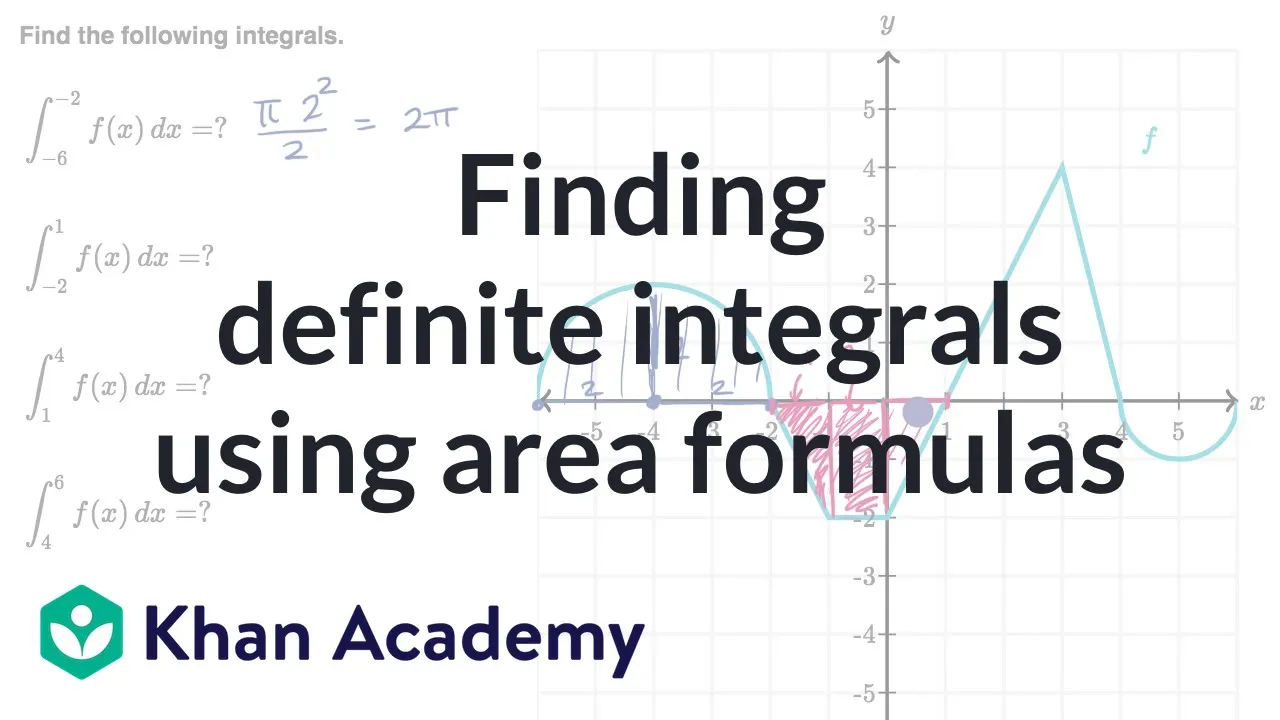 YouTube4:16
Prerequisite in Calculus: Definite integrals → Fundamental theorem of calculus.
Definite integrals · View learning sequence YouTube4:03
Prerequisite in Calculus: Antiderivatives → Fundamental theorem of calculus.
Antiderivatives · View learning sequenceYouTube17:04Visual explanation for Fundamental theorem of calculus, compared with the current lecture.
Fundamental theorem of calculus