Multiplicative inverse modulo m
Two integers a and b are multiplicative inverses modulo m when their product is congruent to 1 modulo m. This is the basic object studied in the clip.
Cathy Frey · YouTube · 5:00
This 120-second whiteboard lecture introduces modular inverses. It first defines multiplicative inverses modulo m by the condition ab ≡ 1 (mod m), then states the theorem that an integer a has an inverse modulo m if and only if gcd(a,m)=1. The remainder of the clip works three concrete examples—finding the inverses of 5 mod 7, 5 mod 11, and 6 mod 17—using a repeated search method: start at 1, keep adding the modulus until a multiple of the target integer appears, then factor that multiple to read off the inverse. This 120-second whiteboard clip teaches how to find modular inverses modulo 19. It first solves 'inverse of 18 mod 19' by a slow brute-force congruence chain, then shows a faster shortcut using negative residues: 18 ≡ -1, so 18 is its own inverse. A second example finds the inverse of 17 mod 19 by rewriting 17 as -2, using (-2)^{-1} ≡ -10, and converting -10 to the positive residue 9. This 60-second whiteboard clip finishes two modular-inverse examples modulo 19 and then introduces a nonexample modulo 10. First, the board shows leading to , and with (-2)^{-1} , giving . The audio adds that a longer search would also reach . The screen then switches to "Find the inverse of 5 mod 10." The presenter begins the direct search , explains that adding 10 never produces a multiple of 5, and then writes (5,10)=5 NOT 1 followed by No inverse. The spoken takeaway is that if the greatest common divisor of the two values is greater than 1, then there is no modular inverse.
Use the learning inspector for key ideas and moments, or open the reading tabs for the complete notes.
Generated from the video's visuals and explanation; not verbatim speech.
The clip opens on a whiteboard-style slide titled “Modular Inverses.” The first mathematical content is a definition: integers a and b are called multiplicative inverses modulo m exactly when ab ≡ 1 (mod m). The speaker restates this informally as “two numbers that multiply together to get you one mod m,” making clear that the inverse is defined through a congruence condition rather than ordinary real-number division.
The slide then presents the central theorem of the segment: the integer a has an inverse modulo m if and only if (a,m)=1. Here (a,m) is read aloud as the greatest common divisor of a and m. The speaker emphasizes the converse direction in words as well: if gcd(a,m)>1, then no inverse modulo m exists. This establishes the existence criterion that governs the examples that follow.
The lecture moves to a worked example: “Find the inverse of 5 mod 7.” The method shown is to search within the congruence class of 1 modulo 7 by repeatedly adding 7. The board writes 1 ≡ 8 ≡ 15 (mod 7). Since 8 is not divisible by 5 but 15 is, the number 15 is factored as . From ≡ 1 (mod 7), the inverse is read off as 3, and the result is written as ≡ 3 (mod 7).
A second example asks for the inverse of 5 modulo 11. The same search strategy is used, but now the modulus is 11, so the chain becomes longer: 1 ≡ 12 ≡ 23 ≡ 34 ≡ 45 (mod 11). The first multiple of 5 encountered in this sequence is 45, which factors as . Therefore ≡ 1 (mod 11), and the inverse is 9, written as ≡ 9 (mod 11).
The final example finds the inverse of 6 modulo 17. Here only one addition of the modulus is needed: 1 ≡ 18 (mod 17). Since , we have ≡ 1 (mod 17), so the inverse of 6 modulo 17 is 3, written as ≡ 3 (mod 17). Across all three examples, the visual procedure consistently demonstrates the same principle: locate a representative congruent to 1 modulo m that is divisible by the target integer, then factor it to identify the inverse.
The clip opens on a digital whiteboard after a previous example, then switches to the new typed prompt: Find the inverse of 18 mod 19.
The instructor begins with the most direct method. Since an inverse of 18 modulo 19 is a number b with 18b ≡ 1 (mod 19), they generate the congruence class of 1 by repeatedly adding 19: 1 ≡ 20 ≡ 39 ≡ 58 ≡ 77 ≡ ... 324 (mod 19).
When the chain reaches 324, the board factors it as . That means ≡ 1 (mod 19), so the inverse of 18 modulo 19 is 18 itself.
The speaker notes that this brute-force procedure always works, but it can waste time because you may have to add the modulus many times before hitting a multiple of the number whose inverse you want.
A shortcut is then introduced: choose a more convenient representative in the same residue class. Since , we have 18 ≡ -1 (mod 19).
Now the inverse question becomes trivial. Because (-1)(-1)=1, the residue -1 is its own inverse. Therefore 18, being congruent to -1 modulo 19, is also its own inverse: ≡ 18 (mod 19).
The same idea is applied to a second example: find the inverse of 17 mod 19. First rewrite 17 as a negative residue: 17 ≡ -2 (mod 19), since -2 + .
The board then reuses the earlier fact that 20 ≡ 1 (mod 19). Because , it follows that (-2)^{-1} ≡ -10 (mod 19).
Finally, the negative answer is converted back to a positive representative by adding 19: -10 + . Hence ≡ 9 (mod 19).
The completed board leaves both results visible: ≡ 18 (mod 19) and ≡ 9 (mod 19), illustrating that negative residues often make modular inverse calculations much faster.
The clip opens on a finished modulo-19 example. The printed prompt asks for the inverse of 18 mod 19. Beneath it, the board records and then . The mathematical point is that reducing 18 to the simpler residue -1 makes the inverse immediate, since -1 is its own inverse modulo 19.
The same board also contains a second completed task, "Find inverse of 17 mod 19." The written chain is , then (-2)^{-1} , then . This shows the method of replacing 17 by a smaller negative residue, inverting that residue, and finally rewriting the answer as a positive residue modulo 19.
While these results are already on screen, the speaker comments on the slower brute-force route: if one kept extending the list of congruences, one would eventually arrive at . The audio therefore contrasts a long search with the shorter structural method already written on the board.
The display changes to a new page with the printed question "Find the inverse of 5 mod 10." This transition signals a shift from examples where inverses exist to a case where they do not.
The presenter begins a direct search by writing modulo 10. The idea is to list numbers congruent to 1 modulo 10 by repeatedly adding 10. The audio explains that this process could continue indefinitely without ever producing a multiple of 5, so the desired inverse cannot be found this way.
The board then records the decisive obstruction: (5,10)=5 NOT 1. Here (5,10) denotes the greatest common divisor of 5 and 10. Because that gcd is 5 rather than 1, the presenter writes the conclusion No inverse underneath.
The spoken rule is generalized beyond this single example: if the greatest common divisor of the two values is greater than 1, then there is no inverse. The clip closes with brief encouragement to practice, with no further mathematics added.
Two integers a and b are multiplicative inverses modulo m when their product is congruent to 1 modulo m. This is the basic object studied in the clip.
An integer a has an inverse modulo m if and only if gcd(a,m)=1. If the gcd is greater than 1, no inverse exists.
To find an inverse of a modulo m by hand, start from 1 and keep adding m until reaching a multiple of a. Factor that multiple as ; then b is the inverse modulo m.
Using the search method, 1 ≡ 8 ≡ 15 (mod 7), and , so the inverse of 5 modulo 7 is 3.
Using the search method, 1 ≡ 12 ≡ 23 ≡ 34 ≡ 45 (mod 11), and , so the inverse of 5 modulo 11 is 9.
Using the search method, 1 ≡ 18 (mod 17), and , so the inverse of 6 modulo 17 is 3.
For integers a and modulus m, the modular inverse of a is a residue b such that ab ≡ 1 (mod m). In this clip the modulus is 19, so finding the inverse of 18 means finding b with 18b ≡ 1 (mod 19).
One reliable but slow strategy is to list numbers congruent to 1 modulo m by repeatedly adding m, then stop when one is divisible by a. The video shows 1 ≡ 20 ≡ 39 ≡ 58 ≡ 77 ≡ ... ≡ 324 (mod 19), and , so ≡ 18 (mod 19).
Instead of staying with large positive representatives, replace a by a congruent negative residue. Since , the problem of inverting 18 modulo 19 becomes the problem of inverting -1, which is immediate.
Because (-1)(-1)=1, the residue -1 is always its own multiplicative inverse. Applying this modulo 19 gives 18 ≡ -1 (mod 19), hence ≡ 18 (mod 19).
Rewrite 17 as -2 modulo 19. From the earlier line 20 ≡ 1 (mod 19) and the factorization , we get (-2)^{-1} ≡ -10 (mod 19). Adding 19 converts -10 to the positive residue 9, so ≡ 9 (mod 19).
A negative residue is a valid intermediate answer, but final answers are often written as positive representatives. The clip demonstrates this by changing -10 into 9 using -10 + .
Throughout the clip, "the inverse of a mod m" is written as . The examples make clear that the topic is multiplicative inversion in modular arithmetic: one seeks a residue x modulo m that serves as the inverse of a modulo m. The clip does not separately spell out the defining equation in words, but the notation and worked cases consistently use this meaning.
The board rewrites 18 as -1 modulo 19 and then immediately records the inverse as 1 modulo 19. This is a compact example of simplifying the representative before inverting.
The presenter reduces 17 to -2 modulo 19, uses the displayed fact (-2)^{-1} , and then rewrites -10 as 9 modulo 19. The audio adds that a longer search would also reach the product .
To test whether 5 has an inverse modulo 10, the board lists numbers congruent to 1 modulo 10: 1, 11, 21, 31, and so on. The spoken explanation is that repeatedly adding 10 never produces a multiple of 5, so this route cannot yield an inverse.
The decisive observation in the second example is that (5,10)=5, which is not 1. From this the board concludes No inverse. The speaker then states the broader rule that if the greatest common divisor of the two values is greater than 1, then there is no inverse.
Explore conditions, steps and evidence. Supplementary explanations are labeled separately from content shown in the video.
The definition line uses the integer symbol a in “integers a and b are multiplicative inverses modulo m if ab ≡ 1 (mod m).”
The theorem line uses the same symbol a in “The integer a has an inverse modulo m if and only if (a,m)=1.”
a
An integer whose multiplicative inverse modulo m is being discussed; in the examples it is instantiated as 5 or 6.
Integers.
The definition line uses b in “integers a and b are multiplicative inverses modulo m if ab ≡ 1 (mod m).”
b
An integer that serves as a multiplicative inverse of a modulo m when ab ≡ 1 (mod m).
Integers.
The definition line contains “modulo m” and “(mod m)”.
The theorem line contains “inverse modulo m” and “(a,m)=1”.
m
The modulus for the congruence relation and for the existence condition of the inverse.
Integers used as a modulus; the video does not explicitly state extra restrictions on m.
The theorem line shows “(a,m)=1”.
The speaker reads this as “the greatest common divisor of a and m is equal to 1.”
(a,m)
The greatest common divisor of a and m.
Defined for the integer pair a and m appearing in the theorem.
The definition uses “ab ≡ 1 (mod m)”.
The worked examples use chains such as “1 ≡ 8 ≡ 15 (mod 7)” and “1 ≡ 12 ≡ 23 ≡ 34 ≡ 45 (mod 11)”.
≡
Congruence modulo the stated modulus.
Used between integers with a specified modulus in parentheses.
The first example writes “ ≡ 3 (mod 7)”.
The second example writes “ ≡ 9 (mod 11)”.
The third example writes “ ≡ 3 (mod 17)”.
Notation for the multiplicative inverse of x modulo the given modulus.
Used for integers x in the examples, namely 5 and 6.
The modulus 19 appears in the problem title and in congruence statements such as 18 ≡ -1 (mod 19) and 17 ≡ -2 (mod 19).
19
The modulus used throughout the main worked examples in this clip.
Positive integer modulus.
The handwritten symbol '≡' is used repeatedly to state congruences modulo 19.
≡
Congruence relation; a ≡ b (mod m) means a and b have the same remainder modulo m.
Binary relation on integers.
Notation such as , (-2)^{-1}, and is written on the board.
Multiplicative inverse of a modulo the stated modulus.
Defined when gcd(a,m)=1; here the relevant residues are invertible modulo 19.
The number 18 is the residue whose inverse modulo 19 is being found.
18
Residue class modulo 19; also identified as -1 modulo 19.
Integer representative of a residue class mod 19.
The second example asks for the inverse of 17 mod 19.
17
Residue class modulo 19; also identified as -2 modulo 19.
Integer representative of a residue class mod 19.
The board writes 18 ≡ -1 (mod 19).
-1
Negative residue equivalent to 18 modulo 19.
Residue class modulo 19.
On-screen text: “Defn: We say that integers a and b are multiplicative inverses modulo m if ab ≡ 1 (mod m).”
The speaker says, “So we're finding multiplicative inverses, and that's two numbers that multiply together to get you one mod m.”
The video defines a pair of integers a and b as multiplicative inverses modulo m exactly when their product is congruent to 1 modulo m. The speaker paraphrases this as “two numbers that multiply together to get you one mod m.”
a and b are integers.
The congruence is taken modulo m.
On-screen text: “Theorem: The integer a has an inverse modulo m if and only if (a,m)=1.”
The speaker says, “a has an inverse mod m if and only if the greatest common divisor of a and m is equal to 1.”
The speaker adds, “If the greatest common divisor between a and m is greater than 1, then there is no inverse mod m.”
The clip states a necessary-and-sufficient condition for the existence of a modular inverse: an integer a has an inverse modulo m precisely when gcd(a,m)=1. The speaker also states the contrapositive in words: if gcd(a,m)>1, then no inverse modulo m exists.
a is an integer.
m is the modulus.
(a,m) denotes gcd(a,m).
In the first example the speaker says, “So we do as we've done in the past. Mod 7, 1 is congruent to 8. That's not a multiple of 5. So we add 7 again and we get 15.”
In the second example the speaker says, “Always start with 1 and add the mod on.”
The written chains are “1 ≡ 8 ≡ 15 (mod 7)”, “1 ≡ 12 ≡ 23 ≡ 34 ≡ 45 (mod 11)”, and “1 ≡ 18 (mod 17)”.
The worked examples use a trial method: start from 1 and repeatedly add the modulus m until reaching a number divisible by the target integer a. Once such a representative is found, factor it as a times another integer; that other integer is the inverse modulo m.
Used to find an inverse of a modulo m.
One looks among integers congruent to 1 modulo m for a multiple of a.
The speaker repeatedly says 'find the inverse of 18 mod 19' and later 'find the inverse of 17 mod 19'.
The board writes conclusions such as ≡ 18 and ≡ 9 (mod 19).
For a residue a modulo m, its inverse is the residue b such that ab ≡ 1 (mod m). The clip uses this notion directly when searching for numbers whose product with 18 or 17 is congruent to 1 modulo 19.
The inverse exists when a is relatively prime to m.
In this clip the modulus is .
The speaker says they can start with 1 ≡ 20, then keep adding 19 until reaching a multiple of 18.
The board writes 1 ≡ 20 ≡ 39 ≡ 58 ≡ 77 ≡ ... ≡ 324, then factors 324 as .
One way to find an inverse modulo m is to list numbers congruent to 1 modulo m by repeatedly adding m, then stop when one of those numbers is divisible by a. In the example, the sequence 20, 39, 58, 77, ..., 324 consists of numbers congruent to 1 modulo 19, and gives the inverse.
Works whenever a has an inverse modulo m.
May be slow if many terms must be checked.
The speaker introduces 'a little bit of a shortcut' by noticing 18 is the same thing as negative 1 mod 19, and later 17 is the same thing as negative 2 mod 19.
The board writes 18 ≡ -1 (mod 19) and 17 ≡ -2 (mod 19).
Instead of working only with positive representatives, replace a by an equivalent smaller-magnitude residue modulo m. This often makes the inverse easier to recognize. Here 18 is replaced by -1 and 17 by -2, turning the problem into finding inverses of simpler residues.
The replacement must be congruent modulo the same m.
The resulting residue should still be invertible modulo m.
The speaker asks what the inverse of negative 1 is and answers that multiplying negative 1 by negative 1 gives positive 1.
The board shows 18 ≡ -1 (mod 19) and concludes ≡ 18 (mod 19).
Because (-1)(-1)=1, the residue -1 modulo any m is always its own multiplicative inverse. Since 18 ≡ -1 (mod 19), it follows immediately that ≡ 18 (mod 19).
Valid for any modulus m.
The speaker says they will add 19 to negative 10 because they want positive numbers.
The board converts (-2)^{-1} ≡ -10 (mod 19) into ≡ 9 (mod 19).
After finding an inverse in negative form, add the modulus once or more to obtain the standard positive representative. Here -10 + , so the inverse of 17 modulo 19 is reported as 9.
Used when a negative residue answer is acceptable algebraically but a positive representative is preferred.
Printed title: "Find the inverse of 18 mod 19."
Written lines include and .
Written lines include , (-2)^{-1} , and .
This segment shows two completed modular-inverse computations modulo 19. For 18, the presenter rewrites 18 as -1 modulo 19 and concludes that its inverse is 1 modulo 19. For 17, the presenter rewrites 17 as -2 modulo 19, uses (-2)^{-1} , and then records . The audio adds that the same result for 17 could also be reached by continuing a longer list of congruences until reaching .
Modulus is 19.
The displayed method assumes the relevant inverses already exist modulo 19.
The board repeatedly uses notation in examples such as and .
The speaker frames both examples as "find the inverse" problems modulo a given number.
In this video, "the inverse of a mod m" means a residue class x modulo m that serves as a multiplicative inverse of a modulo m. The worked examples use the notation . The clip does not separately state the defining equation in words, but the notation and examples make clear that the topic is multiplicative inversion in modular arithmetic.
Applies to integers a and positive modulus m.
Existence is not automatic; the later example shows failure when gcd(a,m) .
The board writes (5,10)=5 NOT 1 and then No inverse.
The speaker says, "the greatest common divisor of 5 and 10 is 5, which is not 1. So the answer is that there is no inverse."
The speaker generalizes: "if there's a greatest common divisor greater than 1 between those two values, then there is no inverse."
The second example teaches a quick existence test before trying to compute an inverse. For 5 mod 10, the presenter computes (5,10)=5, notes that this is not 1, and concludes that 5 has no inverse modulo 10. The spoken rule is generalized to any pair whose greatest common divisor is greater than 1.
Used for deciding whether a modular inverse exists.
In this clip the rule is stated for the case gcd > 1 implying no inverse.
The theorem statement is visible on screen: “The integer a has an inverse modulo m if and only if (a,m)=1.”
The speaker reads the theorem aloud and explains the case gcd(a,m)>1 means no inverse exists.
For integers a and m, a has a multiplicative inverse modulo m if and only if (a,m)=1.
a is an integer.
m is the modulus.
For the integers a and m appearing in the statement.
The speaker says, “If the greatest common divisor between a and m is greater than 1, then there is no inverse mod m.”
If the greatest common divisor of a and m is greater than 1, then a has no inverse modulo m.
a and m are integers.
(a,m)>1.
For integers a and m satisfying the gcd condition.
The board writes ≡ 18 after showing , and again after using 18 ≡ -1 (mod 19).
The speaker states, 'So 18's inverse is 18' and later '18 is its own inverse.'
≡ 18 (mod 19).
Work modulo 19.
Use the fact that 18 ≡ -1 (mod 19), or equivalently that ≡ 1 (mod 19).
Specific numerical statement for modulus 19.
The board writes 17 ≡ -2 (mod 19), then (-2)^{-1} ≡ -10 (mod 19), then ≡ 9 (mod 19).
The speaker concludes that the inverse of 17 is congruent to 9 mod 19.
≡ 9 (mod 19).
Work modulo 19.
Use 17 ≡ -2 (mod 19) and , so (-2)^{-1} ≡ -10 (mod 19).
Convert -10 to the positive representative 9 modulo 19.
Specific numerical statement for modulus 19.
The speaker asks what multiplied by negative 1 gives positive 1 and answers negative 1.
The reasoning is written through 18 ≡ -1 (mod 19) and the conclusion ≡ 18 (mod 19).
(-1)^{-1} ≡ -1 (mod m), because (-1)(-1)=1.
Any modulus m is allowed for this general fact.
In the clip it is applied with .
General proposition applied to modulus 19 in the example.
"So if there's a greatest common divisor greater than 1 between those two values, then there is no inverse."
Board text: (5,10)=5 NOT 1, followed by No inverse.
The clip states only the direction gcd>1 implies no inverse; it does not explicitly state the converse condition gcd=1 implies existence.
For the numbers under consideration, if the greatest common divisor of a and m is greater than 1, then a has no modular inverse modulo m.
a and m are integers with modulus m.
(a,m)>1.
The spoken wording is general over "those two values," but the clip only proves or illustrates the claim in the specific example , .
Board text includes .
The speaker says that eventually one would get to 17 times 9, which would be 153.
.
Working modulo 19.
Using the intermediate facts and (-2)^{-1} shown on the board.
Specific numerical claim.
Board text includes and .
.
Working modulo 19.
Using .
Specific numerical claim.
The board shows the chain “1 ≡ 8 ≡ 15 (mod 7)” with 15 factored below into 5 and 3.
The speaker says, “Mod 7, 1 is congruent to 8. That's not a multiple of 5. So we add 7 again and we get 15. 15 is 5 times 3 mod 7.”
The final written conclusion is “ ≡ 3 (mod 7)”.
Start from 1 and add the modulus 7 once to obtain another representative congruent to 1 modulo 7.
Adding the modulus preserves congruence modulo 7.
Check whether 8 is a multiple of 5; it is not, so continue searching.
The method requires finding a representative congruent to 1 modulo 7 that is divisible by 5.
Add 7 again to reach 15, which is still congruent to 1 modulo 7.
Repeated addition of the modulus stays within the same congruence class.
Factor 15 as 5 times 3.
Ordinary integer factorization.
Since ≡ 15 ≡ 1 (mod 7), the inverse of 5 modulo 7 is 3.
By the definition of multiplicative inverse modulo m.
The inverse of 5 modulo 7 is 3, written as ≡ 3 (mod 7).
The board shows “1 ≡ 12 ≡ 23 ≡ 34 ≡ 45 (mod 11)” with 45 factored into 5 and 9.
The speaker says, “So hopefully you said 1 was congruent to 12 mod 11. Always start with 1 and add the mod on. Congruent to 23, adding 11, 34, and eventually we get to 45. And that's 5 times 9 mod 11.”
The final written conclusion is “ ≡ 9 (mod 11)”.
Begin with 1 and add the modulus 11 to get 12.
Adding the modulus preserves congruence modulo 11.
Continue adding 11 until reaching a number divisible by 5.
All these numbers remain congruent to 1 modulo 11.
Factor 45 as 5 times 9.
Ordinary integer factorization.
Because ≡ 1 (mod 11), the inverse of 5 modulo 11 is 9.
By the definition of multiplicative inverse modulo m.
The inverse of 5 modulo 11 is 9, written as ≡ 9 (mod 11).
The board shows “1 ≡ 18 (mod 17)” with 18 factored into 6 and 3.
The speaker says, “So you've got 1 congruent to 18 because we're adding 17 this time, and that's 6 times 3 mod 17.”
The final written conclusion is “ ≡ 3 (mod 17)”.
Start from 1 and add the modulus 17 to obtain 18.
Adding the modulus preserves congruence modulo 17.
Factor 18 as 6 times 3.
Ordinary integer factorization.
Since ≡ 1 (mod 17), the inverse of 6 modulo 17 is 3.
By the definition of multiplicative inverse modulo m.
The inverse of 6 modulo 17 is 3, written as ≡ 3 (mod 17).
The board lists 1 ≡ 20 ≡ 39 ≡ 58 ≡ 77 ≡ ... ≡ 324 and factors 324 as .
The speaker narrates adding 19 repeatedly until reaching 324, which is 18 times 18.
The intermediate omitted terms between 77 and 324 are not all written explicitly; only the ellipsis is shown.
Start from 1 and keep adding the modulus 19 to generate numbers congruent to 1 modulo 19.
If x ≡ 1 (mod 19), then ≡ 1 (mod 19).
Identify the first listed number that is a multiple of 18.
Direct factorization shown on the board.
Since ≡ 1 (mod 19), the inverse of 18 modulo 19 is 18.
Definition of modular multiplicative inverse.
The brute-force search proves that ≡ 18 (mod 19).
The board writes 18 ≡ -1 (mod 19) and then ≡ 18 (mod 19).
The speaker explains that instead of adding 19, we can subtract 19, and that the inverse of -1 is -1.
Replace 18 by the congruent negative residue -1.
Subtracting the modulus preserves congruence: .
Recognize that -1 multiplied by itself gives 1.
Basic integer multiplication.
Therefore the inverse of 18 is itself modulo 19.
Because 18 ≡ -1 and (-1)^{-1} ≡ -1.
Using the negative residue -1 gives a much faster proof that 18 is its own inverse modulo 19.
The board writes 17 ≡ -2 (mod 19), notes , writes (-2)^{-1} ≡ -10 (mod 19), and finally ≡ 9 (mod 19).
The speaker says 17 is the same thing as negative 2 mod 19, looks back at 20 = negative 2 times negative 10, and then adds 19 to negative 10 to get a positive number.
Rewrite 17 as the negative residue -2.
Adding 19 to -2 gives 17, so they are congruent modulo 19.
Use the earlier line 1 ≡ 20 (mod 19) and factor 20 as (-2)(-10).
Direct arithmetic identity shown on the board.
Since (-2)(-10)=20 ≡ 1 (mod 19), -10 is the inverse of -2 modulo 19.
Definition of modular inverse together with 20 ≡ 1 (mod 19).
Convert the negative representative -10 to the positive residue 9.
Adding the modulus does not change the congruence class.
Therefore the inverse of 17 modulo 19 is 9.
Substitute 17 ≡ -2 and the converted inverse.
The shortcut method yields ≡ 9 (mod 19).
The board shows and directly below it .
Rewrite 18 as its negative residue modulo 19.
Congruence reduction modulo 19 shown on the board.
Conclude that the inverse of 18 modulo 19 is 1.
The video presents this as the immediate consequence of the preceding congruence; the underlying fact is that -1 is its own inverse modulo 19.
.
The board shows , (-2)^{-1} , and .
The speaker mentions the longer route ending at .
The clip does not show the intermediate verification ; it only states in the audio.
Replace 17 by the smaller negative residue -2 modulo 19.
Congruence reduction modulo 19 shown on the board.
Use the inverse of -2 modulo 19.
Written directly on the board as a known intermediate step.
Convert -10 to the positive residue 9 modulo 19 and record the inverse of 17.
Since -10 , the board rewrites the inverse in positive form.
.
The board writes and then (5,10)=5 NOT 1 and No inverse.
The speaker says adding 10 to 1 gives 11, 21, 31, and one would never get a multiple of 5.
The speaker identifies the problem as gcd(5,10)=5, not 1.
The written congruence line is visually incomplete after the final sign; the intended continuation is supplied by the audio as 11, 21, 31, ...
Begin listing numbers congruent to 1 modulo 10 by repeatedly adding 10.
The board shows , and the audio explains the pattern of adding 10.
Observe that this sequence never reaches a multiple of 5.
Stated explicitly in the audio: "you would never get a multiple of 5."
Compute the greatest common divisor of 5 and 10.
Written on the board and spoken aloud.
Conclude that 5 has no inverse modulo 10.
The speaker states the general rule that gcd greater than 1 implies no inverse.
There is no inverse of 5 modulo 10 because (5,10)=.
Prompt on screen: “Find the inverse of 5 mod 7.”
Work shown: “1 ≡ 8 ≡ 15 (mod 7)” with 15 split into 5 and 3.
Conclusion written: “ ≡ 3 (mod 7)”.
Find the inverse of 5 mod 7.
Target integer: 5.
Modulus: 7.
Find an integer b such that 5b ≡ 1 (mod 7).
Add 7 to 1 to search within the congruence class of 1 modulo 7.
Congruence is preserved when adding the modulus.
Add 7 again to reach 15.
15 is still congruent to 1 modulo 7.
Recognize 15 as a multiple of 5.
Integer factorization.
Conclude that 3 is the inverse of 5 modulo 7.
Because ≡ 1 (mod 7).
and 15 ≡ 1 (mod 7).
Prompt on screen: “Find the inverse of 5 mod 11.”
Work shown: “1 ≡ 12 ≡ 23 ≡ 34 ≡ 45 (mod 11)” with 45 split into 5 and 9.
Conclusion written: “ ≡ 9 (mod 11)”.
Find the inverse of 5 mod 11.
Target integer: 5.
Modulus: 11.
Find an integer b such that 5b ≡ 1 (mod 11).
Start with 1 and add 11.
Adding the modulus preserves congruence modulo 11.
Keep adding 11 until reaching a multiple of 5.
All listed numbers remain congruent to 1 modulo 11.
Factor 45 as 5 times 9.
Integer factorization.
Conclude that 9 is the inverse of 5 modulo 11.
Because ≡ 1 (mod 11).
and 45 ≡ 1 (mod 11).
Prompt on screen: “Find the inverse of 6 mod 17.”
Work shown: “1 ≡ 18 (mod 17)” with 18 split into 6 and 3.
Conclusion written: “ ≡ 3 (mod 17)”.
Find the inverse of 6 mod 17.
Target integer: 6.
Modulus: 17.
Find an integer b such that 6b ≡ 1 (mod 17).
Add 17 to 1 to get 18.
Adding the modulus preserves congruence modulo 17.
Factor 18 as 6 times 3.
Integer factorization.
Conclude that 3 is the inverse of 6 modulo 17.
Because ≡ 1 (mod 17).
and 18 ≡ 1 (mod 17).
The typed prompt on screen reads 'Find the inverse of 18 mod 19.'
The board solves it first by listing 1 ≡ 20 ≡ 39 ≡ 58 ≡ 77 ≡ ... ≡ 324 and then by writing 18 ≡ -1 (mod 19).
Find the inverse of 18 mod 19.
Modulus .
Residue .
Find b such that 18b ≡ 1 (mod 19).
Generate numbers congruent to 1 modulo 19 by repeatedly adding 19.
Congruence is preserved when adding the modulus.
Notice that 324 is divisible by 18, with quotient 18.
Factorization shown on the board.
Conclude that 18 is its own inverse modulo 19.
Because ≡ 1 (mod 19).
A faster route is to rewrite 18 as -1 and use that -1 is self-inverse.
Negative residues are congruent modulo 19, and (-1)(-1)=1.
≡ 18 (mod 19).
Check: and 324 ≡ 1 (mod 19); equivalently, 18 ≡ -1 and (-1)^2 ≡ 1.
The handwritten prompt reads 'Find inverse of 17 mod 19.'
The board writes 17 ≡ -2 (mod 19), (-2)^{-1} ≡ -10 (mod 19), and ≡ 9 (mod 19).
Find the inverse of 17 mod 19.
Modulus .
Residue .
Earlier in the clip, 1 ≡ 20 (mod 19) was already established.
Find b such that 17b ≡ 1 (mod 19).
Replace 17 by the simpler negative residue -2.
Adding 19 to -2 gives 17.
Factor the previously noted number 20, which is congruent to 1 modulo 19.
Direct arithmetic identity.
Thus -10 is the inverse of -2 modulo 19.
Because (-2)(-10)=20 ≡ 1 (mod 19).
Convert the negative inverse to a positive representative.
Adding the modulus preserves congruence.
Therefore the inverse of 17 modulo 19 is 9.
Substitute back 17 ≡ -2.
≡ 9 (mod 19).
Check: and , so ≡ 1 (mod 19).
Printed prompt: "Find the inverse of 18 mod 19."
Handwritten work includes , , Find inverse of 17 mod 19, , (-2)^{-1} , .
The speaker says the long way would reach .
The top congruence chain visible on the board is only partially legible in this clip; the exact full sequence before 324 cannot be transcribed reliably from the provided frames.
Compute the modular inverses of 18 and 17 modulo 19.
Modulus .
Numbers whose inverses are requested: 18 and 17.
Intermediate congruences shown: , , (-2)^{-1} .
Express each inverse as a residue modulo 19.
Reduce 18 to a simpler representative modulo 19.
Shown on the board.
Record the inverse of 18.
Directly written on the board as the next line.
Reduce 17 to a simpler representative modulo 19.
Shown on the board under "Find inverse of 17 mod 19."
Use the inverse of -2 modulo 19.
Shown on the board.
Rewrite -10 as 9 modulo 19 to give the positive residue for the inverse of 17.
Shown on the board; the conversion uses -10 .
and .
The audio notes that the longer route for 17 reaches , consistent with checking the product before reducing modulo 19.
Printed prompt: "Find the inverse of 5 mod 10."
Handwritten work includes , (5,10)=5 NOT 1, and No inverse.
The speaker says adding 10 repeatedly never yields a multiple of 5, then states gcd(5,10)=5, not 1, so there is no inverse.
The written congruence line ends with a trailing sign without a visible next numeral; the audio supplies the intended continuing pattern.
Determine whether 5 has a multiplicative inverse modulo 10, and find it if it exists.
Modulus .
Number whose inverse is requested: 5.
Decide existence of and conclude accordingly.
Try the direct search by listing numbers congruent to 1 modulo 10.
The board writes the beginning of this chain, and the audio explains adding 10 to 1, then 11, 21, 31.
Notice that none of these candidates is divisible by 5, so no product 5x can equal 1 modulo 10 by this route.
Explicitly stated in the audio.
Compute the greatest common divisor of 5 and 10.
Written on the board and spoken aloud.
Compare the gcd with 1.
The board writes NOT 1 beside (5,10)=5.
Conclude that 5 has no inverse modulo 10.
Written on the board and justified by the spoken gcd rule.
No inverse.
The example is checked by the explicit gcd computation (5,10)= and by the failed search through 1, 11, 21, 31, ...
A white slide titled “Modular Inverses” shows a definition line and a theorem line in black text.
Purple underlines are drawn sequentially beneath key phrases and symbols in the definition and theorem.
Title “Modular Inverses”.
Definition sentence.
Theorem sentence.
Purple underline strokes.
Underline appears under “multiplicative inverses modulo m” around 10s.
Underline appears under “ab ≡ 1 (mod m)” around 12s–14s.
Underline appears under “a” in the theorem around 25s.
Underline appears under “modulo m” around 26s–27s.
Underline appears under “(a,m)=1” around 28s–29s.
The slide text itself remains unchanged while annotations are added.
The visual emphasis tracks the spoken explanation, highlighting the definition of inverse and the gcd condition in the theorem.
New slide prompt: “Find the inverse of 5 mod 7.”
Purple handwriting builds the congruence chain and factor tree step by step.
Prompt text.
Handwritten congruence chain “1 ≡ 8 ≡ 15 (mod 7)”.
Factor branches from 15 to 5 and 3.
Final notation “ ≡ 3 (mod 7)”.
First “1 ≡ 8” is written.
Then “≡ 15” is appended.
Then 15 is factored into 5 and 3 below.
Finally the inverse statement is written underneath.
The modulus remains 7 throughout the example.
The animation shows the search process: move through numbers congruent to 1 modulo 7 until a multiple of 5 is found, then read off the inverse.
New slide prompt: “Find the inverse of 5 mod 11.”
Purple handwriting extends a longer congruence chain and then factors the terminal number.
Prompt text.
Handwritten chain “1 ≡ 12 ≡ 23 ≡ 34 ≡ 45 (mod 11)”.
Factor branches from 45 to 5 and 9.
Final notation “ ≡ 9 (mod 11)”.
The chain grows term by term from 12 to 23 to 34 to 45.
After 45 is reached, it is factored into 5 and 9.
The inverse statement is then written below.
The modulus remains 11 throughout the example.
This visual sequence demonstrates the same add-the-modulus search method with more iterations before hitting a multiple of 5.
New slide prompt: “Find the inverse of 6 mod 17.”
Purple handwriting shows “1 ≡ 18 (mod 17)” and factors 18 into 6 and 3.
Prompt text.
Handwritten congruence “1 ≡ 18 (mod 17)”.
Factor branches from 18 to 6 and 3.
Final notation “ ≡ 3 (mod 17)”.
18 is written as the next representative after 1.
18 is factored into 6 and 3.
The inverse statement is written below.
The modulus remains 17 throughout the example.
The shortest example shows that sometimes one addition of the modulus already yields a multiple of the target integer.
The screen changes from a previous problem about 6 mod 17 to a new typed prompt 'Find the inverse of 18 mod 19.'
Previous handwritten solution for 6 mod 17
New typed prompt for 18 mod 19
Old work disappears.
New problem statement appears at the top.
The interface remains a digital whiteboard with purple handwriting.
This marks the start of the main example in the clip.
Purple handwriting successively adds terms to the chain 1 ≡ 20 ≡ 39 ≡ 58 ≡ 77 ≡ ... ≡ 324, then writes the factor pair 18 and 18 beneath 324.
Congruence chain beginning with 1
Number 324
Factor labels 18 and 18
Each new term is obtained by adding 19.
The chain ends at 324.
324 is decomposed visually into .
All displayed terms remain in the same congruence class as 1 modulo 19.
The visual process demonstrates a search for a multiple of 18 inside the congruence class of 1 modulo 19.
Below the earlier work, the presenter writes 18 ≡ -1 (mod 19), then rewrites the inverse conclusion as ≡ 18 (mod 19).
Expression 18 ≡ -1 (mod 19)
Expression ≡ 18 (mod 19)
The positive residue 18 is replaced by the negative residue -1.
The inverse statement is restated using the shortcut.
The modulus stays 19.
The residue class represented by 18 does not change.
The visual rewrite emphasizes that choosing a convenient representative can simplify inverse calculations.
A horizontal divider is drawn, then the new prompt 'Find inverse of 17 mod 19' is written, followed by 17 ≡ -2 (mod 19), (-2)^{-1} ≡ -10 (mod 19), and ≡ 9 (mod 19).
Divider line
Prompt 'Find inverse of 17 mod 19'
Congruences involving -2, -10, and 9
The board shifts from the first example to a second example.
The solution proceeds through negative residues and then converts back to a positive answer.
The modulus remains 19 throughout.
The layout separates two applications of the same shortcut idea.
The display changes from the completed modulo-19 board to a new page headed "Find the inverse of 5 mod 10."
Completed handwritten work for 18 and 17 modulo 19
New printed heading "Find the inverse of 5 mod 10."
The previous board disappears.
A fresh whiteboard page appears with only the new problem statement at first.
The lesson remains focused on finding modular inverses.
The notation style stays the same, using handwritten purple math on a digital whiteboard.
This visual transition marks a shift from successful inverse computations to a counterexample showing when an inverse does not exist.
The presenter writes (5,10)=5, then adds NOT 1, then writes No inverse underneath.
Expression (5,10)=5
Annotation NOT 1
Conclusion No inverse
First the gcd value is written.
Then the comparison to 1 is added.
Finally the nonexistence conclusion is written below.
The modulus remains 10 and the number remains 5 throughout this sequence.
The visual order encodes the reasoning: compute the gcd, observe it is not 1, and therefore conclude that no modular inverse exists.
The speaker explicitly says, “If the greatest common divisor between a and m is greater than 1, then there is no inverse mod m.”
One might think any integer a has some inverse modulo m regardless of its common factors with m.
The video states that if gcd(a,m)>1, then a has no inverse modulo m.
The speaker says the brute-force method will always work, but sometimes you end up spending a lot of time trying to find the inverse.
One might think that repeatedly adding the modulus until a multiple appears is the best general strategy.
The clip explicitly contrasts this reliable but slow method with a faster shortcut using negative residues.
The speaker says we are used to adding 19, but we can subtract 19 as well, and later adds 19 back to -10 because they want positive numbers.
The board uses 18 ≡ -1 (mod 19), 17 ≡ -2 (mod 19), and (-2)^{-1} ≡ -10 (mod 19).
Students may believe modular arithmetic must always stay within positive representatives.
The video shows that negative residues are valid and often simpler, though one may convert back to a positive representative at the end.
The speaker contrasts the earlier successful examples with "what if I was asked to find the inverse of 5 mod 10?" and then shows that no inverse exists.
The board writes No inverse after (5,10)=5 NOT 1.
One might expect the same search method to always produce an inverse, as it did in the modulo-19 examples.
The video shows that this fails for 5 mod 10: the search through numbers congruent to 1 modulo 10 never reaches a multiple of 5, and the gcd test explains why no inverse exists.
At the start the speaker says the long way would eventually get to , "it just takes a little bit longer."
Later the speaker says one could "spend the rest of your life adding 10" and still never get a multiple of 5.
A learner may think modular inverses must always be found by extending a long list of congruences.
The clip demonstrates faster structural methods: rewrite numbers as smaller residues modulo the modulus, and check gcd(a,m) to decide existence immediately.
The theorem directly refers to “has an inverse modulo m,” which is defined in the preceding definition line.
The existence theorem is about the notion introduced in the definition of multiplicative inverses modulo m.
After stating the theorem, the speaker moves to examples and searches for actual inverses.
Each example finds a concrete inverse consistent with the theorem’s existence condition.
The worked examples apply the existence criterion by finding inverses in cases where the integers are coprime to the modulus.
All three examples use the same pattern of writing 1 ≡ ≡ ≡ … until a multiple of the target integer appears.
The first example is a direct application of the add-the-modulus search method.
The second example repeats the same search pattern with modulus 11.
The second example applies the same method with a longer search chain.
The third example again starts from 1 and adds the modulus once to reach a multiple of the target integer.
The third example applies the same method in the simplest case, requiring only one addition of the modulus.
The search for a number congruent to 1 that is divisible by 18 directly implements the definition of inverse.
The brute-force method is a direct application of the definition ab ≡ 1 (mod m).
After noting the slow method, the speaker introduces 'a little bit of a shortcut.'
The shortcut is presented as a faster alternative to the exhaustive search.
The shortcut is applied by rewriting 18 as -1 and then using (-1)^.
The fact that -1 is self-inverse is a special case enabled by replacing a residue with a negative representative.
After obtaining (-2)^{-1} ≡ -10, the board converts to 9 by adding 19.
Once a negative-residue inverse is found, the final step is to express it as a positive residue.
The second example first attempts a search, then stops and uses the gcd to explain the failure.
The board moves from the attempted congruence chain to (5,10)=5 NOT 1 and No inverse.
This ordering is inferred from the presentation flow rather than stated as an explicit theorem.
The lesson contrasts cases where an inverse can be computed with a case where the inverse does not exist at all.
After the specific computation (5,10)=5, the speaker generalizes: "if there's a greatest common divisor greater than 1 between those two values, then there is no inverse."
The specific example of 5 modulo 10 is used to motivate and illustrate the general nonexistence rule.
The definition line is visible on the title slide.
The theorem line states the gcd condition.
The speaker states the case gcd(a,m)>1 gives no inverse.
The examples all show the same handwritten search procedure.
The first worked example is fully shown on screen.
The second worked example is fully shown on screen.
The third worked example is fully shown on screen.
The board shows 18 ≡ -1 (mod 19) and concludes ≡ 18 (mod 19).
The speaker explains that we can subtract 19 as well as add it.
The examples rewrite 18 as -1 and 17 as -2.
The board derives ≡ 9 (mod 19).
The speaker says the long method always works but can take a lot of time, then introduces a shortcut.
The speaker asks what happens for the inverse of 5 mod 10 and then explains the gcd obstruction.
Board text: (5,10)=5 NOT 1, No inverse.
Covered · Title slide presents the definition of multiplicative inverses modulo m and the theorem giving the gcd existence criterion, with spoken explanation and purple annotations.
Covered · First worked example finds the inverse of 5 modulo 7 by adding the modulus until reaching a multiple of 5.
Covered · Second worked example finds the inverse of 5 modulo 11 using the same search method with a longer congruence chain.
Covered · Third worked example finds the inverse of 6 modulo 17, showing the shortest case of the method.
Covered · Transition from previous problem to the new prompt 'Find the inverse of 18 mod 19.'
Covered · First example solved by listing numbers congruent to 1 modulo 19 until reaching .
Covered · The presenter introduces the shortcut 18 ≡ -1 (mod 19) and concludes 18 is its own inverse.
Covered · Second example finds the inverse of 17 modulo 19 via 17 ≡ -2 and (-2)^{-1} ≡ -10, then converts to 9.
Covered · Final hold on the completed board with no new mathematical content.
Covered · Completed modulo-19 examples for 18 and 17, including the spoken remark about the longer route reaching .
Covered · New problem "Find the inverse of 5 mod 10" and the attempted search , with audio explaining that this never yields a multiple of 5.
Covered · Computation (5,10)=5 NOT 1, conclusion No inverse, and the generalized spoken rule about gcd greater than 1.
Covered · Closing remarks only: the speaker says the lesson should help, suggests practice, and ends with "have a great day"; no additional mathematical content appears.
Reviewed English material v1: card "Existence theorem for modular inverses" at 0:23 — An integer a has an inverse modulo m if and only if gcd(a,m)=1. If the gcd is greater than 1, no inverse exists.
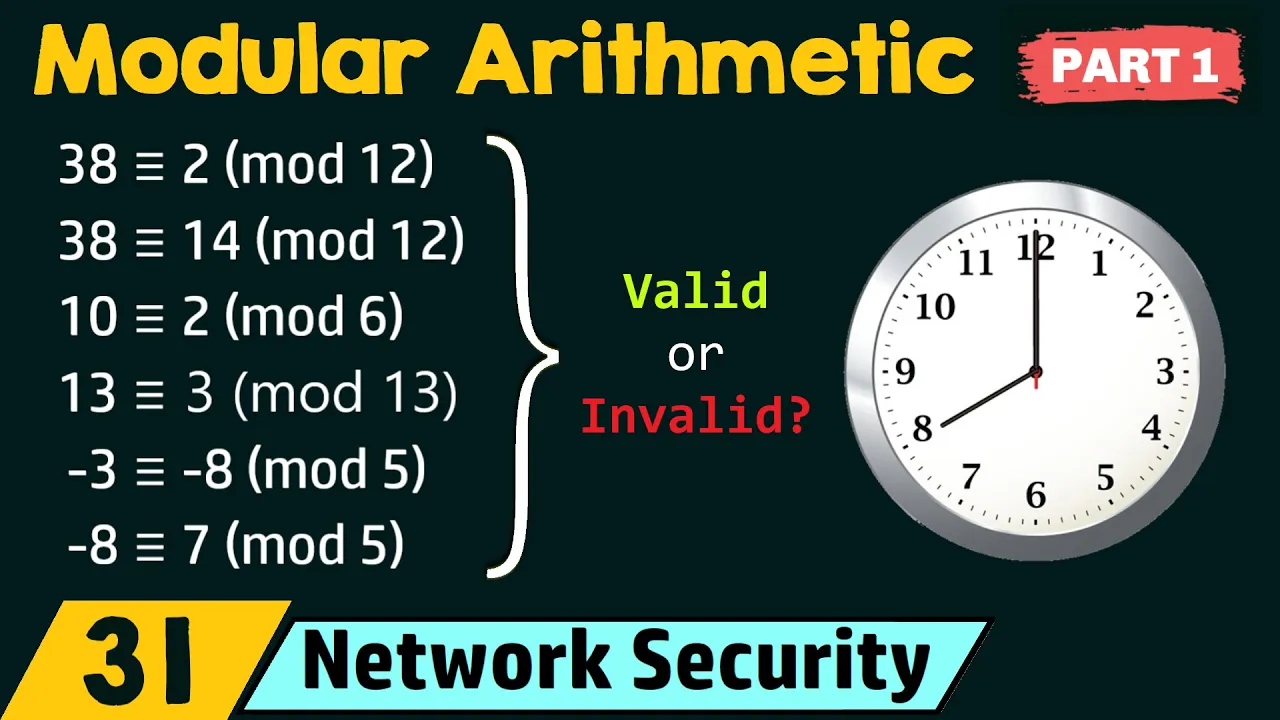 YouTube10:56
Prerequisite in Cryptography: Modular arithmetic → Modular inverses.
Modular arithmetic · View learning sequence YouTube4:35
Prerequisite in Cryptography: Modular arithmetic → Modular inverses.
Modular arithmetic · View learning sequence YouTube8:49
Prerequisite in Cryptography: Modular arithmetic → Modular inverses.
Modular arithmetic · View learning sequence