Read a marginal distribution
A component of a jointly normal vector is normal. Its mean comes from the corresponding mean-vector entry, and its variance from the diagonal of the covariance matrix.
math et al · YouTube · 8:24
Reduce multivariate normal probability questions to univariate normal distributions using means and covariances.
Use the learning inspector for key ideas and moments, or open the reading tabs for the complete notes.
Generated from the video's visuals and explanation; not verbatim speech.
A component of a jointly normal vector is normal. Its mean comes from the corresponding mean-vector entry, and its variance from the diagonal of the covariance matrix.
For the given jointly normal X₂ and X₃, the combination 5X₂+4X₃ has mean and variance , hence standard deviation 18.
For a row coefficient vector a, the variance of aX is aΣaᵀ. Include correlations before standardizing with the resulting standard deviation; marginal normality alone does not guarantee every combination is normal.
A component of a jointly normal vector is normal. Its mean comes from the corresponding mean-vector entry, and its variance from the diagonal of the covariance matrix.
For the given jointly normal X₂ and X₃, the combination 5X₂+4X₃ has mean and variance , hence standard deviation 18.
For a row coefficient vector a, the variance of aX is aΣaᵀ. Include correlations before standardizing with the resulting standard deviation; marginal normality alone does not guarantee every combination is normal.
A component of a jointly normal vector is normal. Its mean comes from the corresponding mean-vector entry, and its variance from the diagonal of the covariance matrix. For the given jointly normal X₂ and X₃, the combination 5X₂+4X₃ has mean and variance , hence standard deviation 18. For a row coefficient vector a, the variance of aX is aΣaᵀ. Include correlations before standardizing with the resulting standard deviation; marginal normality alone does not guarantee every combination is normal.
 YouTube5:12
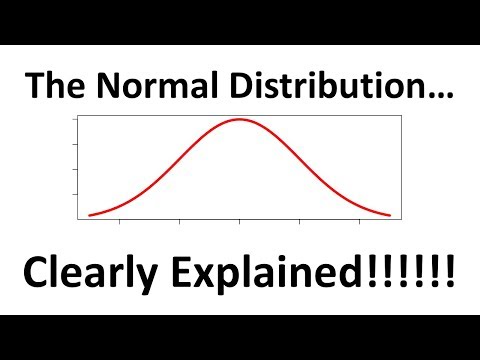
Another explanation of Normal distribution.
Normal distribution YouTube4:09
Next in Probability and statistics: Normal distribution → Central limit theorem.
Central limit theorem · View learning sequence YouTube10:38
Prerequisite in Probability and statistics: Variance → Normal distribution.
Variance · View learning sequence YouTube10:54
Prerequisite in Probability and statistics: Distributions → Normal distribution.
Distributions · View learning sequenceYouTube5:12Visual explanation for Normal distribution, compared with the current whiteboard.
Normal distribution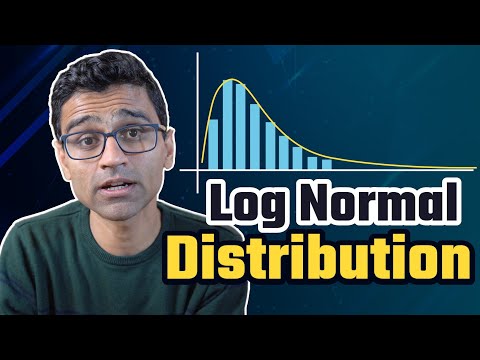 YouTube6:44
Application of Normal distribution, complementing the current explanation.
Normal distribution