A vector-valued product
Unlike the scalar dot product, the cross product of two three-dimensional vectors is a vector. Expand its component formula with alternating signs when using the determinant mnemonic.
Professor Dave Explains · YouTube · 6:45
Compute the three-dimensional cross product and connect its magnitude and direction to geometry.
Use the learning inspector for key ideas and moments, or open the reading tabs for the complete notes.
Generated from the video's visuals and explanation; not verbatim speech.
Unlike the scalar dot product, the cross product of two three-dimensional vectors is a vector. Expand its component formula with alternating signs when using the determinant mnemonic.
For angle θ between the vectors, the cross-product magnitude is |a||b|sin θ, the area of their parallelogram. A nonzero result is perpendicular to both inputs, with direction set by the right-hand rule.
Reversing the operands reverses the sign: . Parallel vectors give zero; the product distributes over addition but is not generally associative.
Unlike the scalar dot product, the cross product of two three-dimensional vectors is a vector. Expand its component formula with alternating signs when using the determinant mnemonic.
For angle θ between the vectors, the cross-product magnitude is |a||b|sin θ, the area of their parallelogram. A nonzero result is perpendicular to both inputs, with direction set by the right-hand rule.
Reversing the operands reverses the sign: . Parallel vectors give zero; the product distributes over addition but is not generally associative.
Unlike the scalar dot product, the cross product of two three-dimensional vectors is a vector. Expand its component formula with alternating signs when using the determinant mnemonic. For angle θ between the vectors, the cross-product magnitude is |a||b|sin θ, the area of their parallelogram. A nonzero result is perpendicular to both inputs, with direction set by the right-hand rule. Reversing the operands reverses the sign: . Parallel vectors give zero; the product distributes over addition but is not generally associative.
When the two input vectors are parallel, their cross product is the zero vector. This is because the angle between them is 0 or , making , and thus the magnitude is zero.
Conditions: The two vectors are parallel (or anti-parallel).; You are computing their cross product.
Unlike the scalar dot product, the cross product of two three-dimensional vectors is a vector. To compute it, you can use the determinant mnemonic, expanding its component formula with alternating signs.
Conditions: The vectors are three-dimensional.; You are using the determinant mnemonic to find the components.
The magnitude of the cross product of two vectors and with angle between them is . Geometrically, this value represents the area of the parallelogram formed by the two vectors.
Conditions: and are three-dimensional vectors.; is the angle between and .
Reversing the operands reverses the sign of the resulting vector. Specifically, .
Conditions: You are computing the cross product of two vectors.; You swap the order of the vectors.
A nonzero cross product result is perpendicular to both input vectors. Its specific direction is set by the right-hand rule.
Conditions: The cross product is nonzero (input vectors are not parallel).; You are determining the orientation of the resulting vector.
No, the cross product is not generally associative. This means that is not necessarily equal to .
Conditions: You are evaluating expressions involving multiple cross products.; You are checking if grouping affects the result.
Yes, the cross product distributes over addition. This means and .
Conditions: You are simplifying expressions involving cross products and sums.; You are applying algebraic properties to vector operations.
 Bilibili4:27
Next in Linear algebra: Vectors → Matrices.
Matrices · View learning sequenceNext in Linear algebra: Vectors → Vector spaces.
Vector spaces · View learning sequence YouTube9:59
Next in Linear algebra: Vectors → Linear independence.
Linear independence · View learning sequenceNext in Linear algebra: Vectors → Span.
Span · View learning sequence YouTube3:37
Next in Linear algebra: Vectors → Matrices.
Matrices · View learning sequence YouTube9:51
Visual explanation for Vectors, compared with the current lecture.
Vectors YouTube5:16
Whiteboard for Vectors, compared with the current lecture.
Vectors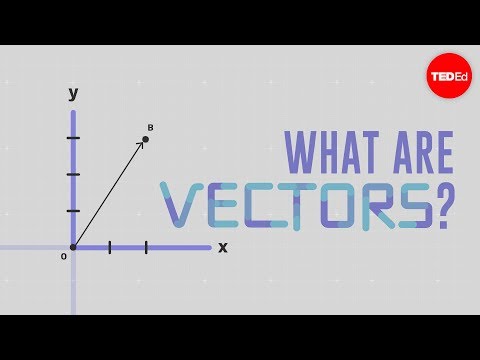 YouTube4:41
Visual explanation for Vectors, compared with the current lecture.
Vectors