Definition of the Assignment Problem
Assignment means assigning a task—or workload—to a person. It is a model in which various tasks are distributed among different individuals.
DWIVEDI GUIDANCE · YouTube · 8:20
This video segment introduces the fundamental concept of the Assignment Problem or Assignment Model. It explains that assignment means assigning a task to a person or allocating workload. To illustrate this, three practical examples are given: after an election, the government allocates various ministries among different members of parliament; friends divide tasks for preparing a birthday party; and a college assigns various subjects to different faculty members for teaching. The video also clarifies that the main objective of the Assignment Model is not merely to distribute tasks, but to achieve an optimal allocation such that the final outcome—such as higher marks or better performance—is maximized. This video segment introduces the fundamental concept of the assignment problem in Operations Research. It defines the problem as one where jobs are assigned to persons or resources so that the total cost, distance, or time is minimized, or profit is maximized. The video also explains that the assignment problem is a special case of the transportation problem, where the number of resources equals the number of activities. An example with 4 persons and 4 jobs is given, followed by a formal definition. This introductory lecture segment defines the assignment problem as the technique of selecting the best possible assignment of tasks from available alternatives. It explains that the problem arises because resources (like men and machines) have varying degrees of efficiency for different activities. Consequently, the cost, profit, or time required to perform tasks differs across resources. The ultimate goal of the assignment problem is to determine how these assignments should be made to optimize a specific objective, such as minimizing time and cost or maximizing profit. The speaker uses examples like assigning faculty to subjects and comparing task completion times to illustrate these concepts. This segment introduces the basic meaning, tabular representation, common solution methods, and applications of the Assignment Problem. The video first explains that because different resources perform different tasks with varying efficiency, an optimal assignment is needed; then presents an worker–job cost table, explains how to read assignment costs from the table, and states the objective of minimizing total cost; next lists the Enumeration Method, the Transportation Method, the Simplex Method, and the Hungarian Method, emphasizing that the Hungarian Method is the focus of this course; finally introduces applications of this model in machine order assignment, space utilization, salesperson assignment, matching employees to machines, and teacher scheduling. This introductory segment outlines the practical applications of the Assignment Model in Operations Research, such as allocating machines, salesmen, and teachers. It also identifies the Hungarian Method as the standard algorithm for solving these one-to-one allocation problems.
Use the learning inspector for key ideas and moments, or open the reading tabs for the complete notes.
Generated from the video's visuals and explanation; not verbatim speech.
The fundamental concept of the Assignment Problem—or Assignment Model—is assigning a specific task to a person. This is called assignment in mathematical language.
To understand this, first consider the example of government ministries. After elections, the government assigns various ministries—such as Education, Human Resource Development, and Petroleum—to different Members of Parliament so that each Member can handle their designated workload.
Similarly, in daily life, when friends jointly organize a birthday party, they divide up the tasks: one person brings balloons, another decorates the room, a third brings the cake, and a fourth arranges the music. This too is a form of assignment.
Now consider the college context. Suppose there are 6 subjects and 6 faculty members. Here, the problem is not simply which subjects to assign, but rather which subject to assign to which faculty member so that students achieve higher scores and outcomes improve.
Although all faculty members can teach all subjects, optimal results can be achieved through the right assignment. This is precisely the main objective of the Assignment Model—not merely dividing tasks, but selecting the best possible combination.
The basic idea of the assignment problem is to assign various jobs to various persons or resources such that the total cost, distance, or time is minimized, or profit is maximized. For example, if an organization has four machines and four workers, and only one worker can operate each machine, then deciding which worker to assign to which machine to minimize total cost or maximize profit is an assignment problem.
In the context of mathematics and Operations Research, the assignment problem is regarded as a special case of the transportation problem. Here, the number of given resources (such as workers or machines) equals the number of activities (such as jobs or machines). Each resource can be assigned to only one activity, and each activity can be assigned to only one resource. The goal of this assignment is to minimize total cost, distance, or time, or to maximize total profit.
As a specific example, suppose four persons are available to perform four distinct jobs, and only one person can work on each job. The problem here is how to assign jobs to persons so that the total cost is minimized. If we consider distance or time, the objective is to achieve the minimum distance traveled or the minimum time required to complete the jobs. If we consider profit, the objective is to select the assignment that yields maximum profit.
Formally, the assignment problem is the technique for selecting the best possible assignment of jobs among many alternatives. This assignment is considered optimal when it optimizes a predetermined objective function—whether minimizing cost or maximizing profit.
The assignment problem is fundamentally about making the best choice. When you have multiple alternatives or resources available, the goal is to select the optimal assignment of tasks among them. This process of finding the best possible allocation is what defines the assignment problem.
But why does this problem even exist? It arises because the resources at our disposal—whether they are human workers, machines, or other entities—do not perform all tasks equally well. Each resource has a varying degree of efficiency depending on the specific activity it is assigned to. For instance, consider a college assigning faculty members to teach different subjects. While a professor might be capable of teaching any subject, their effectiveness and the resulting student performance will vary significantly based on their specific expertise and proficiency in that particular area. To achieve the best outcomes, such as maximizing student marks or generating profit, tasks must be assigned according to these differing efficiencies.
This variation in efficiency has a direct consequence: the metrics used to evaluate performance—such as cost, profit, or time—will also differ from one resource to another for the exact same task. If one worker is highly efficient, they might complete a job in 5 minutes, whereas a less efficient worker might take 10 minutes for the identical task. Because these costs and times are not uniform, we cannot simply assign tasks randomly.
Therefore, the core mathematical challenge of the assignment problem is to determine exactly how these assignments should be structured. The objective is to optimize a specific goal, which could be minimizing the total time required, minimizing the overall cost, or maximizing the total profit generated by the chosen allocation of resources to tasks.
The segment begins by introducing the concept of the Assignment Problem: when available resources—such as workers or machines—perform different tasks with varying efficiency, the corresponding costs, profits, or times also differ; thus, we must decide how to assign resources to tasks so that a given objective is optimized.
Next, the screen displays an table, with rows labeled Worker 1, Worker 2, and Worker 3, and columns labeled Job 1, Job 2, and Job 3; the numbers in the table represent the objective values for the corresponding assignments. The instructor explains that these numbers may denote cost or time, and gives examples: assigning Worker 1 to Job 1 incurs cost 15, assigning Worker 1 to Job 2 incurs cost 10, and assigning Worker 2 to Job 3 incurs cost 10. The problem then becomes: based on this table, determine which worker should perform which job to minimize total cost.
After stating the problem, the video lists several methods for solving the assignment problem: the Enumeration Method, the Transportation Method, the Simplex Method, and the Hungarian Method—and emphasizes that the Hungarian Method is the most important one covered in this course.
Finally, the video moves to the applications section, explaining that the assignment model can be used to assign machines to factory orders, arrange machines for optimal space utilization, assign salespeople to different sales territories, assign employees to machines, and assign teachers to subjects or classes.
The video presents a slide titled 'Application of assignment model'. The speaker discusses examples like assigning teachers to subjects or classes, noting these are all assignment-related problems.
The speaker concludes by stating that the Hungarian Method is used to solve these assignment problems.
Assignment means assigning a task—or workload—to a person. It is a model in which various tasks are distributed among different individuals.
After elections, the government assigns various ministries to different members of parliament so that each member can handle their designated responsibilities. This is a practical expression of assignment.
When friends jointly plan a birthday party, they divide up the tasks, such as bringing balloons, decorating the room, bringing the cake, and arranging music. This is a simple everyday example of assignment.
In college, various subjects are assigned to different faculty members for teaching. Here, the main problem is how to make such an assignment that maximizes students' scores and improves overall outcomes.
The main objective of the assignment model is not merely to distribute tasks, but to achieve an optimal distribution that yields the best possible final result. Even though all combinations are feasible, the essence lies in selecting the best combination.
The assignment problem is the problem of deciding how to assign jobs or activities to persons or resources so that the total cost, distance, or time is minimized, or profit is maximized. For example, determining the optimal assignment between four machines and four workers is an assignment problem.
The assignment problem is a special case of the transportation problem, where the number of given resources equals the number of activities. Each resource can be assigned to exactly one activity, and each activity can be assigned to exactly one resource. Its objective is to minimize total cost, distance, or time, or to maximize total profit.
Suppose four persons are available to work on four distinct tasks, and only one person can work on each task. The problem is how to assign the tasks to the persons so that the total cost is minimized (or the profit is maximized). This clarifies the basic conditions of the assignment problem.
Formally, the assignment problem is a technique for selecting the best possible assignment of tasks among several alternatives. Such an assignment is considered optimal when it optimizes a predetermined objective function.
The assignment problem is the technique of selecting the best possible assignment of tasks from a number of available alternatives. It focuses on optimal allocation to achieve the best outcome.
Assignment problems arise because available resources (men, machines, etc.) have varying degrees of efficiency for performing different activities. Tasks must be assigned based on these efficiency differences to optimize results like minimizing time/cost or maximizing profit.
Due to varying resource efficiencies, the cost, profit, or time required to perform different activities will also differ across resources. For example, one person might take 5 minutes for a task while another takes 10 minutes.
The fundamental problem is determining how the assignment should be made so as to optimize a given objective, such as minimizing time, minimizing cost, or maximizing profit.
The Assignment Problem studies how to make one-to-one assignments between resources and tasks so as to minimize total cost, maximize total profit, or optimize total time. Its core reason is that different resources perform different tasks with differing efficiency, resulting in differing associated costs.
In problems, the assignment problem is commonly represented by a table: rows represent resources—such as workers—and columns represent tasks—such as jobs; the value in each cell represents the cost, time, or other objective value incurred when assigning the resource in that row to the task in that column. The solution objective is to select an assignment scheme from the table that optimizes the total objective value.
The video lists four common methods: Enumeration Method, Transportation Method, Simplex Method, and Hungarian Method, and notes that the Hungarian Method is typically the focus of the course.
This model can be applied to scenarios such as matching machines to jobs, arranging machine layouts in space, assigning salespeople to territories, matching workers to machines, and assigning teachers to subjects or classes.
The assignment model is applied in scenarios requiring optimal one-to-one allocation. Examples from the video include: 1. Assigning machines to factory orders. 2. Machine allocation for optimum space utilization. 3. Assigning salesmen to different sales areas. 4. Assigning employees to machines. 5. Assigning teachers to subjects or classes.
The Hungarian Method is the specific algorithm mentioned for solving assignment problems. It is designed to find the optimal assignment that minimizes cost or maximizes efficiency in one-to-one allocation scenarios.
Explore conditions, steps and evidence. Supplementary explanations are labeled separately from content shown in the video.
The screen displays a table with row labels Worker 1, Worker 2, Worker 3, and column labels Job 1, Job 2, Job 3, and a numerical matrix inside.
Worker i, Job j
Represents the cost of assigning the i-th worker to the j-th job, used to construct the rows and columns of the assignment problem cost matrix.
A discrete set; in the video example, there are 3 workers and 3 jobs.
The numbers inside the table are 15, 10, 9; 9, 15, 10; 10, 12, 8.
The presenter explains that these numbers can represent cost or time, and gives an example: assigning worker 1 to job 1 incurs a cost of 15.
c_{ij}
Represents the objective value—such as cost, profit, or time—when assigning the i-th resource to the j-th task.
Nonnegative real numbers or values given in the problem.
Assignment means assigning a task to a person, entrusting someone with a job, or allocating work.
Assignment Problem / Model
Assignment means assigning a task to a person or allocating work. It is a model in which various tasks are distributed among different people.
Both tasks and people must be identifiable.
Each person is assigned exactly one task.
Which subject should be assigned to which faculty member so that the resulting outcome is excellent—the focus is on assigning each subject to the most suitable faculty member to maximize marks.
The main objective of the Assignment Model is to distribute tasks in such a way that the final outcome (such as higher marks or better performance) is optimal.
The best combination must be selected from among the available options.
A criterion must exist for measuring the outcome.
Explains that the assignment problem means assigning jobs or tasks to persons in a way that yields the best result, minimizes cost, or maximizes profit.
Gives an example: there are four machines and four workers; one worker can work on one machine; so which worker should be assigned to which machine to generate maximum benefit at minimum cost?
Title 'Assignment Problem / Model', and a cartoon teacher stands beside a blackboard.
The assignment problem is the problem of assigning jobs or activities to persons or resources such that the total cost, distance, or time is minimized, or profit is maximized.
Only one job is assigned to each resource.
The goal is to minimize total cost, distance, or time, or to maximize profit.
States that the assignment problem or model is a type of transportation problem where given resources are allocated to an equal number of activities.
'Case of a transportation problem' (black).
'where the given resources are allocated to an equal number of activities' (red).
'with an aim of either minimising total cost, distance, time or maximizing profit' (blue).
The assignment problem is a special type of transportation problem in which given resources are allocated to an equal number of activities with the objective of minimizing total cost, distance, or time, or maximizing profit.
The number of resources equals the number of activities.
The objective function is based on cost, distance, time, or profit.
States that this is precisely what is called the assignment problem and reads it as a formal definition.
'Assignment problem is the technique of selecting the best possible assignment of tasks from a number of alternatives' (red).
The assignment problem is a technique for selecting the best possible assignment of tasks from among several alternatives.
There is a finite number of alternatives.
The criterion for the best assignment depends on the objective function.
Slide text: 'Assignment problem is the techniques of selecting best possible assignment of tasks from a number of alternatives'
Speaker explains in Hindi that when different alternatives are available, one must select the best possible assignment of tasks, which is called the assignment problem.
The assignment problem is defined as the technique of selecting the best possible assignment of tasks from a number of available alternatives.
There must be multiple alternatives or resources available.
The goal is to find the best possible assignment of tasks.
Slide text: 'The problem of assignment rises because the resources that are available such as men, machine etc have varying degree of efficiency for performing different activities'
Speaker explains that resources like men and machines have different efficiencies for different activities, so they must be assigned based on efficiency to minimize time/cost and maximize profit. Gives an example of faculty members teaching different subjects with varying proficiency.
The assignment problem arises because available resources (such as men, machines, etc.) possess varying degrees of efficiency for performing different activities. Therefore, tasks must be assigned based on these efficiency differences to optimize outcomes like minimizing time and cost, or maximizing profit.
Resources have varying efficiencies for different tasks.
Slide text: 'therefore the cost, profit or time of performing different activities are also different'
Speaker states that because efficiency is different, the cost, profit, or time taken to perform any task will also be different. Gives an example where one person takes 5 minutes and another takes 10 minutes for the same work.
As a direct consequence of varying resource efficiencies, the cost, profit, or time associated with performing different activities will also differ across resources.
Resource efficiencies vary.
Slide text: 'this the problem is how should the assignment be made so as to optimise the given objective'
Speaker concludes that the core problem is determining how the assignment should be made to optimize the given objective, whether it is minimizing time, minimizing cost, or maximizing profit.
The fundamental question of the assignment problem is how to make the assignments such that a specified objective function is optimized (e.g., minimized or maximized).
An objective function (cost, time, profit) is defined.
The slide title is Assignment Problem / Model. The body text explains that resources—such as men or machines—exhibit different efficiencies when performing different activities, resulting in different costs, profits, or times; the question is how to make assignments to optimize the objective.
The presenter explains in Hindi that the assignment problem involves assigning people or machines to tasks so as to optimize the objective.
The Assignment Problem studies one-to-one assignments between a set of resources and a set of tasks, aiming to minimize total cost, maximize total profit, or optimize total time. It arises because different resources perform different tasks with different efficiencies, leading to differing costs, profits, or times.
There are several resources and several tasks.
Assigning different resources to different tasks incurs different costs, profits, or times.
The objective is to optimize the assignment scheme.
The screen displays an table, with rows labeled Worker 1, Worker 2, Worker 3, and columns labeled Job 1, Job 2, Job 3; the matrix is [[15,10,9],[9,15,10],[10,12,8]].
The presenter explains that the numbers in the table represent either cost or time, and gives examples: assigning worker 1 to job 1 yields 15, assigning worker 1 to job 2 yields 10, and assigning worker 2 to job 3 yields 10.
In problems, the Assignment Problem is commonly presented in tabular form: rows represent resources (e.g., workers), columns represent tasks (e.g., jobs), and the entries indicate the cost, time, or other objective value incurred when assigning the resource in that row to the task in that column. The goal is to select an assignment from the table that optimizes the total objective value.
Rows represent resources.
Columns represent tasks.
Cell entries represent the objective value for the corresponding assignment.
Below the table, four methods appear sequentially: Enumeration Method, Transportation Method, Simplex Method, Hungarian Method.
The presenter lists these methods and emphasizes that the Hungarian method is the most important one in the syllabus.
The video lists several methods for solving the assignment problem: the Enumeration Method, the Transportation Method, the Simplex Method, and the Hungarian Method. The instructor emphasizes that, according to the course syllabus, the Hungarian Method is the most important.
used to solve the assignment problem
Elections take place, voting occurs… the government divides different ministries among different members of parliament. One member will handle the Education Ministry, another the HRD Ministry, and yet another the Petroleum Ministry.
After the election, how should the government assign various ministries to different members of parliament?
Various ministries (Education, HRD, Petroleum)
Various members of parliament
Assign each member of parliament one ministry so that the workload is properly distributed.
The government assigns different ministries to different members of parliament.
This establishes a one-to-one relationship between tasks and individuals.
Each member of parliament is given a specific ministry and handles its workload.
This example clearly illustrates the basic concept of Assignment.
We want to celebrate our friend's birthday... Mr. A will bring balloons, Mr. B will decorate the room with decorative items, Mr. C will bring a cake, and Mr. D will arrange the music system.
Balloon and birthday cake clipart appear on screen.
How should various tasks be assigned among four or five friends to celebrate a birthday?
Four people (Mr. A, Mr. B, Mr. C, Mr. D)
Four tasks (bring balloons, decorate the room, bring cake, arrange music)
Assign each person one task to ensure smooth event planning.
Mr. A was assigned the task of bringing balloons and decorative items.
A one-to-one assignment of tasks to people.
Mr. B was assigned the task of decorating the room.
Distributing different tasks among different people.
Mr. C was assigned the task of bringing cake.
Each person was assigned a specific task.
Mr. D was assigned the task of arranging music.
All tasks have been assigned.
All four friends divided the work among themselves, ensuring the party was successfully organized.
This example illustrates the practical utility of the Assignment Problem in daily life.
In college there are 6 subjects and 6 faculty members... the problem is to assign each subject to a faculty member so that students earn higher marks.
Cartoon teacher with blackboard appears.
Given 6 subjects and 6 faculty members in college, which faculty member should teach which subject?
6 subjects
6 faculty members
All faculty members can teach all subjects.
An assignment that maximizes students' marks and improves overall results.
All faculty members can teach all subjects, but priority is given to assigning each subject to the most suitable faculty member.
This illustrates the need for optimization.
The purpose of assignment is to ensure good outcomes and higher scores.
The main objective of the Assignment Model is to optimize the outcome.
Subjects should be assigned to the faculty member who can deliver the best outcome in that subject.
This example shows that the Assignment Problem is not limited to merely distributing tasks, but is a mathematical method for achieving the optimal outcome.
States that suppose there are four men available to work on four separate jobs; only one person can work on any one job; and the problem is to determine how to make the assignment so that the total cost is minimized or the profit is maximized.
'Four men available for work on four separate jobs' (black).
'Only one man can work on any one job' (black).
how to assign the job such that the total cost of assignment is minimum
Four people are available to work on four distinct jobs, and only one person can work on each job.
4 men available for work
4 separate jobs
Only one man can work on any one job
Determining how to assign jobs to people so that the total cost is minimized or the profit is maximized.
The number of resources (people) equals the number of activities (jobs).
Slide text: 'Four men available for work on four separate jobs'
Only one person can be assigned to each job.
Slide text: 'only one man can work on any one job'
The goal is to determine how to make the assignments so that the total cost is minimized.
Slide text: 'how to assign the job such that the total cost of assignment is minimum'
This is an assignment problem where 4 persons are assigned to 4 jobs so that the total cost is minimized or the profit is maximized.
The example conditions (4 men, 4 jobs, 1-to-1 mapping) match the definition of an assignment problem.
Speaker provides an example of assigning faculty members to subjects. Faculty can teach all subjects, but some teach certain subjects much better, leading to higher student marks. Thus, specific subjects are assigned to specific faculty based on their proficiency.
How should a college assign its faculty members to teach various subjects?
Faculty members can teach all subjects.
Faculty members have varying levels of proficiency and teaching effectiveness for different subjects.
Assign each subject to a faculty member to maximize overall student performance.
Identify the varying efficiencies/proficiencies of each faculty member for each subject.
Based on the principle that resources have varying degrees of efficiency for different activities.
Assign specific subjects to the faculty members who teach them best, rather than having everyone teach everything.
To optimize the outcome (student marks/profit).
Assign each subject to the most proficient faculty member for that specific subject.
Students achieve better marks in subjects taught by highly proficient faculty.
Speaker gives a numerical example: one person might take 5 minutes to do a task, while another person might take 10 minutes for the exact same task due to differing efficiencies.
Illustrate how varying efficiency affects task completion time.
Two different persons are assigned the same task.
Their efficiencies for this task are different.
Show the difference in time taken.
Person A completes the task in 5 minutes.
Higher efficiency.
Person B completes the same task in 10 minutes.
Lower efficiency.
The time taken differs (5 mins vs 10 mins) because the efficiencies of the resources (persons) are different.
Direct comparison of the stated times.
The screen shows 3times3 the cost table: Worker 1 for Job 1slash2slash3 are 15, 10, 9; Worker 2 are 9, 15, 10Worker 3 are respectively 10, 12, 8.
The instructor explains that, based on this table, we must determine which worker should be assigned to which job to minimize the total cost, and gives an example: worker 1 → job 1 with cost 15, worker 1 → job 2 with cost 10, worker 2 → job 3 with cost 10.
The video only poses the problem and does not provide the final optimal assignment or the minimum total cost in this segment.
Given a cost table for 3 workers and 3 jobs, decide how to assign each worker to one job so that the total cost is minimized.
Worker 1 has cost for Job 1, Job 2, Job 3 of 15, 10, 9
Worker 2 for Job 1, Job 2, Job 3 are 9, 15, 10
Worker 3 for Job 1, Job 2, Job 3 cost respectively 10, 12, 8
Find the worker–job assignment scheme that minimizes the total cost.
Read the table: rows represent workers, columns represent jobs, and cell values represent the corresponding assignment costs.
The video screen directly displays the table structure.
Understand the problem objective: select a one-to-one assignment from the table such that the sum of the selected cell values is minimized.
The presenter states in the audio that we need to determine which job to assign to which worker to achieve the minimum cost.
This segment only sets up the problem model and does not provide the final answer.
The video does not solve or verify the solution within this segment.
Assignment Problem / Model
Text 'Assignment Problem / Model'
Watermark 'Dwivedi Guidance'
Screen is static
No animation
At the beginning of the video, the topic name is displayed.
Balloon and birthday cake clipart appear on the right side of the screen.
balloons
birthday cake
images of balloons and cake appear on screen
title text remains
This animation provides visual support using the example of a birthday party.
Cartoon image of an old teacher holding a pointer next to a green blackboard appears.
cartoon teacher
green blackboard
pointer
teacher's image appears on screen
Title text appears
This animation illustrates an example of faculty and subject assignment in a college.
The cartoon teacher and blackboard disappear, leaving only the title 'Assignment Problem / Model' and the watermark.
Cartoon teacher
Blackboard
Title text
The teacher and blackboard are removed
Title 'Assignment Problem / Model'
Watermark 'Dwivedi Guidance'
This visual transition represents the shift from the video's introductory phase to its main educational content.
Slide titled 'Assignment Problem / Model' displays the definition of the assignment problem.
Title text
Bullet point with definition
Slide layout
Watermark 'Dwivedi Guidance'
Introduces the basic concept of the assignment problem.
Slide updates to show the reason why the assignment problem arises (varying efficiency of resources).
Title text
First bullet point (definition)
Second bullet point (cause)
New bullet point appears explaining the cause.
Slide layout
Watermark
Explains the underlying reason for the existence of assignment problems.
Slide updates to add a third bullet point stating that cost, profit, or time are therefore different.
Title text
Three bullet points
Third bullet point appears.
Slide layout
Watermark
Details the direct consequences of varying resource efficiencies.
Slide updates to add a fourth bullet point defining the core problem as optimizing the given objective.
Title text
Four bullet points
Fourth bullet point appears.
Slide layout
Watermark
States the ultimate goal of solving an assignment problem.
The first slide displays the title Assignment Problem / Model and three bullet points in English, with a Dwivedi Guidance watermark in the background.
Title: Assignment Problem / Model
Three bullet points
Dwivedi Guidance watermark
The screen remains static until approximately 11 seconds, then switches to the next slide.
The title and the three definitional statements remain unchanged
This frame explains in text the origin and the optimization objective of the assignment problem.
The second slide displays an table, followed by the sequential appearance of four method names starting at approximately 59 seconds.
Worker 1, Worker 2, Worker 3
Job 1, Job 2, Job 3
An numerical matrix
Enumeration Method
Transportation Method
Simplex Method
Hungarian Method
First display the complete table
Enumeration Method appears at approximately 59 seconds
Transportation Method appears at approximately 62 seconds
Simplex Method appears at approximately 64 seconds
Hungarian Method appears at approximately 66 seconds
The table values and row and column labels remain unchanged
This frame concretizes the abstract definition into a readable assignment matrix and lists applicable solution methods.
The third slide is titled Application of assignment model, followed by five application items appearing one by one.
Title: Application of assignment model
Five application items
The first application appears at approximately 80 seconds
The second application appears at approximately 86 seconds
The third application appears at approximately 96 seconds
The fourth application appears at approximately 108 seconds
The fifth application appears at approximately 118 seconds
The title remains unchanged
This frame illustrates the scope of application of the assignment model in practical management scenarios.
Static slide showing bullet points of assignment model applications.
Text list of applications
Slide content remains static throughout the clip.
Visual aid supporting the verbal explanation of where the assignment model is applied.
Anyone can pass it on, but higher marks lead to better results...
The idea that any faculty member can teach any subject, so assignment makes no real difference.
Although all faculty members can teach all subjects, proper assignment yields higher student scores and better outcomes.
In the same way...
The example of government ministries applies the definition of assignment in a practical setting.
In the same way, suppose that...
The birthday party example applies the concept of assignment to daily life.
In the same way, you may have observed in your college...
The example of subject assignment in colleges implements the adaptation objective of the assignment model.
States that the assignment problem is a type of transportation problem.
Case of a transportation problem
The assignment problem is a special case of the transportation problem in which the number of sources equals the number of destinations, and the capacity from each source to each destination is 1 unit.
The word 'therefore' connects the second and third bullet points on the slide.
The varying efficiency of resources directly causes the differences in cost, profit, or time for performing activities.
The transition from the third to the fourth bullet point outlines the problem statement.
Because costs/times/profits differ, the core problem becomes finding the assignment that optimizes the specific objective.
After the definition slide, an table appears, and the presenter immediately uses this table to explain the meaning of the assignment problem.
The video first defines the assignment problem in words, then concretizes that definition into an operational problem format using an cost table.
The list of methods appears directly below the cost table.
After explaining the table-based problem, the presenter lists solution methods.
After presenting the table-based problem, the video further lists methods applicable to solving this type of problem.
The title of the third slide is Application of assignment model.
The presenter transitions from definitions and methods to real-world applications.
The application section builds upon the general definition of the assignment problem, illustrating how this model can be transferred to resource allocation scenarios involving machines, personnel, teachers, and other resources.
Speaker links Hungarian method directly to solving assignment problems.
The Hungarian method is a specific technique applied to solve the general assignment problem.
What does assignment mean?
So that higher marks are obtained.
Election… birthday… college…
Explains what the assignment problem means.
States that the assignment problem is a type of transportation problem.
with an aim of either minimising total cost, distance, time or maximizing profit
Slide definition.
Slide text about varying efficiency.
Slide text about optimizing the objective.
The presenter explains the meaning of the assignment problem.
The slide provides a verbal definition of the assignment problem.
An table displays costs between workers and jobs.
The presenter explains that the numbers in the table represent cost or time.
List four methods.
The presenter lists and emphasizes the Hungarian method.
Covered · The definition of assignment has been given.
Covered · An example of allocating government ministries has been provided.
Covered · An example of organizing a birthday party has been provided.
Covered · An example of assigning subjects in college and explaining the optimization objective has been provided.
Covered · The sentence remains incomplete; no new mathematical information is included.
Covered · Introductory explanation and example of the assignment problem.
Covered · Defining the assignment problem as a special case of the transportation problem.
Covered · An example with four people and four tasks.
Covered · Formal definition of the assignment problem.
Covered · Definition of assignment problem presented and explained.
Covered · Slide transition; speaker finishes previous thought and introduces the next point.
Covered · Explanation of why assignment problems arise due to varying resource efficiency, including the faculty example.
Covered · Slide transition to the next bullet point.
Covered · Discussion on how varying efficiency leads to different costs, profits, or times, with a numerical example.
Covered · Slide transition to the final bullet point.
Covered · Statement of the core problem: optimizing the given objective through proper assignment.
Covered · Explain the definition and optimization objective of the assignment problem.
Covered · Use an table to show the data format of the assignment problem and state the minimum-cost objective.
Covered · List four methods for solving the assignment problem and emphasize the Hungarian method.
Covered · Introduce the practical applications of the assignment model one by one.
Covered · Entire clip covers applications and solution method of the assignment problem.
Reviewed English material v2: card/concept_card "Definition of the Assignment Problem" starting at 0:00 — Assignment means assigning a task—or workload—to a person. It is a model in which various tasks are distributed among different individuals.
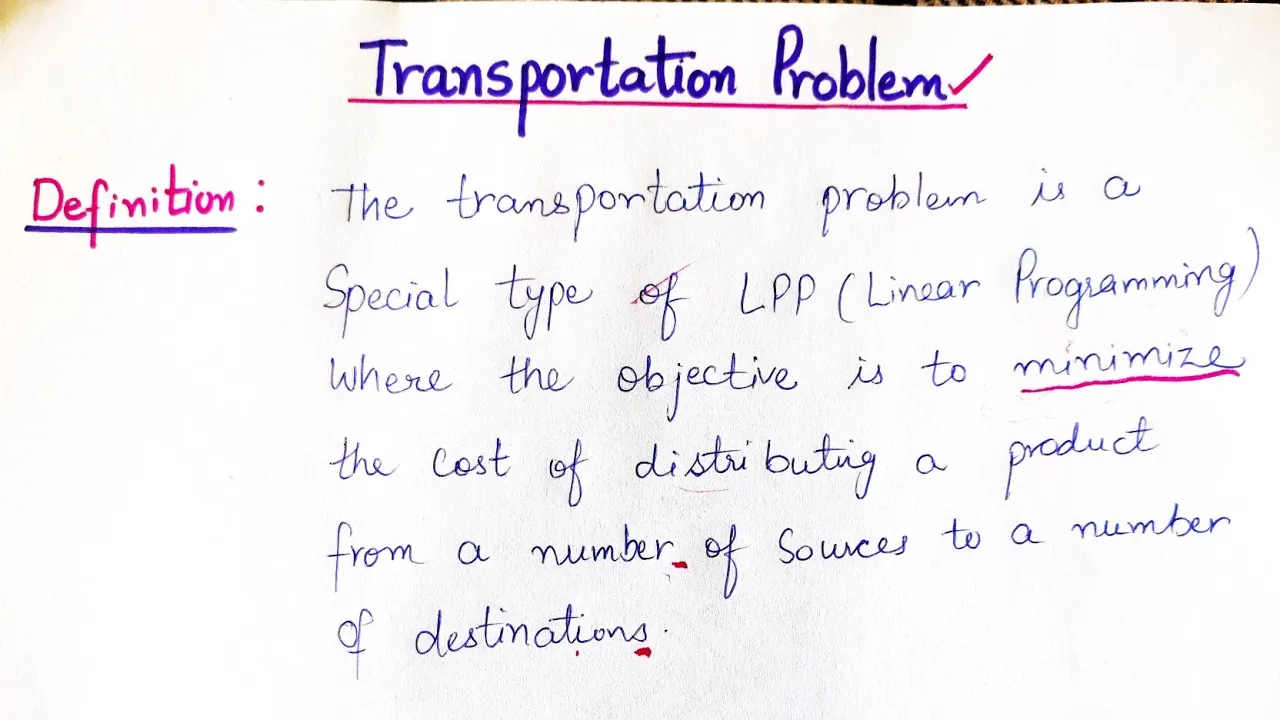 YouTube10:40
Another explanation of Transportation and assignment problems.
Transportation and assignment problems YouTube6:11
Another explanation of Transportation and assignment problems.
Transportation and assignment problems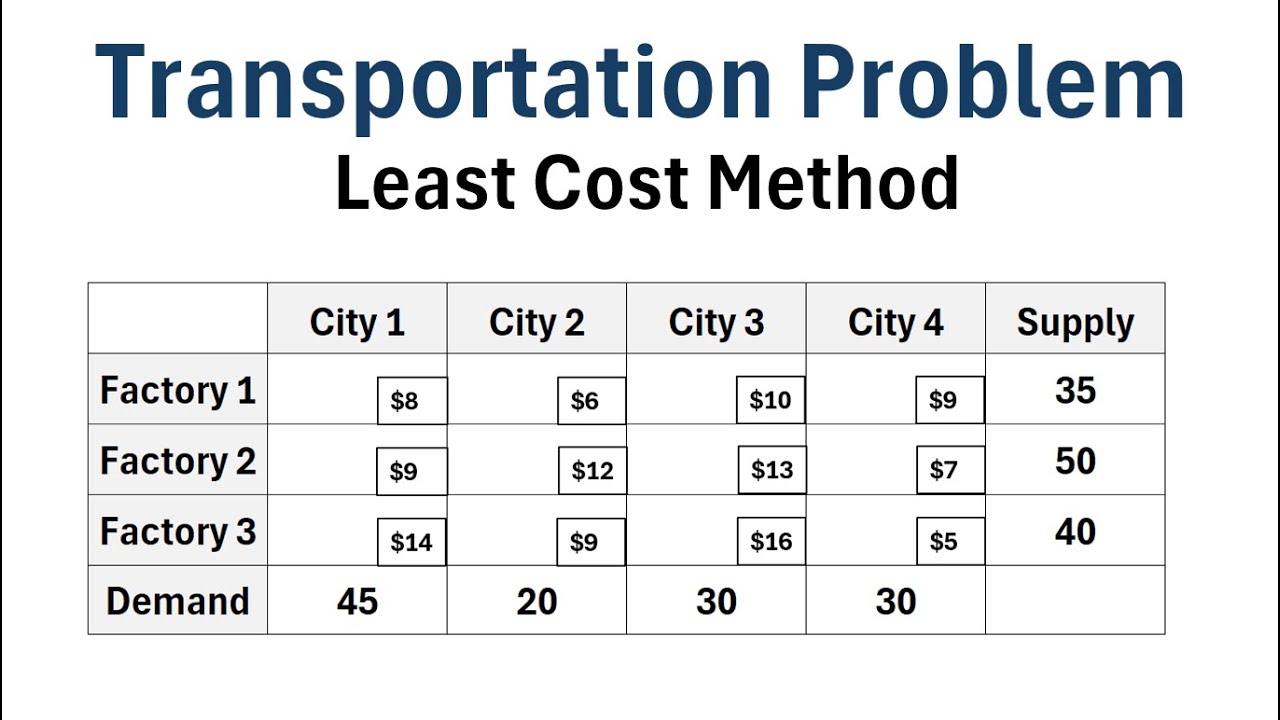 YouTube6:47
Another explanation of Transportation and assignment problems.
Transportation and assignment problemsYouTube10:40Whiteboard for Transportation and assignment problems, compared with the current lecture.
Transportation and assignment problemsYouTube6:11Whiteboard for Transportation and assignment problems, compared with the current lecture.
Transportation and assignment problemsYouTube6:47Whiteboard for Transportation and assignment problems, compared with the current lecture.
Transportation and assignment problems