Reverse a conditional probability
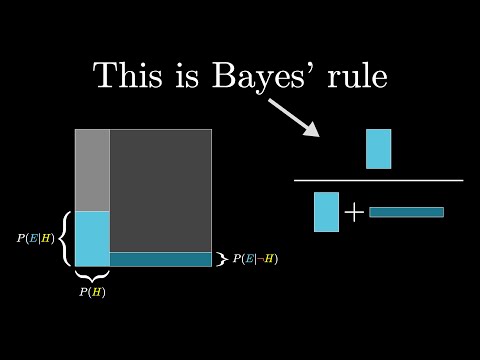
The probability of A given B need not equal the probability of B given A. Bayes’ theorem connects them with the prior event probabilities.
Ace Tutors · YouTube · 8:02
Derive Bayes’ theorem from a shared intersection and use weather information to update a probability.
Use the learning inspector for key ideas and moments, or open the reading tabs for the complete notes.
Generated from the video's visuals and explanation; not verbatim speech.
The probability of A given B need not equal the probability of B given A. Bayes’ theorem connects them with the prior event probabilities.
Write P(A∩B)=P(A|B)(B|A). Dividing by a positive gives Bayes’ formula. The two conditional definitions require nonzero conditioning probabilities.
In the picnic example, cloudiness is the observed event and rain is the event of interest. Substitute the supplied prior and likelihood values, then normalize by the probability of the observed cloudiness.
The probability of A given B need not equal the probability of B given A. Bayes’ theorem connects them with the prior event probabilities.
Write P(A∩B)=P(A|B)(B|A). Dividing by a positive gives Bayes’ formula. The two conditional definitions require nonzero conditioning probabilities.
In the picnic example, cloudiness is the observed event and rain is the event of interest. Substitute the supplied prior and likelihood values, then normalize by the probability of the observed cloudiness.
The probability of A given B need not equal the probability of B given A. Bayes’ theorem connects them with the prior event probabilities. Write P(A∩B)=P(A|B)(B|A). Dividing by a positive gives Bayes’ formula. The two conditional definitions require nonzero conditioning probabilities. In the picnic example, cloudiness is the observed event and rain is the event of interest. Substitute the supplied prior and likelihood values, then normalize by the probability of the observed cloudiness.
To update the probability of rain given the observation of cloudiness, you apply Bayes' theorem. You substitute the supplied prior probability of rain, the likelihood of cloudiness given rain, and the marginal probability of cloudiness into the formula.
Conditions: Cloudiness is the observed event (B).; Rain is the event of interest (A).; Prior probabilities and likelihoods are supplied.; .
The probability of A given B and the probability of B given A are generally different because they condition on different events. Bayes' theorem connects these two conditional probabilities by incorporating the prior probabilities of the individual events, and .
Conditions: A and B are events in a probability space.; and .
Bayes' formula is derived by expressing the joint probability of the intersection of events A and B, , in two different ways using the definition of conditional probability. By equating these two expressions, and , and then dividing by , we isolate to obtain Bayes' theorem.
Conditions: to allow division.; Events A and B are defined in the same probability space.
The derivation of Bayes' theorem requires that the conditioning probabilities be nonzero. Specifically, when deriving from the intersection, we divide by , so must be positive.
Conditions: Deriving Bayes' formula from conditional probability definitions.; for to be defined.; for to be defined.
 YouTube15:11
Another explanation of Bayes theorem.
Bayes theorem YouTube19:14
Another explanation of Bayes theorem.
Bayes theorem YouTube3:47
Another explanation of Bayes theorem.
Bayes theorem YouTube4:33
Prerequisite in Probability and statistics: Conditional probability → Bayes theorem.
Conditional probability · View learning sequence YouTube6:13
Prerequisite in Probability and statistics: Conditional probability → Bayes theorem.
Conditional probability · View learning sequenceYouTube3:47Prerequisite in Probability and statistics: Conditional probability → Bayes theorem.
Conditional probability · View learning sequenceYouTube19:14Whiteboard for Bayes theorem, compared with the current visual explanation.
Bayes theorem YouTube5:31
Whiteboard for Bayes theorem, compared with the current visual explanation.
Bayes theorem