Start from conditional probability
For , conditional probability is . Reversing the roles gives the corresponding expression for when .
Dr. Trefor Bazett · YouTube · 5:31
Bayes' theorem follows from writing the same intersection probability in two conditional orders. The lesson derives the formula and checks it with a two-child probability example.
Use the learning inspector for key ideas and moments, or open the reading tabs for the complete notes.
Generated from the video's visuals and explanation; not verbatim speech.
For , conditional probability is . Reversing the roles gives the corresponding expression for when .
Since , we have . Substitution gives . The denominator normalizes the probability; it is not generally a prior-odds term.
The example assumes four equally likely ordered outcomes: . Conditioning on at least one girl removes , leaving three possibilities. This conclusion depends on that stated conditioning event, not on a different way of selecting or reporting a child.
Let be two girls and be at least one girl. Then , and , giving .
For , conditional probability is . Reversing the roles gives the corresponding expression for when .
Since , we have . Substitution gives . The denominator normalizes the probability; it is not generally a prior-odds term.
The example assumes four equally likely ordered outcomes: . Conditioning on at least one girl removes , leaving three possibilities. This conclusion depends on that stated conditioning event, not on a different way of selecting or reporting a child.
Let be two girls and be at least one girl. Then , and , giving .
For , conditional probability is . Reversing the roles gives the corresponding expression for when . Since , we have . Substitution gives . The denominator normalizes the probability; it is not generally a prior-odds term. The example assumes four equally likely ordered outcomes: . Conditioning on at least one girl removes , leaving three possibilities. This conclusion depends on that stated conditioning event, not on a different way of selecting or reporting a child. Let be two girls and be at least one girl. Then , and , giving .
The probability is . This is calculated using Bayes' theorem where event is 'two girls' and event is 'at least one girl'.
Conditions: Four equally likely ordered outcomes: GG, GB, BG, BB.; Event A: Two girls.; Event B: At least one girl.
The denominator ensures that the posterior probability sums to 1 over all possible mutually exclusive events . It scales the product of the likelihood and prior to a valid probability distribution.
Conditions: Bayes' theorem is written in probability form: .
Bayes' theorem is derived by expressing the joint probability in two different ways using the definition of conditional probability. First, implies .
Conditions: ;
The conditioning event 'at least one girl' restricts the original sample space of four equally likely ordered outcomes ({GG, GB, BG, BB}) to three outcomes ({GG, GB, BG}) by removing the outcome where both children are boys (BB). This reduction changes the denominator in the probability calculation from 4 to 3, directly impacting the final probability.
Conditions: Original sample space: {GG, GB, BG, BB}.; Conditioning event: At least one girl.
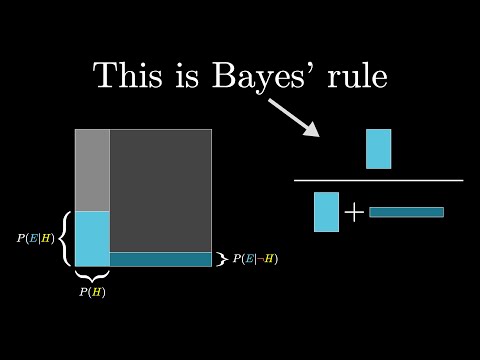 YouTube15:11
Another explanation of Bayes theorem.
Bayes theorem YouTube19:14
Another explanation of Bayes theorem.
Bayes theorem YouTube4:33
Prerequisite in Probability and statistics: Conditional probability → Bayes theorem.
Conditional probability · View learning sequence YouTube6:13
Prerequisite in Probability and statistics: Conditional probability → Bayes theorem.
Conditional probability · View learning sequence YouTube3:47
Prerequisite in Probability and statistics: Conditional probability → Bayes theorem.
Conditional probability · View learning sequence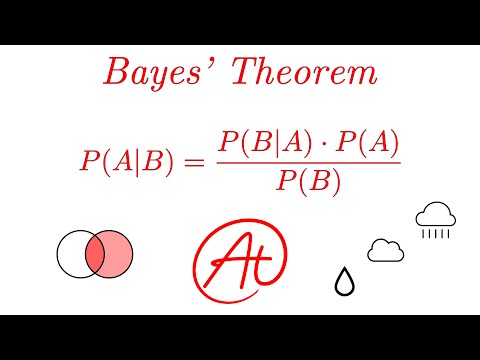 YouTube8:02
Visual explanation for Bayes theorem, compared with the current whiteboard.
Bayes theoremYouTube15:11Visual explanation for Bayes theorem, compared with the current whiteboard.
Bayes theoremYouTube3:47Visual explanation for Bayes theorem, compared with the current whiteboard.
Bayes theorem