Reverse conditioning
For events of positive probability, Bayes' theorem follows by writing the same intersection in two ways: .
The Organic Chemistry Tutor · YouTube · 19:14
Derive Bayes' theorem from conditional probability, then compare set counting, probability trees and frequency trees in worked examples.
Use the learning inspector for key ideas and moments, or open the reading tabs for the complete notes.
Generated from the video's visuals and explanation; not verbatim speech.
For events of positive probability, Bayes' theorem follows by writing the same intersection in two ways: .
In the nine equally likely outcomes, A contains five elements, B six, and their intersection two. Thus , matching the Bayes calculation.
In the lesson's hypothetical screening example, the positive probability is . Dividing the true-positive probability by this total gives about 68.3%. These supplied numbers illustrate the mathematics.
For events of positive probability, Bayes' theorem follows by writing the same intersection in two ways: .
In the nine equally likely outcomes, A contains five elements, B six, and their intersection two. Thus , matching the Bayes calculation.
In the lesson's hypothetical screening example, the positive probability is . Dividing the true-positive probability by this total gives about 68.3%. These supplied numbers illustrate the mathematics.
For events of positive probability, Bayes' theorem follows by writing the same intersection in two ways: . In the nine equally likely outcomes, A contains five elements, B six, and their intersection two. Thus , matching the Bayes calculation. In the lesson's hypothetical screening example, the positive probability is . Dividing the true-positive probability by this total gives about 68.3%. These supplied numbers illustrate the mathematics.
The denominator in Bayes' theorem represents the total probability of the evidence (event B). In the context of a screening test, a positive result can arise from two mutually exclusive scenarios: a true positive (person has the disease and tests positive) or a false positive (person does not have the disease but tests positive).
Conditions: The evidence event B can occur via multiple mutually exclusive paths.; The law of total probability applies.
Bayes' theorem is derived by expressing the same intersection in two different ways using the definition of conditional probability. First, implies .
Conditions: Events A and B have positive probability ().; The definition of conditional probability applies.
The positive predictive value, or the probability of having the disease given a positive test result (), is calculated by dividing the probability of a true positive by the total probability of a positive result. The total probability of a positive result includes both true positives and false positives.
Conditions: Prevalence .; Sensitivity .; False positive rate .; The events are mutually exclusive and exhaustive for the disease status.
In a sample space of nine equally likely outcomes, let event A contain 5 elements and event B contain 6 elements, with their intersection containing 2 elements. The conditional probability is calculated directly as the size of the intersection divided by the size of B: .
Conditions: The sample space has nine equally likely outcomes.; Event A has 5 elements, Event B has 6 elements, and has 2 elements.
The denominator is the marginal probability of the evidence. It acts as a normalizing constant that ensures the posterior probability is a valid probability (i.e., between 0 and 1).
Conditions: .; The events A and B are defined on the same sample space.
The result means that if event B has occurred, there is a one-in-three chance that event A has also occurred. In the specific example with nine equally likely outcomes, B contains 6 outcomes.
Conditions: The sample space consists of nine equally likely outcomes.; Event B has occurred.; We are evaluating the likelihood of A within the context of B.
 YouTube15:11
Another explanation of Bayes theorem.
Bayes theorem YouTube3:47
Another explanation of Bayes theorem.
Bayes theorem YouTube4:33
Prerequisite in Probability and statistics: Conditional probability → Bayes theorem.
Conditional probability · View learning sequence YouTube6:13
Prerequisite in Probability and statistics: Conditional probability → Bayes theorem.
Conditional probability · View learning sequenceYouTube3:47Prerequisite in Probability and statistics: Conditional probability → Bayes theorem.
Conditional probability · View learning sequence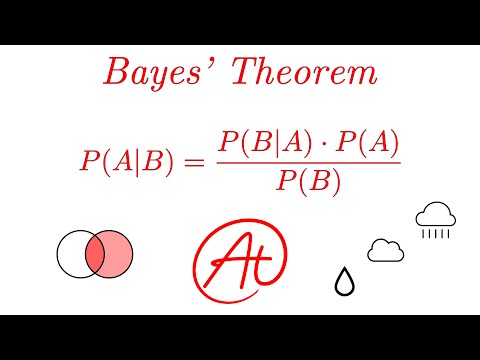 YouTube8:02
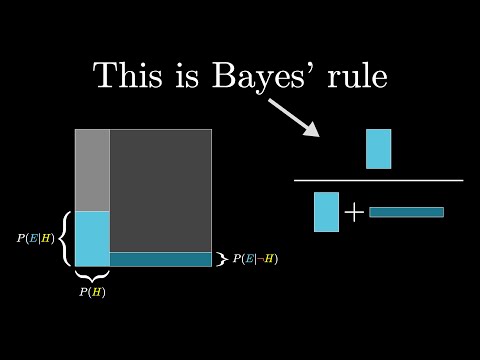
Visual explanation for Bayes theorem, compared with the current whiteboard.
Bayes theoremYouTube15:11Visual explanation for Bayes theorem, compared with the current whiteboard.
Bayes theoremYouTube3:47Visual explanation for Bayes theorem, compared with the current whiteboard.
Bayes theorem