Conversion Formula
Connects coordinate-based integration to arc-length based integration via direction cosines.
 mathvideo•
A Chinese visual explanation of converting between the two kinds of line integrals. Catalog metadata imported from the original Math Video site and checked against the source platform; not a transcript.
This video demonstrates the conversion between line integrals of the second kind (with respect to coordinates) and the first kind (with respect to arc length). By introducing the unit tangent vector T, it derives the relationship using direction cosines: dx = cos(α)ds and dy = cos(β)ds. The final formula shows that integrating a vector field along a curve is equivalent to integrating its tangential component over the arc length. It also highlights how reversing the path direction flips the sign of the integral due to the change in angle orientation.
Generated from the video's visuals and explanation; not verbatim speech.
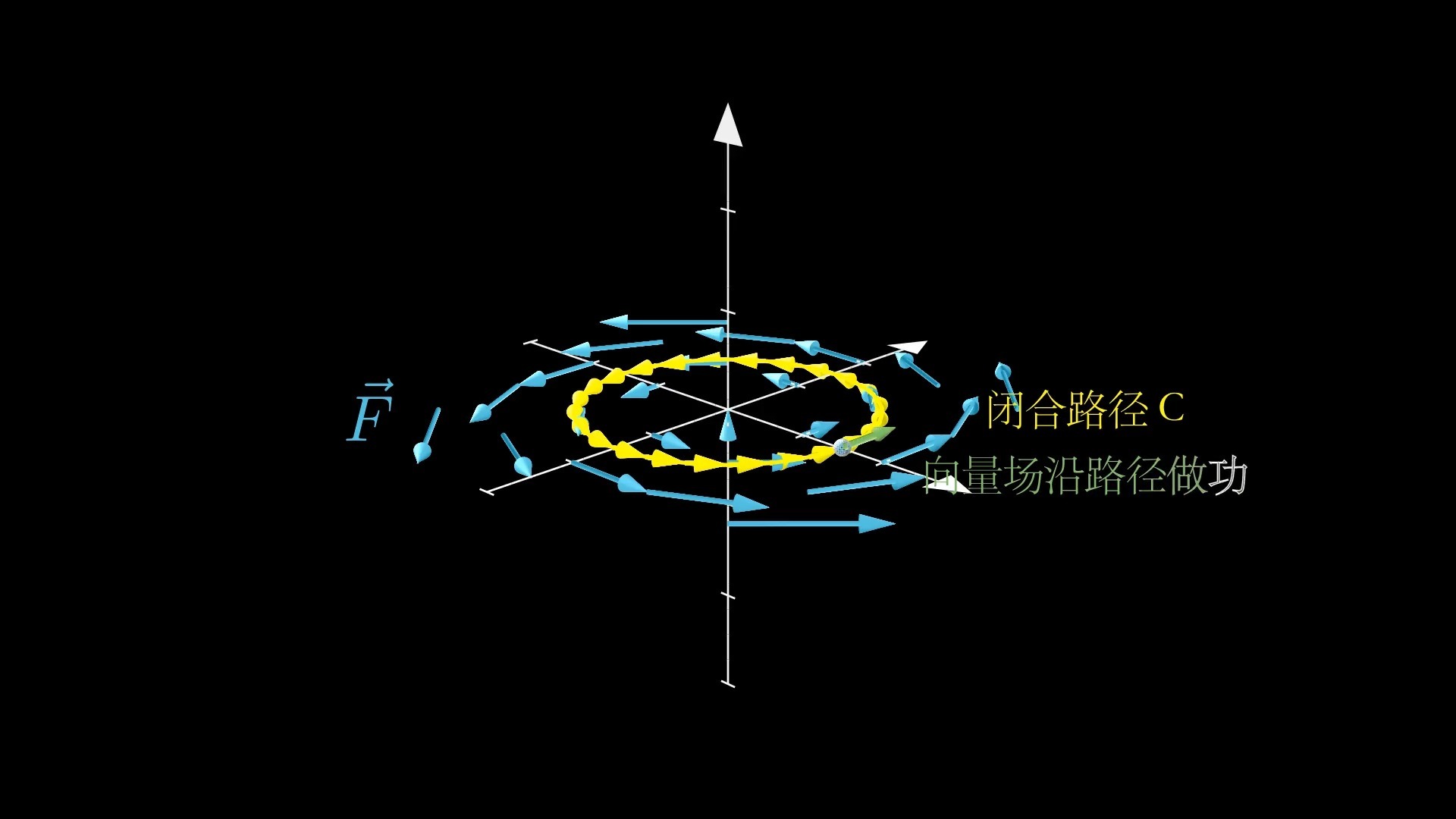
The visual presents a curve L from point A to B with a vector field F=(P,Q). The goal is to evaluate ∫_L P dx + Q dy and ask if it can be converted into an integral with respect to arc length s. The key lies in the tangent vector T. An orange arrow represents the unit tangent vector at a specific point on the curve. Its components are defined by the angles α and β made with the x and y axes respectively, so T = (cos α, cos β).
Next, we examine the differential elements. Zooming in on a small segment of the curve reveals a right triangle formed by the arc length element ds, horizontal projection dx, and vertical projection dy. Based on trigonometry, we establish the bridge between the two types of integrals: dx equals cos α times ds, and dy equals cos β times ds.
Substituting these relationships back into the original expression allows us to transform the integral. We replace dx and dy with their equivalents involving ds. Factoring out ds yields the general conversion formula: ∫_L P dx + Q dy becomes ∫_L (P cos α + Q cos β) ds. Text at the bottom clarifies that the term inside the parenthesis is simply the dot product of the force vector F and the tangent vector T, representing the projection of the field onto the curve's tangent.
Reversing traversal replaces the unit tangent by , negating every direction cosine: . A forward tangent need not make an acute angle with an axis. The vector line integral therefore changes sign. Arc length stays nonnegative; the right-hand integrand changes because it contains the oriented tangent.
Connects coordinate-based integration to arc-length based integration via direction cosines.
The integrand represents the component of the vector field parallel to the curve's path.
Relates infinitesimal displacements in Cartesian coordinates to the arc length parameter.
Reverse traversal negates the unit tangent and its direction cosines. Forward angles need not be acute. Scalar arc-length integration itself is orientation independent.
The reviewed geometric-interpretation card identifies the line-integral integrand as the Euclidean dot product , with the unit tangent of the oriented curve. It applies the inner product to a tangential component. Reversing traversal negates that component; scalar arc-length integration itself is orientation independent.
 Bilibili1:07
Next in Linear algebra: Inner products → Orthogonal projections.
Orthogonal projections · View learning sequence Bilibili4:27
Prerequisite in Linear algebra: Vector spaces → Inner products.
Vector spaces · View learning sequenceBilibili1:07Explanation of Inner products, complementing the current application.
Inner products