Polar Coordinate Transformation
Defines the relationship between Cartesian coordinates and polar parameters. This substitution is essential for integrating functions over regions exhibiting radial symmetry or bounded by circles.
Charles队长 · Bilibili · 0:24
The video illustrates the substitution method for double integrals using polar coordinates. It contrasts Cartesian and parameter planes, mapping a circular region to a rectangular one. The segment derives the transformation equations, calculates the Jacobian determinant as 'r', and presents the final change-of-variable formula.
Use the learning inspector for key ideas and moments, or open the reading tabs for the complete notes.
Generated from the video's visuals and explanation; not verbatim speech.
The screen splits into two views: a standard Cartesian coordinate system () on the left and a parameter plane defined by angle and radius on the right. An animation draws a closed disk centered at the origin with radius 1 (labeled ) on the left grid. Simultaneously, a red rectangle appears on the right, spanning horizontally from 0 to 1 and vertically from 0 to . This visualizes how a complex curved boundary transforms into a simple rectangular domain in the new variables.
Above the graphs, the polar coordinate transformation equations appear within braces: and . Immediately following this, the Jacobian determinant is displayed: . The calculation simplifies directly to , demonstrating the necessary scaling factor required when converting area elements between these systems.
A change of variables updates the integrand, the region and the area factor |J|=r together. The integral remains two-dimensional; the description may simply become easier to use.
Defines the relationship between Cartesian coordinates and polar parameters. This substitution is essential for integrating functions over regions exhibiting radial symmetry or bounded by circles.
Represents the local magnification factor of area during variable substitution. In polar coordinates, it accounts for the fact that arc length increases with distance from the origin, necessitating multiplication by .
General principle stating that an integral over a domain equals the integral over transformed domain of the composed function multiplied by the absolute value of the Jacobian.
Parameterize the unit disk by and . The origin and angular seam prevent a global one-to-one smooth map, but these zero-area exceptions do not affect the usual integral. A rectangular parameter domain does not itself make the integrand separable.
The polar substitution computes the Jacobian determinant r and uses its absolute value as the local area scale; makes the factor r. The unit-disk parameterization has zero-area exceptions at the origin and angular seam. A rectangular parameter domain alone does not make the integrand separable.
 Bilibili4:27
Prerequisite in Linear algebra: Matrices → Determinants.
Matrices · View learning sequence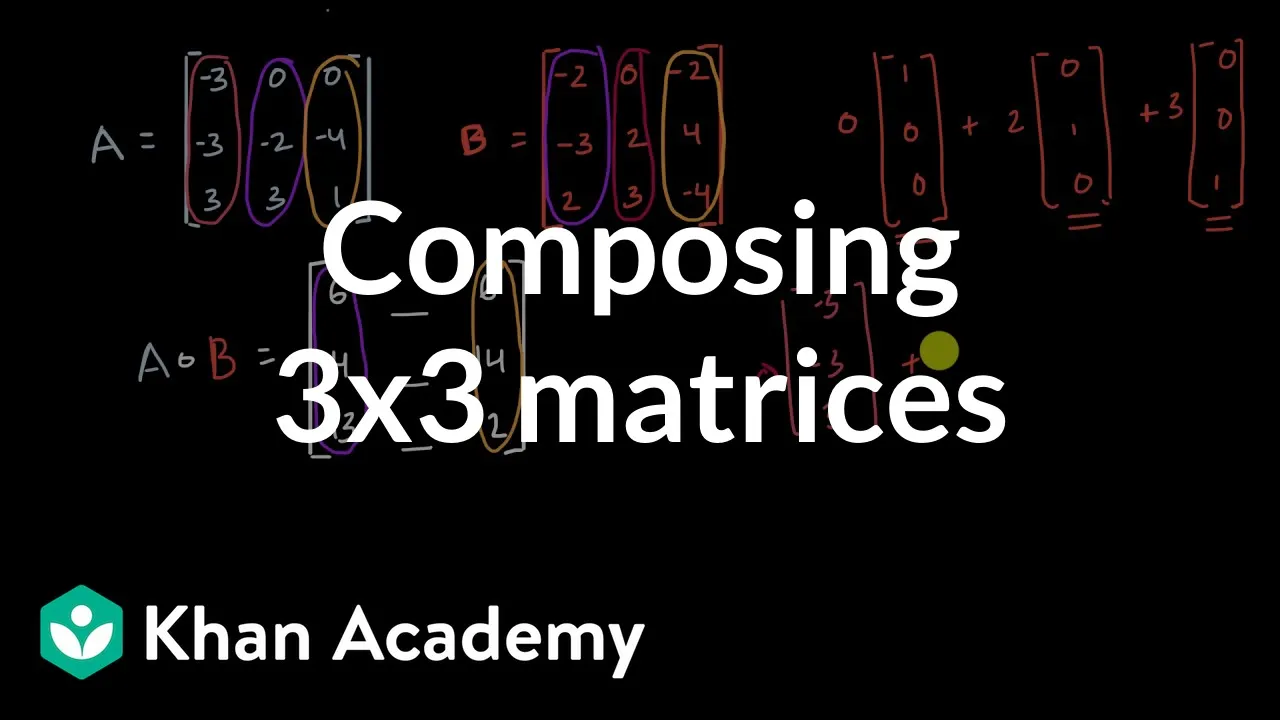 YouTube3:37
Prerequisite in Linear algebra: Matrices → Determinants.
Matrices · View learning sequence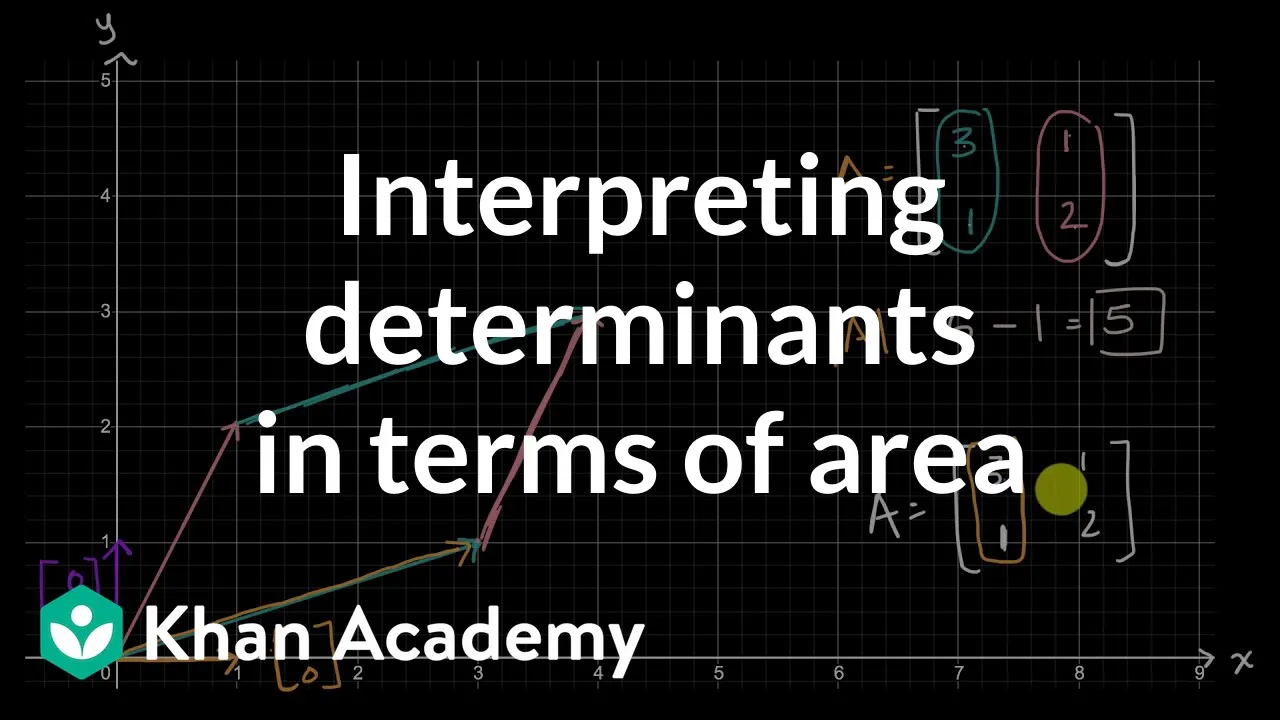 YouTube4:19
Prerequisite in Linear algebra: Matrices → Determinants.
Matrices · View learning sequenceYouTube4:19English video covering Determinants; the current video is in Chinese.
Determinants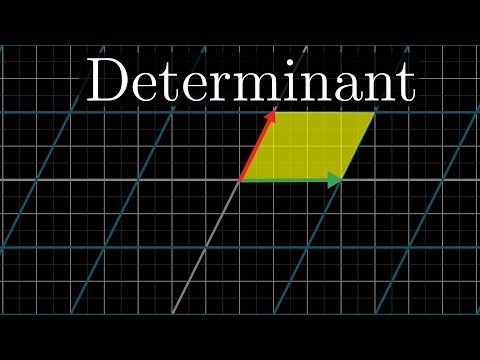 YouTube10:03
English video covering Determinants; the current video is in Chinese.
Determinants YouTube3:26
English video covering Determinants; the current video is in Chinese.
DeterminantsYouTube4:19Explanation of Determinants, complementing the current application.
DeterminantsYouTube10:03Explanation of Determinants, complementing the current application.
DeterminantsYouTube3:26Explanation of Determinants, complementing the current application.
Determinants