Chain rule concept
The video defines the chain rule as the rule for differentiating a composition of functions: take the derivative of the outer function and multiply by the derivative of the inner function.
Mario's Math Tutoring · YouTube · 3:55
This 180-second whiteboard segment teaches the chain rule by first stating it verbally as the derivative of an outer function times the derivative of an inner function, then working example a) in full with , du/dx=3, , dy/du=, and /du·du/dx to reach . The instructor then shows a faster shortcut for power-composite functions and applies the same chain-rule pattern to example b) , obtaining -2sin(2x). Examples c) and d) are visible on the board but not solved in this clip. This 55-second whiteboard segment works one calculus example from a chain-rule lesson: . The instructor first applies the power rule to the outer fourth power, producing , then stresses that the inside must still be differentiated. Because the inside is a quotient, he invokes the quotient rule with the mnemonic "low d high minus high d low over the square of what's below," yielding the second factor []/()^2. The final displayed derivative is the product of those two factors, left unsimplified.
Use the learning inspector for key ideas and moments, or open the reading tabs for the complete notes.
Generated from the video's visuals and explanation; not verbatim speech.
The clip opens on a whiteboard titled HOW TO USE CHAIN RULE FOR DERIVATIVES with four examples listed. The instructor states the core idea in words: the chain rule handles a composition of functions by differentiating the outer function and multiplying by the derivative of the inner function.
He begins example a), , by identifying the inner expression. On the board he writes , turning the composite into an outer power function and an inner linear function.
Next he differentiates the inner part, writing du/dx=3. In speech he notes that the derivative of -2 is 0 and the derivative of 3x is 3 by the power rule.
He then rewrites the original function as and differentiates the outer function with respect to u, producing dy/du=. The spoken explanation matches the written rule: bring down the exponent and subtract one.
The key formula appears on the board as /du · du/dx. Substituting the two computed pieces gives , and then replacing u with 3x-2 yields the final derivative .
After completing the full substitution method, the instructor remarks that it was a long process and introduces a shortcut for cases where a quantity is raised to a power. He writes y'=, showing the same result more directly.
He moves to example b), . Using the known derivative of cosine, he writes the outer derivative as -sin(2x), then multiplies by the derivative of the inside, 2, giving y'=-sin(2x)·2 and simplifying to y'=-2sin(2x).
At the end of the clip he points toward the remaining examples and says he will look at a couple more, but no further solution is developed within this segment.
The clip opens on a whiteboard titled "HOW TO USE CHAIN RULE FOR DERIVATIVES," with example c) written as . The instructor begins by treating the whole fraction as the inside of an outer power function.
He applies the power rule to that outer layer: bring the exponent 4 down in front and reduce the power from 4 to 3, while keeping the base unchanged for the moment. This gives the first factor .
He then emphasizes that this is not yet the full derivative. Because the original function is composite, the chain rule requires a second factor: the derivative of the inside function (2x - 5)/().
Looking at that inside expression, he identifies it as a quotient. Therefore the inner derivative must be computed with the quotient rule rather than with a single elementary rule.
To recall the quotient rule, he uses the mnemonic "low d high minus high d low over the square of what's below." In this problem, high = 2x - 5 and low = .
He writes the numerator of the inner derivative as ()(2) - (2x - 5)(6x): first low times d high, since the derivative of 2x - 5 is 2, then minus high times d low, since the derivative of is 6x.
The denominator of that inner derivative is the square of the original denominator, namely ()^2. Putting the pieces together, the second factor is []/()^2.
The final displayed answer is the product y' = . He notes that algebraic simplification could continue, but intentionally stops here with the unsimplified form.
The video defines the chain rule as the rule for differentiating a composition of functions: take the derivative of the outer function and multiply by the derivative of the inner function.
To apply the chain rule formally, the instructor sets the inner expression equal to u, writing , so the original function becomes .
Differentiating the inner linear expression gives du/dx=3 because the derivative of 3x is 3 and the derivative of -2 is 0.
Differentiating the outer power function with respect to u gives dy/du= by the power rule.
The board combines the two pieces with /du · du/dx, then substitutes to get and finally back-substitutes .
Instead of writing all substitution steps, the instructor shows a faster pattern: bring down the exponent, reduce it by one, keep the inside unchanged, and multiply by the derivative of the inside.
For , the derivative of the outer cosine is -sin(2x), and the derivative of the inner 2x is 2, so the final derivative is -2sin(2x).
When a function has an outer operation applied to an inner function, differentiate the outer part first while leaving the inner expression intact, then multiply by the derivative of the inner expression. In this clip, the outer operation is the fourth power and the inner operation is the quotient (2x - 5)/().
For a quantity raised to a constant power, bring the exponent down as a coefficient and subtract 1 from the exponent. Applied here, ((2x - 5)/())^4 contributes the factor before the inner derivative is attached.
The instructor remembers the quotient rule as "low d high minus high d low over the square of what's below." Translated into symbols, if high is the numerator and low is the denominator, the derivative is (low·high' - high·low')/low^2. This is used to differentiate the inner quotient.
Starting from , the outer power rule gives . The inner quotient derivative is []/()^2. Multiplying these factors yields the final unsimplified derivative shown on the board.
The reviewed lesson identifies inner and outer functions, combines their derivatives, obtains ² and −, and applies the quotient rule inside an outer fourth power.
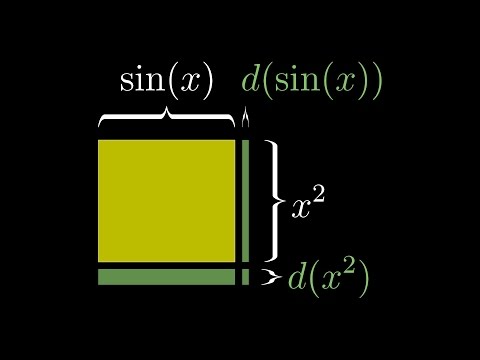 YouTube15:56
Another explanation of Chain rule.
Chain rule Bilibili5:38
Prerequisite in Calculus: Derivatives → Chain rule.
Derivatives · View learning sequence YouTube23:31
Prerequisite in Calculus: Derivatives → Chain rule.
Derivatives · View learning sequence YouTube2:39
Prerequisite in Calculus: Derivatives → Chain rule.
Derivatives · View learning sequenceYouTube15:56Visual explanation for Chain rule, compared with the current whiteboard.
Chain rule