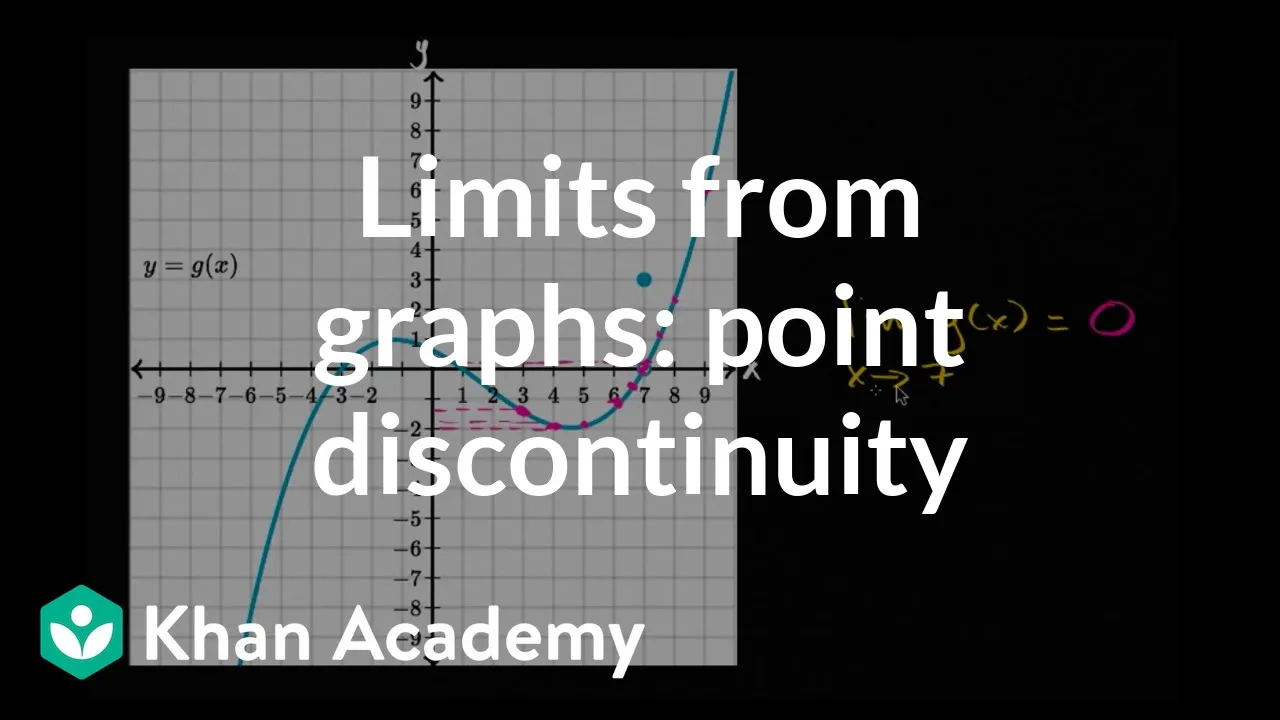
Three conditions
At an interior point a, continuity requires that is defined, the two-sided limit exists, and that limit equals . Check the correct branch on each side.
The Organic Chemistry Tutor · YouTube · 10:10
Apply the continuity test to piecewise functions and distinguish jumps from removable discontinuities.
Use the learning inspector for key ideas and moments, or open the reading tabs for the complete notes.
Generated from the video's visuals and explanation; not verbatim speech.
At an interior point a, continuity requires that is defined, the two-sided limit exists, and that limit equals . Check the correct branch on each side.
At in the first example, the left limit is 7 and the right limit is 11. Their mismatch prevents a two-sided limit and produces a jump.
In the second example, both one-sided limits at equal 3, but . The limit exists; redefining this single function value as 3 would restore continuity.
At an interior point a, continuity requires that is defined, the two-sided limit exists, and that limit equals . Check the correct branch on each side.
At in the first example, the left limit is 7 and the right limit is 11. Their mismatch prevents a two-sided limit and produces a jump.
In the second example, both one-sided limits at equal 3, but . The limit exists; redefining this single function value as 3 would restore continuity.
At an interior point a, continuity requires that is defined, the two-sided limit exists, and that limit equals . Check the correct branch on each side. At in the first example, the left limit is 7 and the right limit is 11. Their mismatch prevents a two-sided limit and produces a jump. In the second example, both one-sided limits at equal 3, but . The limit exists; redefining this single function value as 3 would restore continuity.
Continuity at a point requires the two-sided limit to exist and equal the function value. The two-sided limit exists only if the left-hand limit and the right-hand limit are equal.
Conditions: The point is an interior point of the domain.; The left-hand limit and right-hand limit are finite but unequal.
A jump discontinuity is identified when the left-hand limit and the right-hand limit at a point exist but are not equal. Because the one-sided limits differ, the two-sided limit does not exist, preventing the function from being continuous at that point.
Conditions: The function is defined on both sides of the point.; The left-hand limit and right-hand limit both exist as finite numbers.; The left-hand limit does not equal the right-hand limit.
A removable discontinuity occurs when the two-sided limit exists at a point, but the function is either undefined there or the function value does not equal the limit. Specifically, if the left and right limits are equal (e.g., both equal 3) but is different (e.g., 5), the discontinuity is removable.
Conditions: The left-hand limit and right-hand limit at the point are equal.; The two-sided limit exists.; Either is undefined or .
For a function to be continuous at an interior point , three conditions must be met: first, the function value must be defined; second, the two-sided limit must exist; and third, this limit must equal the function value . When checking the limit for piecewise functions, you must evaluate the correct branch on each side of .
Conditions: The point is an interior point of the domain.; The function is defined piecewise or has branches around .
A removable discontinuity can be restored to continuity by redefining the function value at the point of discontinuity to equal the existing two-sided limit. Since the limit already exists (left and right limits are equal), setting satisfies all three conditions for continuity.
Conditions: The two-sided limit exists at the point .; The current function value is either undefined or different from the limit.
A two-sided limit is considered to exist if and only if both the left-hand limit and the right-hand limit exist and are equal to the same finite value. If they are unequal, the two-sided limit does not exist.
Conditions: The function is defined in a neighborhood around (excluding possibly itself).; We are evaluating the limit as approaches .
The key difference lies in the existence of the two-sided limit. In a jump discontinuity, the left and right limits exist but are unequal, so the two-sided limit does not exist.
Conditions: Comparing two types of discontinuities at an interior point.; One-sided limits are finite in both cases.
Piecewise functions are defined by different formulas on different intervals. To determine the limit as approaches a boundary point , you must use the formula valid for for the left-hand limit and the formula valid for for the right-hand limit.
Conditions: The function is defined piecewise.; The point is a boundary between branches.
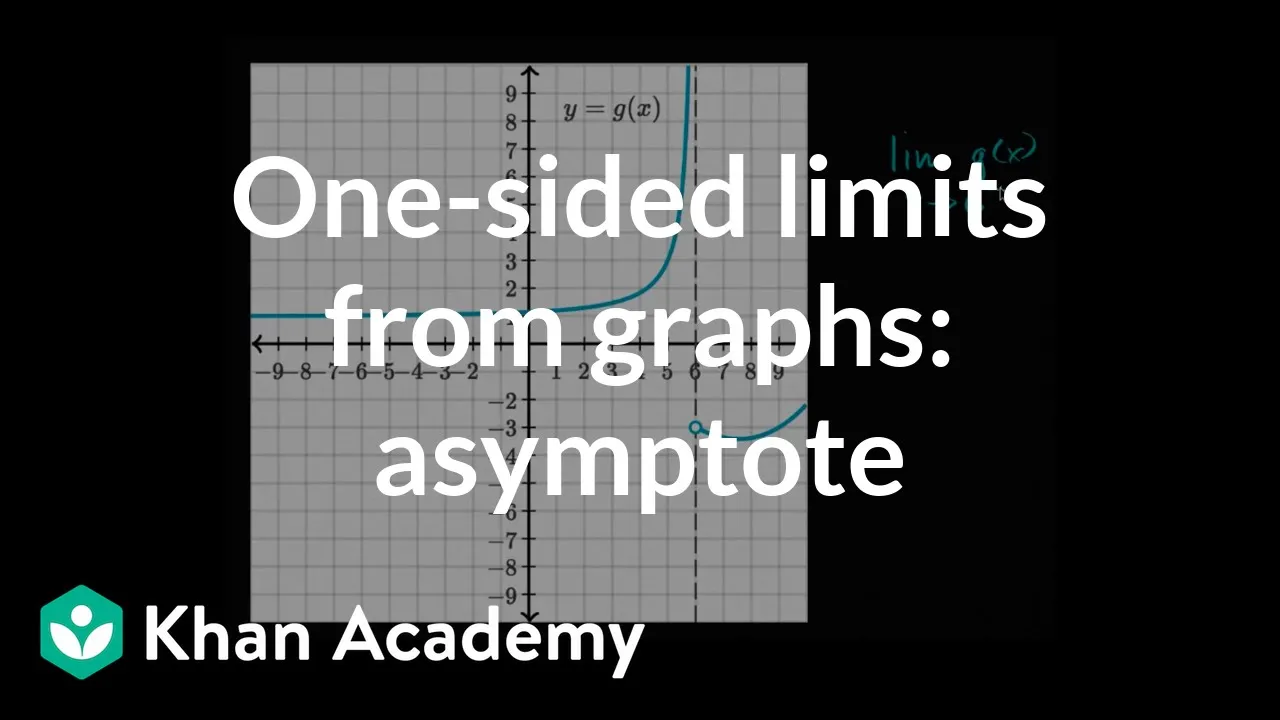 YouTube2:26
Prerequisite in Calculus: Limits → Continuity.
Limits · View learning sequence YouTube7:37
Next in Calculus: Continuity → Mean value theorem.
Mean value theorem · View learning sequence YouTube4:59
Next in Calculus: Continuity → Fundamental theorem of calculus.
Fundamental theorem of calculus · View learning sequence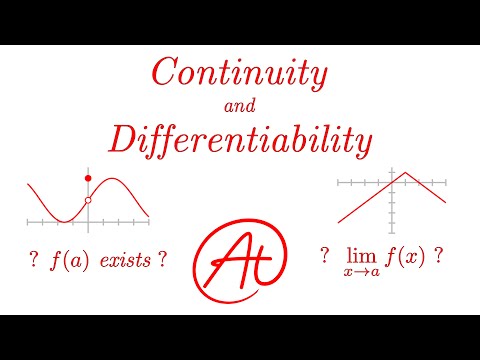 YouTube5:32
Visual explanation for Continuity, compared with the current whiteboard.
Continuity