Special directions
A nonzero vector v is an eigenvector when . The scalar may be negative or zero, so the transformed vector can reverse direction or collapse to zero.
Xu Chen · YouTube · 16:38
Explain eigenvectors as special directions, then use an eigenbasis to simplify a linear transformation and its powers.
Use the learning inspector for key ideas and moments, or open the reading tabs for the complete notes.
Generated from the video's visuals and explanation; not verbatim speech.
A nonzero vector v is an eigenvector when . The scalar may be negative or zero, so the transformed vector can reverse direction or collapse to zero.
If eigenvectors form a basis and , linearity gives . Each eigenvector component is scaled separately.
With an invertible eigenvector matrix T, write . Then ; a complete eigenbasis is required for this method.
A nonzero vector v is an eigenvector when . The scalar may be negative or zero, so the transformed vector can reverse direction or collapse to zero.
If eigenvectors form a basis and , linearity gives . Each eigenvector component is scaled separately.
With an invertible eigenvector matrix T, write . Then ; a complete eigenbasis is required for this method.
A nonzero vector v is an eigenvector when . The scalar may be negative or zero, so the transformed vector can reverse direction or collapse to zero. If eigenvectors form a basis and , linearity gives . Each eigenvector component is scaled separately. With an invertible eigenvector matrix T, write . Then ; a complete eigenbasis is required for this method.
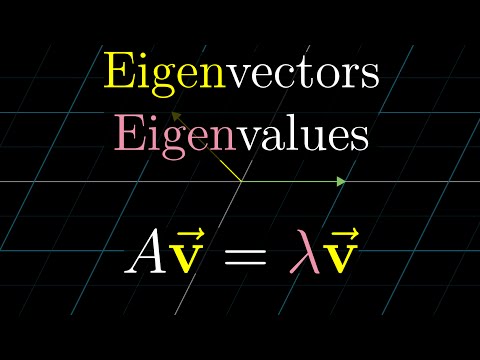 YouTube17:15
Another explanation of Eigenvalues and eigenvectors.
Eigenvalues and eigenvectors YouTube6:25
Another explanation of Eigenvalues and eigenvectors.
Eigenvalues and eigenvectors Bilibili4:27
Prerequisite in Linear algebra: Linear transformations → Eigenvalues and eigenvectors.
Linear transformations · View learning sequence YouTube3:37
Prerequisite in Linear algebra: Linear transformations → Eigenvalues and eigenvectors.
Linear transformations · View learning sequence YouTube13:52
Prerequisite in Linear algebra: Linear transformations → Eigenvalues and eigenvectors.
Linear transformations · View learning sequenceYouTube17:15Visual explanation for Eigenvalues and eigenvectors, compared with the current whiteboard.
Eigenvalues and eigenvectors