Reviewed learning material · Video analysis · EnglishRead the full overview
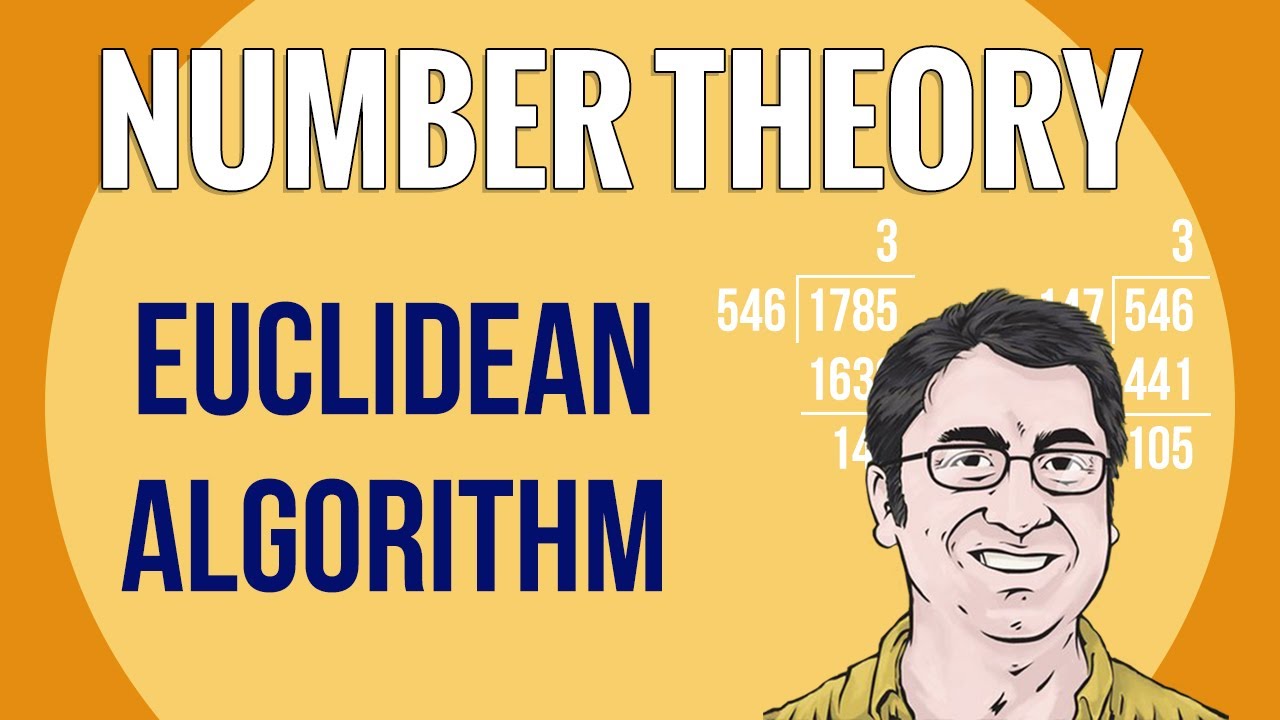
This Mandarin lesson starts from the greatest common divisor and divisibility, then works with positive integers a≥b>0. For a=q1b+r1, the old gcd remains a common divisor of the new pair, and every common divisor of the new pair is bounded by it; this proves gcd(a,b)=gcd(b,r1). The remainder chain leads to an iterative C++ implementation. The complete example uses 1160718174 and 316258250, makes 10 divisions and returns 1078. Notes distinguish the source proof from editorial clarification of domains, immediate divisibility and finite positive-integer descent.
Use the learning inspector for key ideas and moments, or open the reading tabs for the complete notes.
Generated from the video's visuals and explanation; not verbatim speech.
This segment first establishes the topic: the video discusses the "Greatest Common Divisor" and previews the subsequent introduction of the Euclidean algorithm. The title page also provides historical background on Euclid, indicating that this concept is related to the classical number theory tradition.
The two conditions for the greatest common divisor respectively specify whether it is a common factor and whether it satisfies maximality: c divides both a,b, and any common factor of the two numbers divides c. This must be understood as a common factor; numbers dividing only one of the inputs are not within the condition. This site also explicitly writes out the positive number convention and the scope of inputs not both zero.
For integers a,b not both zero, gcd(a,b) is the maximum among the common positive factors. Changing the sign of the inputs does not change the common factors, so gcd(a,b)=gcd(∣a∣,∣b∣). When both are zero, this maximum value definition cannot be used; this boundary is a scope supplement by this site.
Finally, the video supplements a key point at the notation level: the divisibility symbol "|" has a direction. k|a means the left-side k divides the right-side a, equivalent to the existence of an integer m such that a=mk. Here it specifically emphasizes that the left and right terms are the divisor and dividend respectively, to avoid beginners reading the divisibility relation backwards.
This segment continues to explain the divisibility notation: k∣a means there exists an integer m such that a=mk. The second condition in the definition targets common divisors, not just divisors of one input. This site explicitly states that the greatest common divisor is a positive integer and the inputs are not both zero; taking the absolute value of the inputs does not change the common divisors.
The page switches to 'Proof of the Euclidean Algorithm'. Here, the problem is first fixed: to find the greatest common divisor of integers a and b, assuming a≥b>0. Then the greatest common divisor is denoted as d, immediately yielding three basic facts: d|a, d|b, d=gcd(a,b). These three are not new theorems, but premises taken directly from the previous definition of the greatest common divisor; all subsequent derivations will revolve around them.
The next step introduces division with remainder. The screen writes a=q1⋅b+r1, noting q1=⌊a/b⌋, 0≤r1<b. To ground the symbols, the video names the four terms in the formula: a is the dividend, q1 is the quotient, b is the divisor, and r1 is the remainder; the screen also pops up four label boxes in sequence, aligning the terminology with the symbols. The mathematical role here is clear: it transforms the original pair (a,b) into a new pair (b,r1), preparing for comparing the two sets of greatest common divisors later.
The number line concretizes a=qn+r as 70=4×15+10. 60 is the previous multiple of 15, and 70 is 10 more than it, so the remainder is 10; 60 to 75 is a complete step of 15. The remainder represents the distance exceeding the previous multiple, not the distance short of the next multiple.
Finally, returning to the proof page, the video proposes the core proposition of the Euclidean algorithm: the greatest common divisor of a and b is equivalent to the greatest common divisor of b and r1. Immediately after, it begins the first half of the 'careful argument': from ① d|a and ② d|b, we know d divides a−q1⋅b; then according to division with remainder a−q1⋅b=r1, we get ④ d∣r1. Thus d simultaneously divides b and r1, so d is a common divisor of b and r1. The clip ends here; subsequently, it should continue to argue maximality and the reverse inclusion relationship to complete the full proof of gcd(a,b)=gcd(b,r1).
Continue proving gcd(a,b)=gcd(b,r1). Current integer conditions are a≥b>0, and a=q1b+r1, 0≤r1<b. The original greatest common divisor is denoted d; subsequently, we will prove it remains a common factor of the new pair, and that any common factor of the new pair does not exceed it.
Next, let's prove one direction first. Since d=gcd(a,b), we have d∣a and d∣b. Divisibility is closed under linear combinations, so d also divides a−q1b. From a=q1b+r1, we get a−q1b=r1, thus d∣r1. Combining d∣b and d∣r1 shows that d is simultaneously a common factor of b and r1. This step addresses that "the original greatest common divisor d is at least still a common factor of the new pair."
Then prove maximality, which is the other direction. Take an arbitrary integer c such that c is a common factor of b and r1, i.e., c∣b and c∣r1. Still using the closure of divisibility under linear combinations, we get c∣(q1b+r1). Since q1b+r1=a, we have c∣a. Combining with c∣b, we know c is also a common factor of a and b. Because d=gcd(a,b) is the greatest common divisor of a and b, any such c must satisfy c≤d.
Finally, combine the two parts: We already proved d itself is a common factor of b and r1, and now we proved any common factor c of b and r1 does not exceed d. Thus, the greatest common divisor of b and r1 is exactly d, i.e., cmax=d=gcd(b,r1). This completes the proof of gcd(a,b)=gcd(b,r1), concluding with "Q.E.D." on the page.
At the end of the segment, the screen switches to the next page, with the title changing to "3. Thoughts After the Proof." This indicates the formal proof has ended, and the video is preparing to enter subsequent discussion; however, this segment only captures the appearance of the new title, without expanding on the substantive content of this section.
The title of this page is "3. Thoughts After Proof". Its purpose is not to re-prove, but to compress the key idea of the Euclidean algorithm into a memorable substitution rule.
The video first points out: when finding gcd(a,b), you can convert the problem to finding gcd(b,r1), where r1 is the remainder of a divided by b.
This rule written as a formula is gcd(a,b)=gcd(b,amodb). Here a is the input called the "larger number", b is the input called the "smaller number", and a mod b is the remainder of the first division with remainder.
Next, the video explains the significance of doing so: the original problem of "finding the greatest common divisor of two numbers" is transformed into the problem of "finding the greatest common divisor of a smaller number and a remainder", so the problem scale becomes smaller.
If this process is executed repeatedly, continuing until no remainder is produced anymore, this is exactly the meaning of "successive division", hence the Euclidean algorithm is also called the "successive division method".
The formulas on the right fully expand this iterative process: a=q1b+r1, b=q2r1+r2, r1=q3r2+r3, and so on, each step maintaining the form of "dividend = quotient × divisor + remainder".
From these equations, we can see that the parameter pairs of gcd are constantly being substituted: first (a,b), then (b,r1), then (r1, r2), all the way to (rn−2, rn−1), finally landing on (rn, rn−1).
The termination sign appears in the second-to-last row: rn−1=qn+1rn+0. This indicates that rn can divide rn−1, and the iteration stops here.
Thus, the video gives the conclusion: the greatest common divisor d equals the last non-zero remainder rn, i.e., d=gcd(a,b)=rn. Note that the answer is not the final 0, but the rn preceding the 0.
This page first condenses the essence of the Euclidean algorithm into one sentence: it is not directly calculating the greatest common divisor, but performing a kind of "transformation". The right side of the screen gives continuous equations of division with remainder, starting from a=q1b+r1, followed by b=q2r1+r2, then r1=q3r2+r3, all the way to the last rn−1=qn+1rn+0. The text on the left simultaneously points out its significance: constantly reducing "finding the greatest common divisor of two numbers" to "finding the greatest common divisor of the smaller number and the remainder", that is, gcd(a,b)=gcd(b,amodb). The mathematical basis here is division with remainder and the recursive property of the greatest common divisor, resulting in the problem size gradually becoming smaller. The next natural question is: when does it stop? The answer is written in the last line: when the remainder is 0, the last non-zero remainder rn is d=gcd(a,b).
Next, the screen switches to the C++ implementation page, translating the mathematical recursion just mentioned into a program. The function signature is int greatestCommonDivisor(int a, int b), and the comment explicitly states the parameter requirement a≥b>0, and the narrator also reminds that this step needs to be controlled by the caller. The function body first calculates int r=a%b, which is the initial remainder; then enters the while(r>0) loop. Inside the loop, it sequentially executes a=b; b=r; r=a%b;, these three sentences exactly correspond to the mathematical replacement of number pairs: the old divisor becomes the new dividend, the old remainder becomes the new divisor, and then calculate the remainder again. The comment gcd(a,b)=gcd(b,r) on the screen is explaining this correspondence. Because the loop condition is r>0, it exits when the remainder first becomes 0, and the b returned at this time is exactly the last non-zero remainder, which is the greatest common divisor. The bottom of the page also notes that the runtime environment is VS2019.
Then it enters the test case page, first using the program to verify whether the implementation is correct. The code gives specific inputs a=1160718174, b=316258250, and calls greatestCommonDivisor(a,b). The debug window below shows that the function has returned 1078, and the value of the variable gcd is also 1078. The role of this step is to confirm that the previous C++ code can run and output results on real large integer samples. Immediately after, the video is not satisfied with just looking at the program's black-box return value, but continues to expand the same example into a manual calculation process, checking how many times successive division it actually went through.
The last table completely lists the ten rounds of iteration for the example. The first row is 1160718174=3×316258250+211943424, so gcd is reduced to gcd(316258250,211943424); the second row 316258250=1×211943424+104314826; the third row 211943424=2×104314826+3313772; then sequentially obtaining 1587894, 137984, 70070, 67914, 2156, 1078. By the ninth row, it is 67914=31×2156+1078, and the tenth row is 2156=2×1078+0. According to the termination rule explained earlier, when the remainder is 0, the answer is the last non-zero remainder, so d=gcd(1160718174,316258250)=1078. The table contains ten divisions and agrees with the program output. The table and conclusion are kept until the end, and then the explanation finishes.
Knowledge cards
01
Greatest Common Divisor
A positive integer c is the greatest common divisor of a,b if it divides both numbers simultaneously, and every common factor of the two numbers divides c. The factors here are common factors and cannot belong to only one of the numbers. This site explicitly defines the scope as a,b not both zero; the positive number convention avoids confusing c with −c.
c=gcd(a,b)⟺c>0∧c∣a∧c∣b∧[∀d∈Z>0,(d∣a∧d∣b)⇒d∣c]
02
Equivalent Definition of the Greatest Common Divisor
For integers a,b not both zero, the greatest common divisor is the largest positive integer dividing them simultaneously. Changing the sign of the inputs does not change the common factors, so one can take absolute values first. This site explicitly excludes the case where both are zero: this case cannot use this maximum value definition.
The video emphasizes that the divisibility notation "|" distinguishes the divisor and dividend: in k|a, the left side k is the divisor, and the right side a is the dividend, equivalent to a=mk.
k∣a⟺∃m∈Z,a=mk
04
Two-condition definition of the greatest common divisor
A positive integer c is a common divisor of the two inputs, and any common positive divisor of them divides c. A common divisor is not just a divisor of one of the numbers; this site explicitly states that the inputs are integers not both zero.
c=gcd(a,b)⟺c>0∧c∣a∧c∣b∧[∀t∈Z>0,(t∣a∧t∣b)⇒t∣c]
05
Equivalent set definition of gcd
The greatest common divisor is the maximum value among the common positive divisors. This site explicitly states that the inputs are not both zero, avoiding the case where the set has no maximum when both are zero.
gcd(a,b)=max{k∈Z>0:k∣a∧k∣b}
06
Direction of the divisibility symbol |
k|a is read as 'k divides a', meaning there exists an integer m such that a=mk. The video specifically reminds: the left side of the vertical bar is the divisor, and the right side is the dividend; do not reverse them.
k∣a⟺∃m∈Z,a=mk
07
gcd is insensitive to signs
Changing the signs of the inputs does not change the common divisors, therefore for integers not both zero, the greatest common divisor can be calculated after taking absolute values.
Initial setup for the proof of the Euclidean algorithm
At the beginning of the proof, without loss of generality, assume a≥b>0, and denote the greatest common divisor of a and b as d. From this, three basic facts are immediately obtained: d|a, d|b, and d=gcd(a,b).
09
Definition of division with remainder
The video uses division with remainder to decompose a into quotient times divisor plus remainder: a=q1⋅b+r1, where q1=⌊a/b⌋, and 0≤r1<b. The four terms are named Dividend, Quotient, Divisor, and Remainder respectively.
a=q1⋅b+r1,q1=⌊a/b⌋,0≤r1<b
10
Understanding remainder via number line
In the general diagram a=qn+r, a falls between qn and (q+1)n, and the remainder r is the distance from qn to a. For 70=4×15+10, the distance from 60 to 70 is10, which is the remainder.
a=qn+r,0≤r<n
11
Introducing the GCD-preservation invariant
The key identity is gcd(a,b)=gcd(b,r1). The argument begins by showing that d divides both b and r1; the following proof then shows that every common divisor of the new pair also divides the original inputs and cannot exceed d.
gcd(a,b)=gcd(b,r1)
12
Initial Setup for Euclidean Algorithm Proof
The video first restricts the problem to integers a and b, assuming a≥b>0. Let d=gcd(a,b), and use the division algorithm to introduce q1 and r1, such that a=q1b+r1 and 0≤r1<b. The goal of the entire proof is to show that replacing (a,b) with (b,r1) leaves the greatest common divisor unchanged.
a≥b>0,d=gcd(a,b),a=q1b+r1,0≤r1<b
13
First Direction: d is a Common Factor of b and r1
From d=gcd(a,b), we get d∣a and d∣b. Since divisibility is closed under linear combinations, d∣(a−q1b). Also, a−q1b=r1, so d∣r1. Combining with d∣b, we know d is simultaneously a common factor of b and r1. This step establishes that "the old greatest common divisor still belongs to the set of common factors of the new pair."
d∣a∧d∣b⇒d∣(a−q1b)⇒d∣r1
14
Second Direction: Any Common Factor c Does Not Exceed d
Take an arbitrary c as a common factor of b and r1, so c∣b and c∣r1, thus c∣(q1b+r1). Since q1b+r1=a, we get c∣a; combining with c∣b, we know c is also a common factor of a and b. Because d=gcd(a,b), we have c≤d. This step shows that any common factor of the new pair will not exceed the original greatest common divisor.
c∣b∧c∣r1⇒c∣(q1b+r1),q1b+r1=a⇒c∣a,c≤d
15
Core Conclusion: gcd(a,b)=gcd(b,r1)
Merge the two directions: On one hand, d=gcd(a,b) itself is a common factor of b and r1; on the other hand, any common factor c of b and r1 satisfies c≤d. Therefore, the greatest common divisor of b and r1 is exactly equal to d, i.e., gcd(b,r1)=d=gcd(a,b). This is the correctness of one reduction step in the Euclidean algorithm.
gcd(a,b)=gcd(b,r1)
16
Two Linear Combinations in the Proof Structure
Analyst addition: The key to this proof lies not in a single fixed transformation, but in using different linear combinations for the two directions. The first direction uses a−q1b=r1 to transfer common factors of a and b to b and r1; the second direction uses q1b+r1=a to transfer common factors of b and r1 back to a and b. Understanding the difference between these two directions helps avoid misremembering the proof as a single-step identity transformation.
17
Euclidean Algorithm
Following the positive integer condition a≥b>0 from the previous part, first find the remainder of a divided by b, then replace the inputs with the divisor and remainder. This preserves the greatest common divisor and makes the positive remainder smaller for continuing iterations.
gcd(a,b)=gcd(b,amodb)
18
Why Called "Successive Division Method"
In each round, take the previous round's divisor as the new dividend, and the previous round's remainder as the new divisor, until the remainder is 0. The original video explains this process via problem scale reduction; this site adds the finiteness reason: remainders for continuing iterations are strictly decreasing positive integers, thus cannot descend infinitely. If the first round already divides evenly, immediately return the initial divisor.
19
Chain of Consecutive Divisions with Remainder
The formulas on the right display the complete iterative structure: a=q1b+r1, b=q2r1+r2, r1=q3r2+r3, …, rn−2=qnrn−1+rn, rn−1=qn+1rn+0. Each row is a standard division with remainder, remainders strictly decrease, and finally 0 appears as the termination signal.
When the iteration proceeds to rn−1=qn+1rn+0, it indicates that rn divides rn−1, and the process ends. The video finally explicitly writes d=gcd(a,b)=rn, therefore the greatest common divisor is the last non-zero remainder rn, not the 0 appearing at termination.
d=gcd(a,b)=rn
21
Core Transformation of the Euclidean Algorithm
The video summarizes the Euclidean algorithm as a process of repeatedly "becoming smaller": instead of directly finding the greatest common divisor of a and b, it uses division with remainder to reduce the problem to finding the greatest common divisor of b and the remainder r. The formula page explicitly writes gcd(a,b)=gcd(b,amodb), and calls it "successive division". The key to this step is to use the divisor and remainder of the previous round to form a new pair of numbers each time.
gcd(a,b)=gcd(b,amodb)
22
Termination Condition: The Last Non-Zero Remainder
When successive division with remainder proceeds to a step where the remainder is 0, the algorithm stops. At this time, the answer is not 0, but the smaller number from the previous step, which is the last non-zero remainder rn. The formula page finally writes rn−1=qn+1rn+0, therefore d=gcd(a,b)=rn.
rn−1=qn+1rn+0⇒d=gcd(a,b)=rn
23
Structure of C++ Iterative Implementation
The code page gives the function int greatestCommonDivisor(int a,int b). It first calculates r=a%b. While r>0, it executes a=b, b=r and r=a%b in that order. These assignments turn the remainder invariant into state updates. After the loop, it returns b, the last nonzero remainder. The source comment gives a≥b>0 and the demonstration uses VS2019. Inputs are positive integers within the int range, with a nonzero divisor; if the first division is exact, the function immediately returns the initial divisor b.
int greatestCommonDivisor(int a, int b) { int r = a % b; while (r > 0) { a = b; b = r; r = a % b; } return b; }
24
Program Verification of Test Sample
The video uses a=1160718174, b=316258250 as test inputs, calling greatestCommonDivisor(a,b). The debug window shows that the function returns 1078, and the variable gcd is also 1078. The role of this segment is to verify that the previous code implementation can run correctly and provide a specific answer that can be checked.
greatestCommonDivisor(1160718174,316258250)=1078
Detailed learning notes
Explore conditions, steps and evidence. Supplementary explanations are labeled separately from content shown in the video.
Symbols · 46
gcd(a, b)
Clear evidence
Supplementary explanation
Evidence
Formula
Observation
The slide displays gcd(a,b)= max {k | k|a and k|b} as well as gcd(a,b)=gcd(∣a∣,∣b∣).
Audio
Observation
The narrator mentions the "greatest common divisor" and reads out the equivalent definition.
Symbol
gcd(a, b)
Meaning
the greatest common divisor of a and b
Domain
integer inputs not both zero; greatest common divisors and common factors are treated as positive integers (explicit scope of this site)
a, b, c
Clear evidence
Supplementary explanation
Evidence
Formula
Observation
The slide definition uses letters a, b, c to represent integers and their common divisors.
Symbol
a, b, c
Meaning
a and b are the integers whose greatest common divisor is sought, and c is a candidate for their greatest common divisor
Domain
integer inputs not both zero; greatest common divisors and common factors are treated as positive integers (explicit scope of this site)
|
Clear evidence
Shown in the video
Evidence
Formula
Observation
The slide uses k|a and k|b to denote divisibility relations.
Audio
Observation
The narrator specifically explains which term is the divisor and which is the dividend in the divisibility notation.
Symbol
|
Meaning
divisibility symbol; k|a means k divides a
Domain
divisibility relation between integers
k
Clear evidence
Supplementary explanation
Evidence
Formula
Observation
The equivalent definition is written as max {k | k|a and k|b}.
Symbol
k
Meaning
a common divisor that divides both a and b
Domain
integer inputs not both zero; greatest common divisors and common factors are treated as positive integers (explicit scope of this site)
|a|, |b|
Clear evidence
Shown in the video
Evidence
Formula
Observation
The slide gives gcd(a,b)=gcd(∣a∣,∣b∣).
Symbol
|a|, |b|
Meaning
the absolute values of a and b
Domain
absolute value on real numbers/integers
a, b
Clear evidence
Shown in the video
Evidence
Formula
Observation
The slide body writes gcd(a,b), and the Notes write k | a and a=mk.
Audio
Observation
Original audio explanation: k divides a is equivalent to a being equal to m times k.
Symbol
a, b
Meaning
The two integers whose greatest common divisor is being discussed.
Domain
Integers; further restricted to a≥b>0 in subsequent proof pages.
c
Clear evidence
Supplementary explanation
Evidence
Formula
Observation
The definition sentence on the first page states that c is called the greatest common divisor of a and b.
Symbol
c
Meaning
Candidate for the greatest common divisor.
Domain
Positive integer; integer inputs not both zero (scope explicitly stated on this site)
k
Clear evidence
Supplementary explanation
Evidence
Formula
Observation
The page writes gcd(a,b)=max{k, where k|a and k|b}, and the Notes also write k|a.
Audio
Observation
The narrator explains the roles of the left and right terms in the divisibility symbol |.
Symbol
k
Meaning
Candidate for a common divisor that divides both a and b.
Domain
Common positive divisor; integer inputs not both zero (scope explicitly stated on this site)
m
Clear evidence
Shown in the video
Evidence
Formula
Observation
The Notes provide a=mk.
Audio
Observation
The narrator reads k|a as 'a equals m times k'.
Symbol
m
Meaning
The multiplier such that a=mk holds.
Domain
Integer.
d
Clear evidence
Shown in the video
Evidence
Formula
Observation
The second page writes let d be the greatest common divisor of a and b, and lists d=gcd(a,b).
Audio
Observation
Original audio states: Let d be the greatest common divisor of a and b.
Symbol
d
Meaning
The greatest common divisor of a and b.
Domain
Positive integer.
q₁
Clear evidence
Shown in the video
Evidence
Formula
Observation
The page writes a=q1⋅b+r1, and q1= floor(a/b).
Audio
Observation
Original audio states: q1 is called the quotient.
Animation
Observation
At 152 seconds, a quotient label points to q1.
Symbol
q₁
Meaning
The quotient in division with remainder.
Domain
Integer.
r₁
Clear evidence
Shown in the video
Evidence
Formula
Observation
The page writes 0≤r1<b.
Audio
Observation
Original audio states: The value of r1 is between 0 and b; r1 is called the remainder.
Animation
Observation
At 157 seconds, the remainder label points to r1.
Symbol
r₁
Meaning
The remainder when a is divided by b.
Domain
Integer, satisfying 0≤r1<b.
Knowledge points · 20
Definition of the Greatest Common Divisor
Clear evidence
Supplementary explanation
Evidence
Formula
Observation
The slide title is "1. Definition of Greatest Common Divisor", listing two determining conditions.
Audio
Observation
The narrator explains condition one and condition two item by item.
Formula
Observation
This site clarifies the common factor, positive number convention, and the non-zero input scope; supplementary conditions are not attributed to the original video's exact words.
Definition
Explanation
c must be a common divisor of a,b, and any common divisor of the two numbers must divide c. This distinguishes whether it is a common divisor and whether it satisfies maximality; numbers dividing only one of the inputs are not included in the second condition. This site supplements the explicit scope of c>0 and inputs not both zero.
Formula
c=gcd(a,b)⟺c>0∧c∣a∧c∣b∧[∀d∈Z>0,(d∣a∧d∣b)⇒d∣c]
Conditions
Integers a,b are not both zero (scope note by this site)
c is a positive integer and divides both a,b
Any common positive divisor divides c
Prerequisites
gcd(a, b)
a, b, c
|
Equivalent Definition of the Greatest Common Divisor
Clear evidence
Supplementary explanation
Evidence
Formula
Observation
The slide writes gcd(a,b)= max {k | k|a and k|b}, and further writes gcd(a,b)=gcd(∣a∣,∣b∣).
Audio
Observation
The narrator explains that because the greatest common divisor sought is positive, it can be reduced to the absolute value form.
Formula
Observation
This site clarifies the common factor, positive number convention, and the non-zero input scope; supplementary conditions are not attributed to the original video's exact words.
Formula
Explanation
Defining gcd(a,b) as the maximum of the common positive divisors shows that changing the sign of the inputs does not affect the structure of common divisors; thus taking absolute values preserves the greatest common divisor. This site explicitly limits the inputs to not both zero.
Integers a,b are not both zero (this site explicitly excludes the case where the maximum cannot be taken)
k is a positive integer dividing both a,b
Prerequisites
Definition of the Greatest Common Divisor
k
|a|, |b|
Reading and Direction of Divisibility Notation
Clear evidence
Shown in the video
Evidence
Formula
Observation
The Notes at the bottom of the slide explain that the divisibility notation "|" distinguishes which is the dividend and which is the divisor, giving the example that k|a is equivalent to a=mk.
Audio
Observation
The narrator verbally emphasizes the roles of the left and right terms in the divisibility notation.
Method
Explanation
The video specifically explains the direction of the divisibility notation "|": the left side is the divisor, and the right side is the dividend. Taking k|a as an example, it is equivalent to the existence of an integer m such that a=mk.
Formula
k∣a⟺∃m∈Z,a=mk
Conditions
Used for divisibility relations between integers
The left side is the divisor, and the right side is the dividend
Prerequisites
|
k
Two-condition definition of the greatest common divisor
Clear evidence
Supplementary explanation
Evidence
Formula
Observation
The title of the first page is '1. Definition of Greatest Common Divisor'.
Formula
Observation
The body lists two conditions: 1. c is a divisor of a and b; 2. Any divisor of a and b is a divisor of c.
Definition
Explanation
A positive integer c is a common divisor of the two inputs, and any common positive divisor of them divides c. A common divisor is not just a divisor of one of the numbers; this site explicitly states that the inputs are integers not both zero.
Formula
c=gcd(a,b)⟺c>0∧c∣a∧c∣b∧[∀t∈Z>0,(t∣a∧t∣b)⇒t∣c]
Conditions
Integer inputs not both zero; the greatest common divisor takes a positive value (site scope statement).
The second condition quantifies over common positive divisors of the two inputs.
Prerequisites
Reading and roles of the divisibility notation
Set maximum definition of the greatest common divisor
Clear evidence
Supplementary explanation
Evidence
Formula
Observation
The page writes: The following is an equivalent definition: gcd(a,b)= max {k, where k | a and k | b}.
Definition
Explanation
The greatest common divisor is the maximum value among the common positive divisors. This site explicitly states that the inputs are not both zero, avoiding the case where the set has no maximum when both are zero.
Formula
gcd(a,b)=max{k∈Z>0:k∣a∧k∣b}
Conditions
Integer inputs not both zero (explicit scope of this site).
Candidates are common positive divisors.
Prerequisites
Two-condition definition of the greatest common divisor
Greatest common divisor is insensitive to signs
Clear evidence
Shown in the video
Evidence
Formula
Observation
Yellow text on the first page writes gcd(a,b)=gcd(a,−b)=gcd(−a,b)=gcd(−a,−b)=gcd(∣a∣,∣b∣).
Formula
Explanation
The video directly gives a chain of properties: changing the signs of a and b does not change the greatest common divisor, so the discussion can be reduced to the non-negative absolute value case.
Integer inputs not both zero (site scope statement).
Prerequisites
Two-condition definition of the greatest common divisor
Set maximum definition of the greatest common divisor
Reading and roles of the divisibility notation
Clear evidence
Shown in the video
Evidence
Formula
Observation
The Notes write that the divisibility symbol '|' distinguishes who is the dividend and who is the divisor. For example, k | a is equivalent to a=mk.
Audio
Observation
Original audio states: k divides a is equivalent to a being equal to m times k. Thus, the left term is the divisor, and the right term is the dividend.
Definition
Explanation
The video specifically explains the directionality of the vertical bar symbol: the left side is the divisor, and the right side is the dividend; k|a means there exists an integer m such that a=mk.
Formula
k∣a⟺∃m∈Z,a=mk
Conditions
k, a, and m are integers.
The video emphasizes this is a memory point, not a derivation.
Initial setup for the proof of the Euclidean algorithm
Clear evidence
Shown in the video
Evidence
Formula
Observation
The title of the second page is '2. Proof of Euclidean Algorithm'.
Formula
Observation
The body writes: To find the greatest common divisor of integers a and b, without loss of generality assume a≥b>0, and let d be the greatest common divisor of a and b.
Audio
Observation
Original audio states: Now we formally begin the proof of the Euclidean algorithm... without loss of generality assume a is greater than or equal to b, which is greater than 0.
Method
Explanation
When entering the proof, the video first fixes the goal: to find the greatest common divisor of integers a and b; then makes a sorting assumption without loss of generality a≥b>0, and denotes the greatest common divisor as d.
Conditions
a and b are integers.
The proof page explicitly assumes a≥b>0.
Prerequisites
Two-condition definition of the greatest common divisor
Set maximum definition of the greatest common divisor
Definition of division with remainder and names of the four terms
Clear evidence
Shown in the video
Evidence
Formula
Observation
The page writes: By the definition of division, we can obtain: a=q1⋅b+r1. (q1= floor(a/b), 0≤r1<b.)
Audio
Observation
The narration explains the division identity, the floor quotient and the nonnegative remainder bound.
Animation
Observation
From 149 to 158 seconds, the dividend, quotient, divisor and remainder labels appear in order.
Definition
Explanation
The video defines the key tool in the proof as division with remainder: a is written as q1b+r1, where q1 is the quotient, r1 is the remainder, and the remainder is strictly less than the divisor b. The screen also uses label boxes to name a, q1, b, and r1 as Dividend, Quotient, Divisor, and Remainder respectively.
Formula
a=q1⋅b+r1,q1=⌊a/b⌋,0≤r1<b
Conditions
Used in the context of integer division where a≥b>0.
The video does not separately prove this division definition, but cites it directly.
Prerequisites
Initial setup for the proof of the Euclidean algorithm
Initial Setup for the Correctness Proof of the Euclidean Algorithm
Clear evidence
Shown in the video
Evidence
Formula
Observation
The slide title is "2. Proof of Euclidean Algorithm." The text begins with "To find the greatest common divisor of integers a and b, without loss of generality assume a≥b>0. Let d be the greatest common divisor of a and b."
Audio
Observation
The narrator discusses the divisibility of a and b by d and subsequent derivations in this section.
Definition
Explanation
This segment enters the "Proof of Euclidean Algorithm" section. It first sets up the problem: given integers a and b, assume without loss of generality that a≥b>0. Let d be the greatest common divisor of a and b. Then, using the division algorithm, introduce quotient q1 and remainder r1 to establish the relationship between a, b, and r1, preparing to prove gcd(a,b)=gcd(b,r1).
Formula
a≥b>0,d=gcd(a,b),a=q1⋅b+r1,q1=⌊a/b⌋,0≤r1<b
Conditions
a and b are integers
The video explicitly assumes a≥b>0
q1 and r1 are defined by the division algorithm
From gcd(a,b) to d dividing b and r1
Clear evidence
Shown in the video
Evidence
Formula
Observation
The slide states "∵ Equations ① and ②, ∴ d∣(a−q1⋅b)=d∣r1 …④" and "∵ Equations ② and ④, ∴ d is simultaneously a common factor of b and r1."
Audio
Observation
The audio applies the divisibility of the GCD to the linear combination of the difference, concluding it divides the remainder, and thus is a common factor of the new pair.
Method
Explanation
This method first uses d=gcd(a,b) to obtain d∣a and d∣b. Then, utilizing the property that divisibility is closed under linear combinations, it derives d∣(a−q1b). Since a−q1b=r1, it follows that d∣r1. Combining this with d∣b, we conclude that d is a common factor of both b and r1. This step proves the direction that "an element d from the set of common factors of (a,b) belongs to the set of common factors of (b,r1)."
Formula
d∣a∧d∣b⇒d∣(a−q1b)⇒d∣r1
Conditions
d=gcd(a,b) has been established
a=q1b+r1 has been used
Property that divisibility is closed under linear combinations is used
Prerequisites
Initial Setup for the Correctness Proof of the Euclidean Algorithm
Proving d is the Greatest Common Divisor of b and r1
Clear evidence
Shown in the video
Evidence
Formula
Observation
The lower half of the proof takes an arbitrary common factor c of the new pair, uses q1b+r1=a to restore c's divisibility of a; since c is also a common factor of the original pair, c≤d. Combined with d itself dividing b and r1, it concludes the GCD of the new pair equals d.
Audio
Observation
The narrator sequentially explains taking an arbitrary c, restoring c|a via linear combination of sum, comparing c with the original GCD d, and finally merging with the first half to get the same GCD.
Method
Explanation
After completing the proof that "d is a common factor of b and r1, " the video proceeds to prove maximality: take any common factor c of b and r1. Then c∣b and c∣r1, so c divides their linear combination q1b+r1. Since q1b+r1=a, we get c∣a. Given c∣b, c is also a common factor of a and b. Because d=gcd(a,b), any common factor of a and b cannot exceed d, so c≤d. Combining this with the previously proven fact that d itself is a common factor of b and r1, we know the greatest common divisor of b and r1 is exactly d.
c is taken as an arbitrary common factor of b and r1
a=q1b+r1 is used
Maximality definition of d=gcd(a,b) is used
Prerequisites
Initial Setup for the Correctness Proof of the Euclidean Algorithm
From gcd(a,b) to d dividing b and r1
Claims and conditions · 7
Introducing the GCD-preservation invariant
Clear evidence
Shown in the video
Evidence
Formula
Observation
New yellow text on the page writes: Boldly hypothesize: the greatest common divisor of a and b is equivalent to the greatest common divisor of b and r1.
Audio
Observation
Original audio states: Next, let us boldly hypothesize that the greatest common divisor of a and b is equivalent to the greatest common divisor of b and r1.
Uncertainties
At the end of the clip, only this proposition to be proved is proposed, without a complete proof.
Proposition
Statement
Under the current setup, the video proposes the proposition to be proved: gcd(a,b) is equivalent to gcd(b,r1).
Hypotheses
a and b are integers.
a≥b>0.
a=q1⋅b+r1, and 0≤r1<b.
Quantifiers
For integers a and b satisfying the above conditions and their remainder r1 from division with remainder.
Core Proposition of Euclidean Algorithm: gcd(a,b)=gcd(b,r1)
Clear evidence
Shown in the video
Evidence
Formula
Observation
The slide first states "Bold Hypothesis: The greatest common divisor of a and b is equivalent to the greatest common divisor of b and r1, " then through two parts of argument concludes "c_max = d=gcd(b,r1). Q.E.D."
Audio
Observation
The narrator explicitly states at the end, "c_max is the greatest common divisor of b and r1. Q.E.D."
Theorem
Statement
For integers a, b satisfying a≥b>0, and a=q1b+r1 with 0≤r1<b, it holds that gcd(a,b)=gcd(b,r1).
Hypotheses
a and b are integers
a≥b>0
a=q1b+r1
q1=⌊a/b⌋
0≤r1<b
Quantifiers
Holds for integers a, b, q1, r1 satisfying the above conditions; the proof uses universal quantification over "any common factor c."
Recursive Equivalence of GCD
Clear evidence
Shown in the video
Evidence
Formula
Observation
Left side explicitly writes gcd(a,b)=gcd(b,a mod b).
Audio
Observation
The narrator verbally restates it as "the greatest common divisor of a and b equals the greatest common divisor of b and the remainder".
Proposition
Statement
In the context of this segment, gcd(a,b)=gcd(b,amodb).
Hypotheses
Integers a≥b>0, following the proof conditions from the previous part of the original video.
Remainder is determined by division with a positive divisor.
The previous bidirectional common factor and maximality proof supports this invariant summary.
Quantifiers
For the pair of integer inputs a,b discussed in the video.
Last Non-Zero Remainder Equals Greatest Common Divisor
Clear evidence
Shown in the video
Evidence
Formula
Observation
Last row on the right writes d=gcd(a,b)=rn, and the row above is rn−1=qn+1rn+0.
Audio
Observation
The narrator says, "and r n minus 1 and r n can be divisible. Then d, i.e., the greatest common divisor, is denoted as r n."
Proposition
Statement
If consecutive divisions with remainder proceed to rn−1=qn+1rn+0, then gcd(a,b)=rn.
Hypotheses
There exists a chain of consecutive divisions with remainder as shown.
rn is the last non-zero remainder.
rn−1 is divisible by rn.
Quantifiers
For the situation at the termination of this remainder chain.
Answer at Termination is the Last Non-Zero Remainder
Clear evidence
Shown in the video
Evidence
Audio
Observation
The original audio clearly distinguishes between the terminating zero remainder and the last positive divisor that gives the answer.
Formula
Observation
The formula page states rn−1=qn+1rn+0 and d=gcd(a,b)=rn.
Proposition
Statement
In the sequence of successive divisions of the Euclidean algorithm, when the remainder of a certain step is 0, the smaller number rn from the previous step equals the greatest common divisor of the original two numbers.
Hypotheses
Successive divisions with remainder have been performed according to the Euclidean algorithm
rn is the last non-zero remainder
Quantifiers
Holds for integers a, b satisfying the algorithm process
Recursive Relation of gcd
Clear evidence
Shown in the video
Evidence
Formula
Observation
The text on the left states gcd(a,b)=gcd(b,amodb).
Formula
Observation
The code comment states // successive division gcd(a,b)=gcd(b,r).
Proposition
Statement
Finding the greatest common divisor of a and b can be transformed into finding the greatest common divisor of b and the remainder of a divided by b.
Hypotheses
a, b are integers
The video's code page requires a≥b>0
Quantifiers
Holds for applicable inputs
Example Requires Ten Rounds of Iteration
Clear evidence
Shown in the video
Evidence
Formula
Observation
The actual final frame table starts from a=q1b+r1, with a total of 10 rows of division; the last row is r8=q10r9+r10, where r10=0 and r9=1078.
Audio
Observation
The original audio counts ten rounds of calculation and gives the result 1078.
Proposition
Statement
For the example inputs a=1160718174 and b=316258250, the manual calculation process shown in the video performs a total of 10 rounds of division with remainder, ultimately yielding the greatest common divisor 1078.
Hypotheses
Using this specific test sample
Quantifiers
Holds for this numerical example
Derivations and proofs · 7
Three basic facts derived from the definition of the greatest common divisor
Clear evidence
Shown in the video
Evidence
Formula
Observation
The page lists: From the known conditions, we can obtain: d | a ...①, d | b ...②, d=gcd(a,b) ...③.
Audio
Observation
The narrator reads these three items one by one.
Proof
Steps
Expression
d∣a
Explanation
Since d is denoted as the greatest common divisor of a and b, d must first be a divisor of a.
Justification
Using the 'common divisor' condition from the previously given definition of the greatest common divisor.
Shown in the video
Expression
d∣b
Explanation
Similarly, d must also be a divisor of b.
Justification
Using the 'common divisor' condition from the definition of the greatest common divisor.
Shown in the video
Expression
d=gcd(a,b)
Explanation
The page lists this notation itself as item ③, serving as the starting point for subsequent arguments.
Justification
From the proof setup 'let d be the greatest common divisor of a and b'.
Shown in the video
Conclusion
Obtain three numbered facts ① d|a, ② d|b, ③ d=gcd(a,b), preparing for the subsequent comparison of gcd(a,b) and gcd(b,r1).
First half of the argument deriving d∣r1 from d|a and d|b
Clear evidence
Shown in the video
Evidence
Formula
Observation
Under 'Careful Argument', the page writes: ∵ Equations ① and ②, ∴ d∣(a−q1⋅b)=d∣r1 ...④.
Formula
Observation
The next line writes: ∵ Equations ② and ④, ∴ d is simultaneously a common divisor of b and r1.
Audio
Observation
The narration begins the argument using the first numbered premise as the current interval ends.
Uncertainties
The clip only shows the beginning of this half-direction, without showing the complete conclusion, nor the reverse direction argument.
Proof
Steps
Expression
d∣a,d∣b
Explanation
First cite the previously established ① and .
Justification
From the definition of the greatest common divisor.
Shown in the video
Expression
d∣(a−q1⋅b)
Explanation
Since d divides both a and b, it also divides the linear combination of a minus q1 times b.
Justification
Using the standard property that divisibility is closed under linear combinations; the video does not verbally expand on the name of this principle.
Shown in the video
Expression
a−q1⋅b=r1
Explanation
From the definition of division with remainder a=q1⋅b+r1, rearranging gives a−q1⋅b=r1.
Justification
Using the division definition given earlier.
Shown in the video
Expression
d∣r1
Explanation
Substituting the previous step, we get that d divides r1, which is item ④ on the page.
Justification
Substitution of equals.
Shown in the video
Expression
d∣b∧d∣r1
Explanation
Combining ② and the newly obtained ④, it shows that d is simultaneously a common divisor of b and r1.
Justification
Definition of common divisor.
Shown in the video
Conclusion
The visible conclusion within the clip stops at 'd is simultaneously a common divisor of b and r1'; to completely prove gcd(a,b)=gcd(b,r1), it is still necessary to continue arguing maximality and the other direction, which do not appear in this clip.
First Direction: From d=gcd(a,b) to d being a Common Factor of b and r1
Clear evidence
Shown in the video
Evidence
Formula
Observation
The upper half of the proof lists d|a, d|b, d=gcd(a,b), and a=q1b+r1, using the linear combination of the difference to transfer divisibility to r1; then states d divides both b and r1.
Audio
Observation
The narrator verbally recites these steps, describing a−q1b as a linear combination of a and b.
Proof
Steps
Expression
d∣a,d∣b
Explanation
Since d is the greatest common divisor of a and b, d divides a and b respectively.
Justification
Known conditions ① and ② from the video slide.
Shown in the video
Expression
a=q1b+r1
Explanation
Introduce the division algorithm definition, writing a as quotient times b plus remainder.
Justification
Division algorithm definition from the video slide.
Shown in the video
Expression
d∣(a−q1b)
Explanation
Since d divides both a and b, d divides the linear combination a−q1b.
Justification
Divisibility is closed under linear combinations; the original clip uses the linear combination of the difference.
Shown in the video
Expression
a−q1b=r1⇒d∣r1
Explanation
From a=q1b+r1, we have a−q1b=r1, therefore d divides r1.
Justification
Algebraic manipulation and substitution.
Shown in the video
Expression
d∣b∧d∣r1
Explanation
Combine d|b with the newly derived d∣r1 to conclude that d is a common factor of b and r1.
Justification
Definition of a common factor.
Shown in the video
Conclusion
Completed the first half of the proof: d=gcd(a,b) must be a common factor of b and r1.
Second Direction: From Maximality of Arbitrary Common Factor c to gcd(b,r1)=d
Clear evidence
Shown in the video
Evidence
Formula
Observation
The lower half of the proof takes an arbitrary common factor c of the new pair, uses q1b+r1=a to restore c's divisibility of a; since c is also a common factor of the original pair, c≤d. Combined with d itself dividing b and r1, it concludes the GCD of the new pair equals d.
Audio
Observation
The narrator reads and explains this section sentence by sentence, ending with "Q.E.D."
Proof
Steps
Expression
c∣b,c∣r1
Explanation
Take an arbitrary integer c as a common factor of b and r1.
Justification
Setup from the original clip taking an arbitrary common factor c of the new pair.
Shown in the video
Expression
c∣(q1b+r1)
Explanation
Since c divides b and r1, c divides their linear combination q1b+r1.
Justification
Divisibility is closed under linear combinations; the original clip uses the linear combination of the sum.
Shown in the video
Expression
q1b+r1=a⇒c∣a
Explanation
According to the division algorithm a=q1b+r1, substitute the linear combination with a, obtaining c divides a.
Justification
Substitution.
Shown in the video
Expression
c∣a∧c∣b
Explanation
Combine c|a and c|b to conclude that c is also a common factor of a and b.
Justification
Definition of a common factor.
Shown in the video
Expression
c≤d
Explanation
Since d=gcd(a,b) and c is any common factor of a and b, c cannot exceed the greatest common divisor d.
Justification
Maximality definition of the greatest common divisor; the original clip compares arbitrary common factor c with the original GCD d.
Shown in the video
Expression
d∣b∧d∣r1,cmax=d
Explanation
The first half proved d itself is a common factor of b and r1; now we proved any common factor c satisfies c≤d, so the greatest common divisor of b and r1 is exactly d.
Justification
Combining both halves of the proof and the definition of maximality.
Shown in the video
Conclusion
Completed the second half of the proof, obtaining gcd(b,r1)=d=gcd(a,b), which establishes the correctness of one reduction step in the Euclidean algorithm.
Stepwise Reduction from gcd(a,b) to gcd(rn,rn−1)
Clear evidence
Shown in the video
Evidence
Formula
Observation
Equation system on the right lists row by row: a=q1b+r1, b=q2r1+r2, r1=q3r2+r3, …, rn−2=qnrn−1+rn, rn−1=qn+1rn+0, d=gcd(a,b)=rn.
Audio
Observation
Original audio explains along adjacent pairs transforming from original inputs to divisor and remainder, repeating the same transformation until the last adjacent terms are divisible.
Intuitive argument
Steps
Expression
gcd(a,b)→gcd(b,r1)
Explanation
The video first rewrites the original problem gcd(a,b) as gcd(b,r1), where r1 is the remainder of a divided by b.
Justification
Based on the core transformation gcd(a,b)=gcd(b,amodb) given on the left.
Shown in the video
Expression
gcd(b,r1)→gcd(r1,r2)
Explanation
Next, gcd(b,r1) is rewritten as gcd(r1,r2), where r2 is the remainder of b divided by r1.
Justification
Repeating the same "dividend, divisor, remainder" division-with-remainder transformation for the new parameter pair.
Shown in the video
Expression
gcd(r1,r2)→gcd(r2,r3)→⋯
Explanation
Ellipsis indicates repetition of the same rule: the divisor from the previous round divides the remainder from the previous round, yielding the next round's remainder.
Justification
The continuous equations on the right and the narrator's "continuous cyclic iteration" jointly indicate this is the repeated application of the same rule.
Shown in the video
Expression
gcd(rn−2,rn−1)→gcd(rn,rn−1)
Explanation
The narrator expresses the penultimate stage as: to find the greatest common divisor of rn−2 and rn−1, one can equivalently transform it to finding the greatest common divisor of rn and rn−1.
Justification
The remainder invariant and symmetry of gcd justify the reversed final pair in the source wording; this symmetry explanation is editorial.
Supplementary explanation
Expression
rn−1=qn+1rn+0
Explanation
The final step shows that the remainder of rn−1 divided by rn is 0, meaning rn divides rn−1.
Justification
The zero-remainder equation in the last row directly states that the last non-zero remainder divides the previous term.
Shown in the video
Expression
d=gcd(a,b)=rn
Explanation
Since the iteration reduces all the way to the last non-zero remainder rn, the video accordingly denotes the greatest common divisor as rn.
Justification
The last row on the right directly writes d=gcd(a,b)=rn; this is the endpoint of the previous stepwise substitution chain.
Shown in the video
Conclusion
The video intuitively illustrates through iterative reduction: consecutive divisions with remainder reduce gcd(a,b) all the way to the last non-zero remainder rn, therefore d=gcd(a,b)=rn.
From Successive Division with Remainder to Final Answer
Clear evidence
Shown in the video
Evidence
Formula
Observation
The formula on the right sequentially writes out a=q1b+r1, b=q2r1+r2, r1=q3r2+r3, …, rn−2=q_nr_{n-1}+rn, rn−1=qn+1rn+0, d=gcd(a,b)=rn, and annotates 0<r1<b, 0<r2<r1, …, 0<rn<rn−1.
Audio
Observation
The original audio summarizes the location of the greatest common divisor based on the final exact division.
Uncertainties
In this short segment, the video does not fully verbally explain why the remainder strictly decreases at each step, only providing the formula chain and conclusion.
Intuitive argument
Steps
Expression
a=q1b+r1,0<r1<b
Explanation
First divide a by b to get the first remainder r1.
Justification
The first step of division with remainder directly given on the video's formula page.
Shown in the video
Expression
b=q2r1+r2,0<r2<r1
Explanation
Then divide b by r1 to get the next smaller remainder r2.
Justification
The second step directly given on the video's formula page.
Shown in the video
Expression
r1=q3r2+r3,0<r3<r2
Explanation
Continue performing division with remainder on the divisor and remainder of the previous round.
Justification
The video's formula page uses ellipsis to indicate that this process continues.
Shown in the video
Expression
rn−2=qnrn−1+rn,0<rn<rn−1
Explanation
After several steps, obtain the last non-zero remainder rn.
Justification
The penultimate step given on the video's formula page.
Shown in the video
Expression
rn−1=qn+1rn+0
Explanation
The remainder of the next round of division is 0, indicating that the algorithm terminates.
Justification
The terminating equation given on the video's formula page.
Shown in the video
Expression
d=gcd(a,b)=rn
Explanation
Therefore, the greatest common divisor of the original two numbers is the last non-zero remainder rn.
Justification
The conclusion jointly given by the video's formula page and the narrator's speech.
Shown in the video
Conclusion
The Euclidean algorithm reduces the problem size by constantly replacing the pair of numbers with "divisor, remainder" until the remainder is 0, at which point the last non-zero remainder is the greatest common divisor.
Correspondence Between Code Statements and Mathematical Recursion
Clear evidence
Shown in the video
Evidence
Formula
Observation
The code page displays int r = a % b; while (r>0) { a=b; b=r; r = a % b; } return b; and the comment // successive division gcd(a,b)=gcd(b,r).
Audio
Observation
The original audio maps the exit condition of zero remainder and the three assignment updates to the transformation of number pairs that preserves the greatest common divisor.
Visual argument
Steps
Expression
int r = a % b;
Explanation
First calculate the initial remainder r.
Justification
In the division identity a=q1b+r1, this is the remainder r1.
Shown in the video
Expression
while (r > 0)
Explanation
As long as the current remainder is not 0, continue iterating.
Justification
Corresponds to the termination condition described in the video: "stop when the remainder is zero".
Shown in the video
Expression
a = b; b = r;
Explanation
Make the old divisor the new dividend, and the old remainder the new divisor.
Justification
Corresponds to the mathematical replacement of number pairs (a,b)→(b,r).
Shown in the video
Expression
r = a % b;
Explanation
Recalculate the remainder on the new pair of numbers.
Justification
Corresponds to the next round of division with remainder.
Shown in the video
Expression
return b;
Explanation
Return the current b when the loop ends.
Justification
At this point, b is exactly the last non-zero remainder, i.e., the greatest common divisor.
Derived from the video
Conclusion
This C++ code is a direct iterative implementation of the Euclidean recursive relation: updating (a,b,r) each time is executing gcd(a,b)=gcd(b,r).
Worked examples · 3
Example of division with remainder: 70 divided by 15
Clear evidence
Shown in the video
Evidence
Formula
Observation
The example below writes: Example: 70=(4×15)+10.
Diagram
Observation
The number line uses 15 as the step size; the upper bracket from 60 to 75 is marked 15, and the lower bracket from 60 to 70 is marked 10. The original frame at 170 seconds can be directly verified.
Audio
Observation
The narration pairs 70=4×15+10 with 70 as dividend,4 as quotient,15 as divisor and 10 as remainder.
Problem
Use a number line to explain the positional relationship of the dividend, quotient, divisor, and remainder in 70=4×15+10.
Given
The dividend is 70.
The divisor is 15.
The quotient is 4.
The remainder is 10.
Goal
Map the abstract formula a=q1⋅b+r1 to specific numerical values and intervals on the number line.
Steps
Expression
70=4×15+10
Explanation
First decompose 70 into 4 complete 15s plus a remaining 10.
Justification
Definition of division with remainder.
Shown in the video
Expression
0,15,30,45,60,75
Explanation
Mark multiple points on the number line with a step size of 15, where 60=4×15 and 75=5×15.
Justification
Directly given by the scale in the diagram.
Shown in the video
Expression
60→70:10
Explanation
70 falls between 60 and 75, and the length from the previous multiple of 15, which is 60, is 10; this is the remainder.
Justification
Bracket annotation in the diagram.
Shown in the video
Answer
70 is the dividend, 4 is the quotient, 15 is the divisor, and 10 is the remainder.
Verification
The remainder 10 satisfies 0≤10<15, consistent with the general rule 0≤r<n on the page.
C++ Program Execution Example
Clear evidence
Shown in the video
Evidence
Formula
Observation
The code page displays int a=1160718174, b=316258250; int gcd = greatestCommonDivisor(a, b);.
Diagram
Observation
The debug window shows that greatestCommonDivisor returns 1078, gcd=1078.
Audio
Observation
The original audio reports the program output as 1078.
Problem
Call greatestCommonDivisor(a,b) to calculate the greatest common divisor of a=1160718174 and b=316258250.
Given
a=1160718174
b=316258250
Use the C++ function given earlier
Goal
Find the program output value of gcd(a,b).
Steps
Expression
int gcd = greatestCommonDivisor(1160718174, 316258250);
Explanation
Pass the given integers to the function.
Justification
Directly given by the test case code.
Shown in the video
Expression
gcd=1078
Explanation
The debug window shows that the function return value is 1078.
Justification
The result is directly given by the variable watch window in the video screen.
Shown in the video
Answer
1078
Verification
The video subsequently verifies with a manual calculation table, obtaining the same result 1078.
Manual Ten-Round Iteration Example
Clear evidence
Shown in the video
Evidence
Formula
Observation
The table row by row gives 1160718174=3×316258250+211943424; 316258250=1×211943424+104314826; 211943424=2×104314826+3313772; 104314826=31×3313772+1587894; 3313772=2×1587894+137984; 1587894=11×137984+70070; 137984=1×70070+67914; 70070=1×67914+2156; 67914=31×2156+1078; 2156=2×1078+0.
Audio
Observation
The original audio reports that this calculation takes ten rounds, yielding 1078.
Problem
Step-by-step execution of the Euclidean algorithm for a=1160718174, b=316258250 to verify the greatest common divisor.
Given
a=1160718174
b=316258250
Goal
Find d=gcd(a,b) and count the number of iterations.
Steps
Expression
1160718174=3×316258250+211943424
Explanation
First round of division with remainder, obtaining remainder 211943424.
Justification
First row of the manual calculation table.
Shown in the video
Expression
316258250=1×211943424+104314826
Explanation
Second round continues dividing the divisor and remainder of the previous round.
Justification
Second row of the manual calculation table.
Shown in the video
Expression
211943424=2×104314826+3313772
Explanation
Third round obtains remainder 3313772.
Justification
Third row of the manual calculation table.
Shown in the video
Expression
104314826=31×3313772+1587894
Explanation
Fourth round obtains remainder 1587894.
Justification
Fourth row of the manual calculation table.
Shown in the video
Expression
3313772=2×1587894+137984
Explanation
Fifth round obtains remainder 137984.
Justification
Fifth row of the manual calculation table.
Shown in the video
Expression
1587894=11×137984+70070
Explanation
Sixth round obtains remainder 70070.
Justification
Sixth row of the manual calculation table.
Shown in the video
Expression
137984=1×70070+67914
Explanation
Seventh round obtains remainder 67914.
Justification
Seventh row of the manual calculation table.
Shown in the video
Expression
70070=1×67914+2156
Explanation
Eighth round obtains remainder 2156.
Justification
Eighth row of the manual calculation table.
Shown in the video
Expression
67914=31×2156+1078
Explanation
Ninth round obtains remainder 1078.
Justification
Ninth row of the manual calculation table.
Shown in the video
Expression
2156=2×1078+0
Explanation
Tenth round remainder is 0, algorithm terminates.
Justification
Tenth row of the manual calculation table.
Shown in the video
Expression
d=gcd(1160718174,316258250)=1078
Explanation
The last non-zero remainder is 1078, so the greatest common divisor is 1078.
Justification
Derived from the termination rule d=gcd(a,b)=rn.
Derived from the video
Answer
1078, total 10 rounds of iteration
Verification
Consistent with the program output 1078. Site verification based on actual code: including initialization, there are 10 modulo operations, while the while loop body executes 9 times; do not mistakenly say the loop body executed ten times for the ten rows of division.
Visual events · 14
Title Page and Introduction to Euclid
Clear evidence
Shown in the video
Evidence
Diagram
Observation
The title page displays "Greatest Common Divisor", with a portrait on the right and introductory text about Euclid appearing below.
Audio
Observation
The narrator introduces the topic at the beginning and mentions the Euclidean algorithm.
Objects
Title text
Portrait
Euclid introduction text
Changes
Introduction text appears below the title page
Red laser pointer moves between the title and introduction text
Invariants
The page theme remains the introduction of the greatest common divisor and the Euclidean algorithm
Interpretation
This scene establishes the course topic and historical background, without yet entering the formal definition.
Item-by-item Explanation on the Definition Page
Clear evidence
Shown in the video
Evidence
Diagram
Observation
The slide switches to "1. Definition of Greatest Common Divisor", listing two definition conditions, the equivalent definition, and the explanation of divisibility notation.
Animation
Observation
The red laser pointer sequentially points to condition one, condition two, the equivalent definition, and the Notes at the bottom.
Objects
Definition Condition 1
Definition Condition 2
Equivalent Definition Formula
Divisibility Notation Explanation in Notes
Changes
The explanation order progresses from definition conditions to the equivalent definition, then to the notation explanation at the bottom
The laser pointer moves between different formulas and texts to indicate the current object of explanation
Invariants
The page always revolves around the definition of the greatest common divisor
The content of formulas and text remains unchanged within the same page
Interpretation
The visual structure breaks down the abstract definition into four layers: "preconditions — maximality condition — equivalent expression — notation explanation".
Item-by-item labeling of the four terms in division with remainder
Clear evidence
Shown in the video
Evidence
Animation
Observation
Below the formula a=q1⋅b+r1, four gray label boxes appear sequentially: Dividend, Quotient, Divisor, Remainder.
Audio
Observation
The narrator synchronously names a, q1, b, and r1 item by item.
Objects
Formula a=q1⋅b+r1
Label box 'Dividend'
Label box 'Quotient'
Label box 'Divisor'
Label box 'Remainder'
Changes
At 149 seconds, a receives its corresponding division-term label.
At 152 seconds, q1 receives its corresponding division-term label.
At 155 seconds, b receives its corresponding division-term label.
At 157 seconds, r1 receives its corresponding division-term label.
Invariants
The formula itself remains unchanged.
The roles of a, b, q1, and r1 correspond one-to-one and do not change with the order of labeling.
Interpretation
This animation binds abstract symbols to English terminology, helping the audience remember the name of each term in division with remainder.
Number line diagram juxtaposing generality and specific example
Clear evidence
Shown in the video
Evidence
Diagram
Observation
The page switches to two horizontal number lines, the upper one for the general relationship, and the lower one for the specific example of 70.
Formula
Observation
The figure caption writes Figure 4.1 Relation a=qn+r, 0≤r<n.
Objects
Upper number line: 0, n, 2n, 3n, qn, a, (q+1)n
Lower number line: 0, 15, 30, 45, 60, 70, 75
Bracket annotations n, r, 15, 10
Changes
The upper part first uses letters n, q, r to represent the general case.
The lower part then instantiates the same structure with 15, 4, 10, and 70.
Invariants
Both diagrams express the same relationship: the target point a is located after q steps and before (q+1) steps.
The remainder is always the distance from a to the previous multiple point.
Interpretation
Through the dual number line layout of 'first general, then specific', the video transforms division with remainder from a symbolic definition into a visualized interval length relationship.
Slide and Laser Pointer Indication for the First Half of the Proof
Clear evidence
Shown in the video
Evidence
Diagram
Observation
The screen shows a white-background slide titled "2. Proof of Euclidean Algorithm." The top lists known conditions and the "Bold Hypothesis." A red laser pointer sequentially points to d|a, d|b, a=q1⋅b+r1, and the lines starting with "∵ Equations ① and ..."
Animation
Observation
Across 196–229 seconds, the pointer follows the existing premises, the difference a−q1b and the conclusion that d divides both b and r1.
Objects
Title "2. Proof of Euclidean Algorithm"
Known conditions d|a, d|b, d=gcd(a,b)
Division algorithm definition a=q1⋅b+r1
Red laser pointer dot
Changes
Laser pointer moves from top conditions to middle derivation lines
Visual focus shifts from "d|a, d|b" to "d∣(a−q1b)=d∣r1" and then to "d is a common factor of b and r1"
Invariants
Slide layout remains unchanged
The upper proof text stays on the slide throughout this interval.
Interpretation
Visual aids help the audience align oral explanations with corresponding formulas line by line, emphasizing the citation relationships in the first direction of the derivation.
Slide Expansion for the Second Half of the Proof
Clear evidence
Shown in the video
Evidence
Diagram
Observation
At 229 seconds, the lower proof text appears and the pointer follows the arbitrary-common-divisor and maximality argument.
Animation
Observation
The laser pointer sequentially points to "Let integer c be any common factor of b and r1, " "c∣(q1⋅b+r1)=a, " "c≤d, " and "c_max = d=gcd(b,r1)."
Objects
Newly added lower half proof text
Red laser pointer dot
Conclusion line c_max = d=gcd(b,r1)
Changes
Page expands from only the upper half proof to include the complete lower half proof
Laser pointer focus shifts to the arbitrariness and maximality argument for c
Invariants
Title remains "2. Proof of Euclidean Algorithm"
Upper half known conditions and first direction derivation remain on the page
Interpretation
The visual presentation merges the "existence of common factors" and "maximality" parts into a complete proof by supplementing the second half of the argument on the same page.
Transition from Proof Page to Next Section Title Page
Clear evidence
Shown in the video
Evidence
Diagram
Observation
At 290 seconds, the slide changes to section3, Thoughts After the Proof, with the main text area still largely blank.
Audio
Observation
The narrator says "Regarding after the proof..." before the clip ends.
Uncertainties
Specific content of the new chapter is not expanded upon in this segment.
Objects
New title "3. Thoughts After the Proof"
Blank body area
Red laser pointer dot
Changes
Page title changes from "2. Proof of Euclidean Algorithm" to "3. Thoughts After the Proof"
Original proof text disappears
Invariants
Still the same white-background slide style
Red laser pointer continues as the indication tool
Interpretation
This indicates the proof section has ended and the video is preparing to enter subsequent discussion, but this segment only captures the appearance of the new title.
Title Page and Appearance of Core Transformation Formula
Clear evidence
Shown in the video
Evidence
Diagram
Observation
White slide title at the top is "3. Thoughts After Proof"; then the first bullet point text and formula gcd(a,b)=gcd(b,amodb) appear.
Animation
Observation
Red laser pointer sequentially points to keywords like "transformation", "larger number a", "smaller number b", "remainder r1", "gcd(a,b)", "gcd(b,amodb)".
Objects
Title "3. Thoughts After Proof"
First bullet point text
Formula gcd(a,b)=gcd(b,amodb)
Red laser pointer dot
Changes
At 294–296 seconds, the heading and blank text area appear before the next statement.
At 296 seconds, the first statement and formula appear.
Laser pointer moves along the text order, highlighting "transformation" and both sides of the formula.
Visually establishes first that "this is a summarizing thought after the proof", then uses highlighting to abstract the core of the Euclidean algorithm into a single substitution rule.
"Problem Scale Becomes Smaller" and Alias Explanation
Clear evidence
Shown in the video
Evidence
Diagram
Observation
Second text explains smaller number and remainder replacing the original problem, reducing scale, repeating division until remainder 0, and the alias "successive division".
Animation
Observation
Red laser pointer sequentially sweeps across "simplify", "smaller", "problem scale", "successive division", "successive division method".
Objects
Second bullet point text
Yellow highlighted "problem scale"
Yellow highlighted "successive division method"
Red laser pointer dot
Changes
At 322 seconds, the explanation of problem-size reduction is added.
Laser pointer moves according to semantic emphasis, first pointing to "simplify/smaller", then "problem scale", finally "successive division method".
Invariants
The first core formula remains at the top.
Interpretation
This segment advances the previous formula from "how it changes" to "why it is useful": scale reduction, repeated division, until remainder is 0.
Right-Side Remainder Chain and Termination Condition
Clear evidence
Shown in the video
Evidence
Diagram
Observation
A column of continuous equations and inequalities appears on the right: a=q1b+r1(0<r1<b), b=q2r1+r2(0<r2<r1), r1=q3r2+r3(0<r3<r2), …, rn−2=qnrn−1+rn(0<rn<rn−1), rn−1=qn+1rn+0, d=gcd(a,b)=rn.
Animation
Observation
Red laser pointer indicates equations row by row from top to bottom, pausing at the end on rn−1=qn+1rn+0 and d=gcd(a,b)=rn.
Objects
Continuous division-with-remainder equation system
Remainder range annotations beside each row
0 boxed in red
rn boxed in red
Red laser pointer dot
Changes
At 344 seconds, the whole remainder-chain formula block appears on the right.
Laser pointer traces the iterative process row by row from top to bottom.
Ending focus falls on "+0" and "=rn".
Invariants
The two explanatory texts on the left continue to remain.
Each row maintains the form of division with remainder: "dividend = quotient × divisor + remainder".
Interpretation
This visual information concretizes the abstract gcd substitution rule into a finite descending sequence of remainders, clearly terminating at remainder 0, with the last non-zero remainder rn being the answer.
Formula Summary Page
Clear evidence
Shown in the video
Evidence
Diagram
Observation
The slide title is "3. Thoughts after proof", with three lines of text explanation on the left and the formula chain of the Euclidean algorithm on the right, with a red laser pointer moving between the text and formulas.
Objects
Title "3. Thoughts after proof"
Three lines of text explanation on the left
Chain of division with remainder formulas on the right
Red laser pointer
Changes
Laser pointer first points to "transformation", "problem size", and "successive division" in the text on the left
Then moves to rn and d=gcd(a,b)=rn in the formula on the right
Invariants
The page content itself remains unchanged
The formula chain always displays the recursive process from a,b to rn
Interpretation
This page summarizes the essence of the Euclidean algorithm with text and formulas: constantly reducing gcd(a,b) to gcd(b,r) until the remainder is 0.
C++ Code Page
Clear evidence
Shown in the video
Evidence
Diagram
Observation
The slide switches to "4. C++ Implementation of the 'Euclidean' Algorithm", displaying the complete C++ function code in the center, with a Note at the bottom: Runtime environment is VS2019.
Objects
Title "4. C++ Implementation of the 'Euclidean' Algorithm"
C++ function greatestCommonDivisor
Comment // Parameter requirement: a≥b>0
Comment // Successive division gcd(a,b)=gcd(b,r)
Red laser pointer
Changes
Laser pointer sequentially points to function name, parameters, return value, while condition, assignment statements, and return b
Points to runtime environment description at the end of the page
Invariants
Code text remains unchanged
Interpretation
This page translates the previous mathematical recursive relation into an executable iterative program, emphasizing the loop condition and variable update order.
Misconceptions · 8
Confusion over the Direction of Divisibility Notation
Clear evidence
Shown in the video
Evidence
Formula
Observation
The slide Notes specifically write that the divisibility notation "|" distinguishes which is the dividend and which is the divisor.
Audio
Observation
The narrator verbally emphasizes the roles of the left and right terms to avoid confusing the divisor and dividend.
Misconception
Learners easily reverse the roles of the left and right sides in k|a, mistakenly thinking the right side is the divisor.
Clarification
The video explicitly states: in k|a, the left side k is the divisor, and the right side a is the dividend, equivalent to a=mk.
Reversing the left and right terms in k|a
Clear evidence
Shown in the video
Evidence
Formula
Observation
The Notes specifically write that the divisibility symbol '|' distinguishes who is the dividend and who is the divisor.
Audio
Observation
Original audio emphasizes: The left term is the divisor, and the right term is the dividend; just memorize it.
Misconception
It is easy to mistakenly think that the left side of the vertical bar is the dividend and the right side is the divisor.
Clarification
The video clearly points out that in k|a, the left k is the divisor, and the right a is the dividend, equivalent to a=mk.
Misunderstanding the greatest common divisor as any common divisor
Clear evidence
Supplementary explanation
Evidence
Formula
Observation
The first page splits the definition into two conditions, noting qualitative judgment and quantitative analysis respectively.
Misconception
Only verifying that c is a common divisor of a and b, and thinking that it has already been proved to be the greatest common divisor.
Clarification
Maximality must also be satisfied: any common divisor of the two inputs divides the candidate greatest common divisor; here, the divisors must be common divisors.
Linear Combinations for the Two Directions Are Not the Same Object
Clear evidence
Supplementary explanation
Evidence
Formula
Observation
The video uses two different linear combinations, a−q1b and q1b+r1, corresponding to the two directions of the proof.
Audio
Observation
The narration uses a difference to pass divisibility to the remainder and a sum to pass it back to the original dividend.
Misconception
Learners might mistakenly believe the proof requires only one fixed linear combination to complete the bidirectional equivalence in one go.
Clarification
Analyst addition: The video actually splits into two steps. The first step starts from common factors of a and b, using a−q1b=r1 to prove d is also a common factor of b and r1. The second step starts from an arbitrary common factor c of b and r1, using q1b+r1=a to prove c is also a common factor of a and b. The linear combinations used in the two directions are different, and their logical roles are also different.
"Successive Division Method" Is Not an Independent Algorithm
Clear evidence
Shown in the video
Evidence
Formula
Observation
The second text says "so, the Euclidean algorithm is also called 'successive division method'" only after explaining "continuously perform successive division until no remainder is produced".
Audio
Observation
The narrator attributes the alias to the process of repeated division until no remainder.
Misconception
One might mistakenly think "successive division method" is a different method parallel to the Euclidean algorithm.
Clarification
The video explicitly treats "successive division method" as an alias for the Euclidean algorithm, precisely because of its mechanism of repeated division with remainder until the remainder is 0.
The 0 at Termination Is Not the Answer; the Previous Non-Zero Remainder Is
Clear evidence
Shown in the video
Evidence
Formula
Observation
Second-to-last row on the right writes rn−1=qn+1rn+0, and the last row writes d=gcd(a,b)=rn.
Audio
Observation
The narrator says, "r n minus 1 and r n can be divisible. Then d, i.e., the greatest common divisor, is denoted as r n."
Misconception
Seeing "+0" at the end, one might mistakenly take 0 as the greatest common divisor.
Clarification
The video shows that a remainder of 0 only indicates that divisibility has occurred and the iteration stops; the true greatest common divisor is the last non-zero remainder rn.
Distinguish Original Video Input Convention from Actual Scope of Algorithm
Clear evidence
Supplementary explanation
Evidence
Formula
Observation
The code comment states // Parameter requirement: a≥b>0.
Audio
Observation
The original audio reminds callers to satisfy the given input convention; regarding the one-time conversion of reversed positive inputs, this is a site inference about the actual code, not an additional test by the original author.
Misconception
Misunderstanding the original video's explanation convention of a≥b>0 as the code automatically checking sorting, or misunderstanding that two reversed positive inputs will definitely calculate incorrectly.
Clarification
The original video explicitly sets a≥b>0 as the calling convention, and the code itself has no parameter check. It cannot be asserted that positive inputs a<b will definitely calculate incorrectly: the first modulo and assignment will switch to the normal order of magnitude (site inference). b=0 and negative inputs are still outside the discussion scope of this video.
Mistaking 0 as the Answer
Clear evidence
Shown in the video
Evidence
Formula
Observation
The formula page states rn−1=qn+1rn+0 and d=gcd(a,b)=rn.
Formula
Observation
The code page states while (r>0).
Audio
Observation
The original audio explains ending when the remainder is zero, but returning the current positive divisor, not the zero remainder.
Misconception
When the remainder becomes 0, the greatest common divisor is this 0.
Clarification
The video explains that the answer at termination is the "smaller number rn", which is the last non-zero remainder, not the current remainder of 0; the code also reflects this by returning b after the loop ends.
Concept relations · 18
Definition of the Greatest Common Divisor → Equivalent Definition of the Greatest Common Divisor
Clear evidence
Shown in the video
Evidence
Formula
Observation
The same page first gives the two-condition definition, then presents "the following is an equivalent definition".
Equivalent
Explanation
The video presents the two-condition definition and the notation max {k | k|a and k|b} as equivalent expressions.
Equivalent Definition of the Greatest Common Divisor → |a|, |b|
Clear evidence
Shown in the video
Evidence
Formula
Observation
The slide writes gcd(a,b)=gcd(∣a∣,∣b∣) after the equivalent definition.
Audio
Observation
The narrator explains that this is because the greatest common divisor sought is positive.
Application
Explanation
The absolute value form is a direct application of the equivalent definition under the convention that the greatest common divisor takes positive values.
Reading and Direction of Divisibility Notation → Definition of the Greatest Common Divisor
Clear evidence
Shown in the video
Evidence
Formula
Observation
Both the definition and the equivalent definition use divisibility notations like k|a and k|b.
Prerequisite
Explanation
To understand the definition of the greatest common divisor, one must first understand the direction and meaning of the divisibility notation.
Two-condition definition of the greatest common divisor → Set maximum definition of the greatest common divisor
Clear evidence
Shown in the video
Evidence
Formula
Observation
The page first gives the two-condition definition, then writes: The following is an equivalent definition: gcd(a,b)=max{...}.
Equivalent
Explanation
The video explicitly calls the set maximum notation an equivalent definition of the previous two-condition definition.
Definition of division with remainder and names of the four terms → First half of the argument deriving d∣r1 from d|a and d|b
Clear evidence
Shown in the video
Evidence
Formula
Observation
The proof page first introduces a=q1⋅b+r1, and then replaces a−q1⋅b with r1 in the careful argument.
Proof dependency
Explanation
The latter half of the argument relies on division with remainder to rewrite a−q1b as r1, in order to derive d∣r1 from d|a and d|b.
Example of division with remainder: 70 divided by 15 → Definition of division with remainder and names of the four terms
Clear evidence
Shown in the video
Evidence
Diagram
Observation
The number line example directly corresponds to the general formula a=qn+r above.
Application
Explanation
The example 70=4×15+10 is a concrete demonstration of the definition of division with remainder.
Initial setup for the proof of the Euclidean algorithm → Introducing the GCD-preservation invariant
Clear evidence
Shown in the video
Evidence
Formula
Observation
The proof page first sets a≥b>0, d=gcd(a,b), and then proposes the equivalence hypothesis of gcd(a,b) and gcd(b,r1).
Prerequisite
Explanation
The core equivalence proposition is proposed in the context of the already set a, b, d, and r1.
Initial Setup for the Correctness Proof of the Euclidean Algorithm → From gcd(a,b) to d dividing b and r1
Clear evidence
Shown in the video
Evidence
Formula
Observation
The slide first gives a≥b>0, d=gcd(a,b), a=q1⋅b+r1, and immediately writes "∵ Equations ① and ②, d∣(a−q1⋅b)=d∣r1."
Prerequisite
Explanation
The first direction derivation directly depends on the initial setup's d=gcd(a,b) and the division relation a=q1b+r1.
From gcd(a,b) to d dividing b and r1 → Core Proposition of Euclidean Algorithm: gcd(a,b)=gcd(b,r1)
Clear evidence
Shown in the video
Evidence
Formula
Observation
The first half proves d is a common factor of b and r1; the second half proves any common factor c≤d, finally yielding c_max=d=gcd(b,r1).
Proof dependency
Explanation
One half of the core proposition depends on the conclusion that "d is a common factor of b and r1."
Proving d is the Greatest Common Divisor of b and r1 → Core Proposition of Euclidean Algorithm: gcd(a,b)=gcd(b,r1)
Clear evidence
Shown in the video
Evidence
Formula
Observation
The second half derives c≤d from an arbitrary common factor c, and combined with the first half's conclusion, obtains gcd(b,r1)=d.
Proof dependency
Explanation
The other half of the core proposition depends on the maximality argument, i.e., any common factor of b and r1 does not exceed d.
From gcd(a,b) to d dividing b and r1 → Proving d is the Greatest Common Divisor of b and r1
Clear evidence
Supplementary explanation
Evidence
Formula
Observation
The video splits the proof into "d is a common factor of b and r1" and "when any c is a common factor of b and r1, c≤d."
Contrast
Explanation
Analyst addition: These two parts correspond to the "existence/inclusion direction" and the "maximality/reverse control direction," respectively, jointly constituting the equivalence proof.
Core Transformation of the Euclidean Algorithm → Significance of Transformation and Name "Successive Division"
Clear evidence
Shown in the video
Evidence
Formula
Observation
First gives gcd(a,b)=gcd(b,amodb), then explains its significance is "the problem scale has become smaller".
Application
Explanation
The second "significance" explains why the first core transformation is effective: because this transformation replaces the original gcd problem with a new gcd problem having smaller parameters.
Find an answer · 22
What is the definition of the greatest common divisor gcd(a,b)?
Clear evidence
Shown in the video
Evidence
Formula
Observation
The page title and body text are both defining the greatest common divisor.
Knowledge points
Definition of the Greatest Common Divisor
Equivalent Definition of the Greatest Common Divisor
Why can gcd(a,b) be written as gcd(∣a∣,∣b∣)?
Clear evidence
Shown in the video
Evidence
Audio
Observation
The narrator explains that because the greatest common divisor is positive, it can be written as gcd(∣a∣,∣b∣).
Knowledge points
Equivalent Definition of the Greatest Common Divisor
|a|, |b|
In the divisibility notation k|a, which side is the divisor and which is the dividend?
Clear evidence
Shown in the video
Evidence
Formula
Observation
The Notes explicitly explain that k|a is equivalent to a=mk, distinguishing the divisor and dividend.
Knowledge points
Reading and Direction of Divisibility Notation
Confusion over the Direction of Divisibility Notation
How is the greatest common divisor defined, and why is saying it's a common divisor not enough?
Clear evidence
Shown in the video
Evidence
Formula
Observation
The first page completely gives the definition and equivalent definition of the greatest common divisor.
Knowledge points
Two-condition definition of the greatest common divisor
Set maximum definition of the greatest common divisor
What do the left and right sides represent in k | a?
Clear evidence
Shown in the video
Evidence
Audio
Observation
The narrator specifically explains who is the divisor and who is the dividend on the left and right sides of |.
Knowledge points
Reading and roles of the divisibility notation
In a=q1⋅b+r1, which term is the dividend, quotient, divisor, and remainder?
Clear evidence
Shown in the video
Evidence
Animation
Observation
The four terms of the formula are labeled one by one as Dividend, Quotient, Divisor, and Remainder.
Knowledge points
Definition of division with remainder and names of the four terms
Why does the segment from 60 to 70 on the number line represent the remainder 10?
Clear evidence
Shown in the video
Evidence
Diagram
Observation
The dual number line juxtaposes the general relationship a=qn+r with the example 70=4×15+10.
Knowledge points
Example of division with remainder: 70 divided by 15
Definition of division with remainder and names of the four terms
Why can we derive d∣r1 from d|a and d|b?
Clear evidence
Shown in the video
Evidence
Formula
Observation
The page writes that from ①② we get d∣(a−q1⋅b)=r1, and from ②④ we get that d is a common divisor of b and r1.
Uncertainties
The complete proof has not yet ended within this clip.
Knowledge points
First half of the argument deriving d∣r1 from d|a and d|b
Definition of division with remainder and names of the four terms
Which core equation of the Euclidean algorithm is this video segment proving?
Clear evidence
Shown in the video
Evidence
Formula
Observation
Title is "2. Proof of Euclidean Algorithm," ending with "c_max = d=gcd(b,r1). Q.E.D."
Knowledge points
Initial Setup for the Correctness Proof of the Euclidean Algorithm
Core Proposition of Euclidean Algorithm: gcd(a,b)=gcd(b,r1)
Why can we derive d∣r1 from d|a and d|b?
Clear evidence
Shown in the video
Evidence
Formula
Observation
The slide states "∵ Equations ① and ②, ∴ d∣(a−q1⋅b)=d∣r1 …④."
Knowledge points
From gcd(a,b) to d dividing b and r1
First Direction: From d=gcd(a,b) to d being a Common Factor of b and r1
Why must any common factor c of b and r1 satisfy c≤d?
Clear evidence
Shown in the video
Evidence
Formula
Observation
The slide states "From c | a and c | b, we get that c is a common factor of a and b, which must satisfy: c≤d."
Knowledge points
Proving d is the Greatest Common Divisor of b and r1
Second Direction: From Maximality of Arbitrary Common Factor c to gcd(b,r1)=d
How is this proof divided into two directions to complete gcd(a,b)=gcd(b,r1)?
Clear evidence
Shown in the video
Evidence
Formula
Observation
The page first proves d is a common factor of b and r1, then proves d is the greatest common divisor of b and r1, ending with "Q.E.D."
Knowledge points
From gcd(a,b) to d dividing b and r1
Proving d is the Greatest Common Divisor of b and r1
Core Proposition of Euclidean Algorithm: gcd(a,b)=gcd(b,r1)
Coverage and review notes
Covered · Title page and Euclidean background introduction, no mathematical derivation, but establishes the topics "Greatest Common Divisor" and "Euclidean Algorithm".
Covered · Formally enters the definition of the greatest common divisor, the equivalent definition, and the explanation of divisibility notation.
Covered · Only a very short closing at the end of the clip, with no new identifiable mathematical content.
Covered · The first slide completely covers the definition of the greatest common divisor, the equivalent definition, sign properties, and the explanation of the divisibility notation.
Covered · Page transition, no new mathematical content.
Covered · The beginning of the second slide gives the setup for the proof of the Euclidean algorithm and lists the three basic facts ①③.
Covered · The formula for division with remainder and the labeling of the four terms are completely visible.
Covered · Page switches to the number line diagram, brief transition with no new formulas.
Covered · The general number line and the example 70=4×15+10 are completely covered.
Covered · Page switches back to the proof page, transitional moment with no new content.
Covered · The invariant is introduced and the first common-divisor argument begins; the complete maximality argument follows immediately afterwards.
Covered · Covers the title page, known conditions, division algorithm definition, and the first direction derivation.
Covered · Covers the second direction maximality argument, final conclusion "Q.E.D.," and the relationship between the two halves of the proof.
Covered · Covers the transition screen switching to "3. Thoughts After the Proof"; the content of this new chapter is not yet expanded, but visible information within the segment is recorded.
Covered · Only displays the title "3. Thoughts After Proof" and blank layout, no mathematical content unfolded yet.
Covered · Gives the core transformation formula of the Euclidean algorithm gcd(a,b)=gcd(b,amodb).
Covered · Explains the significance of the transformation, reduction of problem scale, and the origin of the name "successive division method".
Covered · Momentary layout transition, left text is complete, right formulas about to appear.
Covered · Displays the chain of consecutive divisions with remainder, termination condition rn−1=qn+1rn+0, and d=gcd(a,b)=rn.
Covered · After narration ends, screen stays on the complete formula page, no new mathematical content.
Covered · Formula summary page and oral explanation of the recursion and termination conditions of the Euclidean algorithm.
Covered · Transition of the slide from the formula page to the code page, no new mathematical content.
Covered · C++ implementation page, explaining function structure, loop conditions, and correspondence with mathematical recursion.
Covered · Test case code and debug window, showing program output 1078.
Covered · Manual iteration table, verifying ten rounds of calculation and final result row by row.
Covered · Closing thanks and pause, no new mathematical content.
From 27 to 98 seconds, the source defines the greatest common divisor through common divisibility and maximality, gives the equivalent maximum-set definition, explains divisibility notation, and notes sign invariance.
From 196 to 290 seconds, under a>=b>0 and a=q1∗b+r1, the source first proves gcd(a,b) divides both b and r1, then proves every common divisor of b and r1 also divides a and is bounded by gcd(a,b), establishing gcd(a,b)=gcd(b,r1).
From 296 to 487 seconds, the source develops gcd(a,b)=gcd(b,a mod b), follows the remainder chain to the last non-zero remainder, implements the loop in C++, and verifies gcd(1160718174,316258250)=1078 with ten divisions. Formal finite-descent and input-boundary wording is explicitly editorial.