Compare common divisors
For and , the common positive divisors are and , so their greatest common divisor is . Listing divisors works for small inputs but is not the efficient general method.
Chirag Lecture Tutorials · YouTube · 4:50
The greatest common divisor is the largest positive divisor shared by the given positive integers. The Euclidean algorithm finds it by repeatedly replacing a pair with the divisor and the remainder.
Use the learning inspector for key ideas and moments, or open the reading tabs for the complete notes.
Generated from the video's visuals and explanation; not verbatim speech.
For and , the common positive divisors are and , so their greatest common divisor is . Listing divisors works for small inputs but is not the efficient general method.
For nonnegative and positive , the Euclidean step is . The remainder is smaller than , which makes repeated steps terminate.
The sequence is . Stop at the zero second argument rather than attempting a remainder with a zero divisor.
For and , the common positive divisors are and , so their greatest common divisor is . Listing divisors works for small inputs but is not the efficient general method.
For nonnegative and positive , the Euclidean step is . The remainder is smaller than , which makes repeated steps terminate.
The sequence is . Stop at the zero second argument rather than attempting a remainder with a zero divisor.
For and , the common positive divisors are and , so their greatest common divisor is . Listing divisors works for small inputs but is not the efficient general method. For nonnegative and positive , the Euclidean step is . The remainder is smaller than , which makes repeated steps terminate. The sequence is . Stop at the zero second argument rather than attempting a remainder with a zero divisor.
For and , the common positive divisors are and , so their greatest common divisor is . Listing divisors works for small inputs but is not the efficient general method. For nonnegative and positive , the Euclidean step is . The remainder is smaller than , which makes repeated steps terminate. The sequence is . Stop at the zero second argument rather than attempting a remainder with a zero divisor.
The greatest common divisor of 10 and 15 is 5. This is determined by listing the common positive divisors of both numbers, which are 1 and 5, and selecting the largest one.
Conditions: The inputs are the positive integers 10 and 15.; The method used is listing all common positive divisors.
The Euclidean algorithm keeps the GCD by repeatedly applying the step for nonnegative and positive . This replaces the pair with the divisor and the remainder, preserving the greatest common divisor.
Conditions: is a nonnegative integer.; is a positive integer.; The operation computes the remainder of divided by .
The Euclidean algorithm terminates because the remainder in each step is strictly smaller than the previous divisor. Since the second argument is a nonnegative integer that decreases with each step, it must eventually reach zero.
Conditions: The algorithm operates on nonnegative integers.; Each step replaces the pair with .; The remainder is strictly less than when .
The base case for the Euclidean algorithm is when the second argument of the pair is zero. At this point, the algorithm stops, and the first argument is returned as the greatest common divisor.
Conditions: The algorithm is in the process of replacing pairs using .; The second argument has reached zero.
In the Euclidean step , the remainder becomes the new second argument of the pair. It replaces the original dividend in the next iteration.
Conditions: is a nonnegative integer.; is a positive integer.; The operation is the Euclidean step .
You should stop the Euclidean algorithm when the second argument of the pair becomes zero. At this point, the first argument is the greatest common divisor.
Conditions: The algorithm is tracing the steps of the Euclidean algorithm.; The pair is represented as .; The operation is .
To trace the Euclidean algorithm for , repeatedly apply the step until the second argument is zero. The sequence is .
Conditions: The initial pair is (10, 15).; The algorithm uses the Euclidean step .; The process stops when the second argument is zero.
 YouTube4:25
Another explanation of Greatest common divisor.
Greatest common divisor YouTube5:01
Another explanation of Greatest common divisor.
Greatest common divisor YouTube16:34
Another explanation of Greatest common divisor.
Greatest common divisor YouTube2:43
Next in Discrete Mathematics: Counting and Number Theory: Greatest common divisor → Euclidean algorithm.
Euclidean algorithm · View learning sequence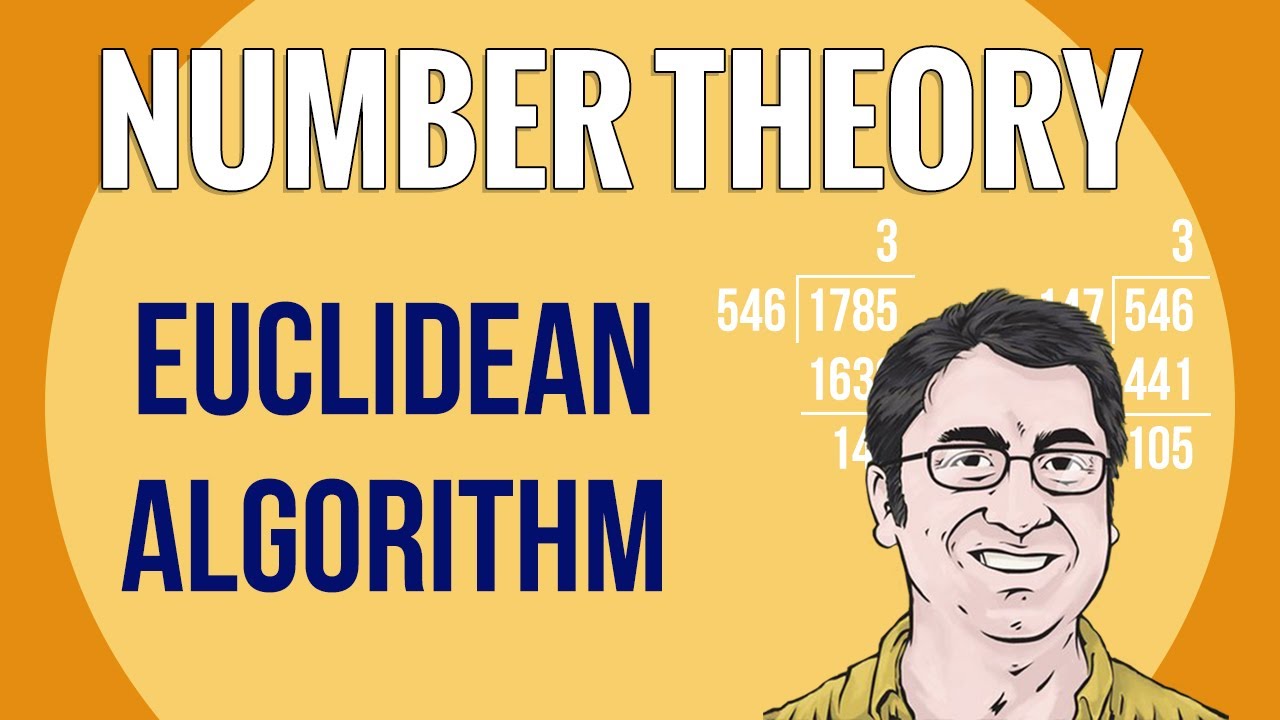 YouTube2:03
Next in Discrete Mathematics: Counting and Number Theory: Greatest common divisor → Euclidean algorithm.
Euclidean algorithm · View learning sequenceYouTube5:01Next in Discrete Mathematics: Counting and Number Theory: Greatest common divisor → Euclidean algorithm.
Euclidean algorithm · View learning sequenceYouTube2:43Application of Greatest common divisor, complementing the current explanation.
Greatest common divisorYouTube4:25Visual explanation for Greatest common divisor, compared with the current whiteboard.
Greatest common divisorApplication of Greatest common divisor, complementing the current explanation.
Greatest common divisorYouTube2:03Application of Greatest common divisor, complementing the current explanation.
Greatest common divisor