Project the endogenous regressor
The first stage regresses the endogenous regressor on the instruments and exogenous controls. Its fitted values represent the component explained by those variables.
Ben Lambert · YouTube · 8:24
Introduce two-stage least squares for an endogenous regressor and explain why instrument quality matters.
Use the learning inspector for key ideas and moments, or open the reading tabs for the complete notes.
Generated from the video's visuals and explanation; not verbatim speech.
The first stage regresses the endogenous regressor on the instruments and exogenous controls. Its fitted values represent the component explained by those variables.
The second stage uses those fitted values in place of the endogenous regressor in the structural regression. Validity requires instrument exogeneity and sufficient relevance; ordinary second-stage standard errors alone are not generally the correct 2SLS uncertainty estimate.
The lesson warns that weak or redundant instruments can harm finite-sample behavior. Claims of improved efficiency need valid instruments and the corresponding model assumptions; first-stage strength should be assessed.
The first stage regresses the endogenous regressor on the instruments and exogenous controls. Its fitted values represent the component explained by those variables.
The second stage uses those fitted values in place of the endogenous regressor in the structural regression. Validity requires instrument exogeneity and sufficient relevance; ordinary second-stage standard errors alone are not generally the correct 2SLS uncertainty estimate.
The lesson warns that weak or redundant instruments can harm finite-sample behavior. Claims of improved efficiency need valid instruments and the corresponding model assumptions; first-stage strength should be assessed.
The first stage regresses the endogenous regressor on the instruments and exogenous controls. Its fitted values represent the component explained by those variables. The second stage uses those fitted values in place of the endogenous regressor in the structural regression. Validity requires instrument exogeneity and sufficient relevance; ordinary second-stage standard errors alone are not generally the correct 2SLS uncertainty estimate. The lesson warns that weak or redundant instruments can harm finite-sample behavior. Claims of improved efficiency need valid instruments and the corresponding model assumptions; first-stage strength should be assessed.
 YouTube27:09
Prerequisite in Linear algebra: Linear systems → Least squares.
Linear systems · View learning sequence YouTube8:44
Prerequisite in Linear algebra: Orthogonal projections → Least squares.
Orthogonal projections · View learning sequence YouTube7:43
Prerequisite in Linear algebra: Linear systems → Least squares.
Linear systems · View learning sequence YouTube12:13
Proof of Least squares, complementing the current application.
Least squares YouTube15:32
Explanation of Least squares, complementing the current application.
Least squares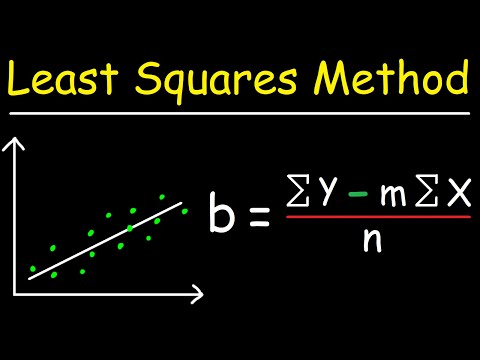 YouTube15:05
Explanation of Least squares, complementing the current application.
Least squares