Factor and cancel near the point
For near 2, . Its limit as is . Cancellation concerns nearby inputs, not evaluation of the original expression at its missing point.
Arnold Tutoring · YouTube · 5:00
Three algebraic techniques resolve the lesson's indeterminate limits: factor and cancel, use a conjugate, and clear an inner denominator. The simplified functions agree near the target point even when the original expressions are undefined there.
Use the learning inspector for key ideas and moments, or open the reading tabs for the complete notes.
Generated from the video's visuals and explanation; not verbatim speech.
For near 2, . Its limit as is . Cancellation concerns nearby inputs, not evaluation of the original expression at its missing point.
For , multiply by . The difference of squares produces in the denominator; after cancellation the remaining expression approaches .
Near , with , multiplying the numerator and denominator of by gives . Thus the limit is . These examples start from forms; a zero denominator alone is not a general license to cancel.
For near 2, . Its limit as is . Cancellation concerns nearby inputs, not evaluation of the original expression at its missing point.
For , multiply by . The difference of squares produces in the denominator; after cancellation the remaining expression approaches .
Near , with , multiplying the numerator and denominator of by gives . Thus the limit is . These examples start from forms; a zero denominator alone is not a general license to cancel.
For near 2, . Its limit as is . Cancellation concerns nearby inputs, not evaluation of the original expression at its missing point. For , multiply by . The difference of squares produces in the denominator; after cancellation the remaining expression approaches . Near , with , multiplying the numerator and denominator of by gives . Thus the limit is . These examples start from forms; a zero denominator alone is not a general license to cancel.
Factoring and cancelling resolves the limit by simplifying the expression to a form that is defined near the target point. For near 2, the expression factors into .
Conditions: The limit is as .; The original expression is undefined at (indeterminate form ).; Cancellation is valid only for .
Clearing the inner fraction resolves the limit by simplifying the complex rational expression into a polynomial form. Near , with , multiplying the numerator and denominator of by gives .
Conditions: The limit is as .; The expression contains an inner fraction in the denominator.; Multiplication by is valid for , and specifically near where .; The original expression is undefined at (indeterminate form ).
Multiplying by the conjugate resolves the limit by eliminating the radical in the denominator, which causes the indeterminacy. For , multiply the numerator and denominator by .
Conditions: The limit is as .; The expression involves a radical in the denominator causing a form.; The conjugate is .
The simplified functions agree with the original expressions near the target point because the algebraic manipulations (factoring, conjugate multiplication, clearing fractions) are equivalences valid for all in the domain except possibly the target point itself. Limits describe the behavior of a function as the input approaches a value, not the value of the function at that point.
Conditions: The target point is excluded from the domain of the original expression.; The algebraic simplification is valid for all near the target point ( target).; The limit exists for the simplified function.
 YouTube2:26
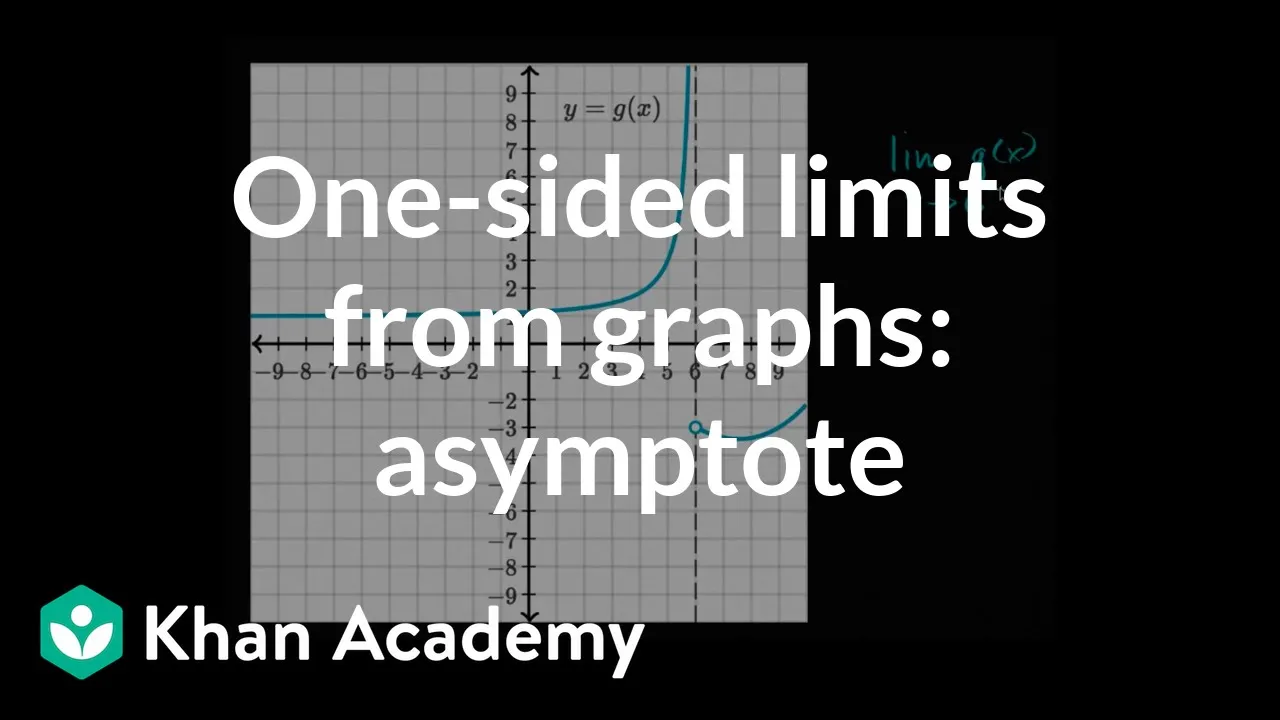
Another explanation of Limits.
Limits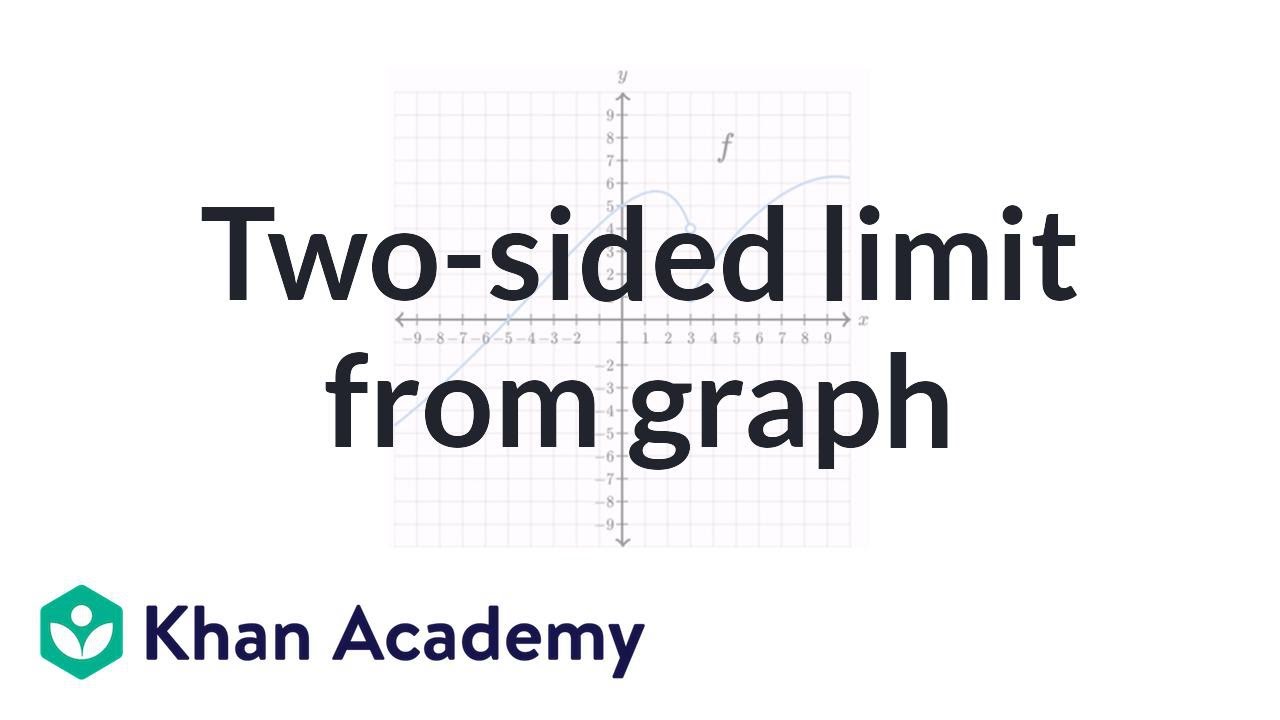 YouTube2:46
Another explanation of Limits.
Limits Bilibili5:38
Next in Calculus: Limits → Derivatives.
Derivatives · View learning sequence YouTube23:31
Next in Calculus: Limits → Derivatives.
Derivatives · View learning sequence YouTube2:28
Next in Calculus: Limits → Definite integrals.
Definite integrals · View learning sequence