Matrices
The worked matrix has a zero third column. Its singularity is established by the complete contradiction below, not by testing one candidate.
 mathvideo•
A complete proof excludes every inverse candidate by comparing the zero third column of BA with the identity matrix. Original bilingual notes clarify factor order and column notation.
A complete contradiction proves that the given3×3 real matrix has no inverse. For every candidate B, the third column of BA remains zero, whereas the identity has a nonzero third column. Original notes clarify regional row/column terminology and distinguish excluding all candidates from testing just one.
Generated from the video's visuals and explanation; not verbatim speech.
Not every square matrix has an inverse. An inverse B must give the identity when multiplied with A in either order.
Look at the given matrix: its third column is zero. We use horizontal rows and vertical columns to clarify regional terminology.
Assume an inverse B exists and leave its entries unspecified. Rejecting one chosen candidate would not rule out every possible inverse.
Compute BA. Each column is B times the corresponding column of A. Its third column is B times zero, so it remains zero for every B.
The identity has third column zero, zero, one, which differs from the zero column of BA. The bottom-right entry alone establishes that BA cannot equal the identity.
This contradicts the inverse assumption. The given A is singular and has no inverse. There is no need to disprove the other product separately: this argument excludes every possible B.
The worked matrix has a zero third column. Its singularity is established by the complete contradiction below, not by testing one candidate.
For the square matrices here, an inverse must satisfy both identity products. The proof assumes one exists, then derives a contradiction.
Left multiplication by B preserves a zero column of A in BA. The factor order matters.
The third columns are different, so no B can make BA equal the identity. This disproves an inverse for the given matrix.
Explore conditions, steps and evidence. Supplementary explanations are labeled separately from content shown in the video.
The problem box on the screen displays
The narration proceeds through the inverse definition, candidate matrix, product comparison and singularity conclusion.
A
The 3×3 matrix to be proven, with elements in the first row 1,4,0; second row 2,5,0; third row 3,6,0
3×3 matrix
The solution area writes "Assume AB=BA=I, let B= be an arbitrary 3×3 matrix"
The narration proceeds through the inverse definition, candidate matrix, product comparison and singularity conclusion.
B
The candidate inverse matrix assumed to exist, being an arbitrary 3×3 matrix
3×3 matrix
The narration proceeds through the inverse definition, candidate matrix, product comparison and singularity conclusion.
The solution area uses I to represent the identity matrix in AB=BA=I
I
Identity matrix, serving as the target product in the definition of the inverse matrix
3×3 identity matrix of the same order as A and B
The nine elements of B are labeled as b_{11},b_{12},b_{13},b_{21},b_{22},b_{23},b_{31},b_{32},b_{33}
The narration proceeds through the inverse definition, candidate matrix, product comparison and singularity conclusion.
b_{ij}
Entry of B in row i and column j.
Elements of matrix B
The screen displays
A
The 3×3 matrix given in the problem, whose third column consists entirely of 0s
3×3 matrices
The screen displays B =
B
An arbitrary 3×3 matrix assumed to exist, serving as a candidate for the inverse of A
3×3 matrices
The entry of B is in horizontal row i and vertical column j.
b_{ij}
Entry of B in row i and column j.
Scalars in the real numbers or the relevant field
Both the screen and audio use I, writing
I
The 3×3 identity matrix
3×3 matrices
The screen and narration compute BA by left-multiplying each corresponding column of A by B. Notes standardize the orientation terminology.
BA
The 3×3 product matrix obtained by left-multiplying matrix A by matrix B
3×3 matrices
The third column of the product matrix is displayed as
The narration proceeds through the inverse definition, candidate matrix, product comparison and singularity conclusion.
Regional source terminology denotes columns. Notes standardize orientation without asserting an author error.
(BA)_{:,3}
The third column of the BA product result, with all three elements being 0
3×1 zero column vector
The screen shows the third column of I as
The narration proceeds through the inverse definition, candidate matrix, product comparison and singularity conclusion.
Regional source terminology denotes columns. Notes standardize orientation without asserting an author error.
I_{:,3}
The third column of the 3×3 identity matrix I
3×1 column vector
The narration proceeds through the inverse definition, candidate matrix, product comparison and singularity conclusion.
The subsequent solution area writes this condition as AB=BA=I
The video describes B as the inverse of A by stating that two matrices A and B satisfy AB=BA=I. The key point here is that the inverse matrix must satisfy both left multiplication and right multiplication resulting in the identity matrix.
A and B must be multipliable and the result must be of the same order
In the video example, A and B are 3×3 matrices
I is the identity matrix
The narration proceeds through the inverse definition, candidate matrix, product comparison and singularity conclusion.
The problem text is "Prove that matrix A=... is a singular matrix"
The video calls a matrix whose inverse does not exist a singular matrix. This example aims to prove that the given 3×3 matrix A belongs to this category.
The subject of discussion is a square matrix
Determined by whether the inverse matrix exists
The problem box shows
The narration proceeds through the inverse definition, candidate matrix, product comparison and singularity conclusion.
The example provides a specific 3×3 matrix A, whose third column consists entirely of 0s. The video requires proving that this A is a singular matrix, i.e., proving that no B exists such that AB=BA=I.
A is a 3×3 matrix
The title reads 'Example: [Inverse Matrix Does Not Exist]', and the problem states 'Prove that matrix A = ... is a singular matrix.'
The narration proceeds through the inverse definition, candidate matrix, product comparison and singularity conclusion.
This example uses 'A is a singular matrix' and 'the inverse of A does not exist' as the same conclusion. The video does not provide an abstract definition of a singular matrix separately, but supports this conclusion by proving that no B exists such that AB=BA=I.
A is a 3×3 matrix
The conclusion concerns whether the inverse of A exists
The solution begins with 'Assume AB = BA = I, let B = ... be an arbitrary 3×3 matrix'
The narration proceeds through the inverse definition, candidate matrix, product comparison and singularity conclusion.
To prove that A has no inverse, the video adopts a proof by contradiction approach: first assume there exists some 3×3 matrix B satisfying both AB=I and BA=I, then check if this assumption leads to a contradiction.
B must be a 3×3 matrix of the same order as A
It must satisfy both left and right multiplication equaling the identity matrix
The screen writes
The narration proceeds through the inverse definition, candidate matrix, product comparison and singularity conclusion.
The video explicitly shows that the three column vectors of the 3×3 identity matrix I are (1,0,0), (0,1,0), and (0,0,1), using it as the target matrix that the inverse product should reach.
This is the 3×3 case
Editorial notation for the source column expansion:
The narration proceeds through the inverse definition, candidate matrix, product comparison and singularity conclusion.
Source regional terminology is clarified by the actual vertical column orientation.
When calculating BA, the video writes A as a concatenation of three column vectors, then lets B left-multiply these three column vectors respectively to obtain the three columns of BA. This is the method of expanding matrix multiplication by columns.
A is a 3×3 matrix
B is a 3×3 matrix
The third column of A is , and after expanding BA, the third column is B
The third column of the final product matrix is displayed as
Since the third column of A is the zero vector, regardless of the elements of B, multiplying B by this zero column will yield a zero column. The video uses this point to directly see that the third column of BA must be (0,0,0).
B is a 3×3 matrix
The multiplied column vector is a 3×1 zero vector
The screen compares the third column of BA (0,0,0) with the third column of I (0,0,1)
The narration proceeds through the inverse definition, candidate matrix, product comparison and singularity conclusion.
The video determines by finding one differing position: the third column of BA is (0,0,0), while the third column of I is (0,0,1), so the two matrices are not equal. This implicitly uses the criterion that matrix equality requires all corresponding entries to be identical.
Comparing matrices of the same order
One differing corresponding entry is sufficient to determine inequality
The narration proceeds through the inverse definition, candidate matrix, product comparison and singularity conclusion.
Not every real square matrix is invertible; a noninvertible square matrix is singular.
The subject of discussion is a square matrix
There exist some matrices without inverses
The screen shows the third column of the calculated BA as (0,0,0), while the third column of I is (0,0,1)
The narration proceeds through the inverse definition, candidate matrix, product comparison and singularity conclusion.
For any 3×3 matrix B, if , then .
A is as given in the problem
B is an arbitrary 3×3 matrix
I is the 3×3 identity matrix
∀ 3×3 matrices B, BA≠I
The conclusion text reads 'which means matrix A ... is a singular matrix.'
The narration proceeds through the inverse definition, candidate matrix, product comparison and singularity conclusion.
Matrix is a singular matrix, meaning the inverse of A does not exist.
A is as given in the problem
The definition of inverse uses AB=BA=I
Holds for this specific matrix A
The narration proceeds through the inverse definition, candidate matrix, product comparison and singularity conclusion.
The solution area gradually displays "Assume AB=BA=I, let B=... be an arbitrary 3×3 matrix, consider"
Only the current0–84second interval is unfinished; the later source completes the contradiction and conclusion.
First assume there exists a matrix B that satisfies both left and right multiplication resulting in the identity matrix.
This is the definition condition of the inverse matrix, which the video reviewed earlier at 10–20 seconds.
Write the assumed existing B as a general 3×3 matrix to facilitate comparing elements later.
The video explicitly states B is an arbitrary 3×3 matrix and lists the nine unknown elements on the screen.
Next, proceed to calculate and compare BA.
Only the current analysis interval ends here; the full source continues the calculation and contradiction.
The current0–84second interval sets up the contradiction assumption and general B; the later source completes the identity comparison.
Starting from 'Assume AB=BA=I', expand BA, compare the third column, and finally conclude and A is singular
The narration proceeds through the inverse definition, candidate matrix, product comparison and singularity conclusion.
Regional source terminology denotes columns. Notes standardize orientation without asserting an author error.
First write down the problem matrix A, and assume there exists an arbitrary 3×3 matrix B as a possible inverse.
From the problem statement on the screen and the initial setting 'Assume AB=BA=I'.
Write the condition for the existence of an inverse as simultaneously satisfying left and right inverses equaling the identity matrix.
The video explicitly writes out this assumption.
Split A into three column vectors by columns, then let B left-multiply these three column vectors respectively to get the three columns of BA.
Matrix multiplication can be expanded by the columns of the right matrix; this step is directly shown on the screen.
After completing the linear combination calculations for the three columns, all three elements of the third column are 0.
Obtained by expanding the calculation column by column from the previous step; the screen fully displays the result.
Compare the third columns of BA and I, finding that at position (3,3), one is 0 and the other is 1.
The screen simultaneously displays the third column of BA and the third column of I, and the audio also points out that 000 differs from 001.
Since there is at least one differing corresponding entry, BA cannot equal the identity matrix I.
Matrix equality requires all corresponding entries to be identical; here the third columns already differ.
Since no arbitrary B can make BA=I, the initial assumption of the existence of an inverse does not hold.
From holding for any B, the assumption AB=BA=I is refuted.
The final conclusion returns to the problem: A is a singular matrix, meaning it has no inverse.
The ending text and narration of the video summarize it this way.
Matrix has no inverse, therefore it is a singular matrix.
Problem box: "Example: [Non-existent Inverse Matrix] Prove that matrix is a singular matrix."
The narration proceeds through the inverse definition, candidate matrix, product comparison and singularity conclusion.
The current analysis interval is the first half; the later source completes the proof.
Prove that matrix is a singular matrix.
A is a 3×3 matrix
The third column of A consists entirely of 0s
A singular matrix is defined here as one whose inverse does not exist
Prove that no matrix B exists such that AB=BA=I.
Use proof by contradiction by first assuming A has an inverse matrix B.
The video explicitly uses this as the starting point of the proof at 57–73 seconds.
Set B as a general 3×3 matrix, with elements denoted by b_{ij}.
The video lists these elements on the screen and in the narration at 74–84 seconds.
Next, calculate BA and compare it with I.
Only the current analysis interval ends here; the full source continues the calculation and contradiction.
Only the current0–84second analysis interval is unfinished. The later source proves the third column of BA is zero, excluding every B and establishing singularity.
The later complete proof verifies the result by comparing third columns with the identity; the whole source conclusion is present.
The screen title is 'Example: [Inverse Matrix Does Not Exist]', and the problem is 'Prove that matrix A=... is a singular matrix.'
The narration proceeds through the inverse definition, candidate matrix, product comparison and singularity conclusion.
Prove that matrix is a singular matrix.
A is a 3×3 matrix
The third column of A consists entirely of 0s
If an inverse exists, it must satisfy AB=BA=I
Prove that A has no inverse, and thus is a singular matrix by definition.
First assume by contradiction that A has an inverse B.
The video explicitly writes out this assumption at the beginning.
Expand A by columns and calculate the three columns of BA.
Matrix multiplication expands by the column vectors of the right matrix.
After calculating BA, it is visible that the third column is always (0,0,0).
The third column comes from B multiplying the zero column, so the result must be a zero column.
Write out the target identity matrix to facilitate column-by-column comparison.
The video screen and narration explicitly give I.
Compare the third columns and find that BA and I have at least one different element.
Matrix equality requires entry-wise identity.
Therefore, no B exists such that BA=I.
Directly inferred from the previous step.
The conclusion matches the problem requirement.
The ending text and narration of the video summarize it.
A is a singular matrix, meaning the inverse of A does not exist.
Verification is completed by comparing the third columns of BA and I: the third column of BA is always (0,0,0), while the third column of I is (0,0,1), hence .
Black background with white text displaying "01-03-02" and "Lin Bing-sen"
Black background white text title
Number 01-03-02
Name Lin Bing-sen
No dynamic changes
The screen remains a static title card
This segment contains course identification information and no mathematical content.
At the top of the whiteboard, there is a toolbar and the text "Feng Chia University Department of Applied Mathematics Multimedia Experiment"
The problem box displays the example and matrix A
The cursor moves between the problem and solution areas; the text in the solution area appears gradually, finally showing "consider" and the expansion of BA
The current analysis interval shows the start of the expansion; the later source completes the proof.
Example title [Non-existent Inverse Matrix]
Problem box for matrix A
Solution: Area
Assume AB=BA=I
Nine elements of the general matrix B
Expansion of BA
First displays the problem and matrix A
Then displays "Solution:"
Next gradually displays the assumption AB=BA=I and the general form of B
Finally displays "consider" and the start of the BA expansion
Matrix A in the problem remains unchanged
The whiteboard layout structure remains unchanged
The visual flow corresponds to the establishment of the proof by contradiction: first presenting the proposition to be proved, then introducing the assumed existing inverse matrix B, and finally preparing to calculate BA.
The entire segment is a whiteboard-style math presentation, with an example title and problem box at the top, and solution formulas appearing step-by-step below
Example title
Problem box
Solution area
Slider
Cursor
As the explanation progresses, the solution area gradually adds the expansion of BA, the product result, comparison with I, and the final conclusion from the assumption
Matrix A in the problem remains unchanged
The title and source text at the top of the layout remain visible
The visual structure shows this is a single example proof, focusing not on animation changes but on line-by-line formula expansion and comparison.
BA first appears in the form of three Bs multiplying column vectors, then expands into a complete 3×3 matrix
The third column is visible as 0 before and after expansion
B
Three column vectors of A
Intermediate form of BA
Complete product matrix of BA
First shows BA decomposed by column vectors of A
Then shows the linear combination results for each column
Finally highlights that the third column is all 0
The third column of A is always the zero column
The element symbols b_{ij} of B remain general and are not assigned specific values
This visual process illustrates: regardless of what B is, as long as A has a zero column, the corresponding column in BA must be a zero column.
The screen simultaneously presents the third column of BA (0,0,0) and the third column of I (0,0,1)
The cursor and check marks point to the third column positions, emphasizing the difference
Regional source terminology denotes columns. Notes standardize orientation without asserting an author error.
Third column of BA
Third column of I
Cursor
Check marks
Focus shifts from full matrix comparison to the third column
Marks emphasize the difference between (0,0,0) and (0,0,1)
The structure of I is fixed
The third column of BA is fixed as zero due to the zero column of A
Visually, finding just one different element is sufficient to negate BA=I, thereby negating the existence of the inverse.
The narration proceeds through the inverse definition, candidate matrix, product comparison and singularity conclusion.
Believing that any matrix necessarily has an inverse.
The discussion concerns square matrices: a noninvertible square matrix is singular. Lacking the two-sided inverse defined here does not make a nonsquare matrix singular.
The narration proceeds through the inverse definition, candidate matrix, product comparison and singularity conclusion.
The screen actually expands the column vectors of A and the third column of BA
Listeners might interpret 'row' in the audio as horizontal rows, leading to misunderstanding the direction of matrix multiplication expansion.
The source uses regional row/column terminology. The actual calculation expands BA by columns of A and compares the third column. Notes use explicit orientation and subscripts without labeling the terminology a mathematical error.
The video assumes AB=BA=I, but subsequently only uses to derive the contradiction
Some might think it is necessary to prove both and to say the inverse does not exist.
Analyst supplement: The definition of inverse existence requires both sides to equal I; proving that for any B is already sufficient to refute the assumption AB=BA=I. This is exactly the approach adopted by the video itself.
The narration proceeds through the inverse definition, candidate matrix, product comparison and singularity conclusion.
The discussion concerns square matrices: a noninvertible square matrix is singular. Lacking the two-sided inverse defined here does not make a nonsquare matrix singular.
The problem requires "Prove that matrix A=... is a singular matrix"
The narration proceeds through the inverse definition, candidate matrix, product comparison and singularity conclusion.
The example applies the concept of "singular matrix" to the specific matrix A, requiring proof that A's inverse does not exist.
The solution area writes "Assume AB=BA=I, let B=... be an arbitrary 3×3 matrix, consider"
The narration proceeds through the inverse definition, candidate matrix, product comparison and singularity conclusion.
To prove that matrix A in the example is a singular matrix, the video adopts the starting point of proof by contradiction: first assuming the existence of B such that AB=BA=I.
The narration proceeds through the inverse definition, candidate matrix, product comparison and singularity conclusion.
The conclusion text links 'singular matrix' with 'inverse does not exist'
In the context of this example, proving that no B exists such that AB=BA=I is equivalent to concluding that A is a singular matrix.
BA is first expanded by column vectors of A, then the fact that the third column is zero implies the third column of BA is zero
The method of expanding multiplication by columns is directly applied to the zero column of A, yielding the corresponding zero column in BA.
From (BA)_{:,3}=(0,0,0) differing from I_{:,3}=(0,0,1), it is deduced that , and then that the inverse does not exist
The key to negating BA=I depends on the criterion that matrix equality requires entry-wise identity.
The narration proceeds through the inverse definition, candidate matrix, product comparison and singularity conclusion.
The solution area displays "Assume AB=BA=I, let B=... be an arbitrary 3×3 matrix, consider"
The narration proceeds through the inverse definition, candidate matrix, product comparison and singularity conclusion.
The screen writes B with entries b_{11} through b_{33} as a general3×3 matrix.
The narration proceeds through the inverse definition, candidate matrix, product comparison and singularity conclusion.
The third column of A is the zero column, and after expanding BA, the third column is B times the zero column
The narration proceeds through the inverse definition, candidate matrix, product comparison and singularity conclusion.
Starts by assuming AB=BA=I, later proves
The narration proceeds through the inverse definition, candidate matrix, product comparison and singularity conclusion.
The narration proceeds through the inverse definition, candidate matrix, product comparison and singularity conclusion.
The screen actually expands BA by column vectors of A
The conclusion writes 'is a singular matrix'
The narration proceeds through the inverse definition, candidate matrix, product comparison and singularity conclusion.
Covered · Opening title card, no mathematical content.
Covered · Speaker reviews the definition of the inverse matrix AB=BA=I, and the whiteboard example layout appears.
Covered · Explains that the inverse matrix does not necessarily exist, and defines the singular matrix.
Covered · Provides the specific 3×3 matrix A and requires proving it is a singular matrix.
Covered · Enters the starting point of proof by contradiction: assume AB=BA=I, let B be a general 3×3 matrix, and the screen displays "consider" and the start of the BA expansion.
Covered · The entire segment demonstrates the same example problem: assume the inverse exists, calculate BA, compare the third column, and conclude that A is singular and its inverse does not exist. Site verification: the actual 166-second frame provides the complete conclusion, original audio lasts until 167.624853 seconds; per the 168-second contract, this segment covers up to 84 seconds, rounding does not add mathematical content.
 YouTube1:51
Another explanation of Matrices.
Matrices Bilibili4:27
Next in Linear algebra: Matrices → Linear transformations.
Linear transformations · View learning sequenceNext in Linear algebra: Matrices → Rank and nullity.
Rank and nullity · View learning sequence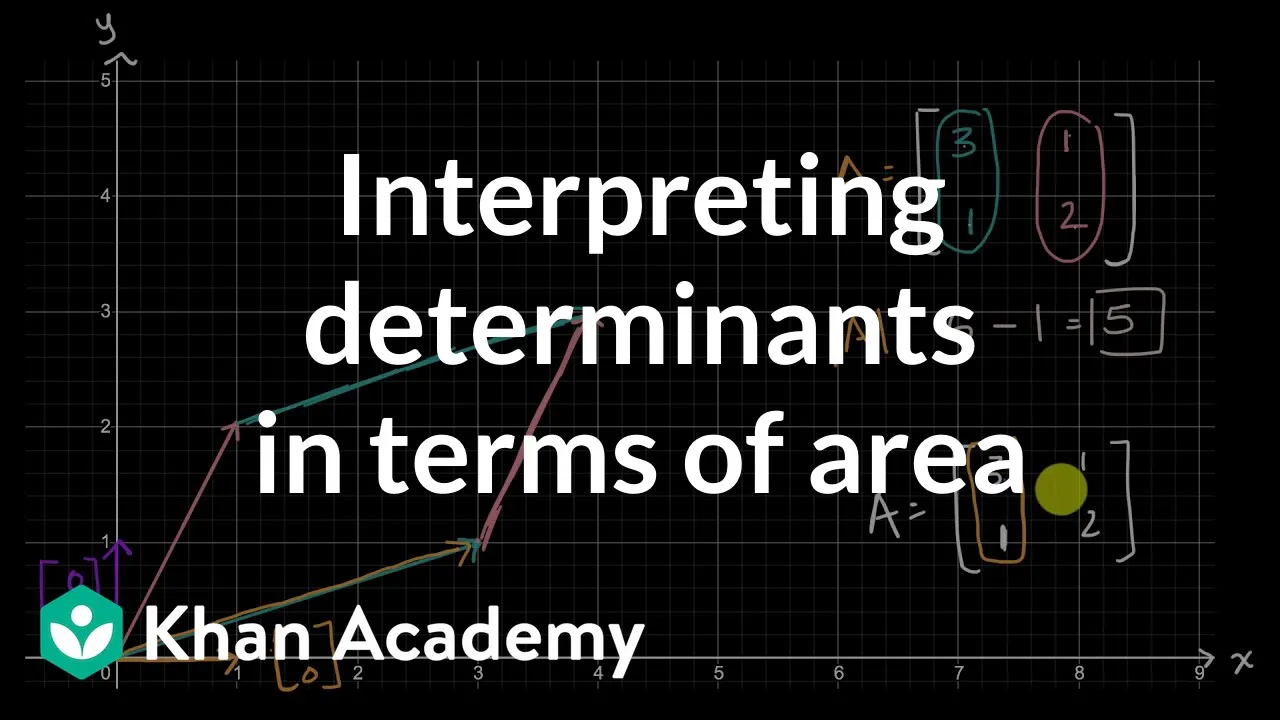 YouTube4:19
Next in Linear algebra: Matrices → Linear transformations.
Linear transformations · View learning sequenceNext in Linear algebra: Matrices → Determinants.
Determinants · View learning sequence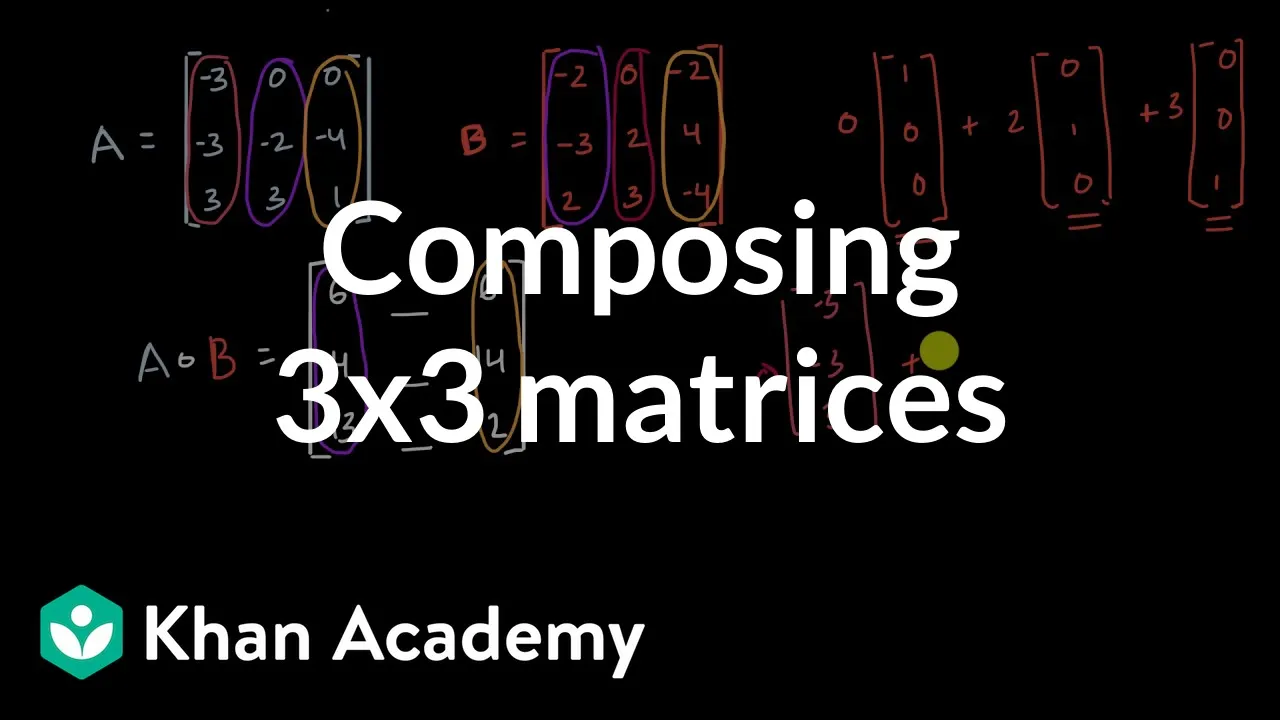 YouTube3:37
Next in Linear algebra: Matrices → Linear transformations.
Linear transformations · View learning sequenceBilibili4:27English video covering Matrices; the current video is in Chinese.
MatricesYouTube3:37English video covering Matrices; the current video is in Chinese.
MatricesYouTube4:19English video covering Matrices; the current video is in Chinese.
MatricesBilibili4:27Visual explanation for Matrices, compared with the current proof.
MatricesYouTube3:37Whiteboard for Matrices, compared with the current proof.
Matrices YouTube2:36
Whiteboard for Matrices, compared with the current proof.
Matrices