Matrices
Keep the common right factor and apply AC+BC=()C in this2×2 example. In general A and B are and C is ; the source does not prove the general theorem.
均一教育平台 Junyi Academy · YouTube · 2:26
A complete2×2 worked example keeps the common factor C on the right, rewrites AC+BC as()C and finishes the addition and multiplication to obtain[[1,9],[3,-8]]. It applies distributivity rather than proving the general theorem. Original notes state compatible dimensions and distinguish horizontal rows from vertical columns.
Use the learning inspector for key ideas and moments, or open the reading tabs for the complete notes.
Generated from the video's visuals and explanation; not verbatim speech.
The problem asks for AC+BC. Both terms share C on the right, so keep its position and combine them as()C.
Add entries in matching positions to obtain , then multiply this sum by C on the right.
Each product entry pairs a row of the left matrix with a column of the right matrix. The top-left entry is four minus three, giving one; the top-right is minus six plus fifteen, giving nine.
The second row follows the same rule: two plus one gives three, and minus three minus five gives minus eight, producing[[1,9],[3,-8]].
This completes the numerical example. In general, A and B have size and C has size . That dimension statement is editorial, and the common right factor must remain on the right.
Keep the common right factor and apply AC+BC=()C in this2×2 example. In general A and B are and C is ; the source does not prove the general theorem.
To add two matrices of the same order, simply add the elements at corresponding positions. For example, in this problem, the element in the first row and first column of is calculated as , and the element in the first row and second column is -9 + .
When AC, BC, and are all defined, AC + BC = ()C. This property allows us to simplify two matrix multiplications into one matrix addition and one matrix multiplication, which is particularly applicable when multiple terms share the same right-side matrix.
The element in the i-th row and j-th column of the resulting matrix equals the dot product of the i-th row vector of the left matrix and the j-th column vector of the right matrix. That is, multiply corresponding elements and sum them up. For example, when calculating the top-left element, you need to multiply the two numbers in the first row of the left matrix by the two numbers in the first column of the right matrix respectively, and then add the two products.
Explore conditions, steps and evidence. Supplementary explanations are labeled separately from content shown in the video.
The screen displays
A
Given 2x2 matrix
2x2 real matrices
The screen displays
B
Given 2x2 matrix
2x2 real matrices
The screen displays
C
Given 2x2 matrix
2x2 real matrices
The screen displays
A
Given matrix A
2x2 matrix
The screen displays
B
Given matrix B
2x2 matrix
The screen displays
C
Given matrix C
2x2 matrix
The narration relates the current equations to distributivity, entrywise addition or row-by-column multiplication.
The screen displays AC + BC = ()C
When the dimensions of matrices A, B, and C are such that AC, BC, and are all defined, the right distributive law can be used to transform AC + BC into ()C, thereby simplifying the calculation.
A and B have size , C has size ; all three source matrices are2×2.
The source demonstrates this numerical example and uses the general distributive law as a known rule, without proving it.
The screen displays AC + BC = ()C
The narration relates the current equations to distributivity, entrywise addition or row-by-column multiplication.
When AC, BC, and are all defined, the right distributive law of matrix multiplication can be used to transform AC + BC into ()C for calculation.
A and B have size , C has size ; all three source matrices are2×2.
The source demonstrates this numerical example and uses the general distributive law as a known rule, without proving it.
The screen displays the calculation process and result of as [[2, 3], [1, -1]]
The narration relates the current equations to distributivity, entrywise addition or row-by-column multiplication.
Add the corresponding elements of two matrices of the same order to obtain a new matrix.
The two matrices must have the same order
The screen displays the expanded calculation process of ()C
The narration relates the current equations to distributivity, entrywise addition or row-by-column multiplication.
Pair each horizontal row of the left factor with each vertical column of the right factor, multiply corresponding entries and sum to obtain the corresponding result entry.
The number of columns of the left factor equals the number of rows of the right factor; both factors here are2×2.
The screen step-by-step shows substituting the matrices and calculating
The narration relates the current equations to distributivity, entrywise addition or row-by-column multiplication.
Only the current0–73second analysis interval lacks the final product; the later source completes all calculations and the answer.
Apply the right distributive law of matrix multiplication
Distributive law of matrix multiplication
Substitute the known matrices A, B, and C into the expression
Problem conditions
Calculate the matrix addition inside the parentheses: , -9+, -5+,
Definition of matrix addition
The current0–73second interval reaches()C; the later full source gives[[1,9],[3,-8]].
The screen step-by-step displays the complete derivation from AC+BC to the final result
The narration relates the current equations to distributivity, entrywise addition or row-by-column multiplication.
Apply the right distributive law of matrix multiplication to transform the original expression into a form of adding first and then multiplying.
Distributive law of matrix multiplication
Calculate the sum of matrices A and B by adding corresponding elements.
Definition of matrix addition
Multiply the calculated result of with matrix C.
Substitution
Calculate the top-left element of the resulting matrix.
Definition of matrix multiplication
Calculate the top-right element of the resulting matrix.
Definition of matrix multiplication
Calculate the bottom-left element of the resulting matrix.
Definition of matrix multiplication
Calculate the bottom-right element of the resulting matrix.
Definition of matrix multiplication
AC + BC = [[1, 9], [3, -8]]
The screen displays the complete problem and part of the solution process
Only the current0–73second analysis interval lacks the final product; the later source completes all calculations and the answer.
Given matrices A, B, and C, find the value of AC + BC.
Calculate AC + BC
Use the distributive law of matrix multiplication to factor out C
Right distributive law of matrix multiplication
Add corresponding elements to calculate
Definition of matrix addition
The current0–73second interval completes only ; the later full source obtains[[1,9],[3,-8]].
Editorial independent computation gives and AC+BC=[[1,9],[3,-8]], agreeing with the complete final source answer.
The screen fully presents the problem conditions and solution process
The narration relates the current equations to distributivity, entrywise addition or row-by-column multiplication.
Given matrices , , and , find the value of AC+BC.
Calculate AC+BC
Observe that AC, BC, and are all defined, so decide to use the distributive law to simplify the calculation.
Right distributive law of matrix multiplication
First perform matrix addition by adding the corresponding elements of A and B.
Matrix addition
Perform matrix multiplication between the addition result and C, calculating the four positional elements one by one.
Matrix multiplication
[[1, 9], [3, -8]]
The final source matrix is[[1,9],[3,-8]]. Independently computing AC and BC and adding them gives the same answer.
A yellow cursor moves over and circles C and () in AC+BC=()C
Yellow circular cursor
Formula AC+BC=()C
Cursor moves and circles specific parts of the formula
Formula content remains unchanged
Visually emphasizes extracting the common right-multiplied matrix C, leaving .
The yellow cursor moves among different numbers in the formula and highlights them according to the speaker's explanation
Yellow circular cursor
Numbers in the formula
The cursor sequentially stays on the elements being calculated
The underlying formula structure remains unchanged
Dynamic highlighting helps learners track the correspondence and calculation progress of individual elements in complex matrix operations.
The narration relates the current equations to distributivity, entrywise addition or row-by-column multiplication.
The right distributive law of matrix multiplication is applied to simplify this matrix calculation example.
The screen first writes AC+BC=()C, then calculates
The application of the distributive law transforms the problem into one requiring matrix addition first.
The screen substitutes the result of and multiplies it by C
The result of matrix addition serves as one of the inputs for matrix multiplication to continue the calculation.
The screen displays AC+BC=()C
The screen displays the matrix addition calculation process
The narration relates the current equations to distributivity, entrywise addition or row-by-column multiplication.
The cursor moves following the calculation steps
Covered · Reading the problem and confirming matrix dimensions. Local transition note: The adjacent transition from reading the problem to the distributive law is included in the complete provided audio/video.
Covered · Explaining and applying the distributive law of matrix multiplication. Local transition note: The adjacent transition from this method to substituting values is included in the complete provided audio/video.
Covered · Substituting values and calculating
Covered · Introduces the problem and applies the distributive law to transform AC+BC into ()C, completing the matrix addition calculation.
Covered · Demonstrates the matrix multiplication process of () and C in detail, calculating the four elements one by one.
Covered · Summarizes the final answer and concludes the lecture.
 Bilibili4:27
Next in Linear algebra: Matrices → Linear transformations.
Linear transformations · View learning sequenceNext in Linear algebra: Matrices → Rank and nullity.
Rank and nullity · View learning sequence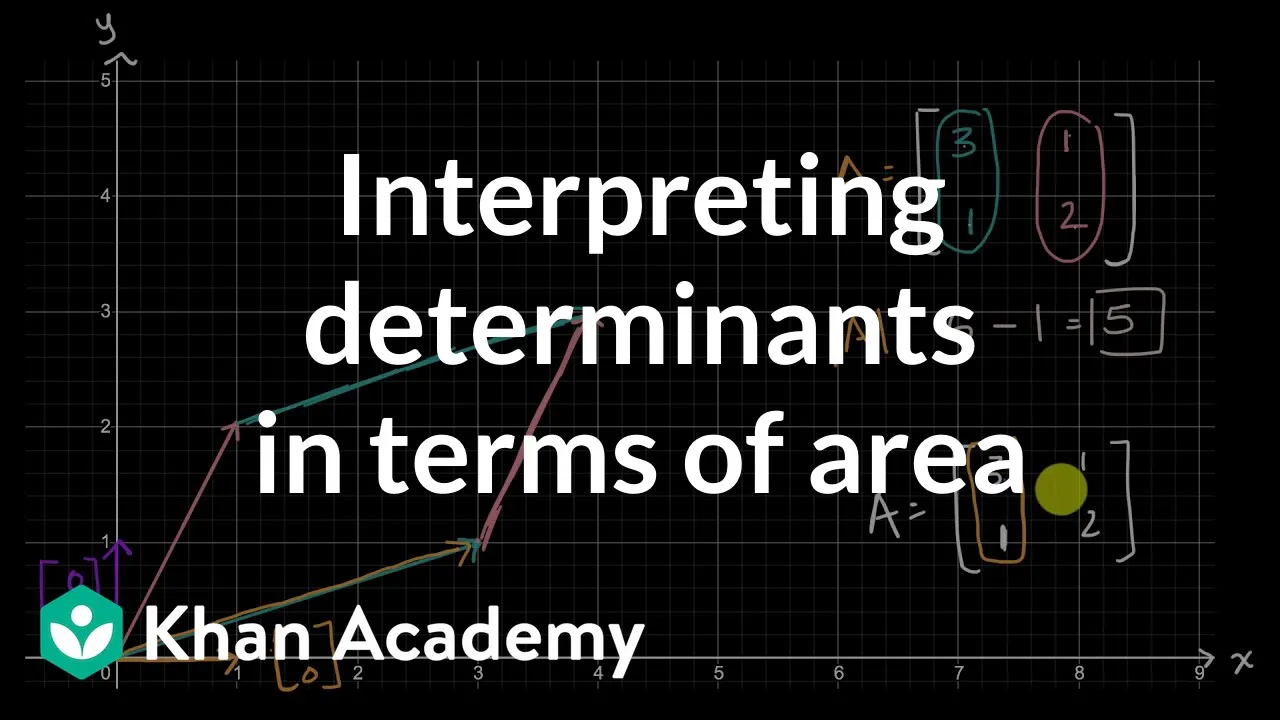 YouTube4:19
Next in Linear algebra: Matrices → Linear transformations.
Linear transformations · View learning sequenceNext in Linear algebra: Matrices → Determinants.
Determinants · View learning sequence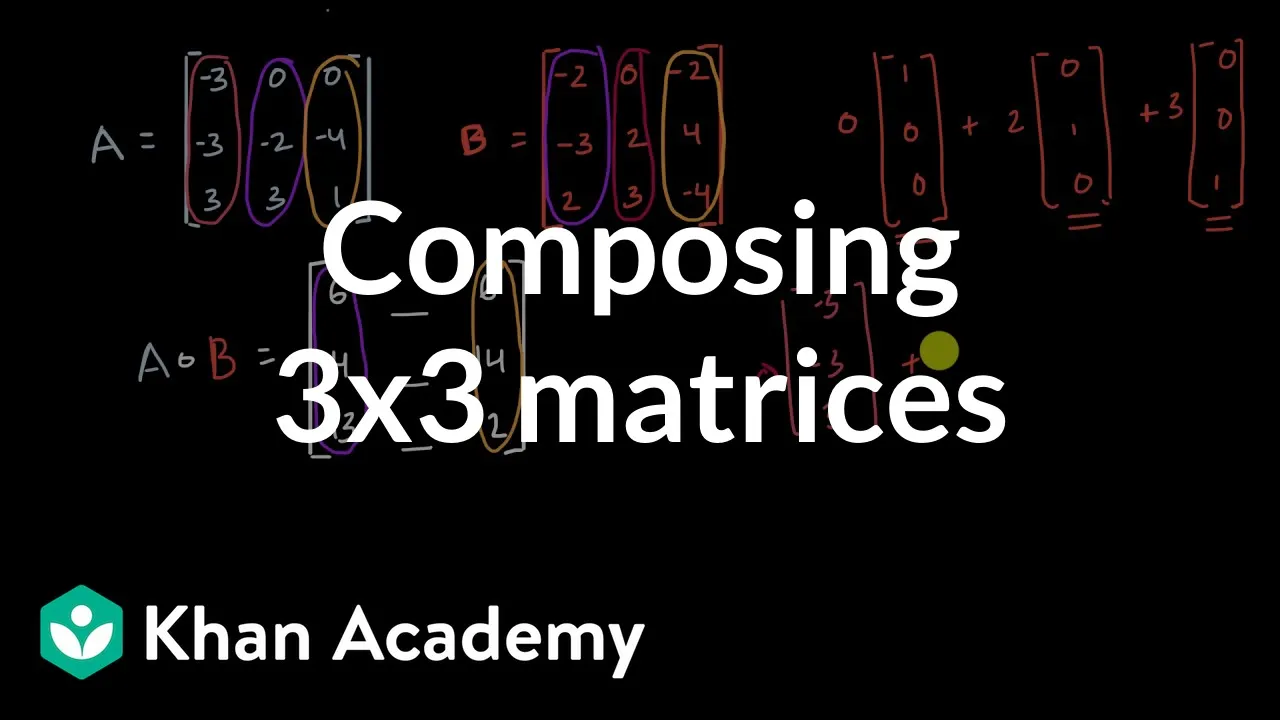 YouTube3:37
Next in Linear algebra: Matrices → Linear transformations.
Linear transformations · View learning sequenceBilibili4:27English video covering Matrices; the current video is in Chinese.
MatricesYouTube3:37English video covering Matrices; the current video is in Chinese.
MatricesYouTube4:19English video covering Matrices; the current video is in Chinese.
MatricesBilibili4:27Visual explanation for Matrices, compared with the current problem solving.
MatricesYouTube3:37Whiteboard for Matrices, compared with the current problem solving.
MatricesYouTube4:19Whiteboard for Matrices, compared with the current problem solving.
Matrices