Start with a tangent approximation
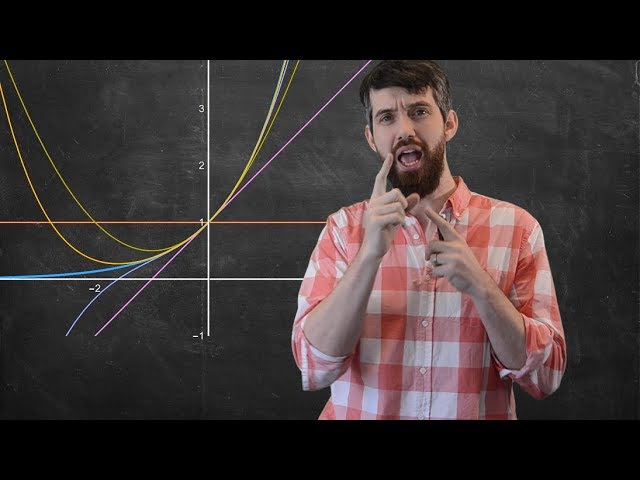
A first-order approximation near p is ′(p)(). It matches both the function value and slope at the center.
Brain Station Advanced · YouTube · 8:27
Build Taylor polynomials by matching a function and its successive derivatives at a chosen center.
Use the learning inspector for key ideas and moments, or open the reading tabs for the complete notes.
Generated from the video's visuals and explanation; not verbatim speech.
A first-order approximation near p is ′(p)(). It matches both the function value and slope at the center.
Adding f″(p)()²/2! matches the second derivative as well. Further coefficients use higher derivatives divided by the corresponding factorials.
At this is the Maclaurin construction. For sine it yields ³/3!+x⁵/5!−⋯; in general, matching all derivatives alone does not guarantee that an infinite Taylor series equals the function away from its center.
A first-order approximation near p is ′(p)(). It matches both the function value and slope at the center. Adding f″(p)()²/2! matches the second derivative as well. Further coefficients use higher derivatives divided by the corresponding factorials. At this is the Maclaurin construction. For sine it yields ³/3!+x⁵/5!−⋯; in general, matching all derivatives alone does not guarantee that an infinite Taylor series equals the function away from its center.
 YouTube12:43
Another explanation of Taylor series.
Taylor series YouTube29:21
Another explanation of Taylor series.
Taylor series Bilibili5:38
Prerequisite in Calculus: Derivatives → Taylor series.
Derivatives · View learning sequence YouTube23:31
Prerequisite in Calculus: Derivatives → Taylor series.
Derivatives · View learning sequence YouTube2:39
Prerequisite in Calculus: Derivatives → Taylor series.
Derivatives · View learning sequenceYouTube29:21Whiteboard for Taylor series, compared with the current visual explanation.
Taylor series