Vectors
A free geometric vector represents displacement and can be translated. For an arbitrary startpoint, subtract its coordinates from the endpoint coordinates. The zero vector has no assigned direction; this is editorial scope.
 mathvideo•
Add vectors by translating arrows and checking their coordinates, then double one vector. Original bilingual notes explain displacement, scaling direction conditions and the brief matrix introduction.
Two presenters connect arrow diagrams, coordinates and vector addition on one whiteboard. They introduce magnitude and direction, write vectors starting at the origin as columns, translate arrows to form a head-to-tail sum, and verify the result with coordinates. An illustrated Guangzhou–Fuzhou–Shanghai route distinguishes net displacement from distance traveled. They then multiply the horizontal vector by 2, compute a new sum and briefly introduce matrices as adjacent vector columns. Editorial scope: these are free geometric vectors. With an arbitrary starting point, coordinates are endpoint minus startpoint; coordinate addition uses the same dimension and basis. The source banner describes direction under scaling too broadly: a positive multiplier preserves the direction of a nonzero vector, a negative multiplier reverses it, and a multiplier of 0 or a zero vector has no direction. The actual example uses the positive multiplier 2 and does not discuss negative or zero cases. Matrices receive only an introductory representation, not a general property proof.
Generated from the video's visuals and explanation; not verbatim speech.
An arrowed segment represents a geometric vector: length records magnitude and the arrow records direction. Editorial clarification: these are free vectors that can be translated. The zero vector has zero length and no assigned direction.
For vectors beginning at the origin, horizontal and vertical coordinates form the upper and lower entries of the column. Here AB=(2,3) and AC=(2,0). From a different startpoint, subtract its coordinates from the endpoint coordinates.
Translate one arrow so its tail meets the head of the other. The arrow from the initial startpoint to the final endpoint is their sum. Translation leaves a free vector’s displacement unchanged.
Place the vectors at a common startpoint, complete the parallelogram and draw its diagonal from that startpoint. The calculation (2,3)+(2,0)=(4,3) agrees with point D in the first diagram. Componentwise addition uses the same dimension and coordinate basis.
The travel route is a displacement analogy. A direct route and a route through an intermediate stop give the same net displacement when their endpoints agree, although distance traveled may differ. This is a plane sketch, not a calculation of actual intercity distances.
Multiply AC=(2,0) by 2 to obtain AE=(4,0). Editorial direction conditions: positive scaling preserves a nonzero vector’s direction, negative scaling reverses it, and a multiplier of 0 or a zero vector gives a result without direction. The source demonstrates the positive multiplier 2.
Add the extended horizontal vector to AB: (2,3)+(4,0)=(6,3). The later diagram’s D is therefore at (6,3); the earlier D at (4,3) belongs to the original calculation.
Placing column vectors side by side introduces a matrix representation. Editorial clarification: the columns need equal length, and their order is part of the matrix. This video does not prove general matrix properties.
A free geometric vector represents displacement and can be translated. For an arbitrary startpoint, subtract its coordinates from the endpoint coordinates. The zero vector has no assigned direction; this is editorial scope.
The illustrated arrows start at the origin, so their endpoint coordinates give their vector columns.
Translate free vectors head to tail or construct their parallelogram. Coordinates add componentwise in the same dimension and basis.
The same endpoints give the same net displacement in the illustrated plane, even when traveled distances differ. The city route is an analogy, not a geographical distance calculation.
Multiply each coordinate by the scalar. A positive scalar preserves a nonzero vector’s direction, a negative scalar reverses it, and zero gives no direction. These editorial conditions qualify the source’s positive-doubling example.
Doubling the horizontal vector changes the sum from the first diagram. The later endpoint D is at(6,3).
An ordered collection of equal-length columns forms a matrix. This is an introductory representation, not a proof of matrix-operation laws.
Explore conditions, steps and evidence. Supplementary explanations are labeled separately from content shown in the video.
A horizontal coordinate axis is drawn on the whiteboard with an arrow at the right end, labeled X.
X
The horizontal axis of the Cartesian coordinate system
Real number line
A vertical coordinate axis is drawn on the whiteboard with an arrow at the top end, labeled Y.
Y
The vertical axis of the Cartesian coordinate system
Real number line
The intersection of the two axes is labeled O.
O
The origin of coordinates
Point in the plane coordinate system
Near the starting point of the line segment originating from the origin, A is labeled; combined with subsequent explanation, its position is known to be the origin.
The board writing labels the starting point as A and the origin as O; the video does not explicitly state whether they refer to the same point.
A
Starting point of the vector; located at the origin in this example
Point in the plane
A point in the first quadrant is labeled B(2,3).
The narration introduces geometric vectors with arrows and explains that translation preserves magnitude and direction.
B(2,3)
Point with coordinates (2,3), used as the terminal point of vector AB
Point in the plane
A point on the horizontal axis is labeled C(2,0).
The narration introduces geometric vectors with arrows and explains that translation preserves magnitude and direction.
C(2,0)
Point with coordinates (2,0), used as the terminal point of vector AC
Point in the plane
A point in the upper right is labeled D(4,3), with dashed lines connecting to B and C.
D's coordinates are clearly visible on the board, but the video does not verbally state these coordinates.
D(4,3)
Terminal point obtained after translation, used as the terminal point of vector AD
Point in the plane
An arrowed line segment pointing from A to B, labeled AB.
The narration introduces geometric vectors with arrows and explains that translation preserves magnitude and direction.
\overrightarrow{AB}
Vector from A to B
Vector in the twoD plane
An arrowed line segment pointing from A to C, labeled AC.
The narration introduces geometric vectors with arrows and explains that translation preserves magnitude and direction.
\overrightarrow{AC}
Vector from A to C
Vector in the twoD plane
An arrowed line segment pointing from A to D, labeled AD.
Written below on the whiteboard is \overrightarrow{AB}+\overrightarrow{AC}=\overrightarrow{AD}.
\overrightarrow{AD}
Vector from A to D, representing the sum vector of AB and AC in this example
Vector in the twoD plane
There is a dashed line connection between B and D; the narration mentions translating AC to BD.
The narration connects column coordinates and translated arrows with the whiteboard construction of vector addition.
BD is presented as a dashed line in the diagram; the video does not write out its coordinate form.
\overrightarrow{BD}
Vector corresponding to AC obtained by translation
Vector in the twoD plane
There is a dashed line connection between C and D; the narration mentions translating AB to CD.
The narration connects column coordinates and translated arrows with the whiteboard construction of vector addition.
CD is presented as a dashed line in the diagram; the video does not write out its coordinate form.
\overrightarrow{CD}
Vector corresponding to AB obtained by translation
Vector in the twoD plane
The narration introduces geometric vectors with arrows and explains that translation preserves magnitude and direction.
The whiteboard title reads "Vector: Magnitude & Direction", and the diagram shows line segments with arrows.
The video defines a vector as "a line segment with magnitude and direction". The visual uses an arrowed line segment to represent direction and length to represent magnitude, using AC as an example: without an arrow, it is just an ordinary line segment; only with an arrow does it become a vector. Editorial scope: these are free geometric vectors; the zero vector has no direction.
The object of discussion is an arrowed line segment in the plane
The definition given here is intuitive, not a rigorous axiomatic definition
The narration connects column coordinates and translated arrows with the whiteboard construction of vector addition.
Written below on the whiteboard are \begin{bmatrix}2\\3\end{bmatrix} and \begin{bmatrix}2\\0\end{bmatrix}.
The video explains writing the horizontal coordinate in the first position and the vertical coordinate in the second position to form a column vector. Thus, AB corresponds to [2;3] and AC corresponds to [2;0].
Applicable to twoD vectors in the Cartesian coordinate system
The video uses vectors originating from the origin as examples
Editorial scope: the same basis and dimension are required; an arbitrary startpoint must be subtracted from the endpoint.
The narration connects column coordinates and translated arrows with the whiteboard construction of vector addition.
The diagram uses dashed lines to translate AC to BD and AB to CD, forming a parallelogram structure with vertices A, B, D, and C.
Written below on the whiteboard is \overrightarrow{AB}+\overrightarrow{AC}=\overrightarrow{AD}.
The video illustrates vector addition in two ways: one is translating AC to BD, and the other is translating AB to CD; both approaches make the two vectors head-to-tail, ultimately resulting in the sum vector AD pointing from the common starting point A to the diagonal point D.
Used for adding vectors in the twoD plane
The video illustrates addition through geometric construction via translation
The narration connects column coordinates and translated arrows with the whiteboard construction of vector addition.
The whiteboard shows \overrightarrow{AB} + \overrightarrow{BD} = \overrightarrow{AD} and \overrightarrow{AC} + \overrightarrow{CD} = \overrightarrow{AD}.
Translate two vectors so they are connected head-to-tail. The vector from the start of the first vector to the end of the second vector is their sum.
Applicable to any planar or spatial vectors
The narration connects column coordinates and translated arrows with the whiteboard construction of vector addition.
A parallelogram with sides AB and AC is drawn on the whiteboard, with diagonal AD.
Translate two vectors so they share a common start point. Construct a parallelogram using these two vectors as adjacent sides. The diagonal vector starting from the common point is their sum.
Applicable to any planar or spatial vectors
The narration connects column coordinates and translated arrows with the whiteboard construction of vector addition.
\begin{bmatrix} 2 \\ 3 \end{bmatrix} + \begin{bmatrix} 2 \\ 0 \end{bmatrix} = \begin{bmatrix} 4 \\ 3 \end{bmatrix} is written at the bottom of the whiteboard.
In a Cartesian coordinate system, vectors can be represented by coordinates (column matrices). Adding two vectors is equivalent to adding their corresponding coordinates separately.
Vectors have established coordinate representations
Editorial scope: the same basis and dimension are required; an arbitrary startpoint must be subtracted from the endpoint.
The source illustrates scaling the horizontal vector by2 with a positive multiplier; its direction banner omits negative and zero cases.
2 \times \begin{bmatrix} 2 \\ 0 \end{bmatrix} = \begin{bmatrix} 4 \\ 0 \end{bmatrix}
The source demonstrates scaling by the positive number2. Editorial clarification: scale each coordinate; positive scaling preserves a nonzero vector’s direction, negative scaling reverses it, and a multiplier of0 or a zero vector gives a result without direction.
k is a real scalar
Editorial direction condition: positive scalar and nonzero vector. The component formula applies to every real scalar.
The narration connects adjacent vector representations with the introductory matrix concept.
Whiteboard shows placing [2, 3] and [4, 0] side by side to form a matrix
A matrix is a combination of multiple vectors. For example, placing two two-dimensional column vectors side by side forms a 2x2 matrix.
Editorial scope: adjacent columns have equal length and fixed order; this source only introduces the representation.
On the right side of the whiteboard, "Guangzhou", "Fuzhou", and "Equivalent" are written, connected by arrows, indicating that vectors at different positions but with the same direction can be considered equivalent.
The narration introduces geometric vectors with arrows and explains that translation preserves magnitude and direction.
The video uses the term "equivalent" to express that vectors remain the same after translation, but does not provide a formal definition of "equal vectors".
Under the premise of having the same direction and magnitude, a vector can be translated from one position to another without changing its identity as a vector; the video expresses this relationship as "equivalent".
Vectors have the same magnitude and direction
Translation within the plane is allowed
Holds for the translation cases shown in the video; a more general universal statement is not explicitly made in the video.
Written below on the whiteboard is \begin{bmatrix}2\\3\end{bmatrix}+\begin{bmatrix}2\\0\end{bmatrix}=\begin{bmatrix}4\\3\end{bmatrix}.
Point D in the diagram is labeled as (4,3), corresponding to the result vector.
The video shows this specific calculation but does not verbally explain the general rule of "component-wise addition" word-for-word.
In this example, the coordinates of the sum vector \overrightarrow{AD} of \overrightarrow{AB} and \overrightarrow{AC} equal the sum of their corresponding coordinates, i.e., [2;3]+[2;0]=[4;3].
Using the column vector notation given in the video
AB=[2;3], AC=[2;0], and AD is the sum vector obtained from geometric addition
Holds for AB, AC, and AD in this specific example.
The source illustrates scaling the horizontal vector by2 with a positive multiplier; its direction banner omits negative and zero cases.
A positive real scalar preserves a nonzero vector’s direction and scales its length. The source demonstrates the positive multiplier2; negative and zero cases are editorial clarifications.
The multiplier is a positive real number (the example in the video is 2)
The original vector is nonzero (editorial scope).
Every nonzero geometric vector and positive real scalar (editorial scope).
The narration connects column coordinates and translated arrows with the whiteboard construction of vector addition.
Written side-by-side below on the whiteboard are \overrightarrow{AB}+\overrightarrow{AC}=\overrightarrow{AD} and \begin{bmatrix}2\\3\end{bmatrix}+\begin{bmatrix}2\\0\end{bmatrix}=\begin{bmatrix}4\\3\end{bmatrix}.
Points B(2,3), C(2,0), D(4,3) and dashed lines in the diagram form a parallelogram.
First, write the two vectors as column vectors according to the video's method.
From the representation rule in ki-vector-coordinate-representation.
Make the two vectors head-to-tail through translation, constructing the geometric path of the sum vector.
From the two addition methods described in ki-vector-addition-rule.
Whether along A→B→D or A→C→D, the final destination is the diagonal point D from the common starting point A, so the sum vector is AD.
Derived from the geometric construction of head-to-tail connection after translation.
Correlate the geometric sum vector AD with D(4,3) in the diagram to obtain the component-wise addition formula.
D is labeled as (4,3) in the diagram, and the whiteboard has already written this equation.
The video uses geometric translation to illustrate vector addition and demonstrates its consistency with coordinate component-wise addition in this example.
The whiteboard provides the specific calculation \begin{bmatrix}2\\3\end{bmatrix}+\begin{bmatrix}2\\0\end{bmatrix}=\begin{bmatrix}4\\3\end{bmatrix}.
Generalize the specific numerical example in the video into a standard form for easier retrieval and transfer to other problems.
This is the standard rule for twoD vector addition; the video only showed a specific instance and did not verbally write the general formula.
Supplementary explanation: This example is a special case of the general rule "adding corresponding components".
The narration connects column coordinates and translated arrows with the whiteboard construction of vector addition.
Geometric figures and vector markings on the whiteboard.
According to the triangle rule, displacement from A to B then to D is equivalent to direct displacement from A to D.
Definition of vector addition via head-to-tail connection
Similarly, displacement from A to C then to D is also equivalent to direct displacement from A to D.
Definition of vector addition via head-to-tail connection
Since \overrightarrow{BD} = \overrightarrow{AC} and \overrightarrow{CD} = \overrightarrow{AB} (opposite sides of a parallelogram are parallel and equal), the sum vector for both paths is \overrightarrow{AD}.
Properties of parallelograms and substitution of equals
Vector addition satisfies both the triangle rule and the parallelogram rule, which are essentially the same.
The narration doubles the horizontal vector, adds it to the original slanted vector and identifies the new endpoint.
Whiteboard draws auxiliary lines for the parallelogram rule, showing vector translation and head-to-tail connection
Translate vector AE to point B so that its start coincides with the end of AB, resulting in vector BD.
Vectors can be freely translated without changing their magnitude and direction.
According to the triangle rule (head-to-tail), AB plus BD equals the vector AD pointing from A to D.
Geometric definition of vector addition.
Through geometric translation and head-to-tail connection, it is proven that \vec{AB} + \vec{AE} = \vec{AD}.
The whiteboard draws A, B(2,3), C(2,0), D(4,3), connected into a vector diagram with arrows.
The narration introduces geometric vectors with arrows and explains that translation preserves magnitude and direction.
Written below on the whiteboard are \overrightarrow{AB}+\overrightarrow{AC}=\overrightarrow{AD} and \begin{bmatrix}2\\3\end{bmatrix}+\begin{bmatrix}2\\0\end{bmatrix}=\begin{bmatrix}4\\3\end{bmatrix}.
In the Cartesian coordinate system, given A as the starting point, B(2,3), and C(2,0), find the geometric and coordinate representation of \overrightarrow{AB}+\overrightarrow{AC}.
A is the starting point of the vector, located near the origin in the diagram
B(2,3)
C(2,0)
D(4,3) is the terminal point obtained from translation construction
Write the result vector of \overrightarrow{AB}+\overrightarrow{AC} and provide its column vector form.
According to the video's method, write the horizontal coordinate in the first position and the vertical coordinate in the second position.
From the explanation of vector coordinate representation.
Use translation to construct a head-to-tail path so that the two vectors can be added.
From the explanation of the two methods of vector addition.
Both paths start from A and reach D, so the sum vector is AD.
Derived from geometric construction.
Correlate AD with D(4,3) in the diagram to get the coordinate addition result.
D is labeled as (4,3) in the diagram, and the whiteboard has already written this equation.
\overrightarrow{AB}+\overrightarrow{AC}=\overrightarrow{AD}, and \begin{bmatrix}2\\3\end{bmatrix}+\begin{bmatrix}2\\0\end{bmatrix}=\begin{bmatrix}4\\3\end{bmatrix}.
Can be cross-checked with D(4,3) in the diagram and the formula on the whiteboard; geometrically, following A→B→D or A→C→D both arrive at the same point D.
The route analogy compares direct travel with an intermediate stop to illustrate the same net displacement.
A schematic diagram showing the relative positions of Guangzhou, Fuzhou, and Shanghai is drawn on the right side of the whiteboard.
Compare the displacement of going directly from Guangzhou to Shanghai versus going from Guangzhou to Fuzhou and then to Shanghai.
Start point: Guangzhou
End point: Shanghai
Intermediate point: Fuzhou
Editorial G/F/S denote Guangzhou/Fuzhou/Shanghai in the plane-displacement analogy; no geographical distances are calculated.
Explain that the total displacement vectors for both paths are equal.
Displacement vector for the direct path.
Definition
Sum of displacement vectors for the indirect path.
Vector addition rule
Regardless of the path taken, if the start and end points are the same, the total displacement vector is the same.
Vectors depend only on start and end points, not on the path
The final displacement vectors for both methods are equivalent, both being vectors from Guangzhou to Shanghai.
Verified by the schematic diagram on the whiteboard and the teacher's oral explanation.
The narration doubles the horizontal vector, adds it to the original slanted vector and identifies the new endpoint.
Whiteboard fully writes out the calculation process: 2[2,0]=[4,0] and [2,3]+[4,0]=[6,3]
Given \vec{AC} = [2, 0] and \vec{AB} = [2, 3]. Find \vec{AE} = 2\vec{AC}, and calculate \vec{AD} = \vec{AB} + \vec{AE}.
\vec{AC} = \begin{bmatrix} 2 \\ 0 \end{bmatrix}
\vec{AB} = \begin{bmatrix} 2 \\ 3 \end{bmatrix}
\vec{AE} = 2\vec{AC}
Find the coordinate representations of \vec{AE} and \vec{AD}
Multiply each component of vector AC by 2 to obtain vector AE.
Algebraic operation rule for scalar multiplication of vectors.
Add the corresponding components of vectors AB and AE to obtain vector AD.
Algebraic operation rule for vector addition.
\vec{AE} = [4, 0], \vec{AD} = [6, 3]
The algebraic calculation result was verified by the geometric figure on the whiteboard (parallelogram rule).
The opening quickly switches between multiple cover images and shots of the speakers, displaying text such as "Three Essential Skills for Data Scientists" and "Data Science Everyone Can Understand".
The introduction identifies the channel and topic.
The intro text is abundant and switches quickly; individual small characters other than the main title are difficult to confirm one by one.
Two main speakers
Channel title card
Previous topic covers
Screen quickly switches between different covers
Channel name and series topic text appear
Always centered around the show identity of "Data Science" and "Engineers and Little Potatoes"
This section mainly serves as the program introduction and has not yet entered the formal mathematical explanation.
The camera cuts to the front of the whiteboard, with the title "Linear Algebra: Vector Addition" and subtitle "Vector: Magnitude & Direction".
The narration introduces geometric vectors with arrows and explains that translation preserves magnitude and direction.
Whiteboard
Two main speakers
Coordinate graph
Switch from intro to fixed-camera whiteboard lecture
Coordinate system, points A, B, C, D, and vector arrows are visible on the whiteboard
The topic of this section is clearly marked as "Vector Addition"
The visual transitions the audience from the program intro to the formal classroom scene and pre-displays the geometric figure to be used later.
The speaker uses a pointer stick to indicate the AC line segment and its arrow.
The narration introduces geometric vectors with arrows and explains that translation preserves magnitude and direction.
Line segment AC
Arrow
Pointer stick
Attention shifts from "line segment" to "arrowed line segment"
AC is explained as a vector with direction and magnitude
The endpoint positions of AC remain unchanged, still from A to C
This visual emphasis illustrates that the key to a vector is not the endpoints themselves, but the additional directional information.
Dashed lines connect B to D and C to D in the diagram, forming a parallelogram structure with adjacent sides AB and AC.
The narration connects column coordinates and translated arrows with the whiteboard construction of vector addition.
Vector AB
Vector AC
Dashed line BD
Dashed line CD
Sum vector AD
Translation paths shown via dashed lines
Two different paths converge at D
Starting point A remains unchanged
The final sum vector is always AD
The animated board writing turns the abstract rule of "head-to-tail connection" into a visible path, helping understand why AD is AB+AC.
On the right side of the whiteboard, "Guangzhou", "Fuzhou", and "Equivalent" are written, connected by arrows.
The correspondence between this annotation and the oral explanation is less clear than the main diagram; it can only be confirmed that it is used to assist in explaining the equivalence relationship after translation.
Text "Guangzhou"
Text "Fuzhou"
Text "Equivalent"
Connecting arrows
Uses city names as metaphorical labels
Always located on the right side of the whiteboard as supplementary explanation
This set of annotations uses a life-like metaphor to suggest: vectors at different positions but with the same direction and magnitude can be considered equivalent.
Throughout the clip, the whiteboard consistently displays a geometric diagram of vector addition with a coordinate system, as well as a travel route schematic on the right.
Coordinate system
Points A, B, C, D
Solid line vectors AB, AC, AD
Dashed line vectors BD, CD
Travel route schematic
The teacher uses a pointer to indicate different vectors and paths sequentially, guiding the audience to understand the addition process.
The start and end coordinates of the vectors remain unchanged.
The geometric structure of the parallelogram remains unchanged.
Through static geometric figures and dynamic indications, it intuitively demonstrates multiple equivalent paths for vector addition and coordinate operation results.
Female instructor draws dashed lines on the whiteboard, translating vector AE to point B to form a parallelogram, and marks the diagonal AD with a blue light pen
Vector AB
Vector AE
Translated vector BD
Resultant vector AD
Position of vector AE is translated, starting point becomes B
Diagonal vector AD is added
Magnitude and direction of vector AE remain unchanged before and after translation
Intuitively demonstrates that vector addition can be achieved through the geometric parallelogram rule or triangle rule (head-to-tail).
The narration introduces geometric vectors with arrows and explains that translation preserves magnitude and direction.
Assuming that any connection between two points is already a vector.
The video emphasizes: AC without an arrow is just an ordinary line segment; only after adding direction does it become a vector.
On the right side of the whiteboard, "Equivalent" is written, connecting illustrative vectors at different positions with arrows.
The narration introduces geometric vectors with arrows and explains that translation preserves magnitude and direction.
Believing that a vector is no longer equivalent after changing its starting position.
The video explains through "translate to BD", "parallel to CD", and the "Equivalent" annotation: as long as magnitude and direction are the same, the translated vector still represents the same vector relationship.
The narration introduces geometric vectors with arrows and explains that translation preserves magnitude and direction.
First defines the vector geometrically and intuitively, then translates the same object into column vector representation.
First writes the column vectors for AB and AC, then writes AB+AC=AD and [2;3]+[2;0]=[4;3].
Coordinate representation provides the foundation for subsequently mapping geometric addition to component-wise addition.
The whiteboard simultaneously provides the geometric equation and the numerical equation.
The specific example in the video is a special case of the general rule "component-wise addition of twoD vectors"; the general rule is supplemented by the analyst.
The narration introduces geometric vectors with arrows and explains that translation preserves magnitude and direction.
The video delineates the conceptual difference by contrasting "line segment" and "vector".
The narration connects column coordinates and translated arrows with the whiteboard construction of vector addition.
The parallelogram rule is a special manifestation of the triangle rule when two vectors share a common start point; the sum vectors calculated by both are completely consistent.
The narration connects column coordinates and translated arrows with the whiteboard construction of vector addition.
Vector coordinate operations (matrix addition) are the specific application and verification method of geometric vector addition rules at the algebraic level.
The source illustrates scaling the horizontal vector by2 with a positive multiplier; its direction banner omits negative and zero cases.
First, obtain new vector AE through scalar multiplication, then use AE as an addend in subsequent vector addition operations.
The narration connects adjacent vector representations with the introductory matrix concept.
A matrix is a structure composed of multiple vectors (such as AB and AE).
The narration introduces geometric vectors with arrows and explains that translation preserves magnitude and direction.
The narration connects column coordinates and translated arrows with the whiteboard construction of vector addition.
The narration connects column coordinates and translated arrows with the whiteboard construction of vector addition.
\begin{bmatrix}2\\3\end{bmatrix}+\begin{bmatrix}2\\0\end{bmatrix}=\begin{bmatrix}4\\3\end{bmatrix}
Annotation "Guangzhou", "Fuzhou", "Equivalent" on the right side of the whiteboard.
The narration introduces geometric vectors with arrows and explains that translation preserves magnitude and direction.
Geometric equation and coordinate equation written side-by-side.
The narration connects column coordinates and translated arrows with the whiteboard construction of vector addition.
The addition equation for column vectors is displayed at the bottom of the whiteboard.
The source illustrates scaling the horizontal vector by2 with a positive multiplier; its direction banner omits negative and zero cases.
The narration doubles the horizontal vector, adds it to the original slanted vector and identifies the new endpoint.
The narration connects adjacent vector representations with the introductory matrix concept.
Covered · Intro montage and channel promotion, no mathematical definitions or derivations, recorded only as visual event ve-intro-montage.
Covered · Entering the main topic, introducing the series theme "Linear Algebra" and this section's topic "Vector Addition", and beginning to give the intuitive definition of a vector.
Covered · Using AC as an example to explain that a vector is a line segment with magnitude and direction, emphasizing that the arrow makes the segment a vector.
Covered · Writing AB and AC as column vectors [2;3] and [2;0], explaining horizontal coordinate first, vertical coordinate second.
Covered · Illustrating vector addition with two translation methods, providing AB+AC=AD and [2;3]+[2;0]=[4;3], and supplementing the general component-wise addition rule.
Covered · The segment fully covers the geometric rules of vector addition, coordinate operations, and real-life analogies.
Covered · Review of equivalence of vector addition from previous section (real-life example: Guangzhou-Fuzhou-Shanghai vs Guangzhou-Shanghai).
Covered · Introduction of scalar multiplication concept, with algebraic calculation example of AC multiplied by 2 to get AE.
Covered · Combining geometric figures (translation, head-to-tail) and algebraic calculations to demonstrate the process of AB + AE = AD.
Covered · The source summarizes its positive-multiplier2 example, preserving the direction of a nonzero vector in this case. The source banner is overbroad; editorial notes distinguish positive scaling of a nonzero vector, reversal for negative scaling, and no direction for a multiplier of0 or a zero vector.
Covered · Introduction of preliminary definition of matrix: combination of multiple vectors.
Covered · Preview of next episode content (determinants) and video ending interaction.
 YouTube9:59
Next in Linear algebra: Vectors → Linear independence.
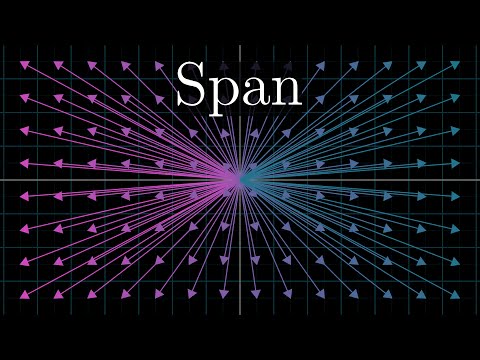
Linear independence · View learning sequenceNext in Linear algebra: Vectors → Span.
Span · View learning sequence Bilibili4:27
Next in Linear algebra: Vectors → Matrices.
Matrices · View learning sequence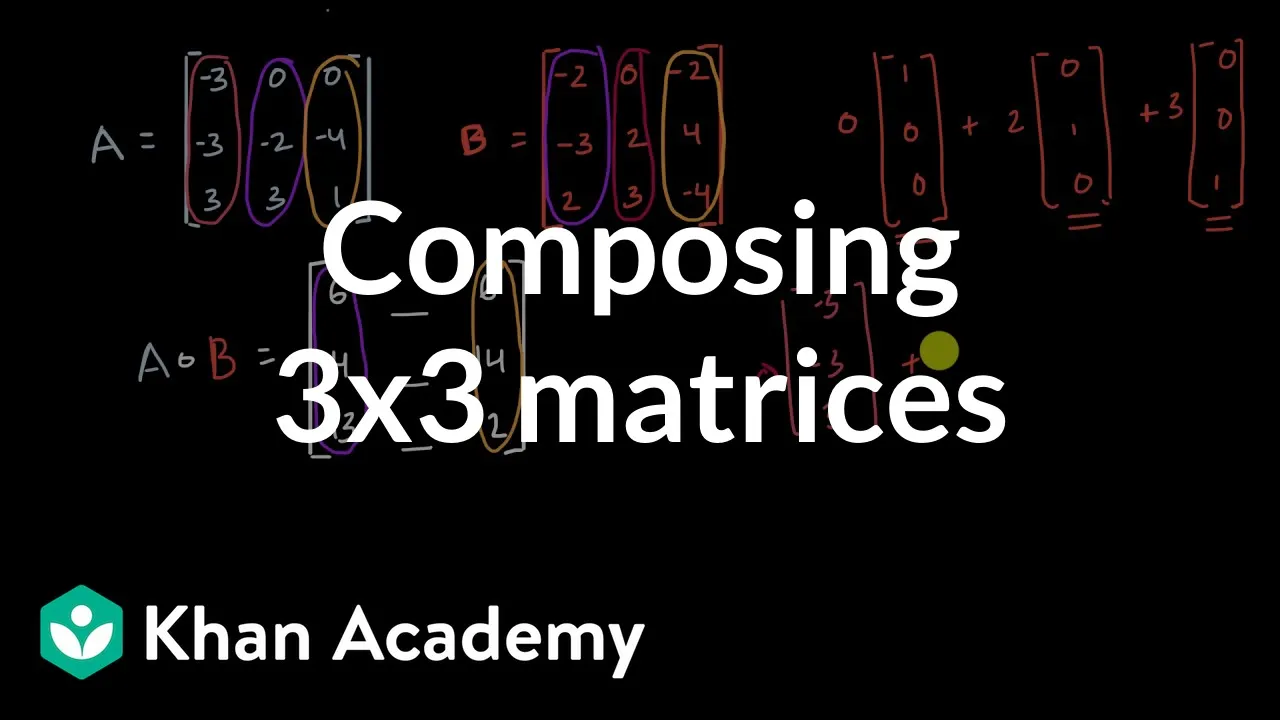 YouTube3:37
Next in Linear algebra: Vectors → Matrices.
Matrices · View learning sequence YouTube5:16
English video covering Vectors; the current video is in Chinese.
Vectors YouTube3:05
English video covering Vectors; the current video is in Chinese.
VectorsYouTube5:16Whiteboard for Vectors, compared with the current visual explanation.
VectorsYouTube3:05Whiteboard for Vectors, compared with the current visual explanation.
Vectors