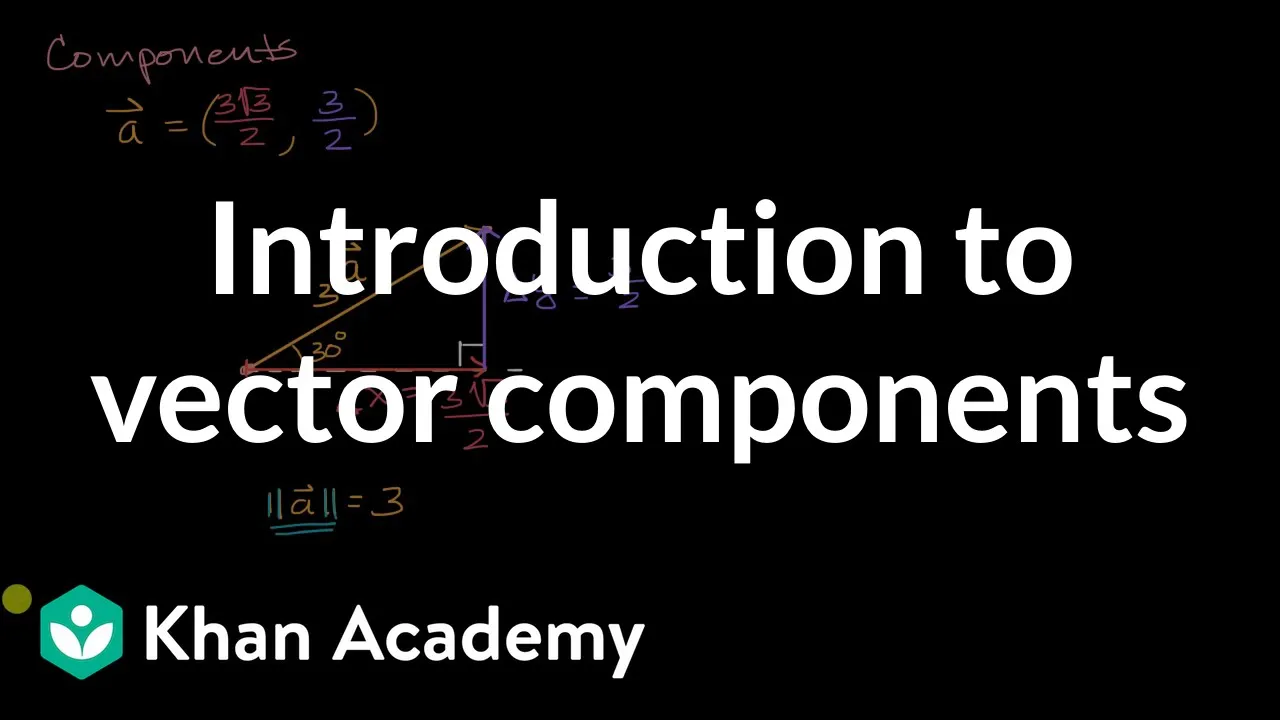
Vectors
In a 2D Cartesian system, a vector is defined by its components. The x-component indicates horizontal displacement, and the y-component indicates vertical displacement. For example, in , the vector moves 5 units right and 3 units down.
 mathvideo•
Compute the Euclidean length of (5,-3), then explain sqrt(34) through an orthogonal component triangle.
Find the Euclidean length of in a standard orthonormal Cartesian plane. Khan Academy first computes with color-coded components, then completes the geometric explanation: draw the displacement from the origin and form a right triangle with leg lengths and . The lesson applies the known Pythagorean theorem and explains why the negative component specifies direction rather than negative length. Editorial notes state the coordinate assumptions and the free-displacement interpretation of translation.
Generated from the video's visuals and explanation; not verbatim speech.
We begin by addressing how to find the magnitude of a vector when only its components are provided. This is one of the most fundamental calculations in vector geometry.
Consider the example vector . By definition, the first number represents the x-component (horizontal displacement), and the second number represents the y-component (vertical displacement).
To find the magnitude, denoted as , we use the formula derived from the Pythagorean theorem: . The instructor emphasizes that this is fundamentally the distance formula applied to vector components. This is Euclidean length in an orthonormal frame; the leg lengths are absolute component values.
Substituting the specific values from our example, we get . Color-coding is used here to clearly map the x-component (5) to the first squared term and the y-component (-3) to the second squared term.
Performing the arithmetic, we square the components to get 25 and 9. Adding these together yields 34. Thus, the exact magnitude of the vector is .
While the algebraic method is efficient, the instructor begins to set up a geometric visualization to explain *why* this works. A y-axis is drawn, preparing to illustrate the vector as the hypotenuse of a right triangle formed by its components.
The algebraic result and remains on screen. Continue by connecting it to the coordinate-plane picture.
The presenter identifies the horizontal axis as the -axis and reads the first component as a positive displacement of . Counting along the axis makes the meaning of the ordered pair explicit: the first coordinate controls horizontal movement.
The second component is then treated as a vertical displacement of . Counting downward on the -axis shows that the negative sign means motion in the negative -direction, not a different kind of object.
The same free displacement may be translated: move both endpoints equally while retaining the components, length and direction. Drawing it from the origin simplifies the picture.
With the vector anchored at the origin, moving units right and units down locates the terminal point at . The directed segment from the origin to that point is the geometric representative of .
The question now shifts from “where is the vector?” to “how long is it?” The magnitude is identified with the length of the drawn segment, so the problem becomes a length computation.
Construct perpendicular legs from horizontal change and vertical change . Their lengths are the absolute component values, and the vector is the hypotenuse.
Because the triangle is right, the Pythagorean theorem applies. The squared leg lengths are and ; equivalently, one may think of the vertical side length as , since squaring removes the sign.
Therefore , and taking the positive square root gives . The final formula on the board matches the geometric construction just explained.
In a 2D Cartesian system, a vector is defined by its components. The x-component indicates horizontal displacement, and the y-component indicates vertical displacement. For example, in , the vector moves 5 units right and 3 units down.
In orthonormal Cartesian coordinates, Euclidean length is the square root of the component squares. The perpendicular legs have lengths equal to the absolute component values. This formula does not apply unchanged to arbitrary nonorthogonal coordinates.
To find the magnitude of , substitute the components into the formula: . Squaring the terms gives , which simplifies to the final answer .
A two-dimensional vector written as encodes horizontal and vertical displacement. The first entry is the -component, and the second entry is the -component. In the coordinate plane, this means move right 5 units and down 3 units from the chosen initial point.
Here the vector represents a free displacement. Translating both endpoints by the same amount preserves its components in the fixed coordinate frame, length and direction; the initial point can therefore be put at the origin.
If the initial point is placed at , then the components directly give the terminal point. For , the terminal point is . The drawn arrow from the origin to that point represents the vector geometrically.
The magnitude is the length of the vector segment. Once the vector is drawn, finding its magnitude becomes a distance problem: measure the length of the arrow from its initial point to its terminal point.
The perpendicular component displacements form the two legs. Their lengths are absolute values, here and ; the negative vertical component indicates downward direction, not a negative side length.
Apply the known Pythagorean theorem: . Since , the sum is and . Changing the vertical component sign reverses its direction but preserves its squared contribution.
Explore conditions, steps and evidence. Supplementary explanations are labeled separately from content shown in the video.
The symbol is written on the board as part of the example vector.
The example vector is introduced by its components.
A two-dimensional vector in the example.
Vectors in .
The notation is written below the vector definition.
The notation represents vector length.
The magnitude (or length) of vector .
Non-negative real numbers.
The number 5 is written as the first component of .
The first coordinate is identified as the positive horizontal component.
x-component
The first coordinate of the vector .
Real numbers.
The number -3 is written as the second component of .
The second coordinate is identified as the negative vertical component.
y-component
The second coordinate of the vector .
Real numbers.
Top-left written expression shows .
The narration identifies horizontal and vertical displacements.
A two-dimensional vector with components in the -direction and in the -direction.
The vector is treated in a Cartesian coordinate plane.
Written formula begins .
The length calculation uses the component right triangle.
The magnitude or length of vector .
Defined for the displayed vector .
A horizontal axis is drawn and labeled .
The horizontal coordinate axis is identified.
Horizontal coordinate axis used to locate the vector’s x-component.
Cartesian coordinate plane.
A vertical axis is drawn and labeled .
The vertical coordinate axis is identified.
Vertical coordinate axis used to locate the vector’s y-component.
Cartesian coordinate plane.
The endpoint is located from the given displacements.
A yellow dot is placed at the endpoint corresponding to and .
Terminal point of the vector when its initial point is placed at the origin.
Coordinate plane.
The equation is written on the screen.
The two entries describe horizontal and vertical displacement.
A vector in two dimensions can be defined by its components, which represent its displacement along the x and y axes. In the example, means the vector moves 5 units in the positive x-direction and 3 units in the negative y-direction.
Applies to vectors in a 2D Cartesian coordinate system.
The formula is implicitly used as .
Narration connects the distance calculation to the Pythagorean relationship.
In orthonormal Cartesian coordinates, Euclidean length is the square root of the component squares. The perpendicular legs have lengths equal to the absolute component values. This formula does not apply unchanged to arbitrary nonorthogonal coordinates.
x and y are the components of the vector.
The result is always non-negative.
Use Euclidean length and orthonormal coordinate directions: perpendicular axes with the same unit scale.
The written vector is .
The given coordinates are located along the two axes.
Tick marks are added along the axes to locate on the x-axis and on the y-axis.
The vector is represented by an ordered pair , where the first entry gives displacement in the -direction and the second entry gives displacement in the -direction.
The vector is being interpreted in a Cartesian coordinate plane.
The first component corresponds to horizontal displacement.
The second component corresponds to vertical displacement.
The board shows .
The presenter calculates the length through the right-triangle relationship.
The magnitude of a vector is computed as the square root of the sum of the squares of its components. For , this gives .
The vector has real components in a Cartesian coordinate system.
The magnitude is the Euclidean length of the vector.
Use Euclidean length and orthonormal coordinate directions: perpendicular axes with the same unit scale.
The vector is moved to begin at the origin while retaining its displacement.
The vector is then drawn starting at the origin.
Here the vector represents a free displacement. Translating both endpoints by the same amount preserves its components in the fixed coordinate frame, length and direction; the initial point can therefore be put at the origin.
Translation must not alter the vector’s length.
Translation must not alter the vector’s direction.
The component displacements are used to construct a right triangle.
A vertical segment and a horizontal segment are drawn from the origin to form a right triangle with the vector as hypotenuse.
The perpendicular component displacements form the two legs. Their lengths are absolute values, here and ; the negative vertical component indicates downward direction, not a negative side length.
The coordinate axes are perpendicular.
The vector is drawn from the origin to its terminal point.
The existing Pythagorean theorem is applied to the perpendicular legs.
The displayed computation uses under a square root.
The video shows the numerical component calculation. The abstract a,b,c notation in this entry is an editorial statement of the theorem being applied.
For a right triangle with leg lengths and , the square of the hypotenuse equals . In the vector context, the hypotenuse is the vector’s magnitude.
The triangle must be a right triangle.
The legs correspond to the absolute component lengths and .
The directed segment is treated as a length problem.
The drawn vector is a line segment from the origin to .
The magnitude of the vector is the length of the drawn line segment representing the vector.
The vector is drawn as a line segment in the coordinate plane.
For the displayed vector .
The drawing position changes while the displacement remains unchanged.
A vector can be translated in the plane without changing it, provided its magnitude and direction remain the same.
The translation does not change the vector’s magnitude.
The translation does not change the vector’s direction.
The object is a free displacement vector in a fixed coordinate frame.
For vectors in the plane as discussed in the video.
The step-by-step calculation is written on the board.
The narration follows the squared components, their sum and the square root.
Substitute the given x and y components into the magnitude formula.
Apply the Euclidean magnitude formula in orthonormal coordinates.
Square the individual components: and .
Arithmetic evaluation.
Add the squared values together.
Arithmetic addition.
The magnitude of the vector is .
The presenter applies the Pythagorean relationship to the drawn component triangle.
The board displays .
The vector is shown as the hypotenuse of a right triangle with horizontal and vertical legs.
Start with the given vector components.
Directly written on the board and stated in the audio.
Place the initial point at the origin and use the components to locate the terminal point.
The speaker states that a vector can be shifted without changing magnitude or direction.
The horizontal change is , and the vertical change has absolute value .
The speaker explicitly sets up a right triangle from the changes in and .
Apply the Pythagorean theorem to the right triangle whose hypotenuse is the vector.
The speaker says the result comes straight out of the Pythagorean theorem.
Simplify the squares and take the square root to obtain the magnitude.
Shown directly in the written formula on the board.
Applying the already-known Pythagorean theorem gives the magnitude of as ; this is not a proof of that theorem.
The entire problem and its solution are written on the screen.
The example asks for the length from the given component pair.
Find the magnitude of the vector .
Use Euclidean length and orthonormal coordinate directions: perpendicular axes with the same unit scale.
Calculate .
Apply the magnitude formula using the given components.
Formula for vector magnitude.
Compute the squares of the components.
Arithmetic.
Sum the values under the square root.
Arithmetic.
The algebraic result is complete in this interval. The drawing starts afterward and the full video completes its geometric justification in the later interval.
The worked example on the board is and .
The narration completes the geometric construction and length calculation.
A coordinate plane is drawn with the vector from the origin to and perpendicular component segments.
Given , find .
The vector is drawn in a Cartesian coordinate plane.
Use Euclidean length and orthonormal coordinate directions: perpendicular axes with the same unit scale.
Compute the magnitude .
Read the ordered pair as horizontal and vertical displacements.
Stated in the audio and written on the board.
Move 5 units in the positive -direction and 3 units in the negative -direction.
The speaker counts off these distances on the axes.
Use the component segments as perpendicular legs.
The speaker explicitly says to set up a right triangle.
Apply the Pythagorean theorem to the triangle.
The speaker attributes the step to the Pythagorean theorem.
Simplify the arithmetic.
Shown directly in the written formula.
The final value matches the written simplification on the board.
The number 5 is circled in blue, and the corresponding is written in blue. The number -3 is circled in pink, and is written in pink.
Colors distinguish each component and its substituted square.
Vector components (5, -3)
Squared terms in the magnitude formula
Colors are introduced to link specific components to their squared terms in the equation.
The mathematical value of the expression remains unchanged.
The color-coding visually demonstrates the substitution process, showing exactly where the x and y components go in the Pythagorean-based magnitude formula.
A vertical white line with an upward arrow is drawn on the left side of the screen.
The presenter starts the coordinate-plane construction.
This opening 88–93-second interval only begins the axes; the same full video draws the vector and triangle afterward.
y-axis
A blank space is transformed into the start of a Cartesian coordinate system.
The algebraic calculation previously completed remains valid.
The speaker is transitioning from an algebraic calculation to a geometric visualization to explain why the magnitude formula is essentially the Pythagorean theorem.
A vertical -axis is already present, then a horizontal -axis is drawn and tick marks are added.
Axes are identified and marked for locating the components.
vertical axis labeled
horizontal axis labeled
tick marks
A horizontal axis is added to the existing vertical axis.
Tick marks are placed to represent unit distances.
The top formulas and remain visible.
The plane is prepared so the vector components can be located geometrically.
A yellow dot appears at the origin, another at , and a yellow arrow is drawn between them.
The displacement is represented by an arrow starting at the origin.
origin point
terminal point
yellow vector arrow
The vector is positioned with initial point at the origin.
The terminal point is placed at .
An arrow is drawn from origin to terminal point.
The component values remain and .
The written magnitude formula remains unchanged.
The vector is represented geometrically as a directed line segment whose length will be computed.
A vertical segment downward and a horizontal segment rightward are added to form a right triangle with the vector as hypotenuse.
Perpendicular component segments are added to the vector picture.
vertical component segment
horizontal component segment
vector as hypotenuse
Perpendicular component segments are added.
The vector becomes visually identified as the hypotenuse.
The vector endpoints remain at the origin and .
The component magnitudes remain and .
The picture converts the vector-magnitude problem into a right-triangle side-length problem.
The vertical leg uses the absolute size of the negative displacement.
The board writes , which equals .
A negative y-component might be thought to reduce the magnitude or enter the formula with a negative contribution.
In the magnitude formula, the component is squared, so ; equivalently, one may use the side length .
The example treats a translated displacement as the same free vector.
One might think moving the vector changes what vector it is.
Translating both endpoints preserves a free displacement vector in the fixed frame. A point position measured from a fixed origin is a different notion.
The length formula is linked to the Pythagorean theorem.
The formula for vector magnitude is a direct application of the Pythagorean theorem to the vector's orthogonal components.
The magnitude formula uses the entries of directly.
The two component values supply the inputs to the length calculation.
The vector’s components are the inputs used in the magnitude formula.
The component triangle justifies the magnitude calculation using an existing theorem.
The computation is .
The vector magnitude formula is justified here by applying the Pythagorean theorem to the component right triangle.
The vector is placed at the origin to simplify its construction.
The vector is then drawn from the origin to .
Placing the vector at the origin makes it possible to read its components directly as perpendicular legs of a right triangle.
The lesson introduces finding length from components.
The explanation links the component formula to the Pythagorean relationship.
The board shows .
The narration completes the component-based length calculation.
Component segments form a right triangle with the vector as hypotenuse.
The drawn perpendicular components allow use of the Pythagorean theorem.
The same displacement is drawn from the origin.
The term appears in the magnitude calculation.
The negative displacement contributes through its square.
Covered · Introduction to the topic of finding vector magnitude from components.
Covered · Definition of the example vector and its components.
Covered · Setup of the magnitude formula and color-coded substitution.
Covered · Arithmetic calculation leading to the final magnitude.
Covered · Transition to geometric visualization; drawing of the y-axis begins.
Covered · The written vector and component values are introduced, and the coordinate axes are prepared.
Covered · The speaker explains translating the vector and draws it from the origin to .
Covered · The magnitude is identified as the vector length, a right triangle is formed, and is obtained.
In a 2D Cartesian system, a vector $\vec{a} = (x, y)$ is defined by its components. The x-component indicates horizontal displacement, and the y-component indicates vertical displacement. For example, in $\vec{a} = (5, -3)$, the vector moves 5 units right and 3 units down.
 Bilibili4:27
Next in Linear algebra: Vectors → Matrices.
Matrices · View learning sequenceNext in Linear algebra: Vectors → Vector spaces.
Vector spaces · View learning sequence YouTube9:59
Next in Linear algebra: Vectors → Linear independence.
Linear independence · View learning sequenceNext in Linear algebra: Vectors → Span.
Span · View learning sequence YouTube3:37
Next in Linear algebra: Vectors → Matrices.
Matrices · View learning sequence YouTube4:35
Chinese video covering Vectors; the current video is in English.
VectorsYouTube4:35Visual explanation for Vectors, compared with the current whiteboard.
Vectors