Geometric Definition (2D)
The absolute determinant is the ordinary area multiplier for measurable planar regions. The determinant itself is signed; an orientation-reversing map has a negative determinant, not a negative ordinary area.
3Blue1Brown · YouTube · 10:03
This video provides a geometric interpretation of the determinant in linear algebra. It begins by explaining that for 2D transformations, the determinant represents the factor by which areas are scaled. The sign of the determinant indicates whether the transformation preserves or flips the orientation of space. Extending to 3D, the determinant measures volume scaling and uses the right-hand rule for orientation. Finally, it introduces the computational formulas for 2x2 and 3x3 matrices and concludes with a conceptual challenge regarding the multiplicative property of determinants.
Use the learning inspector for key ideas and moments, or open the reading tabs for the complete notes.
Generated from the video's visuals and explanation; not verbatim speech.
Linear transformations generally stretch or squash space. To understand this quantitatively, we examine how they affect area. Consider a diagonal matrix that scales the horizontal axis by 3 and the vertical axis by 2. A unit square becomes a rectangle with an area of 6. In contrast, a shear transformation might slant the grid without changing the area of the fundamental unit square. This leads to the core insight: the determinant is precisely the scalar factor by which any region's area changes under the transformation.
However, the full concept requires handling negative values. If a transformation mirrors space—like flipping a piece of paper—it reverses the relative ordering of the basis vectors. We call this an inversion of orientation. When orientation is flipped, the determinant is negative. Its absolute value still tells us the area scaling factor, but the negative sign encodes this directional reversal. Visualizing rotating past shows the determinant smoothly passing through zero into negative territory.
In three dimensions, a unit cube maps to a parallelepiped. Its ordinary volume is , while the sign of the determinant records orientation: positive preserves a right-handed frame, negative reverses it. A zero determinant means the image has lower dimension, so its three-dimensional volume is zero.
Finally, we bridge geometry and arithmetic via computation. For a matrix, the formula is . Geometrically, captures the primary rectangular bounds, while subtracting corrects for the overlapping triangular regions created by off-diagonal shearing. While manual calculation is straightforward, grasping what the number represents—the total signed scale—is far more essential to understanding linear systems.
The closing question asks why . Applying B and then A multiplies their signed area or volume scaling factors, including both orientation signs. This gives the geometric reason for the product rule.
The final title card previews inverse matrices, column space and null space. It introduces the next lesson rather than proving new results in this video.
The absolute determinant is the ordinary area multiplier for measurable planar regions. The determinant itself is signed; an orientation-reversing map has a negative determinant, not a negative ordinary area.
Positive determinants preserve standard counter-clockwise ordering ( left of ). Negative determinants indicate spatial reflection where handedness is reversed.
A square matrix has zero determinant exactly when its columns are dependent. In two dimensions the entire plane maps into a line or a point; in three dimensions it maps into a plane, line or point.
The absolute determinant gives the volume of the transformed unit cube. Its sign records orientation rather than an ordinary negative volume.
Standard evaluation involves cross-multiplying entries along diagonals; visually justified by partitioning bounding boxes minus excess triangles formed by skew components.
Successive linear maps multiply signed area or volume factors. Two orientation reversals cancel, exactly as two negative factors multiply to a positive one.
The reviewed area card explains that scales ordinary planar area, whereas the sign of records orientation. The three-dimensional card similarly gives ordinary volume scaling by the absolute determinant. Zero determinant means dependent columns and a lower-dimensional image; negative determinant does not mean negative ordinary area or volume.
Algebraically, for a matrix , the determinant is . Geometrically, captures the primary rectangular bounds, while subtracting corrects for overlapping triangular regions created by off-diagonal shearing components.
Conditions: Matrix is 2x2; Entries are real numbers
Applying matrix B and then matrix A composes the linear transformations. Since each transformation multiplies the area/volume by its respective determinant (including sign/orientation), the total scaling factor is the product .
Conditions: Matrices A and B are square and compatible for multiplication; Determinants are defined
In 3D, the determinant measures the volume scaling factor of a unit cube mapped to a parallelepiped. The sign indicates orientation: positive preserves the right-handed frame, while negative reverses it.
Conditions: Linear transformation in 3D space; Unit cube input
The determinant is negative because the transformation flips the relative ordering of the basis vectors (e.g., rotating past ), reversing the handedness of the coordinate system. The absolute value still gives the area scale, but the sign encodes this directional reversal.
Conditions: Transformation mirrors or reflects space; Basis vector order is inverted
The determinant represents the scalar factor by which any region's area changes under the transformation. For example, if a unit square becomes a rectangle with an area of 6, the determinant is 6.
Conditions: Linear transformation in 2D space; Measurable planar regions
A zero determinant implies that the columns are linearly dependent, causing the transformation to collapse the space into a lower dimension. In 2D, the plane collapses to a line or point; in 3D, it collapses to a plane, line, or point, resulting in zero volume.
Conditions: Square matrix;
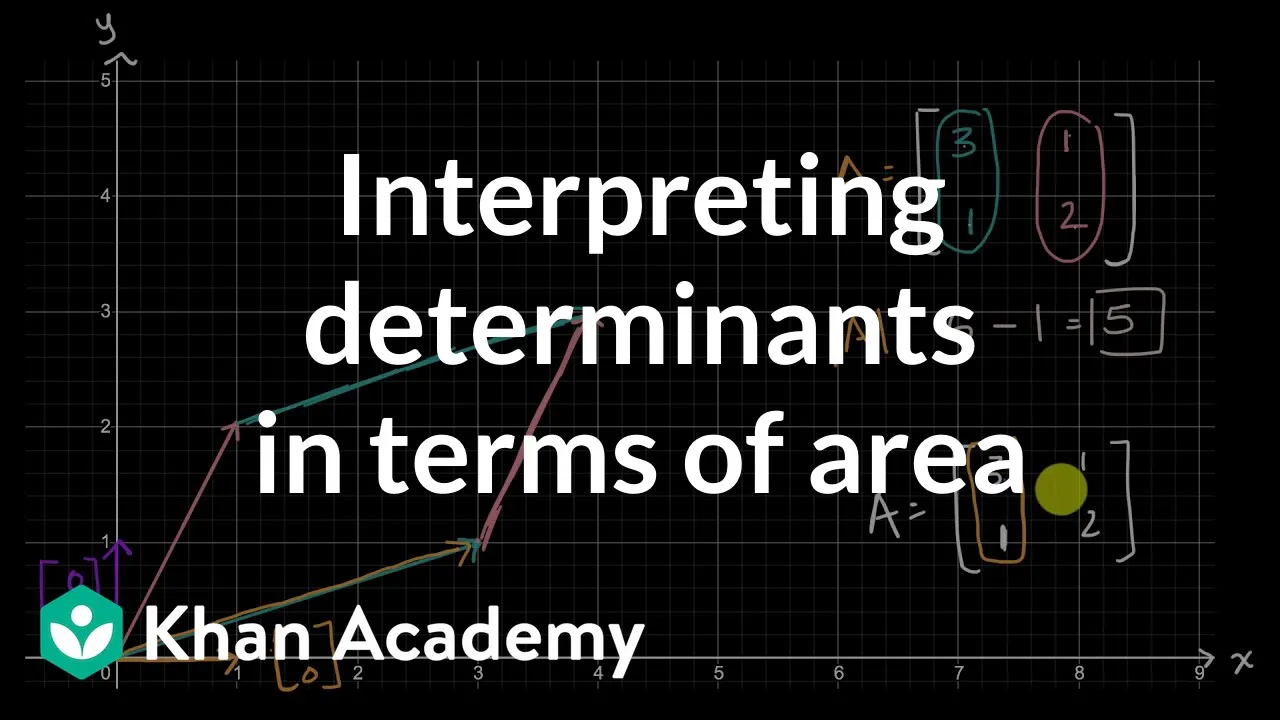 YouTube4:19
Another explanation of Determinants.
Determinants YouTube3:26
Another explanation of Determinants.
Determinants Bilibili4:27
Prerequisite in Linear algebra: Matrices → Determinants.
Matrices · View learning sequence YouTube3:37
Prerequisite in Linear algebra: Matrices → Determinants.
Matrices · View learning sequenceYouTube4:19Prerequisite in Linear algebra: Matrices → Determinants.
Matrices · View learning sequenceYouTube4:19Whiteboard for Determinants, compared with the current visual explanation.
DeterminantsYouTube3:26Whiteboard for Determinants, compared with the current visual explanation.
Determinants