Sequential criterion
The assertion applies to every domain sequence approaching the accumulation point while avoiding it. This is the sequential limit criterion, distinct from the Heine–Cantor uniform-continuity theorem.
Charles队长 · Bilibili · 1:39
The sequential criterion for a function limit requires every sequence of domain points approaching an accumulation point, but excluding that point, to have function values approaching the same limit. The animation contrasts the consistent behavior of x² with the oscillations of .
Use the learning inspector for key ideas and moments, or open the reading tabs for the complete notes.
Generated from the video's visuals and explanation; not verbatim speech.
The sequential criterion connects function limits with sequence limits. Let x₀ be an accumulation point of the domain. The limit of is A precisely when every domain sequence xₙ approaching x₀, with xₙ≠x₀, has f(xₙ) approaching A. Checking a few paths does not satisfy the universal quantifier.
For ², inputs approaching zero produce outputs approaching zero. Algebraically, any sequence xₙ→0 satisfies xₙ²→0. This works for every admissible sequence; the graph makes the statement easier to see.
Different input sequences can approach from opposite sides. If the function limit exists, all corresponding output sequences must have the same limit. Conversely, two admissible sequences with different output limits disprove existence.
For , choose xₙ= and yₙ=. Both approach zero without equaling it, but their outputs are always 1 and −1. The function therefore has no limit as x approaches zero, regardless of whether a value at zero is assigned.
The assertion applies to every domain sequence approaching the accumulation point while avoiding it. This is the sequential limit criterion, distinct from the Heine–Cantor uniform-continuity theorem.
Any input sequence approaching zero has its squares approaching zero. A few animated paths alone do not establish the universal statement.
Two admissible input sequences approaching the same point but giving different output limits suffice to disprove the function limit.
Choose reciprocal angles at sine maxima and minima. Inputs approach zero while outputs remain at 1 and −1.
The reviewed sequential-criterion card requires every sequence in the function domain approaching the accumulation point, while avoiding that point, to produce the same function-value limit. The example fails this requirement through two admissible sequences with values 1 and -1. Checking a few animated paths does not establish the universal condition.
The condition ensures that the limit describes the behavior of the function *near* , independent of the function's value *at* . It excludes the trivial case where the sequence is constantly , which would always yield regardless of the surrounding behavior.
Conditions: is an accumulation point of the domain.; The sequence approaches .; The function may or may not be defined at .
The sequential criterion requires that *every* admissible sequence approaching the accumulation point yields the same limit. Checking only a few paths provides only a subset of cases; a counterexample could exist in an unchecked path, invalidating the universal claim.
Conditions: The criterion applies to all sequences in the domain approaching (excluding ).; A single counterexample is sufficient to disprove the limit.; Finite verification cannot establish a universal truth for infinite sets.
If the function limit exists, all input sequences approaching —including those from the left and right—must produce output sequences converging to the same limit. Discrepancy between left and right limits implies the overall limit does not exist.
Conditions: The accumulation point is .; Sequences are chosen from the domain approaching from different directions (e.g., and ).; The function limit is assumed to potentially exist.
If two sequences and both approach (with terms not equal to ) but their function values and approach different limits and (), then the function limit does not exist.
Conditions: Both sequences must approach the same accumulation point .; Neither sequence can contain the point itself.; The limits of the output sequences must be distinct ().
exhibits stable, predictable convergence where all sequences approaching 0 yield outputs approaching 0. In contrast, oscillates infinitely rapidly near 0, allowing the construction of sequences with distinct output limits (e.g., 1 and -1), thus failing the sequential criterion.
Conditions: Both functions are analyzed at the accumulation point .; The comparison focuses on the behavior of for sequences .; for all sequences considered.
The function has no limit as because one can construct two sequences approaching 0 whose function values oscillate between 1 and -1, violating the requirement that all sequences must converge to the same limit.
Conditions: The domain excludes for the limit consideration.; Sequences must consist of points where the function is defined.; The accumulation point is .
The graph of shows a smooth, continuous curve passing through the origin. Visually, any sequence of x-values approaching 0 maps to y-values approaching 0, illustrating that the output limit is consistent regardless of the input path.
Conditions: The function is .; The accumulation point is .; The graph is used as a visual aid, not a formal proof.
The sequential criterion states that the limit of as approaches is if and only if every sequence of domain points approaching (with ) has its function values approaching .
Conditions: is an accumulation point of the domain.; The sequence must consist of points in the domain.; for all .
 Bilibili5:38
Next in Calculus: Limits → Derivatives.
Derivatives · View learning sequence YouTube2:28
Next in Calculus: Limits → Definite integrals.
Definite integrals · View learning sequence YouTube2:39
Next in Calculus: Limits → Derivatives.
Derivatives · View learning sequence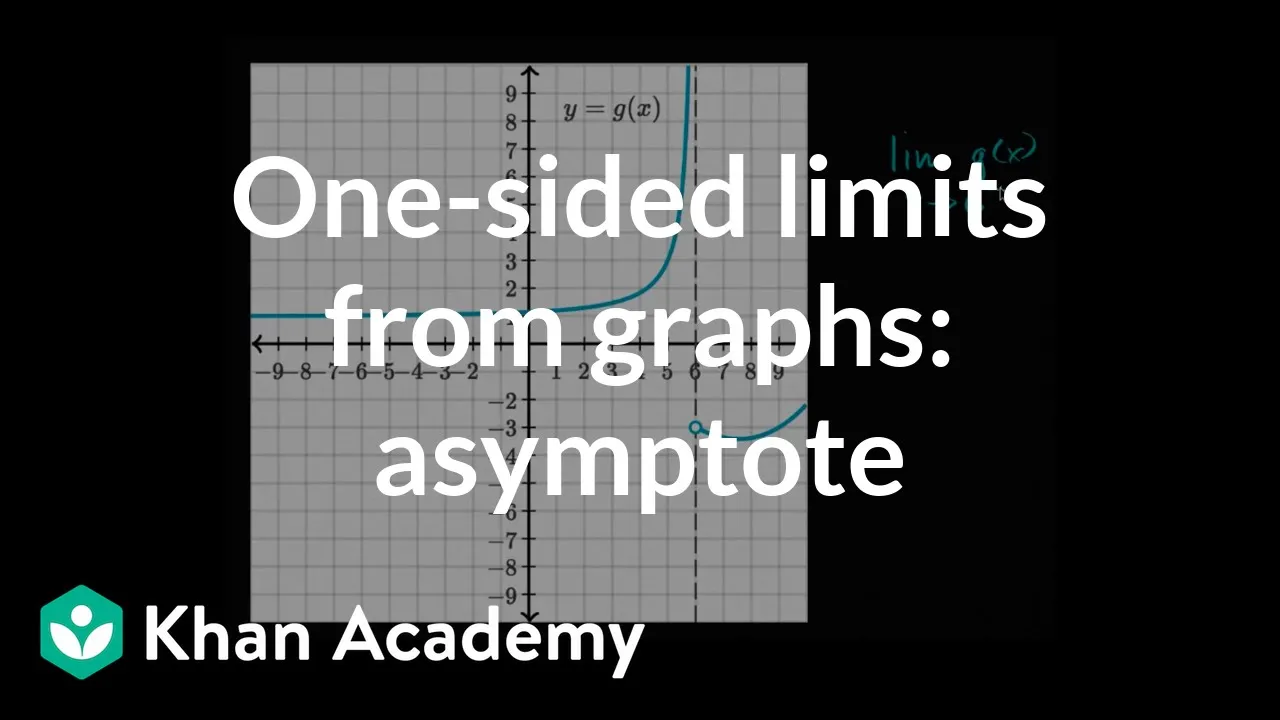 YouTube2:26
English video covering Limits; the current video is in Chinese.
Limits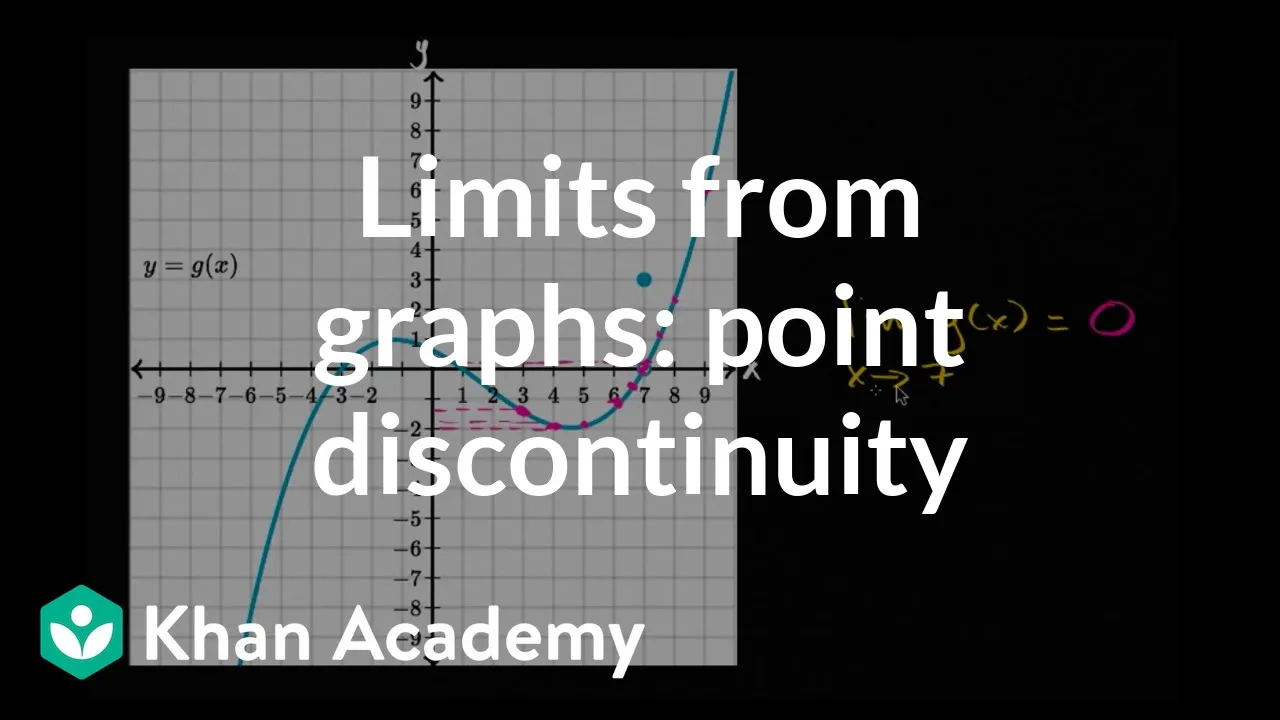 YouTube2:38
English video covering Limits; the current video is in Chinese.
Limits YouTube2:46
English video covering Limits; the current video is in Chinese.
LimitsYouTube2:26Whiteboard for Limits, compared with the current proof.
LimitsYouTube2:38Whiteboard for Limits, compared with the current proof.
LimitsYouTube2:46Whiteboard for Limits, compared with the current proof.
Limits