Difference quotient
The derivative is when this finite limit exists. Substitute everywhere in the original expression.
The Organic Chemistry Tutor · YouTube · 23:31
Work from the limit definition of the derivative, using cancellation and conjugates for polynomial, reciprocal and radical examples.
Use the learning inspector for key ideas and moments, or open the reading tabs for the complete notes.
Generated from the video's visuals and explanation; not verbatim speech.
The derivative is when this finite limit exists. Substitute everywhere in the original expression.
For ², expanding the numerator gives 2xh+h². For nonzero h the quotient becomes , whose limit is 2x.
For =√x, multiply by the conjugate to cancel h. At the limit yields ; the formula does not give a finite derivative at .
The derivative is when this finite limit exists. Substitute everywhere in the original expression.
For ², expanding the numerator gives 2xh+h². For nonzero h the quotient becomes , whose limit is 2x.
For =√x, multiply by the conjugate to cancel h. At the limit yields ; the formula does not give a finite derivative at .
The derivative is when this finite limit exists. Substitute everywhere in the original expression. For ², expanding the numerator gives 2xh+h². For nonzero h the quotient becomes , whose limit is 2x. For =√x, multiply by the conjugate to cancel h. At the limit yields ; the formula does not give a finite derivative at .
You must cancel because direct substitution of into the difference quotient results in the indeterminate form . Algebraic simplification, such as expansion and cancellation for polynomials or rationalization for radicals, removes the singularity at , allowing the limit to be evaluated by direct substitution of the simplified expression.
Conditions: The function is differentiable at .; The difference quotient initially yields a form when .; Algebraic manipulation is valid for nonzero .
The limit definition fails to produce a finite derivative for at . While the formula yields for , substituting results in division by zero, indicating that the slope of the tangent line is vertical and the derivative is undefined (infinite) at that point.
Conditions: .; The point of evaluation is .; The limit is taken as (since the domain is ).
To find the derivative of , substitute into the difference quotient to get . Expanding the numerator yields .
Conditions: .; is nonzero during the cancellation step.; The limit is taken as after simplification.
To find the derivative of , substitute into the difference quotient . Multiply the numerator and denominator by the conjugate to rationalize the numerator.
Conditions: .; for the derivative to be finite.; is nonzero during the algebraic manipulation.
When the finite limit exists, . We do not substitute directly into the quotient; we evaluate its limit.
Conditions: The finite limit must exist.; approaches zero.
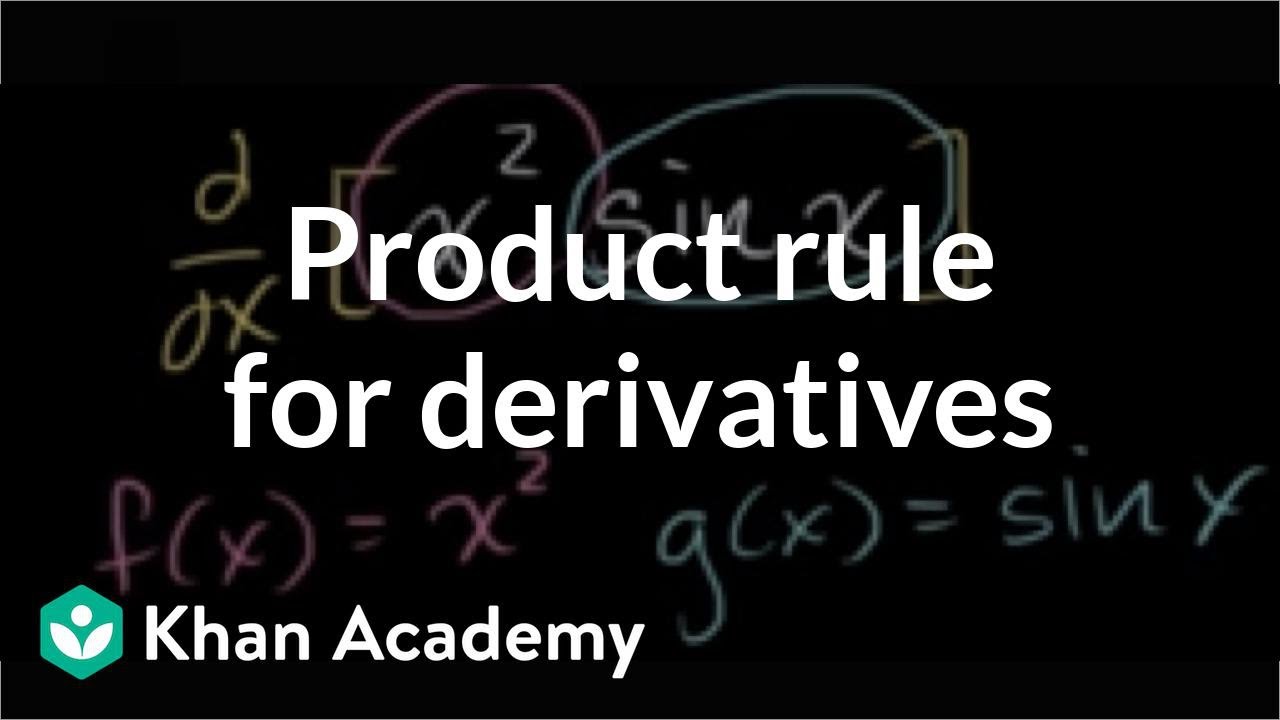 YouTube2:39
Another explanation of Derivatives.
Derivatives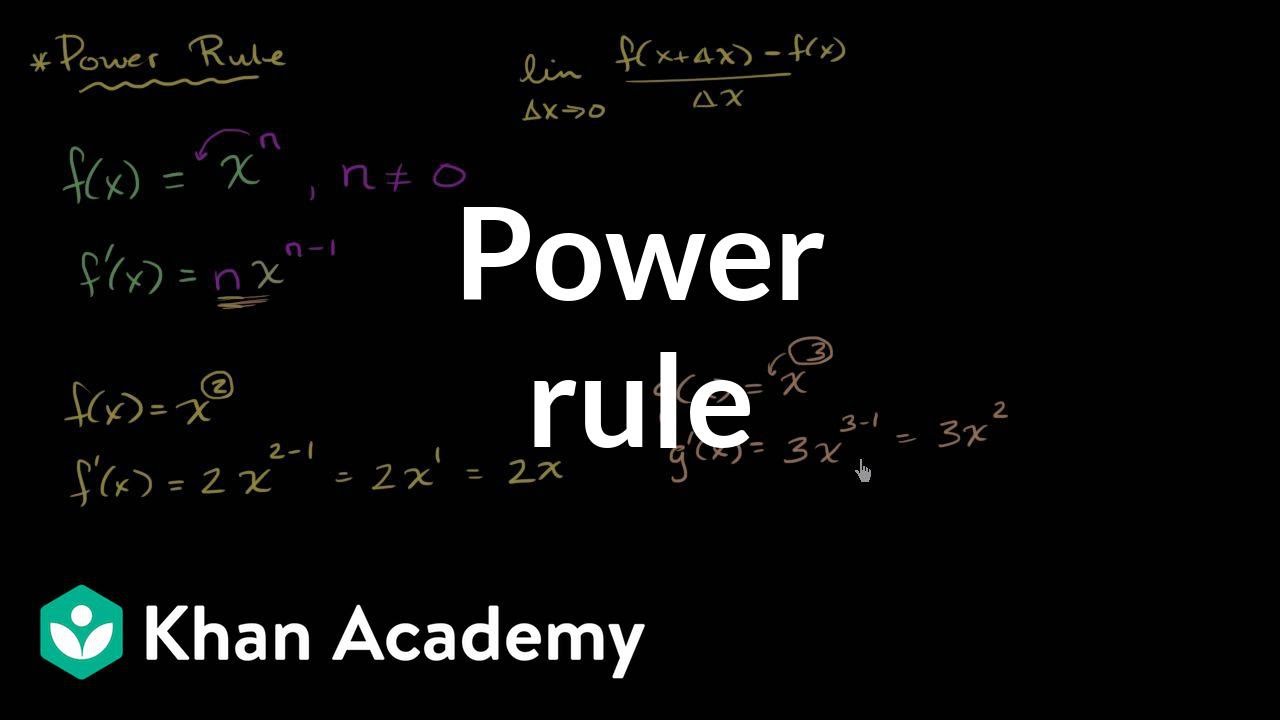 YouTube3:53
Another explanation of Derivatives.
Derivatives YouTube4:16
Next in Calculus: Derivatives → Chain rule.
Chain rule · View learning sequence YouTube8:34
Next in Calculus: Derivatives → Integration by parts.
Integration by parts · View learning sequence YouTube3:55
Next in Calculus: Derivatives → Chain rule.
Chain rule · View learning sequence Bilibili5:38
Visual explanation for Derivatives, compared with the current whiteboard.
Derivatives YouTube3:58
Visual explanation for Derivatives, compared with the current whiteboard.
Derivatives