Columns as transformed basis vectors
Multiplying a matrix by the first or second standard basis vector selects its corresponding column. These two images determine the transformed unit square.
Mu Prime Math · YouTube · 11:31
Understand a two-dimensional determinant by following how a matrix transforms the unit square.
Use the learning inspector for key ideas and moments, or open the reading tabs for the complete notes.
Generated from the video's visuals and explanation; not verbatim speech.
Multiplying a matrix by the first or second standard basis vector selects its corresponding column. These two images determine the transformed unit square.
The columns (3,1) and (2,1) form a parallelogram of area one. The matrix determinant agrees: .
For a 2-by-2 matrix with rows (a,b) and (c,d), the determinant is ad−bc. Its absolute value scales ordinary area; its sign also records orientation.
Multiplying a matrix by the first or second standard basis vector selects its corresponding column. These two images determine the transformed unit square.
The columns (3,1) and (2,1) form a parallelogram of area one. The matrix determinant agrees: .
For a 2-by-2 matrix with rows (a,b) and (c,d), the determinant is ad−bc. Its absolute value scales ordinary area; its sign also records orientation.
Multiplying a matrix by the first or second standard basis vector selects its corresponding column. These two images determine the transformed unit square. The columns (3,1) and (2,1) form a parallelogram of area one. The matrix determinant agrees: . For a 2-by-2 matrix with rows (a,b) and (c,d), the determinant is ad−bc. Its absolute value scales ordinary area; its sign also records orientation.
The formula for the determinant is . This scalar value is computed by multiplying the diagonal elements ( and ) and subtracting the product of the off-diagonal elements ( and ).
Conditions: The matrix is 2x2.; The rows are specified as and .; The entries are real numbers.
The determinant of a 2x2 matrix represents the signed area scaling factor of the linear transformation it defines. Geometrically, it is the area of the parallelogram formed by the matrix's column vectors, starting from the unit square.
Conditions: The matrix is 2x2.; The determinant is calculated as for rows and .; The geometric interpretation assumes the standard Euclidean area measure.
The determinant is 1. This is calculated using the formula for a 2x2 matrix where the columns are .
Conditions: The matrix has columns and .; The determinant formula is applied correctly to the column entries.
A 2x2 matrix transforms the unit square by mapping its standard basis vectors to the matrix's columns. The first column represents the image of the first basis vector, and the second column represents the image of the second basis vector.
Conditions: The matrix is 2x2.; The transformation is linear.; The unit square is defined by the standard basis vectors and .
 YouTube4:19
Another explanation of Determinants.
Determinants Bilibili4:27
Prerequisite in Linear algebra: Matrices → Determinants.
Matrices · View learning sequence YouTube3:37
Prerequisite in Linear algebra: Matrices → Determinants.
Matrices · View learning sequenceYouTube4:19Prerequisite in Linear algebra: Matrices → Determinants.
Matrices · View learning sequence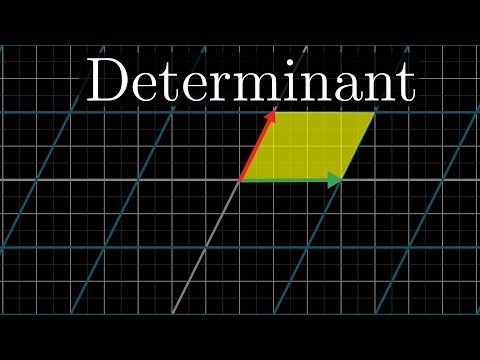 YouTube10:03
Visual explanation for Determinants, compared with the current whiteboard.
Determinants YouTube4:05
Visual explanation for Determinants, compared with the current whiteboard.
Determinants