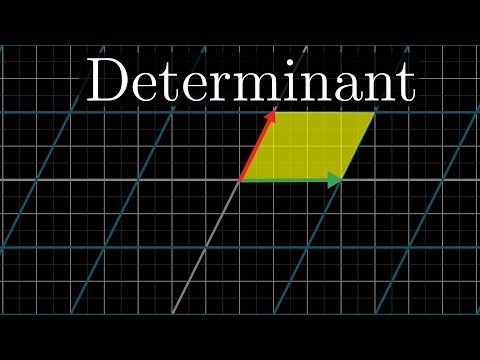
A determinant is a scalar
A square matrix has a determinant, written or . This value can be positive, zero or negative; it is not a matrix absolute value.
Prof Ghrist Math · YouTube · 4:05
Determinants assign a scalar to a square matrix. The lesson works through small matrix cases and then connects the three-dimensional determinant pattern with scalar triple products and the cross-product mnemonic.
Use the learning inspector for key ideas and moments, or open the reading tabs for the complete notes.
Generated from the video's visuals and explanation; not verbatim speech.
A square matrix has a determinant, written or . This value can be positive, zero or negative; it is not a matrix absolute value.
For a matrix , the determinant is . For , it is . A square matrix is invertible exactly when its determinant is nonzero.
For a matrix, the cyclic diagonal pattern organizes three positive and three negative products. It is a mnemonic for that size, not a rule that extends unchanged to larger matrices.
For three-dimensional vectors, , with the vectors as columns. The later cross-product determinant uses basis symbols as a formal memory device, not as ordinary scalar entries of a numerical matrix.
A square matrix has a determinant, written or . This value can be positive, zero or negative; it is not a matrix absolute value.
For a matrix , the determinant is . For , it is . A square matrix is invertible exactly when its determinant is nonzero.
For a matrix, the cyclic diagonal pattern organizes three positive and three negative products. It is a mnemonic for that size, not a rule that extends unchanged to larger matrices.
For three-dimensional vectors, , with the vectors as columns. The later cross-product determinant uses basis symbols as a formal memory device, not as ordinary scalar entries of a numerical matrix.
A square matrix has a determinant, written or . This value can be positive, zero or negative; it is not a matrix absolute value. For a matrix , the determinant is . For , it is . A square matrix is invertible exactly when its determinant is nonzero. For a matrix, the cyclic diagonal pattern organizes three positive and three negative products. It is a mnemonic for that size, not a rule that extends unchanged to larger matrices. For three-dimensional vectors, , with the vectors as columns. The later cross-product determinant uses basis symbols as a formal memory device, not as ordinary scalar entries of a numerical matrix.
A square matrix has a determinant, written or . This value can be positive, zero or negative; it is not a matrix absolute value. For a matrix , the determinant is . For , it is . A square matrix is invertible exactly when its determinant is nonzero. For a matrix, the cyclic diagonal pattern organizes three positive and three negative products. It is a mnemonic for that size, not a rule that extends unchanged to larger matrices. For three-dimensional vectors, , with the vectors as columns. The later cross-product determinant uses basis symbols as a formal memory device, not as ordinary scalar entries of a numerical matrix.
For three-dimensional vectors , the scalar triple product is equal to the determinant of the matrix formed by placing these vectors as columns, denoted as .
Conditions: The vectors are three-dimensional.; The vectors are arranged as columns in the matrix.
No, the determinant is a scalar value that can be positive, zero, or negative. It is explicitly not a matrix absolute value, despite the notation sometimes being used.
Conditions: The object is a square matrix.; The notation or is being interpreted.
For a 1x1 matrix , the determinant is simply the scalar entry itself.
Conditions: The matrix is of size 1x1.; The single entry is .
In the cross-product determinant mnemonic, the basis symbols (like ) serve as a formal memory device. They are not treated as ordinary scalar entries of a numerical matrix, despite being placed in the first row of the determinant-like structure.
Conditions: The context is the mnemonic for calculating the cross product of two 3D vectors.; The structure resembles a 3x3 determinant with basis vectors in the top row.
A square matrix is invertible exactly when its determinant is nonzero. If the determinant is zero, the matrix is singular and not invertible.
Conditions: The matrix is square.; The determinant has been calculated.
The lesson connects them by showing that the scalar triple product of three vectors equals the determinant of the matrix formed by those vectors as columns. It also clarifies that the cross-product mnemonic uses basis symbols as a formal device, linking the algebraic determinant structure to vector operations.
Conditions: Working in three-dimensional space.; Vectors are treated as columns in the determinant.
For a 2x2 matrix , the determinant is calculated as . A square matrix is invertible exactly when its determinant is nonzero.
Conditions: The matrix must be a 2x2 square matrix for the specific formula.; The matrix must be square for the invertibility condition to apply.
The cyclic diagonal pattern organizes three positive and three negative products specifically for 3x3 matrices. It is considered a mnemonic because this specific pattern does not extend unchanged to larger matrices; it is a memory device for that particular size.
Conditions: The matrix is a 3x3 square matrix.; The method being discussed is the cyclic diagonal pattern (Rule of Sarrus).
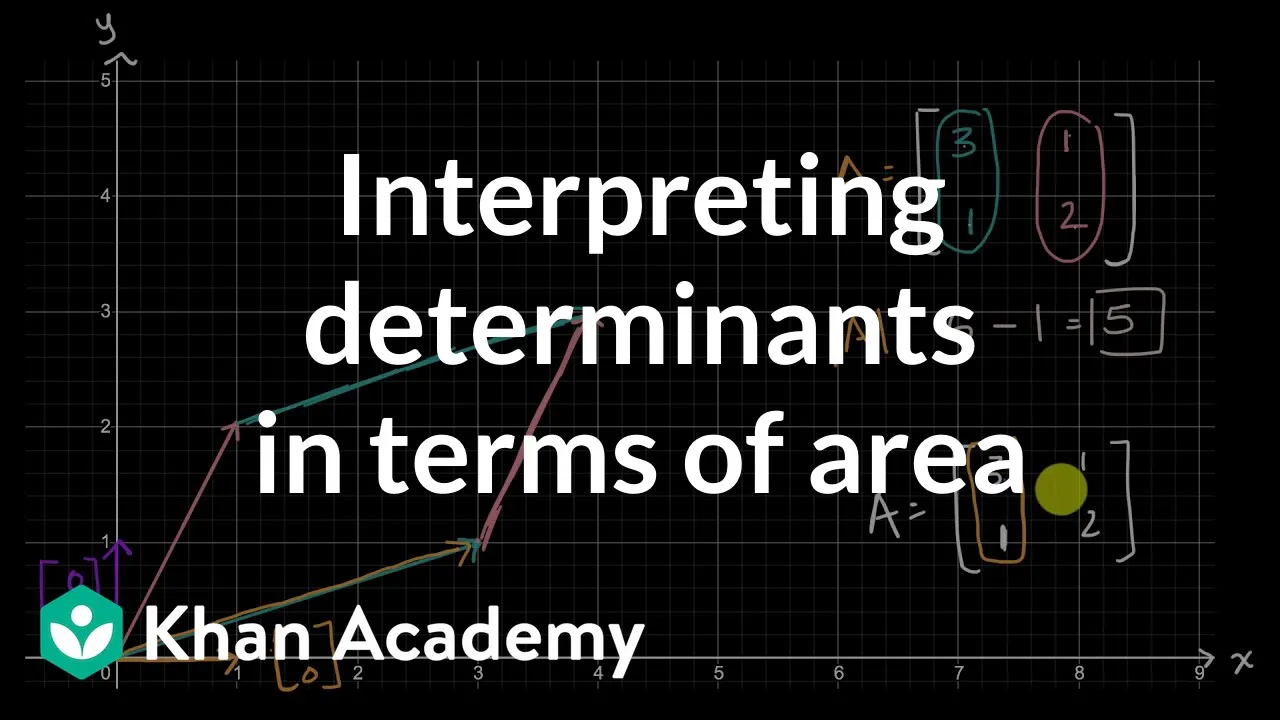 YouTube4:19
Another explanation of Determinants.
Determinants YouTube11:31
Another explanation of Determinants.
Determinants Bilibili4:27
Prerequisite in Linear algebra: Matrices → Determinants.
Matrices · View learning sequence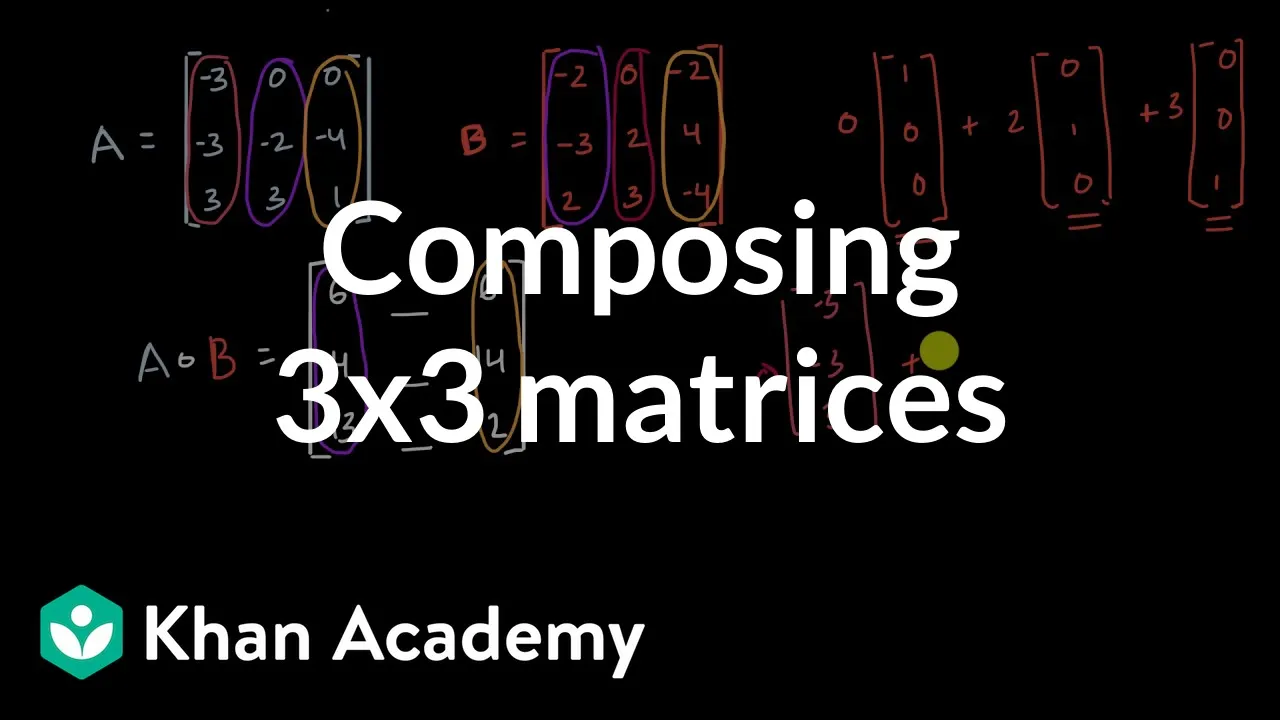 YouTube3:37
Prerequisite in Linear algebra: Matrices → Determinants.
Matrices · View learning sequenceYouTube4:19Prerequisite in Linear algebra: Matrices → Determinants.
Matrices · View learning sequenceYouTube4:19Whiteboard for Determinants, compared with the current visual explanation.
DeterminantsYouTube11:31Whiteboard for Determinants, compared with the current visual explanation.
Determinants YouTube3:26
Whiteboard for Determinants, compared with the current visual explanation.
Determinants