The defining equation
A nonzero v is an eigenvector of A when Av=λv. The reflection about sends (x,y) to (−y,−x).
chrisimm1 · YouTube · 6:25
Read the eigenvectors and eigenvalues of a reflection from its fixed and reversed directions.
Use the learning inspector for key ideas and moments, or open the reading tabs for the complete notes.
Generated from the video's visuals and explanation; not verbatim speech.
A nonzero v is an eigenvector of A when Av=λv. The reflection about sends (x,y) to (−y,−x).
The vector (1,−1) lies along the reflection line and is unchanged. Its eigenvalue is 1.
The vector (1,1) maps to (−1,−1), so its eigenvalue is −1. These two independent directions form an eigenbasis for this example; a general n-by-n matrix need not have n distinct real eigenvalues.
A nonzero v is an eigenvector of A when Av=λv. The reflection about sends (x,y) to (−y,−x).
The vector (1,−1) lies along the reflection line and is unchanged. Its eigenvalue is 1.
The vector (1,1) maps to (−1,−1), so its eigenvalue is −1. These two independent directions form an eigenbasis for this example; a general n-by-n matrix need not have n distinct real eigenvalues.
A nonzero v is an eigenvector of A when Av=λv. The reflection about sends (x,y) to (−y,−x). The vector (1,−1) lies along the reflection line and is unchanged. Its eigenvalue is 1. The vector (1,1) maps to (−1,−1), so its eigenvalue is −1. These two independent directions form an eigenbasis for this example; a general n-by-n matrix need not have n distinct real eigenvalues.
 YouTube16:38
Another explanation of Eigenvalues and eigenvectors.
Eigenvalues and eigenvectors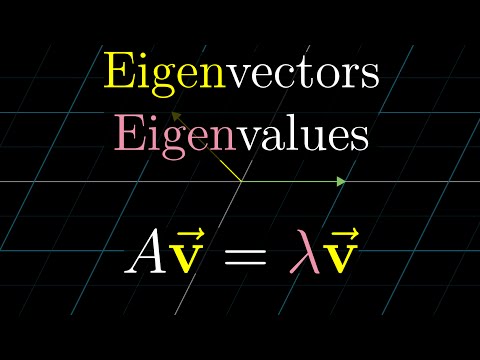 YouTube17:15
Another explanation of Eigenvalues and eigenvectors.
Eigenvalues and eigenvectors Bilibili4:27
Prerequisite in Linear algebra: Linear transformations → Eigenvalues and eigenvectors.
Linear transformations · View learning sequence YouTube3:37
Prerequisite in Linear algebra: Linear transformations → Eigenvalues and eigenvectors.
Linear transformations · View learning sequence YouTube13:52
Prerequisite in Linear algebra: Linear transformations → Eigenvalues and eigenvectors.
Linear transformations · View learning sequenceYouTube17:15Visual explanation for Eigenvalues and eigenvectors, compared with the current whiteboard.
Eigenvalues and eigenvectors