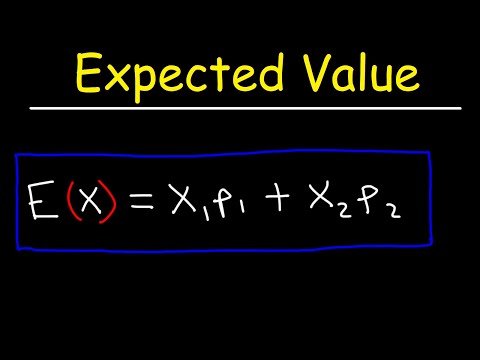
Use net outcomes
Expected value sums each outcome times its probability. When a ticket costs one dollar, distinguish the prize paid from the net profit after the ticket cost.
The Math Sorcerer · YouTube · 4:36
Interpret expected value as a long-run average using a three-digit lottery example.
Use the learning inspector for key ideas and moments, or open the reading tabs for the complete notes.
Generated from the video's visuals and explanation; not verbatim speech.
Expected value sums each outcome times its probability. When a ticket costs one dollar, distinguish the prize paid from the net profit after the ticket cost.
With ten choices in each of three positions and repetition allowed, there are 1000 ordered tickets. Under the lesson’s uniform model, one winning ticket has probability .
If the 500-dollar payment includes the full prize, net outcomes are 499 on a win and −1 on a loss. The expectation is dollars per ticket. It is a long-run mean, not a guaranteed result for one play.
Expected value sums each outcome times its probability. When a ticket costs one dollar, distinguish the prize paid from the net profit after the ticket cost.
With ten choices in each of three positions and repetition allowed, there are 1000 ordered tickets. Under the lesson’s uniform model, one winning ticket has probability .
If the 500-dollar payment includes the full prize, net outcomes are 499 on a win and −1 on a loss. The expectation is dollars per ticket. It is a long-run mean, not a guaranteed result for one play.
Expected value sums each outcome times its probability. When a ticket costs one dollar, distinguish the prize paid from the net profit after the ticket cost. With ten choices in each of three positions and repetition allowed, there are 1000 ordered tickets. Under the lesson’s uniform model, one winning ticket has probability . If the 500-dollar payment includes the full prize, net outcomes are 499 on a win and −1 on a loss. The expectation is dollars per ticket. It is a long-run mean, not a guaranteed result for one play.
The expected value is calculated as a long-run average by weighting each net outcome by its probability. First, determine the net profit for winning and losing.
Conditions: The lottery has three positions with ten choices each, allowing repetition.; The model assumes all 1000 ordered tickets are equally likely.; The ticket costs 500, which includes the full prize amount.
The net outcome for winning is 1. These values are derived by subtracting the 500 prize (for a win) and from $0 (for a loss).
Conditions: The ticket costs 500.; Net outcome is defined as prize minus cost.
You must distinguish them because expected value measures the average financial gain or loss relative to the initial investment. The prize paid is the gross revenue, but the net profit accounts for the cost of the ticket.
Conditions: The lottery ticket has a non-zero cost.; The calculation aims to determine the player's expected financial outcome (profit/loss).
The expected value of -499 or lose 0.50 figure represents the mean outcome if the game were played many times.
Conditions: The expected value has been calculated as -$0.50.; The context involves understanding the meaning of expectation in probability.
The probability of winning is . This is derived from the fact that there are 1000 equally likely ordered tickets, and only one of them is the winning ticket.
Conditions: The lottery consists of three positions.; Each position has ten possible choices (digits 0-9).; Repetition of digits is allowed.; The model assumes a uniform distribution over all possible tickets.
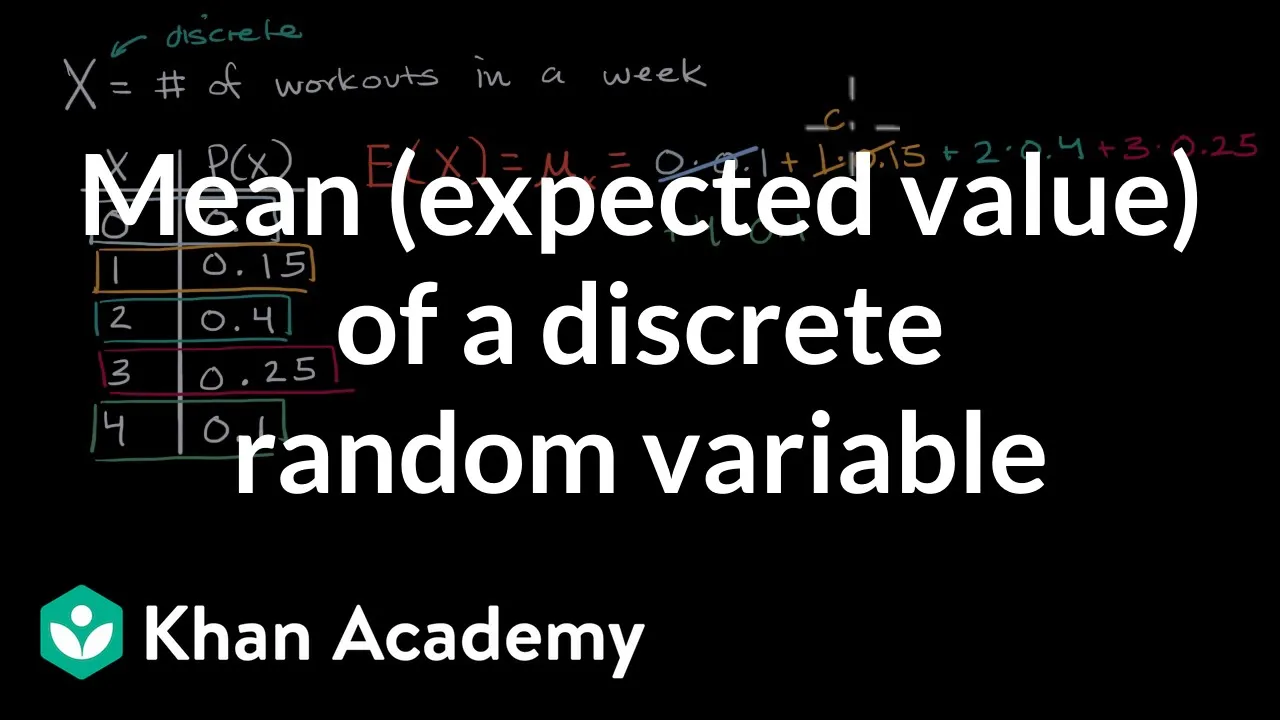 YouTube4:31
Another explanation of Expectation.
Expectation YouTube7:30
Next in Probability and statistics: Expectation → Parameter estimation.
Parameter estimation · View learning sequence YouTube10:38
Next in Probability and statistics: Expectation → Variance.
Variance · View learning sequence YouTube10:54
Prerequisite in Probability and statistics: Distributions → Expectation.
Distributions · View learning sequence