Reviewed learning material · Video analysis · EnglishRead the full overview
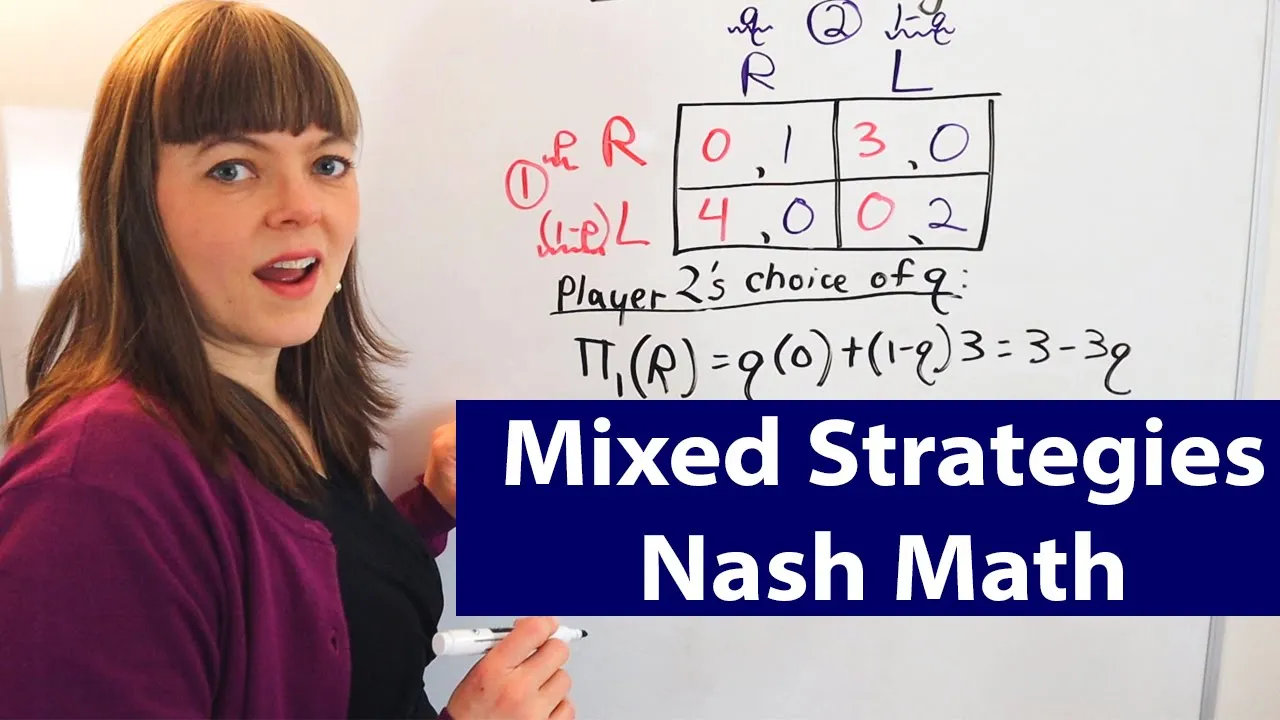
This whiteboard clip solves for the mixed strategy Nash equilibrium of a 2x2 Game of Chicken. The instructor first displays the payoff matrix with strategies Hawk and Dove and opponent mixing probabilities P and 1-P. She then computes player 1's expected payoff from Hawk as Π1(H)=p(−1)+(1−p)(4)=−5p+4 and from Dove as Π1(D)=p(0)+(1−p)(1)=1−p. Using the indifference condition Π1(H)=Π1(D), she solves -5p+4=1−p to obtain p=3/4, which is presented as the mixed strategy equilibrium probability in this symmetric game example.
This video demonstrates two methods for finding the mixed strategy Nash equilibrium in the Game of Chicken. The first method involves calculating the expected payoffs for pure strategies and setting them equal to find the indifference probability. The second method sets up an optimization problem for a player's total expected payoff with respect to their mixing probability and uses the first-order condition. The video highlights a key conceptual point: the first-order condition with respect to a player's own mixing probability reveals the opponent's required mixing probability to maintain equilibrium.
Use the learning inspector for key ideas and moments, or open the reading tabs for the complete notes.
Generated from the video's visuals and explanation; not verbatim speech.
The clip opens on a whiteboard titled "Stable & Unstable Nash" with a 2x2 payoff matrix labeled "Game of Chicken." The rows are Hawk and Dove, and the columns are marked P Hawk and 1-P Dove. The entries are (-1,-1), (4,0), (0,4), and (1,1), so the instructor is setting up a symmetric two-player game before solving for a mixed equilibrium.
She explains the method: choose the probability of playing Hawk so that the other player becomes indifferent between their own pure strategies. In game-theoretic terms, this means comparing the opponent's expected payoffs from Hawk and Dove and finding the mixing probability that equalizes them.
To implement that idea, she focuses on player 1's expected payoff from choosing Hawk. Because the game is symmetric, she says it is enough to analyze one player's payoffs; flipping the players would give the same structure.
Against an opponent who plays Hawk with probability P and Dove with probability 1-P, the expected payoff from Hawk is built from the first row of the matrix. This gives Π1(H)=p(−1)+(1−p)(4), which simplifies step by step to −5p+4.
Next she computes the expected payoff from choosing Dove using the second row. The opponent's Hawk outcome contributes p(0) and the Dove outcome contributes (1−p)(1), so Π1(D)=p(0)+(1−p)(1)=1−p.
The indifference condition is then imposed: player 1 is willing to mix only when the two pure-strategy payoffs are equal. Therefore she sets −5p+4=1−p and solves the linear equation.
Rearranging gives 3=4p, hence p=43. The instructor boxes this value and identifies it as the mixed strategy Nash equilibrium probability for this Game of Chicken example.
The video begins by reviewing the first method for finding a mixed strategy Nash equilibrium in the Game of Chicken. The instructor points to the whiteboard, where the expected payoffs for Player 1 choosing Hawk (Π1(H)) and Dove (Π1(D)) are calculated based on Player 2's mixing probability p. By setting these expected payoffs equal to each other (−5p+4=1−p), the instructor solves for p, finding that Player 2 must play Hawk with a probability of 3/4 to make Player 1 indifferent.
Next, the instructor introduces a second method using optimization. She erases the previous calculations and sets up a new problem. She defines q as the probability that Player 1 chooses Hawk, and 1−q as the probability Player 1 chooses Dove. The goal is to maximize Player 1's total expected payoff function with respect to q. She writes out the full expected payoff function: maxq(q[p(−1)+(1−p)4]+(1−q)[p(0)+(1−p)1]).
The instructor simplifies the expected payoff expression to maxq(−4qp+3q+1−p). She then applies the first-order condition (F.O.C.) by taking the partial derivative of this function with respect to q, yielding ∂q∂π=−4p+3. Setting this derivative equal to zero (−4p+3=0), she solves for p and again finds p=3/4.
Finally, the instructor addresses a common point of confusion. She notes that although the optimization was set up to find Player 1's optimal mixing probability q, the first-order condition actually yielded the opponent's mixing probability p. She explains that this is precisely how mixed strategy Nash equilibria work: a player's optimal mix makes the opponent indifferent, so the F.O.C. reveals the required mix of the *other* player. She concludes by stating that both methods are valid and students can choose whichever they are more comfortable with.
Knowledge cards
01
Game of Chicken payoff matrix
The example uses a 2x2 symmetric game with strategies Hawk and Dove. The displayed payoffs are Hawk/Hawk = (-1,-1), Hawk/Dove = (4,0), Dove/Hawk = (0,4), and Dove/Dove = (1,1). The column headers P and 1-P indicate the opponent's mixing probabilities.
OpponentHawkDoveP:Hawk−1,−10,41−P:Dove4,01,1
02
Mixed strategy equilibrium idea
A mixed strategy assigns probabilities to pure strategies. Here the opponent plays Hawk with probability P and Dove with probability 1-P. The goal is to find the value of P that supports a mixed strategy Nash equilibrium.
P(Hawk)=P,P(Dove)=1−P
03
Indifference method
To find the mixing probability, compute the same player's expected payoff from each pure strategy and set them equal. The equality expresses indifference between the pure strategies, which is the condition used in this worked example.
Π1(H)=Π1(D)
04
Expected payoff from Hawk
Using the first row of the matrix, the expected payoff to player 1 from Hawk is the probability-weighted average of -1 and 4. This simplifies to a linear function of p.
Π1(H)=p(−1)+(1−p)(4)=−5p+4
05
Expected payoff from Dove
Using the second row, the expected payoff to player 1 from Dove is the probability-weighted average of 0 and 1. This simplifies to 1-p.
Π1(D)=p(0)+(1−p)(1)=1−p
06
Solving the equilibrium probability
Set the two expected payoffs equal and solve the resulting linear equation. The algebra gives the unique mixing probability shown on the board.
−5p+4=1−p⇒3=4p⇒p=43
07
Final answer for this example
The instructor concludes that the mixed strategy Nash equilibrium probability in this Game of Chicken example is p=3/4.
p=43
08
Method 1: Equating Expected Payoffs
To find a mixed strategy Nash equilibrium, calculate the expected payoff for each pure strategy of a player, given the opponent's mixing probability. Set these expected payoffs equal to each other. Solving this equation gives the opponent's mixing probability that makes the player indifferent between their pure strategies.
Π1(H)=Π1(D)
09
Method 2: Optimization and First Order Conditions
Set up an optimization problem to maximize a player's total expected payoff with respect to their own mixing probability (e.g., q). Take the first-order condition (partial derivative with respect to q) and set it to zero. Surprisingly, solving this equation yields the *opponent's* required mixing probability (p) for equilibrium, not the player's own q.
∂q∂π=0⇒p=3/4
10
Key Insight: Indifference in Mixed Strategies
In a mixed strategy Nash equilibrium, a player is indifferent between the pure strategies they are randomizing over. Therefore, optimizing your own payoff with respect to your mixing probability doesn't give you a specific optimal probability; instead, the first-order condition reveals the exact mixing probability your opponent must use to keep you indifferent.
Detailed learning notes
Explore conditions, steps and evidence. Supplementary explanations are labeled separately from content shown in the video.
Symbols · 14
P
Clear evidence
Shown in the video
Evidence
Diagram
Observation
The payoff matrix header shows P above Hawk and 1-P above Dove.
Audio
Observation
The instructor says the other player mixes between hawk and dove with a probability of p going hawk and a probability of 1 minus p going dove.
Symbol
P
Meaning
Probability that the opponent plays Hawk.
Domain
0≤P≤1
1-P
Clear evidence
Shown in the video
Evidence
Diagram
Observation
The payoff matrix header shows 1-P above Dove.
Audio
Observation
The instructor refers to the probability of the other player going dove as 1 minus p.
Symbol
1-P
Meaning
Probability that the opponent plays Dove.
Domain
0≤1−P≤1
Hawk
Clear evidence
Shown in the video
Evidence
Diagram
Observation
Hawk labels the first row and the first column of the payoff matrix.
Audio
Observation
The instructor repeatedly names the hawk strategy.
Symbol
Hawk
Meaning
One pure strategy in the Game of Chicken payoff matrix.
Dove
Clear evidence
Shown in the video
Evidence
Diagram
Observation
Dove labels the second row and the second column of the payoff matrix.
Audio
Observation
The instructor repeatedly names the dove strategy.
Symbol
Dove
Meaning
One pure strategy in the Game of Chicken payoff matrix.
[−1,−10,44,01,1]
Clear evidence
Shown in the video
Evidence
Diagram
Observation
The whiteboard shows a 2x2 matrix with entries (-1,-1), (4,0), (0,4), and (1,1).
Symbol
[−1,−10,44,01,1]
Meaning
Payoff matrix for the Game of Chicken, with row player payoffs listed first and column player payoffs second.
Π1(H)
Clear evidence
Shown in the video
Evidence
Formula
Observation
The instructor writes Π1(H) on the board.
Audio
Observation
She says she is finding the payoff to player one from choosing hawk.
Symbol
Π1(H)
Meaning
Expected payoff to player 1 when player 1 chooses Hawk against the opponent's mixed strategy.
Π1(D)
Clear evidence
Shown in the video
Evidence
Formula
Observation
The instructor writes Π1(D) on the board.
Audio
Observation
She says similarly the payoff to player one of going dove is going to be equal to ...
Symbol
Π1(D)
Meaning
Expected payoff to player 1 when player 1 chooses Dove against the opponent's mixed strategy.
p
Clear evidence
Shown in the video
Evidence
Diagram
Observation
The whiteboard shows 'p' above the Hawk column and '1-p' above the Dove column in the payoff matrix.
Audio
Observation
The speaker refers to 'p' as the other player's mix.
Symbol
p
Meaning
Probability that Player 2 chooses Hawk.
Domain
[0, 1]
q
Clear evidence
Shown in the video
Evidence
Diagram
Observation
The speaker writes 'q' next to the Hawk row and '1-q' next to the Dove row.
Audio
Observation
The speaker states, 'I'm going to let player one mix with a probability of q and one minus q.'
Symbol
q
Meaning
Probability that Player 1 chooses Hawk.
Domain
[0, 1]
Π1(H)
Clear evidence
Shown in the video
Evidence
Diagram
Observation
The whiteboard displays the equation 'Π1(H)=p(−1)+(1−p)(4)=−p+4−4p=−5p+4'.
Symbol
Π1(H)
Meaning
Expected payoff for Player 1 when choosing the pure strategy Hawk.
Domain
Real numbers
Π1(D)
Clear evidence
Shown in the video
Evidence
Diagram
Observation
The whiteboard displays the equation 'Π1(D)=p(0)+(1−p)(1)=1−p'.
Symbol
Π1(D)
Meaning
Expected payoff for Player 1 when choosing the pure strategy Dove.
Domain
Real numbers
maxq
Clear evidence
Shown in the video
Evidence
Diagram
Observation
The speaker writes 'max_q' followed by an expression for the total expected payoff function.
Audio
Observation
The speaker says, 'we maximize player one's objective function by choosing q'.
Symbol
maxq
Meaning
Maximization operator with respect to the variable q.
Domain
Real numbers
Knowledge points · 6
Game of Chicken payoff matrix
Clear evidence
Shown in the video
Evidence
Diagram
Observation
The board title reads Stable & Unstable Nash and the matrix is labeled Game of Chicken.
Audio
Observation
The instructor says this particular game of chicken.
Definition
Explanation
The clip uses a two-strategy symmetric game called the Game of Chicken. The strategies are Hawk and Dove, and the displayed payoff matrix gives each outcome pair as (row player payoff, column player payoff).
Formula
OpponentHawkDoveP:Hawk−1,−10,41−P:Dove4,01,1
Conditions
Two players.
Each player has strategies Hawk and Dove.
Payoffs are written as ordered pairs with the row player first.
Mixed strategy Nash equilibrium in this example
Clear evidence
Shown in the video
Evidence
Audio
Observation
The instructor says she is going to find the mixed strategies Nash equilibrium of this particular game of chicken.
Diagram
Observation
The matrix headers use P and 1-P to represent mixing probabilities.
Definition
Explanation
In this example, a mixed strategy is represented by assigning probability P to Hawk and probability 1-P to Dove. The instructor seeks the value of P that makes the opponent indifferent between their own pure strategies.
Formula
P(Hawk)=P,P(Dove)=1−P
Conditions
The opponent randomizes between Hawk and Dove.
Probabilities must sum to 1.
Prerequisites
Game of Chicken payoff matrix
Indifference method for mixed equilibrium
Clear evidence
Shown in the video
Evidence
Audio
Observation
The instructor says one strategy is to choose a probability of going hawk that makes the other player indifferent between their strategies.
Audio
Observation
Later she says player one will be indifferent when the payoff from going hawk is equal to the payoff of going dove.
Method
Explanation
The method shown is to compute the expected payoff of each pure strategy against the opponent's mix, then set those expected payoffs equal. Solving that equality gives the mixing probability that makes the opponent indifferent.
Formula
Π1(H)=Π1(D)
Conditions
Use when looking for a mixed-strategy equilibrium supported by the listed pure strategies.
Compare the same player's expected payoffs across pure strategies.
Prerequisites
Mixed strategy Nash equilibrium in this example
Symmetric game remark
Clear evidence
Shown in the video
Evidence
Audio
Observation
The instructor says it doesn't actually matter here because this is a symmetric game, like the players have the same payoffs if you flip it.
Definition
Explanation
The instructor states that the game is symmetric, meaning the players have the same payoff structure under interchange of roles. This is why she can analyze player 1's payoffs without separately redoing player 2's case in this clip.
Conditions
The payoff structure is unchanged when the players' roles are flipped.
Prerequisites
Game of Chicken payoff matrix
Finding Mixed Strategy Nash Equilibrium
Clear evidence
Shown in the video
Evidence
Audio
Observation
The speaker explains two methods for finding mixed strategy Nash equilibria: equating expected payoffs of pure strategies and using optimization with first-order conditions.
Diagram
Observation
The whiteboard shows the Game of Chicken payoff matrix and the step-by-step derivation of the mixed strategy probability p=3/4 using both methods.
Method
Explanation
A mixed strategy Nash equilibrium can be found by ensuring a player is indifferent between their pure strategies. This can be done by setting the expected payoffs of the pure strategies equal to each other, or by setting up an optimization problem for a player's expected payoff with respect to their mixing probability and taking the first-order condition. In a symmetric game, solving for one player's optimal mixing probability gives the other player's as well.
Formula
Conditions
The game must have at least one mixed strategy Nash equilibrium.
For the optimization method, the expected payoff function must be differentiable with respect to the mixing probability.
Expected Payoff Calculation
Clear evidence
Shown in the video
Evidence
Diagram
Observation
The whiteboard shows calculations like 'Π1(H)=p(−1)+(1−p)(4)' and the full expected payoff function for Player 1.
Formula
Explanation
The expected payoff for a player choosing a specific pure strategy against an opponent's mixed strategy is calculated by multiplying the payoff of each possible outcome by the probability of the opponent choosing that corresponding pure strategy, and summing the results. The total expected payoff for a player using a mixed strategy is the sum of the expected payoffs of each pure strategy weighted by their respective probabilities.
Formula
E[Payoff]=i∑P(Opponent plays i)×Payoff(i)
Conditions
The probabilities of the opponent's strategies must sum to 1.
Claims and conditions · 4
Indifference condition for mixed equilibrium
Clear evidence
Shown in the video
Evidence
Audio
Observation
The instructor says player one will be indifferent when the payoff from going hawk is equal to the payoff of going dove.
Formula
Observation
She then sets -5p+4=1−p and solves.
Proposition
Statement
For the mixed strategy being solved here, player 1 is indifferent between Hawk and Dove exactly when Π1(H)=Π1(D).
Hypotheses
Player 2 mixes with probabilities P and 1-P over Hawk and Dove.
The relevant payoffs are the expected payoffs to player 1 from each pure strategy.
Quantifiers
For the mixing probability P under consideration in this example.
Computed mixed equilibrium probability
Clear evidence
Shown in the video
Evidence
Audio
Observation
The instructor says when we do that we get p equals three fourths is going to be the mixed strategies Nash equilibrium.
Formula
Observation
The board shows the boxed result p=3/4.
Proposition
Statement
Solving the indifference equation for this payoff matrix gives P=43.
Hypotheses
Use the displayed Game of Chicken payoff matrix.
Set Π1(H)=Π1(D).
Quantifiers
For this specific 2x2 Game of Chicken example.
Symmetry in Game of Chicken
Clear evidence
Shown in the video
Evidence
Audio
Observation
The speaker states, 'it would look exactly the same since it's a symmetric problem.'
Proposition
Statement
In the Game of Chicken, the calculation for Player 2's expected payoff from going Hawk is identical to Player 1's because the game is symmetric.
Hypotheses
The game is a symmetric game.
Quantifiers
Universal for all symmetric games.
Result of First Order Condition in Mixed Strategies
Clear evidence
Shown in the video
Evidence
Audio
Observation
The speaker notes, 'what popped out of it had nothing to do with q, it had to do with p, the other player's mix. And that's how mixed strategies Nash equilibrium works.'
Proposition
Statement
When maximizing a player's expected payoff with respect to their own mixing probability (q) to find a mixed strategy Nash equilibrium, the first-order condition will yield an equation that determines the *opponent's* mixing probability (p), not the player's own.
Hypotheses
The game has a mixed strategy Nash equilibrium.
The expected payoff function is linear in the player's own mixing probability.
Quantifiers
Universal for 2x2 games with mixed strategy Nash equilibria.
Derivations and proofs · 5
Derivation of expected payoff from Hawk
Clear evidence
Shown in the video
Evidence
Formula
Observation
The instructor writes Π1(H)=p(−1)+(1−p)(4)=−p+4−4p=−5p+4.
Audio
Observation
She explains each term as probability times payoff for encountering hawk or dove.
Proof
Steps
Expression
Π1(H)=p(−1)+(1−p)(4)
Explanation
The expected payoff from choosing Hawk is the weighted sum of the two possible opponent actions.
Justification
Definition of expected payoff using the opponent's mixing probabilities P and 1-P.
Shown in the video
Expression
=−p+4−4p
Explanation
Distribute the multiplication over the terms.
Justification
Algebraic expansion.
Shown in the video
Expression
=−5p+4
Explanation
Combine like terms in p.
Justification
Algebraic simplification.
Shown in the video
Conclusion
Π1(H)=−5p+4.
Derivation of expected payoff from Dove
Clear evidence
Shown in the video
Evidence
Formula
Observation
The instructor writes Π1(D)=p(0)+(1−p)(1)=1−p.
Audio
Observation
She says the expected payoff is the probability of encountering a hawk times the payoff if you encounter a hawk plus the probability you encounter a dove times the payoff ... is one.
Proof
Steps
Expression
Π1(D)=p(0)+(1−p)(1)
Explanation
The expected payoff from choosing Dove is the weighted sum of the two possible opponent actions.
Justification
Definition of expected payoff using the opponent's mixing probabilities.
Shown in the video
Expression
=1−p
Explanation
The first term vanishes and the second term simplifies.
Justification
Arithmetic simplification.
Shown in the video
Conclusion
Π1(D)=1−p.
Solving the indifference equation
Clear evidence
Shown in the video
Evidence
Formula
Observation
The board shows -5p+4=1−p, then +5p-1, then 3=4p, then p=3/4 boxed.
Audio
Observation
The instructor says set these two things equal to one another and solve for p, then states p equals three fourths.
Proof
Steps
Expression
−5p+4=1−p
Explanation
Set the expected payoff from Hawk equal to the expected payoff from Dove.
Justification
Indifference condition for a mixed strategy equilibrium.
Shown in the video
Expression
+5p−1
Explanation
Move terms to isolate constants and coefficients of p.
Justification
Algebraic rearrangement.
Shown in the video
Expression
3=4p
Explanation
After rearrangement, the constant terms give 3 and the p terms give 4p.
Justification
Algebraic simplification.
Shown in the video
Expression
p=43
Explanation
Divide both sides by 4.
Justification
Solving a linear equation.
Shown in the video
Conclusion
The mixing probability satisfying indifference is p=43.
Method 1: Equating Expected Payoffs
Clear evidence
Shown in the video
Evidence
Diagram
Observation
The whiteboard shows the equations 'Π1(H)=−5p+4' and 'Π1(D)=1−p', followed by '-5p + 4=1−p⇒3=4p⇒p=3/4'.
Proof
Steps
Expression
Π1(H)=p(−1)+(1−p)(4)=−5p+4
Explanation
Calculate the expected payoff for Player 1 if they choose Hawk, given Player 2 mixes with probability p for Hawk.
Justification
Definition of expected value.
Shown in the video
Expression
Π1(D)=p(0)+(1−p)(1)=1−p
Explanation
Calculate the expected payoff for Player 1 if they choose Dove, given Player 2 mixes with probability p for Hawk.
Justification
Definition of expected value.
Shown in the video
Expression
−5p+4=1−p
Explanation
Set the two expected payoffs equal to each other to find the indifference point for Player 1.
Justification
Condition for a mixed strategy Nash equilibrium (player must be indifferent between pure strategies).
Shown in the video
Expression
3=4p⇒p=3/4
Explanation
Solve the resulting linear equation for p.
Justification
Algebraic manipulation.
Shown in the video
Conclusion
Player 2 must play Hawk with probability p=3/4 to make Player 1 indifferent between Hawk and Dove.
Method 2: Optimization and First Order Conditions
Clear evidence
Shown in the video
Evidence
Diagram
Observation
The whiteboard shows the setup of the maximization problem 'maxqq[p(−1)+(1−p)4]+(1−q)[p(0)+(1−p)1]', its simplification to 'maxq−4qp + 3q+1−p', and the first-order condition '∂q∂π=−4p+3=0⇒p=3/4'.
Proof
Steps
Expression
qmax(q[p(−1)+(1−p)4]+(1−q)[p(0)+(1−p)1])
Explanation
Set up the optimization problem to maximize Player 1's total expected payoff with respect to their mixing probability q.
Justification
Definition of expected payoff for a mixed strategy.
Shown in the video
Expression
qmax(−4qp+3q+1−p)
Explanation
Simplify the expected payoff expression by expanding and combining like terms.
Justification
Algebraic simplification.
Shown in the video
Expression
∂q∂π=−4p+3
Explanation
Take the partial derivative of the simplified expected payoff function with respect to q.
Justification
Rules of differentiation (power rule, treating p as a constant).
Shown in the video
Expression
−4p+3=0
Explanation
Set the first-order condition (the derivative) equal to zero to find the critical point.
Justification
Necessary condition for an interior maximum in optimization.
Shown in the video
Expression
p=3/4
Explanation
Solve the resulting equation for p.
Justification
Algebraic manipulation.
Shown in the video
Conclusion
The first-order condition yields p=3/4, which is the probability Player 2 must play Hawk to make Player 1's expected payoff maximized (and thus indifferent between pure strategies).
Worked examples · 2
Worked example: mixed strategy Nash equilibrium in Game of Chicken
Clear evidence
Shown in the video
Evidence
Diagram
Observation
The whole clip works on the displayed Game of Chicken matrix.
Audio
Observation
The instructor explicitly frames the video as solving for the mixed strategies Nash equilibrium of this game.
Problem
Find the mixed strategy probability P that makes the opponent indifferent in the displayed Game of Chicken.
Opponent mixes with probability P on Hawk and 1-P on Dove.
Goal
Compute the mixed-strategy equilibrium probability P.
Steps
Expression
Π1(H)=p(−1)+(1−p)(4)
Explanation
Write the expected payoff to player 1 from choosing Hawk.
Justification
Expected value over the opponent's two pure strategies.
Shown in the video
Expression
Π1(H)=−5p+4
Explanation
Simplify the Hawk payoff expression.
Justification
Algebra.
Shown in the video
Expression
Π1(D)=p(0)+(1−p)(1)
Explanation
Write the expected payoff to player 1 from choosing Dove.
Justification
Expected value over the opponent's two pure strategies.
Shown in the video
Expression
Π1(D)=1−p
Explanation
Simplify the Dove payoff expression.
Justification
Algebra.
Shown in the video
Expression
−5p+4=1−p
Explanation
Set the two expected payoffs equal.
Justification
Indifference condition for mixed equilibrium.
Shown in the video
Expression
p=43
Explanation
Solve the resulting linear equation.
Justification
Algebraic solution.
Shown in the video
Answer
P=43.
Verification
Substitute P=3/4 into the two payoff formulas: Π1(H)=−5(3/4)+4=1/4 and Π1(D)=1−3/4=1/4, so the payoffs are equal.
Mixed Strategy Nash Equilibrium in Game of Chicken
Clear evidence
Shown in the video
Evidence
Diagram
Observation
The whiteboard displays the 'Game of Chicken' payoff matrix with Hawk and Dove strategies and payoffs (-1,-1), (4,0), (0,4), (1,1).
Problem
Find the mixed strategy Nash equilibrium for the Game of Chicken.
Given
Payoff matrix for Game of Chicken: Hawk/Hawk = (-1,-1), Hawk/Dove = (4,0), Dove/Hawk = (0,4), Dove/Dove = (1,1).
Player 2 plays Hawk with probability p and Dove with probability 1-p.
Player 1 plays Hawk with probability q and Dove with probability 1-q.
Goal
Determine the probability p (and by symmetry, q) that constitutes a mixed strategy Nash equilibrium.
Steps
Expression
Π1(H)=−5p+4,Π1(D)=1−p
Explanation
Calculate Player 1's expected payoffs for pure strategies Hawk and Dove.
Justification
Definition of expected value.
Shown in the video
Expression
−5p+4=1−p⇒p=3/4
Explanation
Equate the expected payoffs and solve for p.
Justification
Indifference condition for mixed strategy Nash equilibrium.
Shown in the video
Expression
qmax(−4qp+3q+1−p)
Explanation
Set up and simplify Player 1's total expected payoff function.
Justification
Definition of expected payoff for a mixed strategy.
Shown in the video
Expression
∂q∂π=−4p+3=0⇒p=3/4
Explanation
Take the first-order condition with respect to q and solve for p.
Justification
Optimization condition for Nash equilibrium.
Shown in the video
Answer
The mixed strategy Nash equilibrium involves each player playing Hawk with probability 3/4 and Dove with probability 1/4.
Verification
Both methods (equating expected payoffs and using first-order conditions) yield the same result, p=3/4.
Visual events · 2
Whiteboard setup and progression
Clear evidence
Shown in the video
Evidence
Diagram
Observation
A whiteboard shows the title Stable & Unstable Nash, a 2x2 payoff matrix labeled Game of Chicken, and later handwritten equations beneath it.
Objects
Title text: Stable & Unstable Nash
2x2 payoff matrix
Row labels Hawk and Dove
Column headers P Hawk and 1-P Dove
Side label Game of Chicken
Handwritten equations below the matrix
Changes
At the start, only the title and payoff matrix are visible.
Around 42 seconds, the instructor begins writing Π1(H).
Around 94 seconds, she adds Π1(D).
Around 128 seconds, she writes the equality -5p+4=1−p and solves it.
By the end, the boxed result p=3/4 is visible.
Invariants
The payoff matrix values remain unchanged throughout the clip.
The strategy labels Hawk and Dove remain fixed.
The column headers P and 1-P remain fixed.
Interpretation
The visual progression mirrors the algebraic method: first identify the game, then compute each pure-strategy expected payoff, then impose indifference and solve for the mixing probability.
Whiteboard Demonstration of Optimization Method
Clear evidence
Shown in the video
Evidence
Animation
Observation
The speaker erases previous calculations and writes new equations for the optimization method on the whiteboard.
Objects
Whiteboard
Marker
Speaker
Changes
Previous equations are erased.
New variables q and 1-q are written next to the payoff matrix rows.
The maximization problem is written out step-by-step.
The first-order condition is derived and solved.
Invariants
The Game of Chicken payoff matrix remains visible at the top of the board.
Interpretation
The visual progression demonstrates the alternative method for finding the mixed strategy Nash equilibrium using calculus-based optimization.
Misconceptions · 2
Why analyzing only player 1 is enough here
Clear evidence
Shown in the video
Evidence
Audio
Observation
The instructor says it doesn't actually matter here because this is a symmetric game, like the players have the same payoffs if you flip it.
Misconception
One might think the calculation must be repeated separately for both players even in a symmetric game.
Clarification
The instructor explicitly notes that because the game is symmetric, the same payoff logic applies after flipping the players, so analyzing player 1 suffices for this example.
Misinterpreting the Result of the First Order Condition
Clear evidence
Shown in the video
Evidence
Audio
Observation
The speaker explicitly points out the counter-intuitive result: 'you notice it's a little bit weird that we set up an optimization problem trying to decide what we as player one should choose for our mix, that's q, and what popped out of it had nothing to do with q, it had to do with p, the other player's mix.'
Misconception
Students might expect that maximizing their own payoff with respect to their own mixing probability (q) would directly yield their optimal q.
Clarification
In a mixed strategy Nash equilibrium, a player is indifferent between their pure strategies. The first-order condition of the expected payoff function with respect to a player's own mixing probability actually reveals the *opponent's* required mixing probability to maintain this indifference.
Concept relations · 7
Indifference method for mixed equilibrium → Mixed strategy Nash equilibrium in this example
Clear evidence
Shown in the video
Evidence
Audio
Observation
The instructor introduces the indifference method as a way to find the mixed strategies Nash equilibrium.
Application
Explanation
The indifference method is the computational procedure used to find the mixed strategy Nash equilibrium in this example.
Symmetric game remark → Game of Chicken payoff matrix
Clear evidence
Shown in the video
Evidence
Audio
Observation
The instructor says this is a symmetric game while referring to the displayed payoff matrix.
Special case
Explanation
The displayed Game of Chicken is treated as an instance of a symmetric game, which justifies focusing on one player's payoffs.
Derivation of expected payoff from Hawk → Indifference condition for mixed equilibrium
Clear evidence
Shown in the video
Evidence
Formula
Observation
The board equates the simplified expressions for Π1(H) and Π1(D).
Proof dependency
Explanation
The indifference claim depends on first deriving the expected payoff expressions for Hawk and Dove.
Derivation of expected payoff from Dove → Indifference condition for mixed equilibrium
Clear evidence
Shown in the video
Evidence
Formula
Observation
The board equates -5p+4 and 1-p.
Proof dependency
Explanation
The Dove expected payoff derivation supplies the right-hand side of the indifference equation.
Indifference condition for mixed equilibrium → Computed mixed equilibrium probability
Clear evidence
Shown in the video
Evidence
Formula
Observation
The equality is solved to obtain the boxed p=3/4.
Proof dependency
Explanation
The equilibrium probability follows directly from solving the indifference equation.
The speaker presents two different methods and shows they lead to the same answer, stating 'You can use either method depending on what you're most comfortable with'.
Equivalent
Explanation
Equating expected payoffs of pure strategies and using optimization with first-order conditions are equivalent methods for finding mixed strategy Nash equilibria in 2x2 games.
The derivation explicitly builds the expected payoff function and then applies the first-order condition to it.
Application
Explanation
The concept of expected payoff is applied to construct the objective function for the optimization method of finding a mixed strategy Nash equilibrium.
Find an answer · 8
What payoff matrix is being used in this Game of Chicken example?
Clear evidence
Shown in the video
Evidence
Diagram
Observation
The board labels the matrix Game of Chicken.
Knowledge points
Game of Chicken payoff matrix
How do you find a mixed strategy Nash equilibrium using the indifference method?
Clear evidence
Shown in the video
Evidence
Audio
Observation
The instructor explains choosing a probability that makes the other player indifferent.
Knowledge points
Indifference method for mixed equilibrium
Mixed strategy Nash equilibrium in this example
Why can the instructor analyze only player 1's payoffs in this example?
Clear evidence
Shown in the video
Evidence
Audio
Observation
The instructor says it does not matter because the game is symmetric.
Knowledge points
Symmetric game remark
Why do we set the two expected payoffs equal to each other?
Clear evidence
Shown in the video
Evidence
Audio
Observation
The instructor says player one will be indifferent when the payoff from going hawk is equal to the payoff of going dove.
Knowledge points
Indifference condition for mixed equilibrium
Indifference method for mixed equilibrium
What is the mixed strategy probability found at the end of the clip?
Clear evidence
Shown in the video
Evidence
Formula
Observation
The final boxed result is p=3/4.
Knowledge points
Computed mixed equilibrium probability
Worked example: mixed strategy Nash equilibrium in Game of Chicken
How do you find a mixed strategy Nash equilibrium?
Clear evidence
Shown in the video
Evidence
Audio
Observation
The entire video is dedicated to explaining how to find a mixed strategy Nash equilibrium.
Knowledge points
Finding Mixed Strategy Nash Equilibrium
Why does taking the derivative with respect to my own mixing probability give me the opponent's mixing probability?
Clear evidence
Shown in the video
Evidence
Audio
Observation
The speaker addresses the confusion about why the first-order condition with respect to q yields p.
Knowledge points
Finding Mixed Strategy Nash Equilibrium
Misinterpreting the Result of the First Order Condition
Can you show an example of calculating mixed strategies for the Game of Chicken?
Clear evidence
Shown in the video
Evidence
Diagram
Observation
The whiteboard clearly labels the matrix as 'Game of Chicken'.
Knowledge points
Mixed Strategy Nash Equilibrium in Game of Chicken
Coverage and review notes
Covered · Introduction to the Game of Chicken matrix and the goal of finding the mixed strategy Nash equilibrium.
Covered · The instructor states the indifference-based method for finding the mixed equilibrium.
Covered · Setup of player 1's expected payoff from Hawk and the symmetry remark.
Covered · Computation of player 1's expected payoff from Dove.
Covered · Set the two expected payoffs equal, solve the linear equation, and box the result p=3/4.
Covered · Introduction to the problem and demonstration of the first method (equating expected payoffs).
Covered · Demonstration of the second method (optimization and first-order conditions).
Covered · Explanation of the counter-intuitive result of the first-order condition and conclusion.
Reviewed English material v1: card "Key Insight: Indifference in Mixed Strategies" at 4:13 — In a mixed strategy Nash equilibrium, a player is indifferent between the pure strategies they are randomizing over. Therefore, optimizing your own payoff with respect to your mixing probability doesn't give you a specific optimal probability; instead, the first-order condition reveals the exact mixing probability your opponent must use to keep you indifferent.