State the hypotheses
The example uses a population mean of 23 as the reference claim. The null hypothesis includes the boundary value, while the alternative expresses the particular departure being tested.
Joshua Emmanuel · YouTube · 4:00
Hypothesis testing compares a population claim with evidence from a sample. This introduction explains null and alternative hypotheses, one- and two-tailed tests, significance levels and careful decision language.
Use the learning inspector for key ideas and moments, or open the reading tabs for the complete notes.
Generated from the video's visuals and explanation; not verbatim speech.
The example uses a population mean of 23 as the reference claim. The null hypothesis includes the boundary value, while the alternative expresses the particular departure being tested.
gives a two-tailed test, a left-tailed test, and a right-tailed test. The direction should be chosen for the question before examining the result.
A test can reject or fail to reject it. Failing to reject is not a proof that the null is true; the sample may simply provide insufficient evidence against it.
Under the test's null model, the significance level controls the chance of rejecting a true null. In the displayed symmetric two-tailed construction, each tail receives ; a one-tailed test uses its designated tail.
The example uses a population mean of 23 as the reference claim. The null hypothesis includes the boundary value, while the alternative expresses the particular departure being tested.
gives a two-tailed test, a left-tailed test, and a right-tailed test. The direction should be chosen for the question before examining the result.
A test can reject or fail to reject it. Failing to reject is not a proof that the null is true; the sample may simply provide insufficient evidence against it.
Under the test's null model, the significance level controls the chance of rejecting a true null. In the displayed symmetric two-tailed construction, each tail receives ; a one-tailed test uses its designated tail.
The example uses a population mean of 23 as the reference claim. The null hypothesis includes the boundary value, while the alternative expresses the particular departure being tested. gives a two-tailed test, a left-tailed test, and a right-tailed test. The direction should be chosen for the question before examining the result. A test can reject or fail to reject it. Failing to reject is not a proof that the null is true; the sample may simply provide insufficient evidence against it. Under the test's null model, the significance level controls the chance of rejecting a true null. In the displayed symmetric two-tailed construction, each tail receives ; a one-tailed test uses its designated tail.
In a symmetric two-tailed construction, the significance level is split equally between the two tails. Each tail receives .
Conditions: The test is a symmetric two-tailed test.; The significance level is .
The form of the alternative hypothesis dictates the tail(s) of the test. gives a two-tailed test, a left-tailed test, and a right-tailed test.
Conditions: The null hypothesis is based on a population mean of 23.; The alternative hypothesis is formulated before seeing the data.
Failing to reject the null hypothesis means that the sample provides insufficient evidence against it. It is not a proof that the null is true; it simply indicates that the data do not contradict the null hypothesis strongly enough to warrant rejection.
Conditions: A hypothesis test has been conducted.; The decision is to fail to reject .
The significance level controls the chance of rejecting a true null hypothesis. It defines the probability of making a Type I error, which is rejecting when it is actually true.
Conditions: The test is conducted under the null model.; is the pre-specified significance level.
The null hypothesis includes the boundary value. In the example with a population mean of 23, the null hypothesis is centered around or includes this specific value as the reference claim against which the alternative hypothesis tests for departure.
Conditions: The example uses a population mean of 23.; The null hypothesis is formulated to include this value.
The null hypothesis serves as the reference claim that includes the boundary value. In the example, it represents the status quo or the specific departure being tested against the alternative hypothesis.
Conditions: The population mean is 23.; The null hypothesis includes the boundary value.
A one-tailed test allocates the entire significance level to its designated tail. Unlike a two-tailed test which splits into for each tail, a one-tailed test places all of in either the left or the right tail, depending on the direction specified by the alternative hypothesis.
Conditions: The test is one-tailed.; The significance level is .; The direction is specified by the alternative hypothesis ( or ).
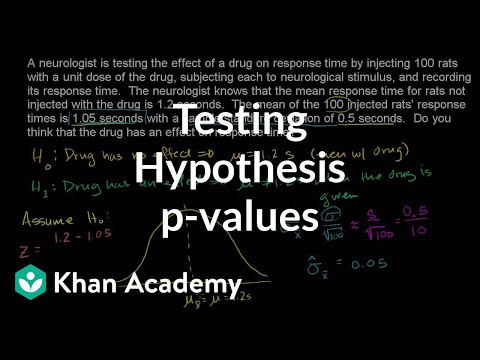 YouTube11:26
Another explanation of Hypothesis testing.
Hypothesis testing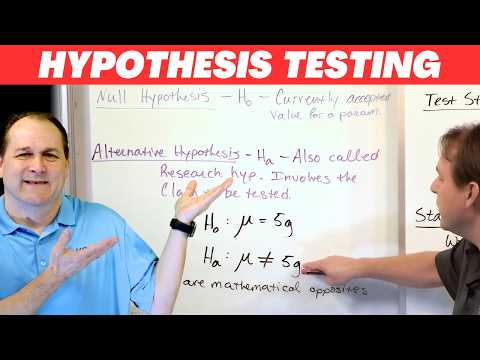 YouTube23:40
Another explanation of Hypothesis testing.
Hypothesis testing YouTube10:54
Prerequisite in Probability and statistics: Distributions → Hypothesis testing.
Distributions · View learning sequence YouTube11:26
Prerequisite in Probability and statistics: Sampling → Hypothesis testing.
Sampling · View learning sequence YouTube5:14
Prerequisite in Probability and statistics: Distributions → Hypothesis testing.
Distributions · View learning sequenceYouTube11:26Whiteboard for Hypothesis testing, compared with the current visual explanation.
Hypothesis testingYouTube23:40Lecture for Hypothesis testing, compared with the current visual explanation.
Hypothesis testing