Components make arithmetic concrete
Add vectors by adding corresponding components. Multiplying by a negative scalar reverses direction; a translated arrow represents the same vector when its displacement is unchanged.
Brain Station Advanced · YouTube · 22:48
Introduce vector components, arithmetic, length, unit vectors, dot products and cross products with geometric and physical examples.
Use the learning inspector for key ideas and moments, or open the reading tabs for the complete notes.
Generated from the video's visuals and explanation; not verbatim speech.
Add vectors by adding corresponding components. Multiplying by a negative scalar reverses direction; a translated arrow represents the same vector when its displacement is unchanged.
The vector (3,4) has length 5. Dividing a nonzero vector by its length produces a unit vector with the same direction; the zero vector cannot be normalized this way.
The dot product gives a scalar and computes work from force and displacement. In three dimensions the cross product gives a perpendicular vector with right-hand orientation and can represent torque; opposite parallel directions have a negative dot product.
Add vectors by adding corresponding components. Multiplying by a negative scalar reverses direction; a translated arrow represents the same vector when its displacement is unchanged.
The vector (3,4) has length 5. Dividing a nonzero vector by its length produces a unit vector with the same direction; the zero vector cannot be normalized this way.
The dot product gives a scalar and computes work from force and displacement. In three dimensions the cross product gives a perpendicular vector with right-hand orientation and can represent torque; opposite parallel directions have a negative dot product.
Add vectors by adding corresponding components. Multiplying by a negative scalar reverses direction; a translated arrow represents the same vector when its displacement is unchanged. The vector (3,4) has length 5. Dividing a nonzero vector by its length produces a unit vector with the same direction; the zero vector cannot be normalized this way. The dot product gives a scalar and computes work from force and displacement. In three dimensions the cross product gives a perpendicular vector with right-hand orientation and can represent torque; opposite parallel directions have a negative dot product.
To add vectors, you add their corresponding components. This means if you have two vectors, you sum the first component of each to get the first component of the result, and similarly for the second component.
Conditions: The vectors must have the same dimension (e.g., both are 2D or both are 3D).; The components are aligned by position (first with first, second with second).
 YouTube9:51
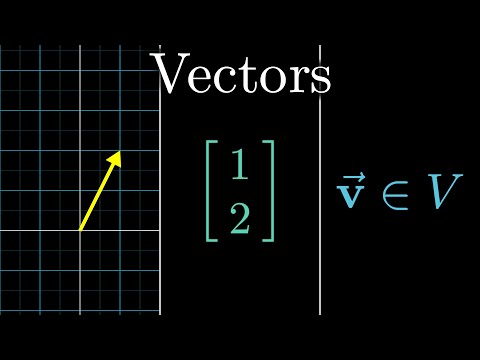
Another explanation of Vectors.
Vectors Bilibili4:27
Next in Linear algebra: Vectors → Matrices.
Matrices · View learning sequenceNext in Linear algebra: Vectors → Vector spaces.
Vector spaces · View learning sequence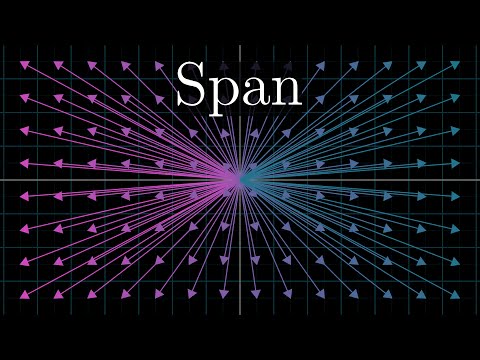 YouTube9:59
Next in Linear algebra: Vectors → Linear independence.
Linear independence · View learning sequenceNext in Linear algebra: Vectors → Span.
Span · View learning sequence YouTube3:37
Next in Linear algebra: Vectors → Matrices.
Matrices · View learning sequence YouTube6:59
Lecture for Vectors, compared with the current visual explanation.
Vectors YouTube6:45
Lecture for Vectors, compared with the current visual explanation.
Vectors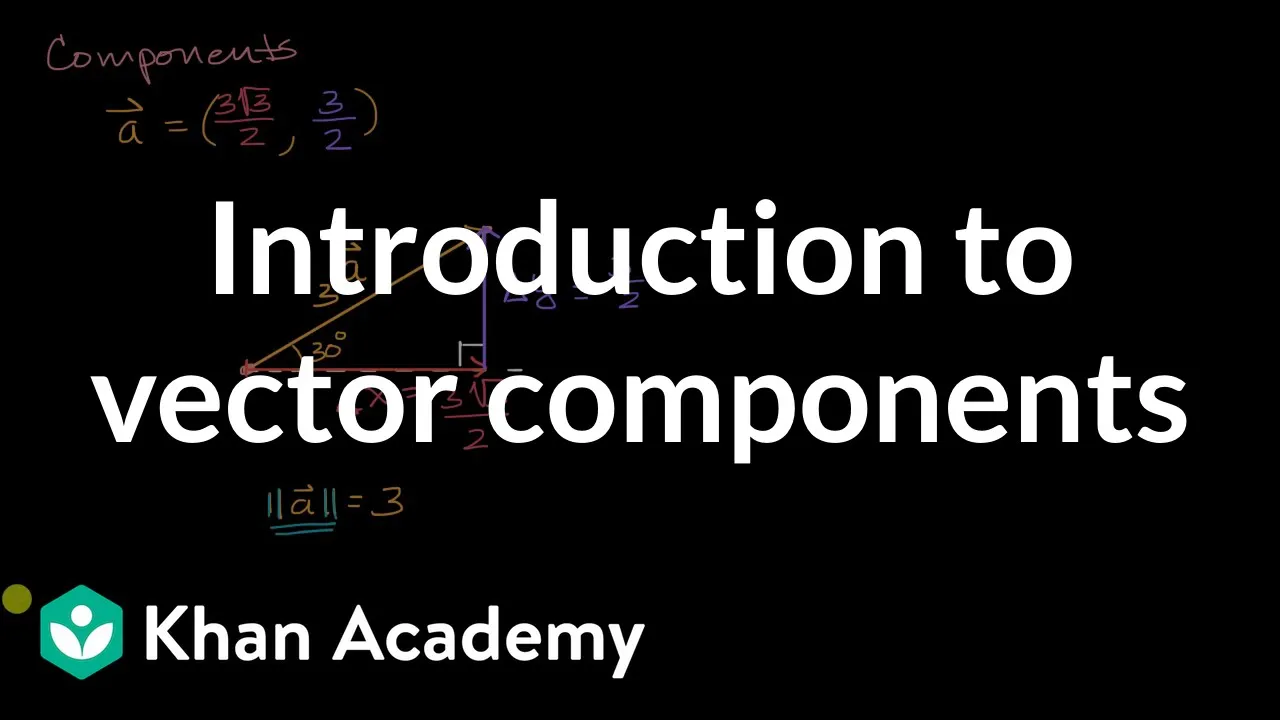 YouTube5:16
Whiteboard for Vectors, compared with the current visual explanation.
Vectors