Pair corresponding components
The dot product multiplies corresponding components and adds the products, producing a scalar. It is symmetric and distributes over vector addition.
Professor Dave Explains · YouTube · 6:59
Calculate dot products from components and use them to determine angles and orthogonality.
Use the learning inspector for key ideas and moments, or open the reading tabs for the complete notes.
Generated from the video's visuals and explanation; not verbatim speech.
The dot product multiplies corresponding components and adds the products, producing a scalar. It is symmetric and distributes over vector addition.
On real coordinate vectors, this dot product is the Euclidean inner product. It is symmetric and linear in each argument, and is the squared length, positive for every nonzero a. These properties connect the component formula to the general inner-product idea.
For two nonzero vectors, divide their dot product by the product of their lengths to obtain cos θ. Taking arccos then gives the angle in the standard range from zero to π.
The displayed exercise computes from and : −. For nonzero vectors, a zero dot product instead indicates a right angle.
The dot product multiplies corresponding components and adds the products, producing a scalar. It is symmetric and distributes over vector addition.
On real coordinate vectors, this dot product is the Euclidean inner product. It is symmetric and linear in each argument, and is the squared length, positive for every nonzero a. These properties connect the component formula to the general inner-product idea.
For two nonzero vectors, divide their dot product by the product of their lengths to obtain cos θ. Taking arccos then gives the angle in the standard range from zero to π.
The displayed exercise computes from and : −. For nonzero vectors, a zero dot product instead indicates a right angle.
The dot product multiplies corresponding components and adds the products, producing a scalar. It is symmetric and distributes over vector addition. On real coordinate vectors, this dot product is the Euclidean inner product. It is symmetric and linear in each argument, and is the squared length, positive for every nonzero a. These properties connect the component formula to the general inner-product idea. For two nonzero vectors, divide their dot product by the product of their lengths to obtain cos θ. Taking arccos then gives the angle in the standard range from zero to π. The displayed exercise computes from and : −. For nonzero vectors, a zero dot product instead indicates a right angle.
On real coordinate vectors, this dot product is the Euclidean inner product. It is symmetric and linear in each argument, and is the squared length, positive for every nonzero a. These properties connect the component formula to the general inner-product idea.
To calculate the dot product, multiply corresponding components of the two vectors and add the products. The result is a scalar.
Conditions: The vectors must have the same number of components.; The vectors are real coordinate vectors.
Yes, the dot product is symmetric. This means that for any two vectors and , .
Conditions: The vectors are in a real inner product space.; The operation is the standard dot product.
Divide the dot product of the two vectors by the product of their lengths to obtain . Then, take the arccosine of this value to find the angle in the range .
Conditions: Both vectors are nonzero.; The vectors are in a real inner product space (e.g., ).
The Euclidean inner product is symmetric, linear in each argument, and positive-definite. Specifically, equals the squared length of , which is positive for every nonzero vector .
Conditions: The vectors are real coordinate vectors.; The operation is the standard dot product.
Yes, the dot product distributes over vector addition. This means .
Conditions: The vectors are in a real inner product space.; The operation is the standard dot product.
A zero dot product indicates that two vectors are orthogonal (form a right angle) if and only if both vectors are nonzero.
Conditions: Both vectors are nonzero.; The dot product of the two vectors is exactly zero.
The dot product is considered a scalar quantity because it is defined as the sum of the products of corresponding components, which results in a single real number, not a vector.
Conditions: The vectors are real coordinate vectors.; The operation is the standard dot product.
The dot product of a vector with itself, , is equal to the square of its length (norm), .
Conditions: The vector is a real coordinate vector.; The length is the Euclidean norm.
 Bilibili4:27
Next in Linear algebra: Vectors → Matrices.
Matrices · View learning sequencePrerequisite in Linear algebra: Vector spaces → Inner products.
Vector spaces · View learning sequenceNext in Linear algebra: Vectors → Vector spaces.
Vector spaces · View learning sequence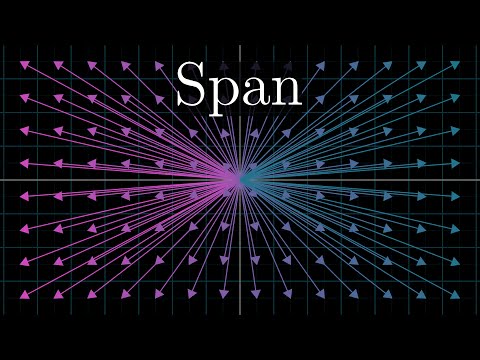 YouTube9:59
Next in Linear algebra: Vectors → Linear independence.
Linear independence · View learning sequenceNext in Linear algebra: Vectors → Span.
Span · View learning sequence YouTube3:37
Next in Linear algebra: Vectors → Matrices.
Matrices · View learning sequence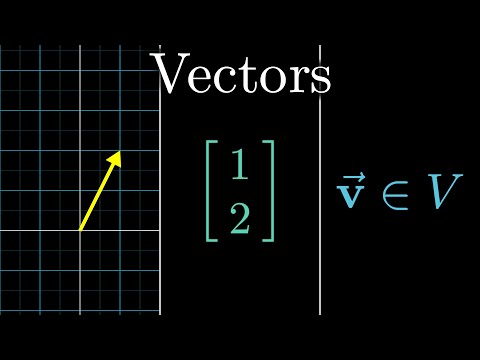 YouTube9:51
Visual explanation for Vectors, compared with the current lecture.
Vectors YouTube5:16
Whiteboard for Vectors, compared with the current lecture.
Vectors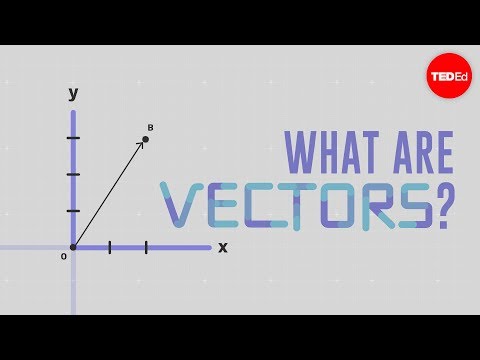 YouTube4:41
Visual explanation for Vectors, compared with the current lecture.
Vectors