Expand around one
For ln x around , derivative values give ()−()²/2+()³/3−⋯. Equality with the function holds for ||<1; endpoints require separate checking.
The Organic Chemistry Tutor · YouTube · 29:21
Construct Taylor and Maclaurin series from derivative values, then create new series by differentiation and substitution.
Use the learning inspector for key ideas and moments, or open the reading tabs for the complete notes.
Generated from the video's visuals and explanation; not verbatim speech.
For ln x around , derivative values give ()−()²/2+()³/3−⋯. Equality with the function holds for ||<1; endpoints require separate checking.
At zero, the even-power coefficients of sine vanish and the odd-power terms alternate: ³/3!+x⁵/5!−⋯. This series converges to sine for every real x.
Termwise differentiation gives the cosine series; replacing x by x² then gives ⁴/2!+x⁸/4!−⋯ for cos(x²). These operations are justified within the power series’ convergence range.
For ln x around , derivative values give ()−()²/2+()³/3−⋯. Equality with the function holds for ||<1; endpoints require separate checking. At zero, the even-power coefficients of sine vanish and the odd-power terms alternate: ³/3!+x⁵/5!−⋯. This series converges to sine for every real x. Termwise differentiation gives the cosine series; replacing x by x² then gives ⁴/2!+x⁸/4!−⋯ for cos(x²). These operations are justified within the power series’ convergence range.
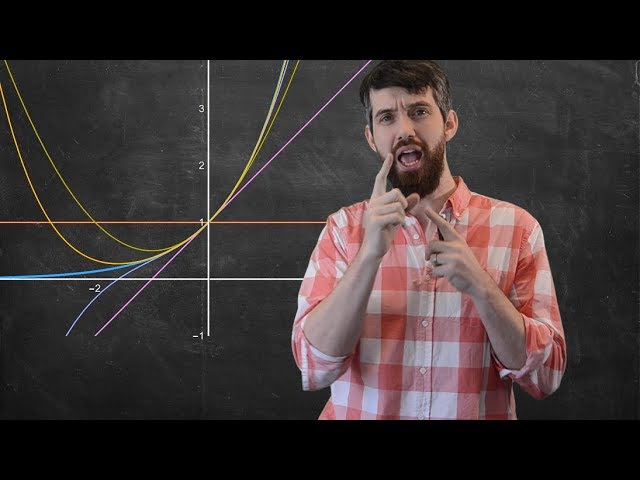 YouTube12:43
Another explanation of Taylor series.
Taylor series YouTube8:27
Another explanation of Taylor series.
Taylor series Bilibili5:38
Prerequisite in Calculus: Derivatives → Taylor series.
Derivatives · View learning sequence YouTube23:31
Prerequisite in Calculus: Derivatives → Taylor series.
Derivatives · View learning sequence YouTube2:39
Prerequisite in Calculus: Derivatives → Taylor series.
Derivatives · View learning sequenceYouTube12:43Visual explanation for Taylor series, compared with the current whiteboard.
Taylor seriesYouTube8:27Visual explanation for Taylor series, compared with the current whiteboard.
Taylor series